

KingMed Diagnostics Completes China's First Third-Party Medical Testing Data Transaction with Over 3 Billion Test Records Disclosed
KingMed Diagnostics
Third-Party Medical Testing and Pathological Diagnosis Service Provider

Medi Cover
Innovative Commercial Insurance Solution Provider
In late December, KingMed Diagnostics, a leader in the third-party medical laboratory testing industry, officially finalized a data product transaction with Medi Cover, a subsidiary of Sinopharm Holdings, and received a product transaction certificate issued by the Guangzhou Data Exchange.
This marks the first on-exchange transaction of a medical laboratory data product on the Guangzhou Data Exchange, as well as the first on-exchange transaction of a data product in China’s third-party medical testing industry., marking a key step toward compliant trading of medical testing data.
The data product involved in this transaction is “KingMed Diagnostics Big Data Analysis Report on Breast Cancer”. This report covers the distribution of various molecular subtypes of breast cancer across different regions and time periods, providing data support for public health prevention and control, precision diagnosis and treatment, and screening of breast cancer.
At the trading ceremony, KingMed Diagnostics also unveiled its inaugural data asset catalog, encompassing over 3 billion test records across multiple disciplines, including genetics and rare diseases, solid tumors, infectious diseases, and hematological disorders.
These data assets span the full spectrum of diseases, the entire life cycle, and the complete diagnosis and treatment process. Characterized by broad geographic coverage, diverse populations, multi-technical platforms, and unified standards, they provide data resource support for scenarios such as basic clinical research, medical device and new drug development, healthcare services, public health monitoring and early warning, insurance product development, and AI model training.
Building on this data foundation, KingMed Diagnostics has curated six major data resources, including a targeted sequencing dataset for respiratory pathogens, and has passed the first batch of data property rights level reviews conducted by the Guangzhou Data Exchange. Currently,KingMed Diagnostics’ five data products, including the “Drug-Resistant Mycobacterium tuberculosis Map” and the “Big Data Analysis Report on Cervical Cancer Screening,” have completed compliance reviews and been listed, awaiting transactions.
Innovation in Medical Testing Driven by Data Elements Has Become the Second Growth Curve Being Cultivated by KingMed Diagnostics. Currently, KingMed Diagnostics has collaborated with government departments, research institutions, and industrial enterprises in areas such as disease warning and monitoring, AI model training for medical testing, scientific research projects, and achievement transformation, providing strong support for the innovative development of the biopharmaceutical industry.
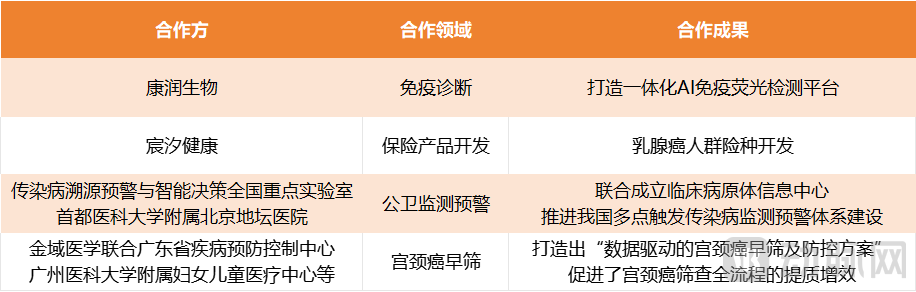
Collaboration on Partial Data Assets of KingMed Diagnostics
Other Party to Data TransactionMedi CoverFocusing on health management and comprehensive patient services, the company was incubated with investment from Sinopharm Group, China’s largest retailer of pharmaceuticals, medical devices, and healthcare products, and Yaojin Capital. It has collaborated with multiple insurance companies to co-develop exclusive recurrence insurance products for breast cancer patients, such as “Ru An Kang,” “Pink Guardian,” and “Pink Defender,” thereby addressing the critical challenge that prevents individuals with pre-existing conditions from obtaining insurance coverage.
Through this collaboration, Medi Cover will leverage disease experience data from the breast cancer patient population to precisely develop relevant products, continuing to safeguard the health of breast cancer patients in China.
China’s health data trading market has been operational since the second half of 2023.
In August 2023, the Shandong Health and Medical Big Data Management Center, together with co-building units of the National Health and Medical Big Data Center (North), pioneered trials in data trading and circulation. They obtained China’s first on-exchange trading certificate for a health and medical data product based on the “Population Epidemiological Analysis Report,” and successfully completed the first on-exchange transaction of a data product at the end of the same month.
In the latter half of the year, the Fujian Big Data Exchange also achieved a “zero breakthrough,” securing the first on-exchange transaction of a health and medical data product in Fujian Province with its *Analysis Report on Endocrine and Metabolic Diseases in Xiamen*.
It should be noted that the data products involved in the aforementioned two transactions are results generated based on health data, rather than the health data itself.The first health data transaction with datasets as the underlying asset occurred in May 2024, the traded products are two health and medical data products developed by Guangdong Provincial People's Hospital: "Guangdong Academy of Medical Sciences Diabetic Retinopathy Diagnosis Data Product" and "Guangdong Academy of Medical Sciences Heart Disease Diagnosis and Prediction Data Product."
According to incomplete statistics, at least 12 medical data asset transactions have been completed in China.
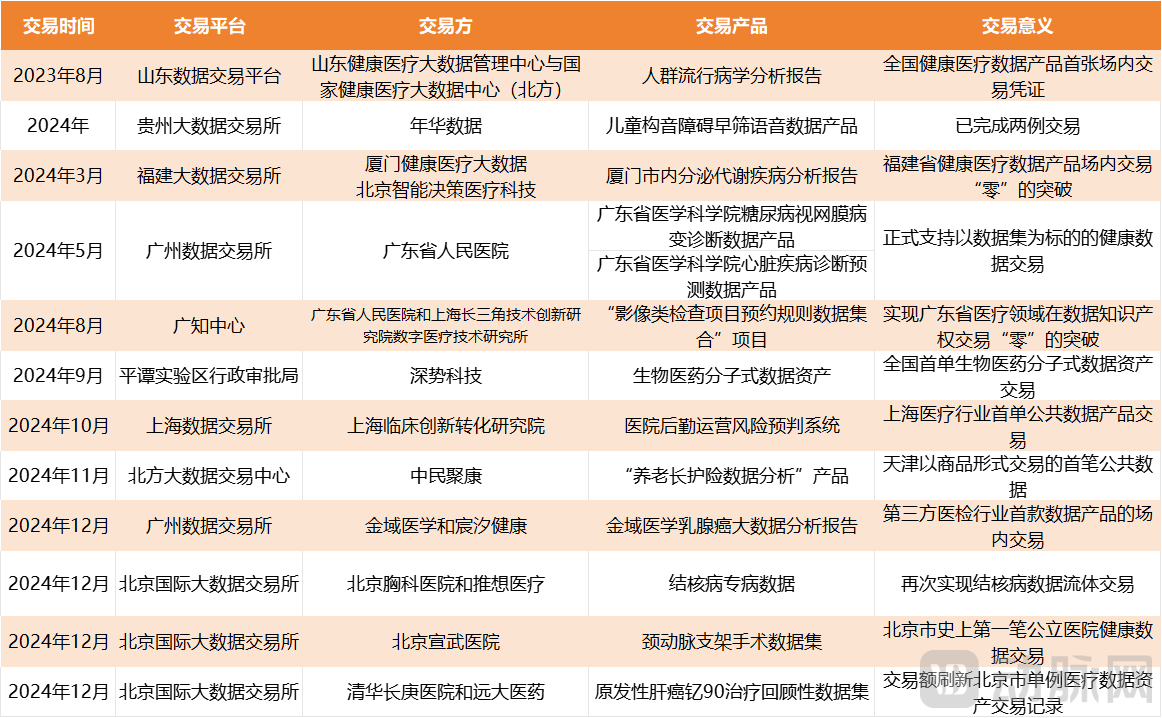
In the table above, four transactions disclosed the trading amounts of medical data. Among them, the product with the lowest price was “Data Analysis for Long-Term Care Insurance for the Elderly,” which analyzed the age structure, health status, and service needs of elderly residents in different communities, with a transaction price of RMB 1,000.
On December 17, Beijing Chest Hospital, Capital Medical University, announced the signing of a framework agreement for data services with Infervision. The transaction value for the “tuberculosis-specific disease data” reached RMB 2 million. This dataset comprises 20,000 high-quality annotated CT images of tuberculosis cases collected from January 2012 to June 2023, with a total data volume of approximately 10 TB.. The calculated price per single medical data asset reaches 200 yuan.
On December 26, Beijing Tsinghua Changgung Hospital announced on its official website that it had signed a tripartite data transaction cooperation agreement with Grand Pharma and the Beijing International Big Data Exchange, completing the hospital’s first on-exchange transaction of medical data assets. The transaction volume set a new record for single-case medical data asset transactions in Beijing.
It should be noted that, given the dual nature of healthcare data as both personal and public data, potential data holders may include patients, medical institutions, health industry regulatory authorities, and medical device manufacturers.
In March 2023, the National Development and Reform Commission (NDRC) issued a document interpreting the “Twenty Data Measures,” providing an analysis of data property rights issues:
Compared with traditional factors of production such as labor, capital, and land, the realization of data’s value lies in its efficient circulation and utilization, as well as its ability to empower the real economy. Moreover, isolated data holds no inherent value; its multiplier effect is generated only through continuous circulation, aggregation, and processing.
In view of this,The “Twenty Measures on Data” explore the establishment of a property rights operation mechanism featuring the separation of data resource holding rights, data processing and usage rights, and data product operational rights. This approach forms a Chinese-characteristic data property rights system based on the “tripartite separation of rights,” which downplays data ownership while emphasizing the circulation of usage rights. Such a framework will help maximize data value and promote the high-quality development of China’s digital economy.
Furthermore,There is currently a lack of unified pricing standards for medical data transactions., primarily through price negotiations between the two trading parties based on factors such as data quality, scarcity, utility, corporate needs, and budget.
In September 2023, the China Appraisal Society issued the “Guidance on Data Asset Valuation,” which integrates valuation approaches such as the income approach, cost approach, and market approach, along with factors affecting data quality—including accuracy, consistency, and completeness—to assess the value of data assets and provide a basis for transaction pricing.
Furthermore,Healthcare data trading also faces challenges related to data standardization.For instance, to ensure high-quality transaction data and fully unlock its value through compliant applications, KingMed Diagnostics is actively participating in the development of standards related to medical laboratory data and AI applications, covering areas such as datasets, artificial intelligence technology applications, intelligent manufacturing, and information system construction.
As of 2023, KingMed Diagnostics has participated in the development and revision of nine relevant standards, such as leading the formulation of the Bay Area Standard for “Renal Pathology Dataset” and the group standard for “Cervical Cancer Laboratory Test Dataset.”
The aforementioned data only covers a subset of publicly reported data trading events; currently, the number of datasets listed on data exchanges across China is significantly larger. As healthcare institutions of greater scale and diverse tiers enter the market, richer and higher-quality health data products will emerge, thereby further realizing the value of medical data as a “factor of production.”