

Lupeng Pharma Advances Phase 2/3 Trials of Next-Gen BTK Inhibitor Rocbrutinib Amid $1.03B BD Deal

Lupeng Pharmaceutical
Developer of New Anticancer Drugs
Recently, the finals of the 13th China Innovation and Entrepreneurship Competition (Guangdong-Guangzhou Division) concluded in Guangzhou. Lupeng Pharmaceutical Ltd. (hereinafter referred to as “Lupeng Pharmaceutical”) successfully defended its title as the champion in the Pharmaceutical R&D Growth Category, claiming the top spot once again after its previous win in 2021.
Two recent milestone events have demonstrated Lupeng Pharmaceutical’s robust capabilities to the public. First, Hansoh Pharmaceutical Group Co., Ltd. (hereinafter referred to as “Hansoh Pharmaceutical,” 03692.HK) entered into a collaboration agreement with Lupeng Pharmaceutical regarding LP-168 (Rocbrutinib), a next-generation BTK inhibitor independently developed by Lupeng Pharmaceutical. Under the agreement, Hansoh Pharmaceutical obtained the rights to develop, register, manufacture, and commercialize LP-168 for non-oncology indications in China, and will pay Lupeng Pharmaceutical an upfront payment along with potential R&D, regulatory, and sales-based commercial milestone payments totaling no more than RMB 729 million.
In the first half of 2024, based on the outstanding efficacy of LP-168 in various B-cell lymphomas, particularly in diffuse large B-cell lymphoma (DLBCL), it was officially included in the Breakthrough Therapy Designation list by the Center for Drug Evaluation (CDE) of the National Medical Products Administration (NMPA) following review and public announcement. The designation was granted on May 9, 2024, for the treatment of adult patients with relapsed or refractory (R/R) non-germinal center B-cell-like (non-GCB) DLBCL who have received at least two prior lines of therapy. Consequently, lobrutinib has become the first Bruton’s tyrosine kinase (BTK) inhibitor in China to be designated as a breakthrough therapy for DLBCL.
Moreover, Lupeng Pharmaceutical’s multiple key pipelines—Letoclax (LP-108, Lacutoclax), LP-118, and LP-128—have all entered clinical trials, accumulating highly competitive clinical data.
Lozurtinib: Beyond Third-Generation BTK Inhibitors
Lupeng Pharmaceutical was co-founded in June 2018 in the Guangzhou Development District by Dr. Tan Fenlai and Dr. Chen Yi, with Dr. Tan serving as Chairman and Chief Executive Officer and Dr. Chen as Chief Scientific Officer. The company specializes in the design and development of novel small-molecule anti-tumor drugs, leveraging its core strengths in pioneering drug design and specialized, efficient clinical development. Throughout the drug design process, the company consistently emphasizes novelty and creativity, aiming to achieve significant clinical differentiation.
Dr. Tan Fenlai previously served as a co-founder, director, senior vice president, and chief medical officer of Beta Pharma Inc., successfully leading the clinical development and regulatory submission of multiple new drugs, including icotinib (the first small-molecule targeted therapy in China), as well as ensartinib, vorolanib, and bevacizumab, which were introduced through licensing-in arrangements.
Dr. Chen Yi is also a serial entrepreneur in innovation and startups. She successfully developed EDO-S101 (Tinostamustine), an innovative dual-target drug against HDAC and DNA, which was out-licensed to the multinational pharmaceutical company Mundipharma for $84 million in 2013. Dr. Chen also led the design and preclinical development of four innovative drugs currently in clinical stages at Lupeng Pharmaceutical, including the aforementioned lobutini, letoclax (a potent and highly selective Bcl-2 inhibitor), LP-118 (a next-generation selective Bcl-2/Bcl-xL inhibitor), and LP-128 (a potent HBsAg inhibitor).
Lobutinib is advancing most rapidly and has entered the pivotal registration clinical trial stage for market approval, with its first indication being relapsed/refractory mantle cell lymphoma (MCL); a marketing application is expected to be submitted in the first half of 2025.
Bruton’s tyrosine kinase (BTK) has long been one of the most prominent targets in medicinal chemistry research. With the market approval of pirtobrutinib, a non-covalent inhibitor developed by Eli Lilly, BTK inhibitors have advanced to the third generation. The C481 mutation in BTK is the primary mechanism underlying acquired resistance to first- and second-generation covalent BTK inhibitors. Although the first-generation BTK inhibitor ibrutinib demonstrates favorable clinical efficacy, its use is limited by notable off-target toxicity and both acquired and primary resistance. These challenges spurred the successful development of second-generation BTK inhibitors, including acalabrutinib, zanubrutinib, and orelabrutinib. These agents offer higher selectivity, reduced off-target toxicity, and lower treatment costs compared with ibrutinib, and are currently experiencing rapid market expansion. In contrast, pirtobrutinib is priced slightly higher than earlier BTK inhibitors. Furthermore, BTK inhibitors are being evaluated in clinical trials for autoimmune diseases, having achieved successful Phase III outcomes in several conditions such as chronic spontaneous urticaria (CSU), primary immune thrombocytopenia (ITP), and multiple sclerosis (MS).
When determining the direction of research and development, the team at Lupeng Pharmaceutical paid particular attention to the issue of resistance to BTK inhibitors. At that time, first- and second-generation BTK inhibitors had already been launched on the market, while third-generation inhibitors were in the development stage and demonstrated the characteristic of reversible non-covalent binding. The team then realized that further innovation based on reversible covalent binding could lead to the development of a fourth-generation BTK inhibitor with greater differentiation and superior efficacy. Regarding the selection of indications, Dr. Tan Fenlai emphasized that the field of hematologic malignancies has always been at the forefront of innovative drug development. Many breakthrough advances have originated from this area, ranging from early chemotherapy agents to later targeted therapies, and now to current immunotherapies.
To achieve this goal, Dr. Chen Yi led her team in conducting extensive research and experiments. While exploring development strategies for next-generation BTK inhibitors, they discovered that introducing a specific chemical structure enables the drug to preferentially bind to the covalent binding site in the absence of mutations, thereby significantly enhancing both efficacy and safety.
Lobrutinib’s unique feature is its “dual mechanism of action.” It can irreversibly inhibit BTK activity by covalently binding to wild-type BTK. When resistance mutations occur at the C481 site of BTK, it can reversibly and non-covalently bind to BTK to inhibit its activity. Particularly when used as a first-line treatment for various indications (wild-type BTK), lobrutinib’s ability to reversibly bind to the C481 mutant blocks the major pathway of acquired resistance via C481 mutation, thereby significantly enhancing efficacy and prolonging patients’ progression-free survival (PFS). Furthermore, rational design has optimized the drug’s potency, selectivity, and pharmacokinetic properties. Compared with existing BTK inhibitors, the novel drug designed by Lupeng Pharmaceutical demonstrates more than tenfold higher potency at the cellular level, more specific and precise target selectivity, and superior pharmacokinetic properties. These advantages have enabled lobrutinib to exhibit significant efficacy and safety in both preclinical and clinical trials.
Another indication under development for lobutininib is diffuse large B-cell lymphoma (DLBCL), the most common pathological subtype of non-Hodgkin lymphoma (NHL). DLBCL accounts for 30%–40% of adult NHL cases in Europe and the United States, and approximately 35%–50% in China, with the non-germinal center B-cell-like (non-GCB) subtype comprising about 60% of cases. The median age at onset ranges from 50 to 70 years. Characterized by aggressive behavior, rapid disease progression, and substantial tumor heterogeneity, DLBCL requires prompt initiation of treatment upon diagnosis. Current standard therapies include immunochemotherapy or sequential stem cell transplantation; however, most patients with relapsed or refractory (R/R) DLBCL remain incurable. Particularly among those who have received multiple lines of therapy, prognosis remains extremely poor even with novel agents, rendering R/R DLBCL a life-threatening condition. Notably, patients with the non-GCB subtype have significantly worse outcomes than those with the GCB subtype.
Clinical study data from China and the United States demonstrate that lobutinib exhibits superior efficacy, safety, and pharmacokinetics (PK) in the treatment of relapsed/refractory (R/R) chronic lymphocytic leukemia/small lymphocytic lymphoma (CLL/SLL) and various R/R non-Hodgkin lymphomas (NHL), including mantle cell lymphoma (MCL), diffuse large B-cell lymphoma (DLBCL), marginal zone lymphoma (MZL), and Waldenström macroglobulinemia (WM), supporting once-daily oral administration.
According to the Phase I study of lobutiniib for the treatment of B-cell malignancies, updated by Lupeng Pharmaceutical at the recent 2024 American Society of Hematology (ASH) Annual Meeting. In terms of efficacy and safety data in R/R MZL, treatment-emergent adverse events (TEAEs) included hematologic toxicity and abnormal biochemical indicators, mostly Grade 1; 29 subjects were evaluable for efficacy, with a median follow-up time of 10.9 months (range: 2.0-32.0), 21 cases (72.4%) achieved response, including 3 cases (10.3%) complete response (CR). High CR rates and response rates were observed in previously heavily treated R/R Non-GCB DLBCL, with good safety profile.
Clinical data have demonstrated superior efficacy and breakthrough clinical value in patients with B-cell lymphoma, regardless of whether they are BTK inhibitor (BTKi)-naïve or have developed resistance to covalent or third-generation non-covalent BTKis, thereby setting a new benchmark for BTKi therapeutic outcomes.
Multiple Pipelines Rank Among the Top Tier
Lupeng Pharmaceutical currently has a R&D pipeline comprising more than 10 candidates. Its core assets—lobutiniib, LP-118, and letoclacra—boast world-class competitiveness and are positioned for the global market. Clinical trials are underway in the United States, Europe, and China, with the potential to become best-in-class products.
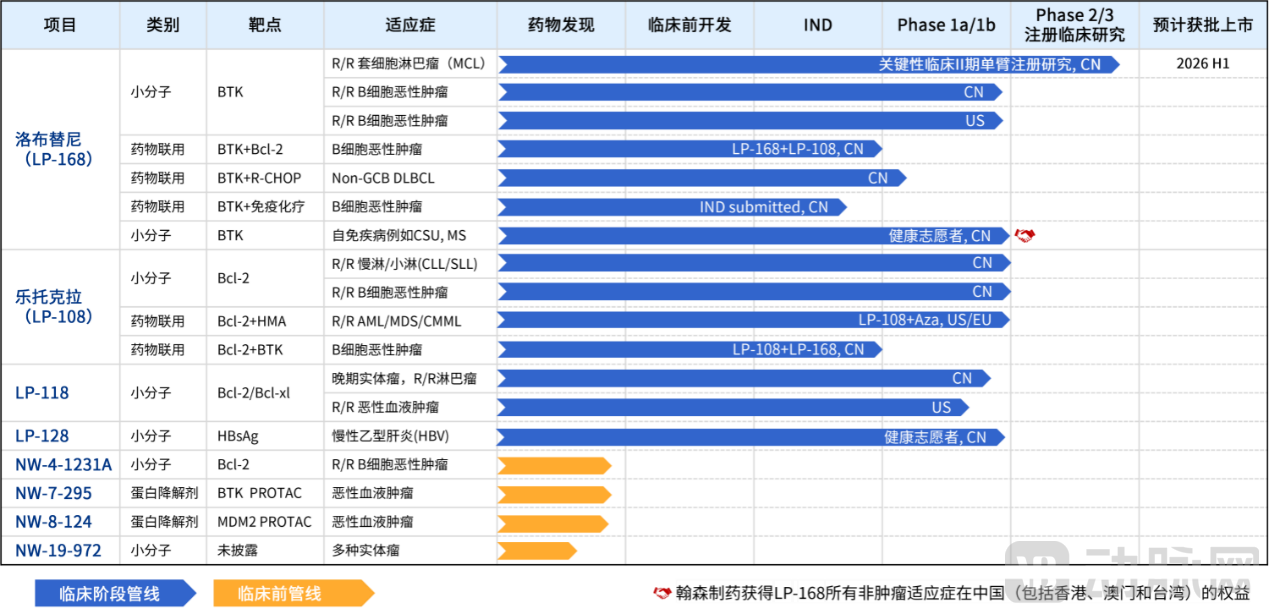
Lupeng Pharmaceutical’s R&D Pipeline. Image source: Lupeng Pharmaceutical official website
Letoclax (LP-108) is a next-generation, highly potent Bcl-2 selective inhibitor independently developed by Lupeng Pharmaceutical. Since the early stages of Letoclax’s development, Lupeng Pharmaceutical has implemented a differentiated clinical development strategy for China and Western markets, accumulating early clinical data on the use of Letoclax in the treatment of lymphoma and leukemia. These data have demonstrated not only outstanding efficacy but also an emerging safety advantage.
In December 2023, the pivotal Phase II registration-enabling clinical study of LP-108 monotherapy for relapsed or refractory chronic lymphocytic leukemia/small lymphocytic lymphoma (CLL/SLL) was approved by the Center for Drug Evaluation (CDE), making it the company’s second program to enter a pivotal registration study for market approval, following lobutinib.
Based on Phase I clinical study data of letoclax monotherapy for the treatment of patients with relapsed or refractory B-cell non-Hodgkin lymphoma (B-NHL), among 55 efficacy-evaluable subjects receiving doses ≥200 mg/day, the overall response rate (ORR) was 60.0% (33/55). The ORR in subjects with relapsed/refractory chronic lymphocytic leukemia/small lymphocytic lymphoma (R/R CLL/SLL) reached 74.2% (23/31), including 6 subjects (19.4%) who achieved complete response (CR) or CR with incomplete hematologic recovery (CRi), and 17 subjects (54.8%) who achieved partial response (PR). Among R/R CLL/SLL subjects previously treated with Bruton’s tyrosine kinase inhibitors (BTKi), the ORR was 70% (14/20), comprising 4 CR/CRi and 10 PR cases; the vast majority of responding subjects (85.7%, 12/14) remained in response at the data cutoff. The estimated 21-month progression-free survival (PFS) rate was 74.8%. Additionally, studies of letoclax in combination with azacitidine conducted in the United States and China for relapsed or refractory myelodysplastic syndromes (MDS), chronic myelomonocytic leukemia (CMML), or acute myeloid leukemia (AML) have also demonstrated favorable efficacy.
In terms of safety, no dose-limiting toxicities (DLTs) occurred in any subjects; Grade 3 or 4 treatment-related adverse events (TRAEs) were primarily hematologic toxicities known to be associated with drugs of the same class, and these toxicities were manageable. No Grade 5 TRAEs occurred. Even under the rapid dose escalation regimen with once-daily dosing, no clinical tumor lysis syndrome (TLS) was observed.
LP-108 has now advanced to the registration study phase. Existing results indicate that LP-108 demonstrates remarkable efficacy in patients with various types of B-cell non-Hodgkin lymphoma (B-NHL). Notably, apart from venetoclax, no other Bcl-2 inhibitor has been approved for marketing worldwide.
LP-118 is a next-generation dual inhibitor of Bcl-2 and Bcl-xL. Preclinical studies (with partial results presented at recent ASH and AACR annual meetings) have demonstrated that LP-118 exhibits prominent antitumor activity in hematologic malignancies and various solid tumors, particularly showing excellent synergistic effects when combined with multiple chemotherapeutic agents and PD-1/PD-L1 inhibitors. These findings lay a solid foundation for the application and clinical development of this drug in solid tumors such as small cell lung cancer and breast cancer.
Clinical study results from China and the United States demonstrate that LP-118 not only exhibits favorable efficacy in various types of non-Hodgkin lymphoma (NHL), acute myeloid leukemia (AML), acute lymphoblastic leukemia (ALL), and T-cell lymphoma, but also shows therapeutic benefit in patients with chronic lymphocytic leukemia (CLL) who have failed or developed resistance to venetoclax. Leveraging its enhanced anti-tumor activity and dual Bcl-2/xL inhibition mechanism that promotes apoptosis, LP-118 has the potential to expand into indications unresponsive to venetoclax, including small cell lung cancer (SCLC), ALL, myelofibrosis, and T-cell lymphoma.
Furthermore, Dr. Wendy Stock, Professor of Medicine at the University of Chicago, is investigating a novel combination therapy for patients with relapsed T-cell acute lymphoblastic leukemia (T-ALL). The study is progressing smoothly, with LP-118 emerging as a prominent new agent in this regimen.
LP-128 is an oral, potent, and highly selective HBsAg inhibitor with fully independent intellectual property rights owned by Lupeng Pharmaceutical. It is the company’s fourth innovative drug to enter clinical development, following Letoclac, Lobutinib, and LP-118, and holds promise for providing better treatment options and hope for a cure to hepatitis B patients worldwide.
HBsAg is a promising new therapeutic target for the cure of hepatitis B. In patients with chronic hepatitis B, immunity against the hepatitis B virus (HBV) is exhausted by the large quantity of HBsAg subviral particles. HBsAg inhibitors can significantly reduce HBsAg expression and decrease the number of HBsAg-coated HBV subviral particles, thereby restoring the host’s immune response against HBV and eliminating the virus. Furthermore, combining HBsAg inhibitors with nucleos(t)ide analogues is expected to substantially increase the cure rate of hepatitis B. Currently, all drugs targeting HBsAg, both domestically and internationally, are in clinical development, with none yet approved for market release.
The Key to Breaking Through Lies in Differentiation
“Lupeng Pharmaceutical takes a highly pragmatic approach when selecting R&D projects, prioritizing targets with clear prospects,” pointed out Dr. Tan Fenlai. “If a chosen target lacks market potential, even the development of a druggable molecule is unlikely to lead to success.” During the R&D process, Lupeng Pharmaceutical discontinued several projects with poor prospects, as in-depth studies revealed that these targets offered suboptimal efficacy and limited market potential.
Dr. Tan emphasized that for start-ups like Lupeng Pharmaceutical, achieving differentiated competition requires focusing on learning from and drawing upon the successful experiences of European and American markets, while also integrating China’s actual conditions to explore a development path suited to their own needs. He believes that only by building on differentiation can companies stand out in fierce market competition and achieve sustainable growth.
This is precisely why the success or failure of commercializing innovative drugs is largely determined at the product selection stage. An ideal differentiated product should feature substantial market potential, strong pricing power, and outstanding product strength (clinical and commercial competitiveness). Although products possessing all these attributes are rare, a candidate should not have any significant weaknesses.
Taking Lupeng Pharmaceutical’s BTK inhibitor, lobrutinib, as an example, the emergence of BTK inhibitors has completely transformed the treatment landscape for B-cell lymphomas (such as chronic lymphocytic leukemia, CLL) over the past decade. However, acquired resistance following covalent BTKi therapy has become increasingly prominent; therefore, these factors must be considered in the design of future BTK inhibitors. Lupeng Pharmaceutical stands out with its disruptive dual-action mechanism targeting the BTK pathway and promising clinical data.
Having secured targets with market potential and innovative molecular designs, Lupeng Pharmaceutical has leveraged successful experiences and strengthened international cooperation and exchanges to advance its R&D pipeline. Meanwhile, the company also prioritizes win-win collaborative development opportunities with domestic pharmaceutical enterprises, recently reaching a partnership with Hansoh Pharmaceutical to jointly develop various non-oncology indications for LP-168.
All of Lupeng Pharmaceutical’s more than 10 pipeline assets possess fully independent intellectual property rights. Since its establishment in 2018, the company has advanced four key products into clinical development, two of which (lobrutinib and letoclax) have been approved for pivotal registration studies. Lobrutinib is poised to become the first BTK inhibitor approved in China for the treatment of diffuse large B-cell lymphoma (DLBCL).
With the steady advancement of clinical trials, lobrutinib, a fourth-generation BTK inhibitor, is poised for successful market launch in 2026, emerging as a shining star in the field of oncology treatment!