

Liying Bio Completes Nearly RMB 100 Million Series A Funding Round, Pioneering a New Era in Synthetic Biology
Recently, Shenzhen Renying Biotechnology Co., Ltd. (hereinafter referred to as “Renying Bio”) successfully completed a Series A financing round of nearly RMB 100 million. This round of financing was led byExisting Shareholders and Industrial Partner: Tianshuiwan TechnologyLead Investor,Xingbo Shenghui, Changjin Holdings, and the Nanjing Normal University Changzhou Institute of Synthetic Biology Industry ResearchCo-investment,Geloo CapitalContinuously serving as the financial advisor for financing,Zhong Lun Law FirmServed as the special legal counsel for this round of financing. The new round of financing will be mainly used for expanding the production capacity of triple-helix collagen, registration and certification, and market promotion of related products.
Shenzhen Renying Biotechnology Co., Ltd.Established in April 2022, Shenzhen Renying Biotechnology Co., Ltd. is committed to becoming a pioneer in hard-tech innovations within the field of protein structure design. By integrating structural biology with AI-driven computational design, Renying Bio engineers and optimizes proteins to meet the customized needs of clients across various industries. Its services span multiple sectors, including biopharmaceuticals, industrial enzyme engineering, food ingredients, medical devices, and daily chemical products. The company provides comprehensive protein product solutions, covering the entire workflow from initial design and small-scale trials to GMP-compliant pilot studies and breakthroughs in mass production.
Renying Biotechnology’s technical prowess is demonstrated not only in protein structure design but also in breakthroughs in practical applications. Particularly in the field of collagen, Renying Biotechnology has overcome key industry-wide technical challenges by leveraging the molecular mechanism of the triple-helix structure, thereby achieving high-efficiency expression and purification of triple-helix collagen.
Liyin Biotech’s collagen products have been validated across multiple expression systems, including Escherichia coli, yeast, and mammalian cells. Test reports issued by the National Institutes for Food and Drug Control (NIFDC), a nationally authorized testing institution, confirm that Liyin Biotech’s collagen products maintain the stability of their triple-helix structure under ambient temperature, physiological temperature, and even after high-temperature treatment. The product is developed through an end-to-end technical process encompassing AI-based screening and design, hydroxylase engineering, and strain optimization.Recent advances have demonstrated that the triple-helix structural characteristics can still be restored following standard moist heat sterilization and irradiation sterilization, marking a first in the industry.(Figure 1).
With the completion of this round of financing, Shenzhen Renying Biotechnology Co., Ltd. will scale up the production of its series of triple-helix collagen products from pilot-scale manufacturing to mass production. These offerings will evolve from raw materials into finished goods, expanding from anti-wrinkle and anti-aging applications to hair care and anti-hair loss solutions, thereby delivering truly valuable products and services to the market and customers (Figure 2). Shenzhen Renying Biotechnology will continue to be technology-driven and innovation-centric, jointly fostering an ecosystem for the synthetic biology industry.
The function of a protein is determined by its structure. Proteins are composed of amino acids, and their structures include the primary structure (amino acid sequence), secondary structure (α-helices, β-sheets, etc.), tertiary structure (the spatial conformation formed by the folding of polypeptide chains), and quaternary structure (structures composed of multiple polypeptide chains). Different structures confer diverse functions to proteins, such as enzymatic catalysis, immune recognition by antibodies, and oxygen transport by hemoglobin. The stability, specificity, and variability of protein structure ensure the stable performance of function, specific recognition, and regulability, respectively.
Among these, the triple-helix structure of proteins is a specialized secondary structure commonly found in collagen. As one of the most abundant proteins in the human body, collagen is widely distributed in connective tissues such as the skin, bones, tendons, and blood vessels, where it performs critical biological functions. The triple-helix structure consists of three polypeptide chains, each adopting a left-handed helical conformation; these three chains are intertwined via hydrogen bonds to form a right-handed triple-helical structure. This configuration confers high stability and tensile strength to collagen, enabling it to play a pivotal role in maintaining the structural integrity and function of tissues.
For example, in the skin, the triple-helix structure of collagen provides elasticity and toughness, enabling it to withstand external stretching and compression; in bones, collagen combines with inorganic minerals to enhance bone strength and toughness, allowing it to bear significant mechanical loads. Furthermore, the triple-helix structure participates in biological processes such as cell signaling, cell adhesion, and tissue repair, playing a crucial regulatory role in cell growth, differentiation, and migration.
On the Triple-Helix Structure: High-precision protein structures are typically resolved and observed using methods such as Nuclear Magnetic Resonance (NMR), X-ray crystallography, and cryo-electron microscopy. However, these three major techniques, which rely on multi-signal averaging calculations, are unable to resolve the structures of flexible, long-chain proteins like collagen. Some researchers have crystallized short-chain collagen peptides (typically 10–30 amino acids) and determined the molecular structure of these short fragments via X-ray diffraction; however, these short-chain molecules do not form stable triple-helix structures in solution. Since collagen is in a physiological solution state in many application scenarios, such as skincare and medical aesthetics, the true objective is to develop recombinant collagen that maintains its triple-helix structure under the actual solution conditions of use.
Currently, only circular dichroism (CD spectroscopy), which is the designated method for detecting triple-helix structures in national standards, can analyze the spatial structure of recombinant collagen in its native solution state. The spectral characteristics of the triple-helix structure include a distinct negative absorption peak near 190–200 nm and a prominent positive absorption peak at 220 nm. During thermal denaturation, as the triple helix unwinds, the positive absorption peak at 220 nm gradually decreases and shifts to negative values.
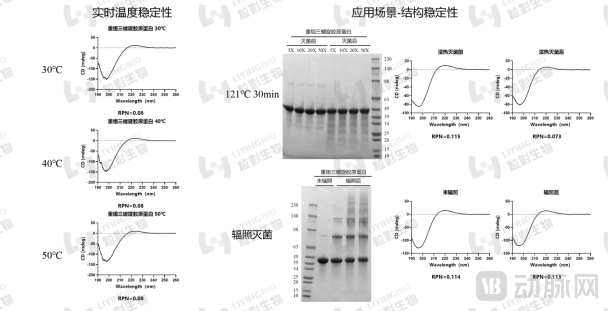
Figure 1. Triple-helix detection of Renying Biotechnology’s recombinant collagen (circular dichroism spectroscopy): The spectral data (left) clearly demonstrate that Renying Biotechnology’s triple-helix collagen exhibits distinct triple-helix characteristic peaks in solution at real-time temperatures of 30°C, 40°C, and 50°C, fully meeting the requirements for human body temperature and daily usage scenarios. The spectral data and protein electrophoresis images on the right show that Renying Biotechnology’s recombinant collagen maintains its triple-helix structure even after standard moist-heat sterilization and irradiation sterilization treatments—a first in the industry. These two tests prove that Renying Biotechnology has overcome certain physicochemical conditions encountered in actual production processes that typically degrade biological macromolecules, thereby achieving structural stability of triple-helix collagen throughout the entire pathway from production to application through innovative technologies. (The RPN value is the ratio of the absolute values of the positive and negative peaks, used to analyze the relative stability of the triple-helix structure.)
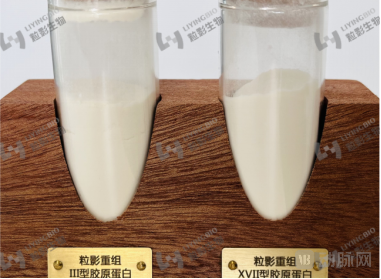
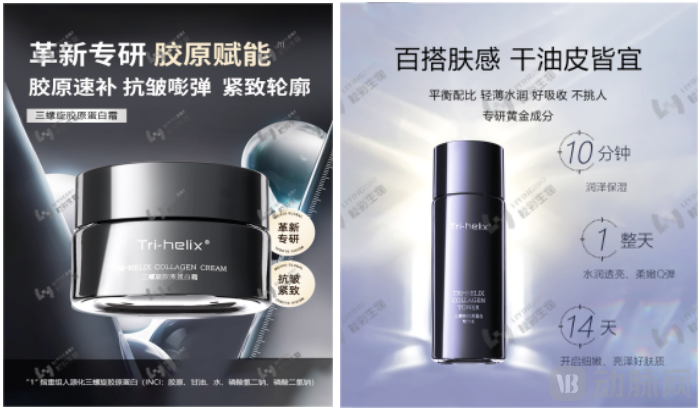
Tri-Helix Products
The growth and maturation of Renying Biotechnology have garnered close attention and strong support from the industry. The participation of investors in this funding round not only acknowledges Renying Biotechnology’s technical prowess but also fully affirms its innovative spirit and future potential within the industry. Renying Biotechnology will continue to uphold the principles of innovation, collaboration, and mutual benefit, driving product innovation and market expansion to maintain technological leadership and empower the synthetic biology industrial ecosystem.
Regarding this round of financing, Dr. Zhang Ying, founder of Renying BiotechnologyWe express our sincere gratitude for the steadfast support from our early-stage investors who have been with us all along, as well as from our new investors. Particularly in the current economic climate and financing environment, Renying Biotechnology is truly fortunate to have gained the recognition of patient capital that remains firmly committed to supporting hard-tech innovations and biotechnologies with longer commercialization timelines. This round of financing will enable Renying Biotechnology to translate its most advanced technologies into tangible products, bringing cutting-edge science to the general public, and propel the company’s development into an entirely new dimension. Dedicated to designing the world’s most complex macromolecules—proteins—to serve human health and wellness, we invite you to join hands with us on this challenging entrepreneurial journey, working together to create a brighter future.
Existing ShareholdersIt indicates that in an increasingly competitive market, the ultimate winners are products with genuine product strength. Currently, as the advantages of differentiated products become increasingly apparent in the marketplace, we remain confident that Shenzhen Renying Biotechnology Co., Ltd. will leverage its unique triple-helix technology and robust R&D capabilities to build brand influence centered on triple-helix collagen, capitalizing on the rapid growth opportunities in the synthetic biology sector.
Cong Yongjian, Founder of the Xingbo Shenghui Synthetic Biology Industry FundThe synthetic biology industry, as a strategic, pioneering, and disruptive sector in China, is spearheading the new quality productive forces driving the latest global scientific and technological revolution and industrial transformation. Amidst the broad applications of synthetic biology, recombinant human collagen has emerged as a preferred choice in fields such as tissue engineering, pharmaceuticals and food, and medical aesthetics, owing to its high purity and human-derived advantages. By leveraging integrated technical approaches—including AI-driven screening and design, enzyme engineering, and strain engineering—Shenzhen Renying Biotechnology Co., Ltd. has achieved dual optimization of cost-effectiveness and performance, demonstrating the development potential of synthetic biology technologies in future industries.
About Tianshuiwan Technology
Beijing Tianshuiwan Technology Co., Ltd. was established on October 12, 2024, primarily engaged in scientific research and technical services.
About Xingbo Shenghui
Shenzhen Xingbo Shenghui Private Equity Venture Capital Fund Partnership (Limited Partnership) was established on October 20, 2023. It is a private equity fund specializing in equity investment, investment management, and asset management. The fund primarily invests in the field of synthetic biology, focusing on startups in sectors such as healthcare, materials, agriculture, energy, and food. Its objective is to promote the transfer and commercialization of scientific and technological achievements in synthetic biology, enhance the synthetic biology industry chain, and foster the clustering, upgrading, and integration of regional industries by investing in startups that apply cutting-edge technologies to bioengineering manufacturing.
About Changjin Holdings
Changzhou Xinbei District Technology Talent Introduction and Cultivation Venture Capital Center (Limited Partnership) was established on May 27, 2022. It is a limited partnership enterprise specializing in venture capital investment. Its business scope includes venture capital investment (restricted to investments in unlisted enterprises), investment activities using its own funds, and corporate management consulting. The establishment of this investment center aims to promote the introduction and cultivation of scientific and technological talents, as well as foster the incubation and development of innovation and entrepreneurship projects, through capital guidance and support. Its investment focus is primarily on small and medium-sized technology-based enterprises, particularly those with high growth potential and innovative capabilities.
About the Changzhou Institute of Synthetic Biology, Nanjing Normal University
Nanjing Normal University Changzhou Institute of Synthetic Biology Industry Co., Ltd. was established on June 9, 2023, as a joint initiative by Nanjing Normal University and the People’s Government of Xinbei District, Changzhou City. It is a new-type R&D institution integrating technological R&D, talent cultivation, capital operation, and project incubation. Leveraging Nanjing Normal University’s strengths in science and technology and human resources, the Institute aligns with major national strategic needs and local industrial development requirements. It focuses on key research areas including strain screening and engineering, discovery and engineering of innovative enzyme preparations, and precise digital fermentation control technologies. The Institute is building an integrated, open, and shared synthetic biology pilot-scale amplification and technological service platform to promote the translation and application of technological achievements and facilitate the optimization and upgrading of industrial structures.