

Lizhi Medical Accelerates Market Expansion in Brain-Computer Intelligent Rehabilitation with Over 20 Products Launched and 40% Improvement in Rehabilitation Efficiency
Lychee Intelligence
AI + Intelligent Rehabilitation Product R&D and Manufacturer
The rehabilitation industry is rapidly entering the era of intelligence.
With the rapid advancement of technology, intelligent devices have emerged to achieve a synergistic effect—“1+1>2”—enabling a single therapist to efficiently manage multiple rehabilitation devices. Once patients become familiar with and master the rehabilitation process, these smart devices can autonomously guide them through training sessions, guided by the therapist’s professional assessments and personalized prescriptions, thereby enhancing rehabilitation efficiency. Despite the promising outlook, Dr. Chen Yan, founder of Lychee Intelligence, noted that “the penetration rate of intelligent rehabilitation equipment in the domestic market is currently less than 3%.”
Facing this market with immense growth potential, Lychee Intelligence has decisively entered the arena and quickly made a name for itself. Since its establishment in 2022, Lychee Intelligence has experienced “rapid” development. Dr. Chen Yan revealed that the company expects to obtain approval for five rehabilitation medical device products this year, and by October next year, the team is poised to secure approvals for up to 20 products.
Breaking Through Three Core Technologies to Establish a Presence in the Intelligent Rehabilitation Sector
The cornerstone of Lychee Intelligence’s market entry lies in its continuous technological breakthroughs and innovations.In the development of intelligent rehabilitation products, the team focuses on breakthroughs in three core technologies: perception, decision-making, and execution capabilities.Leveraging provincial-level research platforms such as the Guangdong Provincial Engineering Research Center for Intelligent and Rehabilitation Equipment, the Guangdong Provincial International Joint Research Center for Intelligent Engineering, the Key Laboratory of the Guangdong Provincial Medical Products Administration, and the Guangdong Institute of New Biomaterials and High-End Medical Devices, as well as multidisciplinary research teams including the South China University of Technology–Lychee Medical Intelligent Rehabilitation Equipment Joint Laboratory, the R&D team has accumulated over a decade of technical expertise in basic research and applied basic research. This has enabled the establishment of a complete technological chain encompassing intelligent sensing, artificial intelligence algorithmic models, and human-robot collaborative integration. The team has secured more than 100 patents and published over 120 high-impact SCI-indexed papers.
For intelligent products, robust external perception capabilities are fundamental. In this process, sensor technology enables real-time monitoring of patients’ physiological parameters, rehabilitation progress, and the operational status of medical devices. To this end, Lychee Intelligence has introduced a series of high-precision physiological sensors, such as brain-computer interfaces and surface electromyography (sEMG) sensors, to establish a comprehensive rehabilitation technology system that achieves real-time capture and monitoring of human physiological signals.
Chen Yan stated, “The development of sensor technology faces both challenges and immense potential.” Therefore, at the hardware level, the team is committed to modular design and optimizing wearing comfort, achieving breakthroughs particularly in the integration and miniaturization of electroencephalogram (EEG) sensors and surface electromyography (sEMG) sensors. Lychee Intelligence has implemented modular designs for EEG and sEMG sensors, establishing standardized data acquisition and data platforms. This enables cross-device sensor training, facilitates data collection for assessment and training, and realizes a digital closed-loop rehabilitation system.
Hardware is merely the foundation; challenges at the algorithmic level are equally significant and cannot be overlooked. To address data noise and inter-individual variability, particularly the pronounced individual differences in electrophysiological signals, the Lychee Intelligence medical team has introduced artificial intelligence technologies to construct standardized data models, perform feature selection and optimization, and achieve multimodal data fusion. “This technological breakthrough enables the team to rapidly and accurately model and learn information related to physiological states, cognitive brain functions, and behavioral biomechanics, thereby providing robust support for precise decision-making in intelligent rehabilitation products,” stated Chen Yan.
At the execution level, rehabilitation robots are employed. Chen Yan emphasizes that, as actuators, the safety of the robots and their on-demand assistance based on human movement intent are key to achieving efficient rehabilitation. To this end, the Lychee Intelligence medical team needs to address robotic safety issues on one hand, enabling the simulation of a wide range of human movements; on the other hand, they focus on developing technologies for recognizing human movement intent and assessing motor capabilities. By analyzing human movement data in real time, these technologies precisely identify movement intent and evaluate motor function, thereby providing real-time, safe assistance. Furthermore, Lychee Intelligence has completed the development of brain-controlled robots, implementing brain-controlled training for patients’ upper limbs, lower limbs, swallowing, and other functions. This shifts the rehabilitation model from a “peripheral-central-peripheral” pattern to a “central-peripheral-central” pattern.
For Lychee Intelligence, the three core technological pillars—sensors, artificial intelligence, and robotics—form its technical foundation, driving the continuous development of intelligent rehabilitation solutions that meet user needs in both clinical and industrial settings.
Launched over 20 products, boosting rehabilitation efficiency by 40%
To deliver “intelligent rehabilitation solutions,” Lychee Intelligence has not only assembled an R&D team of more than 40 members but also established a joint laboratory with South China University of Technology, focusing on the development of next-generation medical devices.
As of now,Lychee Intelligence has successfully launched over 20 products, covering the entire spectrum of neurological rehabilitation, including intelligent physical factor therapy devices, biofeedback training systems, intelligent robotic rehabilitation systems, and home-based rehabilitation equipment. Experimental data show that the group using intelligent rehabilitation robots achieved a rehabilitation efficiency improvement of more than 40% compared to the traditional control group.

Upper Limb Assessment and Training System U100, photo provided by the interviewee
For example, targeting patients with upper limb dysfunction, Lychee Intelligence has launched the Upper Limb Assessment and Training System U100. This product can simulate the dynamic changes and patterns of upper limb movement in real time. Through training of the entire upper limb kinematic chain (shoulder-elbow-hand) and bilateral coordinated mirror therapy, it provides patients with multi-dimensional sensory stimulation integrating motor, visual, auditory, and proprioceptive inputs, thereby comprehensively activating and promoting the synergistic recovery of upper limb function and the nervous system.
For patients with lower limb dysfunction, Lychee Intelligence has launched the L100 Lower Limb Assessment and Training System. This product enables natural bionic gait and automatic steering, breaking through the limitations of traditional training scenarios to provide patients with precise, personalized, and realistic walking training. Notably, through precise monitoring and feedback from plantar pressure and joint torque sensors, the L100 ensures the safety and effectiveness of the entire exercise process.
Regarding the product, Chen Yan continues to emphasize three key aspects to VCBeat: safety, intelligence, and efficacy.“Rehabilitation robots need to simulate the biomimetic structural movements of the human body and achieve a wide range of motion, which is the fundamental guarantee of their effectiveness. Meanwhile, safety is paramount for patients; particular attention must be paid to joints prone to dislocation, such as the shoulder joint, to prevent secondary injuries during movement,” said Chen Yan.
Therefore, the Lychee medical team has devoted substantial effort to simulation design to ensure patient safety throughout the robot’s movement. For instance, the robot can intelligently mimic the patient’s gait and step length, enabling autonomously controlled turns, thereby allowing patients to stand up, walk, and move independently at an early stage. In terms of intelligence, the robot is required to perform basic assessments of the patient during movement, including evaluating motor function, and provide appropriate assistance within the patient’s functional capacity.
Xinzhi Rehabilitation - Multimodal Brain-Controlled Rehabilitation Robot
To further enhance patient autonomy and improve rehabilitation efficiency, Chen Yan revealed that the Lychee Intelligence medical team has completed research on brain-controlled upper and lower limb rehabilitation.
Brain-Computer Interfaces (BCI) are the most highly anticipated future technology, with rehabilitation representing a key application scenario for BCI technology. The multimodal brain-controlled rehabilitation robot is a medical rehabilitation device that integrates advanced technologies such as brain-computer interfaces, multimodal signal recognition and control, and robotic control. By leveraging BCI technology in conjunction with virtual reality motion scenarios, it establishes a closed-loop, active-passive collaborative rehabilitation training system, aiming to provide patients with personalized, efficient, and safe rehabilitation training protocols.
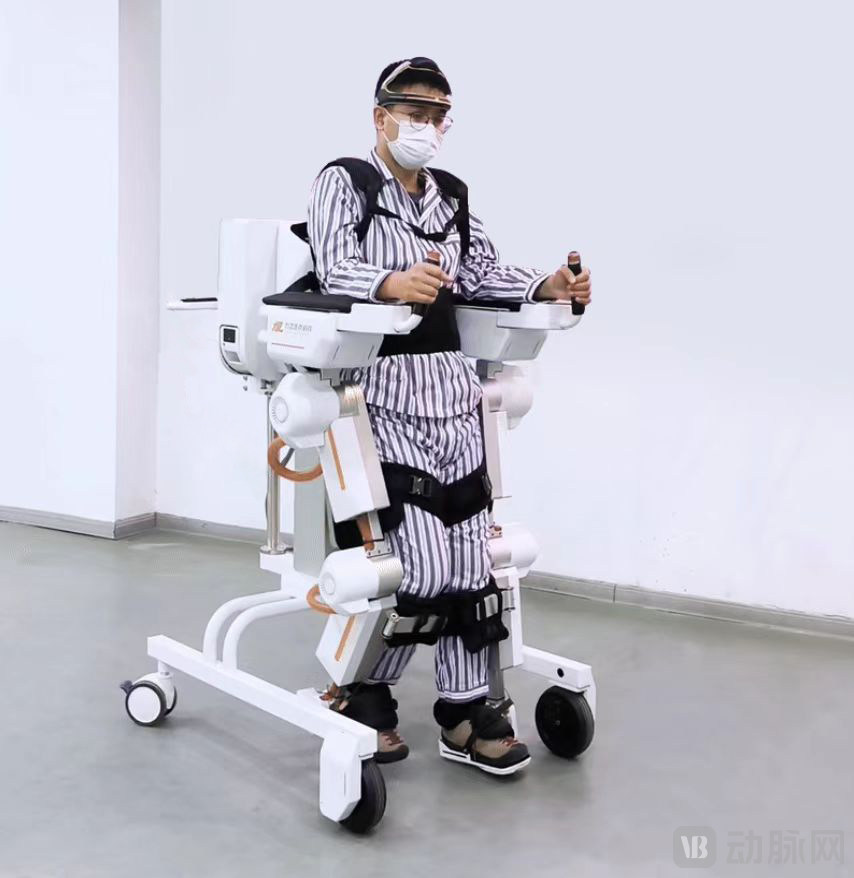
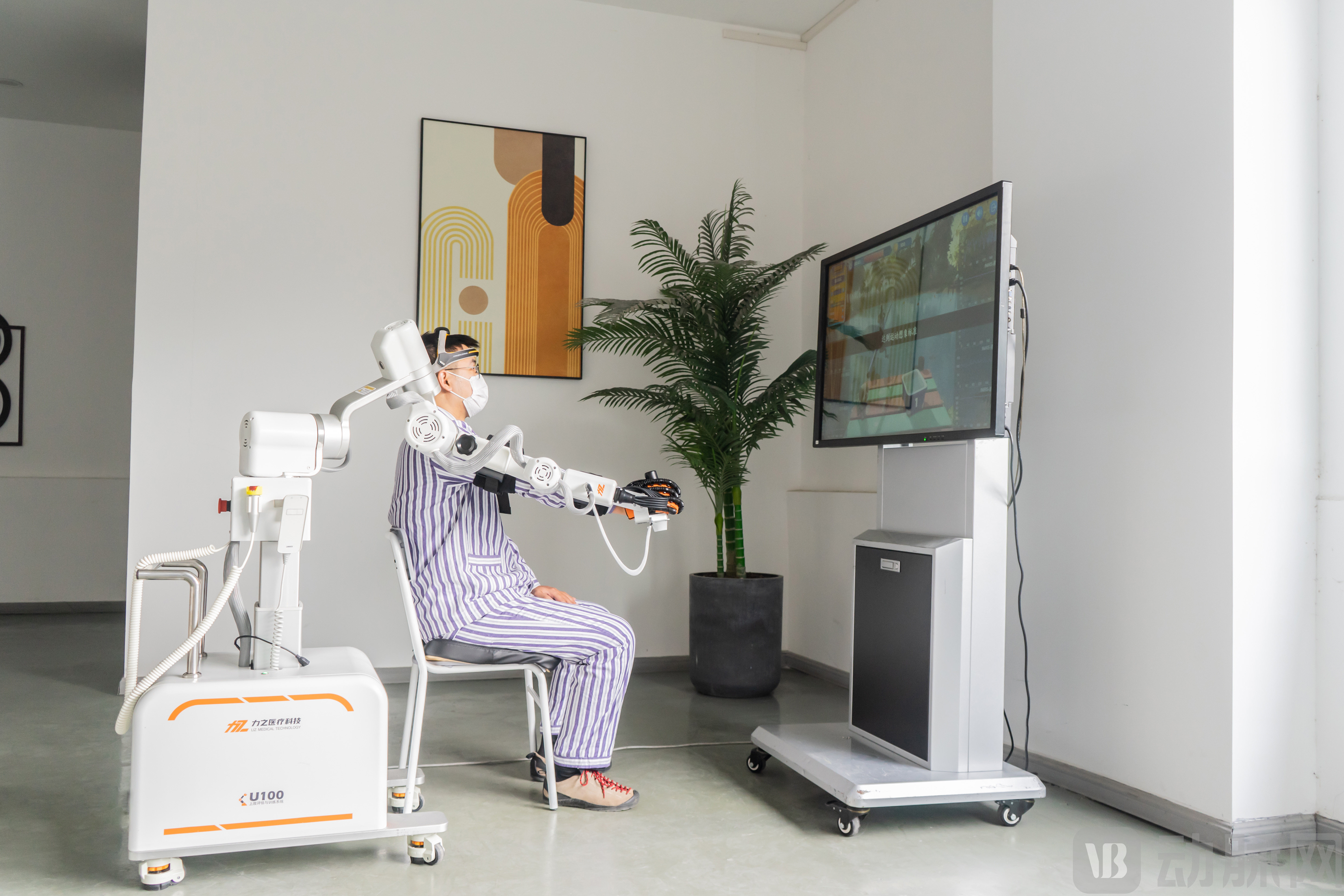
Brain-controlled rehabilitation robot. Photo provided by the interviewee
Specifically, Lychee Intelligence has leveraged its proprietary end-to-end technology chain—comprising intelligent sensing, artificial intelligence algorithm models, and human-robot collaborative robots—to complete the development of a new generation of multimodal brain-controlled rehabilitation robots. By utilizing self-developed modular signal recognition and control technologies for physiological electrical sensors, such as electroencephalogram (EEG) and electromyogram (EMG) sensors, along with personalized rehabilitation treatment plans, this robot can significantly enhance patient recovery outcomes. It facilitates a shift in the rehabilitation paradigm from a "peripheral-central-peripheral" model to a "central-peripheral-central" model.
From Domestic Substitution to Global Technology Export: Accelerating Market Expansion
In Chen Yan’s observation, the competitive landscape of the rehabilitation medical device industry is undergoing a transition from extensive expansion to domestic substitution and specialized deepening. With numerous universities and enterprises entering the field, the industry’s innovation vitality is being continuously stimulated.“In the future, the rehabilitation industry will inevitably accelerate its advancement toward three key directions: a three-tier diagnosis and treatment system, telemedicine, and home-based rehabilitation.”“Chen Yan asserted.”
As an innovation pioneer in the industry, Lychee Intelligence has actively explored multiple dimensions.
In terms of rehabilitation needs, Lychee Intelligence is starting with stroke rehabilitation and gradually expanding into more specialized fields such as sports injury rehabilitation and enhanced recovery after surgery (ERAS) in orthopedics. The team plans to launch a series of innovative products, including preoperative memory training and protocols for early postoperative mobilization, to provide more precise and efficient rehabilitation services for patients with orthopedic injuries. Meanwhile, Lychee Intelligence will also extend its reach into new areas such as pain management, rheumatology and immunology, and obstetric rehabilitation, continuously broadening its business footprint.
In terms of market deployment, Lychee Intelligence is committed to rapidly building comprehensive product solutions, providing one-stop supporting services for the rehabilitation departments of secondary hospitals and community health centers. Furthermore, through robust academic support, Lychee Intelligence will help end-users gain a deeper understanding of the application value and clinical operational standards of its products, thereby enhancing their application efficacy.
To date, Lychee Intelligence’s business has covered eight major regions in China, with plans to expand its market presence to all provinces across the country next year. As its product portfolio continues to be refined, Lychee Intelligence will also adopt diversified market strategies and pioneer exploration of emerging markets such as Eastern Europe, thereby launching its global expansion initiative.
To accelerate product portfolio deployment, Lychee Medical is launching its Series A+ financing round.. It is understood that this funding will provide solid financial support for the team’s future market expansion, product development, and overseas expansion plans, helping Lychee Medical to continue deepening its presence in the rehabilitation medical device industry.
Guangdong Institute of Novel Biomaterials and High-End Medical Devices (hereinafter referred to as the “High-End Medical Device Institute”) is a demonstration base for the transformation of achievements under the National Innovation Cooperation Platform for Biomaterials, jointly established by four national ministries and commissions: the National Medical Products Administration, the Ministry of Science and Technology, the Ministry of Industry and Information Technology, and the National Health Commission. It is a provincial-level public welfare institution dedicated to regulatory science research and committed to promoting the commercialization and translation of innovative medical device achievements through market-oriented approaches.
Under the leadership of Academician Wang Yingjun of the Chinese Academy of Engineering, the High-End Medical Device Institute aggregates high-quality resources with international characteristics across the full transformation chain of high-end medical devices, including the National Engineering Technology Research Center, regulatory science research bases and key laboratories under the National Medical Products Administration (NMPA), and the GHWP (Guangzhou) Institute. It has established a CRMI innovation achievement transformation model guided by regulatory science and centered on “regulatory innovation, R&D, transformation services, clinical promotion, data support, and investment drive.” This initiative aims to build a highland for high-end medical device innovation and achieve self-reliance and controllability in China’s high-end medical device sector.