

WeDoctor Holdings Files for IPO with 107.4% Revenue Surge, Emerges as China's Largest AI Healthcare Platform
The bustling Hong Kong Stock Exchange welcomes another heavyweight member!
On December 31, 2024, WeDoctor Holdings submitted a listing application to the Hong Kong Stock Exchange.
According to the prospectus, WeDoctor Holdings is China’s largest provider of AI-driven healthcare solutions, with core businesses encompassing AI-powered medical services and digital healthcare platforms. While serving individual consumers, it also empowers key stakeholders across the healthcare value chain, including healthcare providers, payers, and supply chain participants.
Unlike other digital health and AI healthcare companies,WeDoctor Holdings has implemented a capitation and value-based payment model for medical services—the Digital Health Community—where revenue is generated based on the effectiveness of member health management.This model has been implemented in Tianjin for over four years, achieving remarkable results. It serves not only as a business benchmark for the company itself but also as a typical case of new nationwide healthcare reform initiatives.
Driven by the solid implementation of its core business, WeDoctor Holdings has achieved scaled revenue and significant growth.In 2021, 2022, and 2023, the Company’s continuing operations generated revenues of RMB 962 million, RMB 1.368 billion, and RMB 1.863 billion, respectively; in the first half of 2024, revenue from continuing operations amounted to RMB 1.818 billion, representing a year-on-year increase of 107.4%.
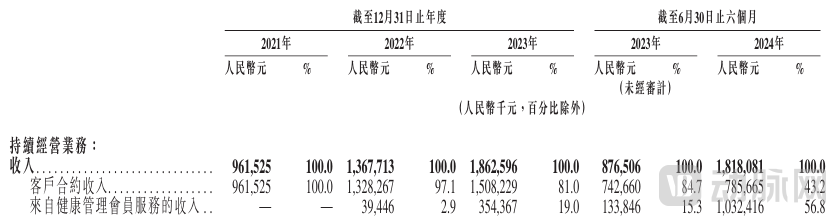 Revenue from Continuing Operations of WeDoctor Holdings, Source: Prospectus
According to Frost & Sullivan,Based on 2023 revenue, WeDoctor Holdings has become China’s largest provider of AI-powered healthcare solutions.As a star enterprise, WeDoctor Holdings’ innovative model and closed-loop business system have drawn significant attention.
WeDoctor Holdings’ core businesses include AI-powered healthcare services and a digital healthcare platform. The AI-powered healthcare services, leveraging the Health Consortium model, provide solutions to medical institutions at all levels, primarily comprising health management membership services, cloud pharmacies, and value-added services. The digital healthcare platform mainly encompasses digital healthcare services, offline medical center services, and corporate membership services.
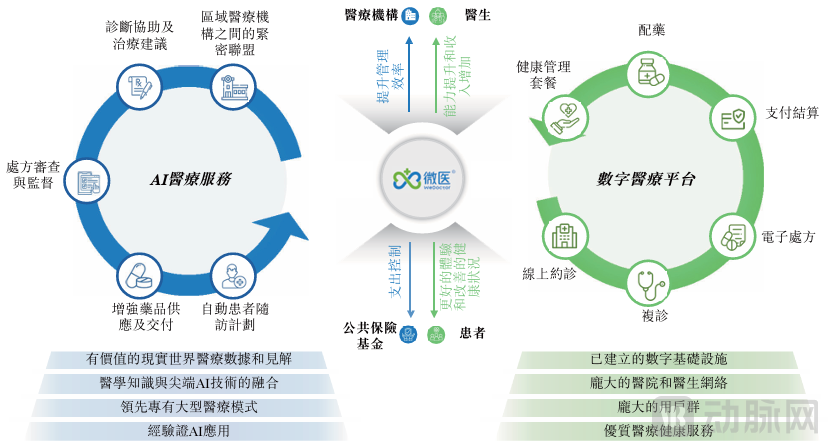
WeDoctor Holdings’ Business Structure and Business Model, Source: Prospectus
Specifically, AI-powered medical services are a suite of offerings built upon the Health Community model, primarily comprising health management membership services, cloud pharmacies, and value-added services.
Health Management Membership Services refer to a health management service system established by the Medical Community within a specific region, involving medical institutions at all levels and integrating online with offline as well as in-hospital with out-of-hospital care. It is a health management service model based on capitation and value-based payment.
Cloud Pharmacy refers to the cloud-based pharmacy platform established within a healthcare consortium, which facilitates the alignment of medication formularies between primary healthcare institutions and secondary and tertiary medical institutions in the region. This initiative enhances the capacity for pharmaceutical supply assurance at the grassroots level, thereby better meeting the medication needs of health management members and other patients.
Value-Added Services: Leveraging the Health Community, WeDoctor Holdings provides residents with comprehensive value-added services, including personalized health management, health education, weight management, testing and report interpretation, and home nursing care, thereby meeting their multi-level needs beyond basic health management membership services.
Digital healthcare platforms provide digital medical services, offline medical center services, and corporate membership and other services.
WeDoctor Holdings established China’s first internet hospital in 2015 and has accumulated extensive high-quality medical resources over the years. Its digital healthcare platform connects approximately 11,500 medical institutions and around 318,000 physicians, providing users with digital healthcare services such as online appointment scheduling, consultations, follow-up visits, and medication dispensing. Offline, WeDoctor Holdings operates six physical hospitals, offering more comprehensive medical services, including disease prevention, diagnosis and treatment, referrals, health check-ups, and vaccinations.
For corporate clients, WeDoctor Holdings offers customized employee health management plans and provides personalized health management package services to end users within these enterprises.
As the scaled operations of the Healthcare Community have advanced over the past three years, WeDoctor Holdings has seen robust growth in its recurring business revenue.
In 2021, 2022, and 2023, WeDoctor Holdings’ revenue from continuing operations amounted to RMB 962 million, RMB 1.368 billion, and RMB 1.863 billion, respectively. In 2024, performance surged further to RMB 1.818 billion, representing a year-on-year increase of 107.4%.
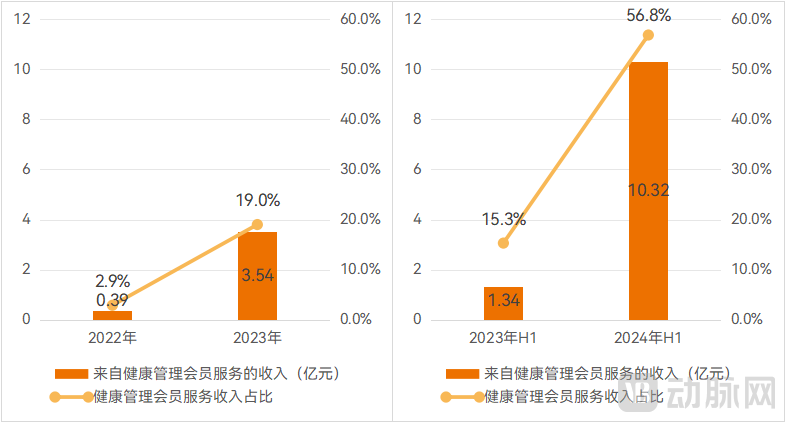 Growth in Health Management Membership Service Revenue of WeDoctor Holdings, Source: Prospectus
Notably, the health management membership services provided by the Jian Gong Ti (Health Community) demonstrated impressive revenue growth. Revenue from these services began in 2022 and has since grown rapidly, with their share of total revenue increasing significantly.In the first half of 2024, revenue from health management membership services reached RMB 1.032 billion, accounting for 56.8% of the revenue from continuing operations.According to the prospectus, WeDoctor Holdings’ revenue from continuing operations saw a substantial increase from July to October 2024.
Health management membership services have become the primary driver of WeDoctor Holdings’ performance growth, and this is also a strategic business for the company.
Transitioning from Internet-based healthcare to AI-driven healthcare, WeDoctor Holdings has achieved a leap from digitalization to digital-intelligence transformation. It not only leverages digital tools to connect doctor-patient resources and improve service efficiency, but also deeply integrates AI into the medical service system, thereby driving systemic change.
As AI’s penetration into healthcare services deepens and the technology continues to iterate, a large number of AI-integrated healthcare products and companies have emerged. Most of these products and companies focus on specific dimensions such as service workflows or specialized disciplines and diseases, applying AI primarily to certain processes, particular conditions, or within select medical institutions only.
By contrast, WeDoctor Holdings places greater emphasis on the systematic integration of AI with healthcare services.
First, WeDoctor Holdings has built and continues to strengthen its foundational AI capabilities.
Currently, WeDoctor Holdings has secured national filings for four AI algorithms: the “WeDoctor Medical Large Model,” the “WeDoctor Medical Assistant Large Model,” the “WeDoctor Health Assistant Model,” and the “WeDoctor Text Generation Algorithm.” It also holds exclusive licensing rights to more than 50 AI invention patents. Notably, the WeDoctor Medical Large Model ranked first on CMB, China’s authoritative evaluation platform for medical large language models, with a high score of 91.71.
Meanwhile, WeDoctor Holdings is accelerating the practical application of AI in two key areas: first, AI implementation within Healthcare Communities, and second, the AI-driven transformation of physical medical institutions.
Within the Health Community, WeDoctor Holdings leverages technologies such as big data and artificial intelligence to empower the existing healthcare system. By building digital and intelligent platforms like the “Four Clouds,” it addresses challenges in data connectivity and payment efficiency within the coordinated development of medical care, health insurance, and pharmaceuticals (“Three Medicals”), thereby enhancing diagnostic and treatment efficiency as well as chronic disease management capabilities in primary healthcare institutions through centralized services.
Specifically, “Cloud Management” serves as a unified management platform for various entities and medical services within the Healthcare Community; “Cloud Services” provide residents with multi-form, multi-tiered medical and health management services; “Cloud Pharmacy” enhances the capacity for grassroots drug supply assurance; and “Cloud Examination” facilitates the establishment of a service model featuring “grassroots-level examinations with higher-level diagnosis,” thereby enabling mutual transmission and recognition of examination and test results as well as the sharing of high-quality medical resources.
On this basis,WeDoctor Holdings has developed AI applications such as the “AI Physician,” “AI Pharmacist,” “AI Health Manager,” and “AI Intelligent Controller” agents, comprehensively empowering the sectors of medical care, pharmaceuticals, testing, health, and management, and integrating AI technology throughout the entire process of diagnosis, treatment, and health management.
Taking AI-driven health management as an example, it can automatically generate personalized health management plans based on members’ specific profiles, thereby improving the quality, efficiency, and standardization of care. With AI assistance, one health manager can oversee the health of approximately 2,000 individuals. Meanwhile, the “Cloud Pharmacy” has expanded the formulary available at primary care facilities to around 5,000 medications, while leveraging AI-assisted manual prescription review to enhance the rationality and cost-effectiveness of medication use and reduce labor costs.
In terms of physical hospital transformation, WeDoctor Holdings built China’s first AI hospital in 2024 and plans to gradually upgrade its other physical hospitals into AI hospitals.
In fact, WeDoctor Holdings has been gradually upgrading its internet hospitals into “smart hospitals” since 2021, laying a solid foundation for the intelligent transformation of physical hospitals. According to public media reports, in August 2024, WeDoctor Holdings established China’s first artificial intelligence hospital—the WeDoctor Shanghai AI Hospital—in Shanghai.
WeDoctor Shanghai AI Hospital is established based on a physical medical institution, holds an internet hospital license, and has been designated as a medical insurance provider.
The reason it is defined as an AI hospital is that the facility fully integrates artificial intelligence into its end-to-end services, including pre-consultation AI-based early screening and testing, intra-consultation AI physicians and AI pharmacists, and post-consultation AI health management, while also achievingEnd-to-End AI-Powered Smart Control for Medical Insurance, Digital and Intelligent Strategic Procurement for Medical Insurance: Achieving Greater Health Benefits at Lower Costs.
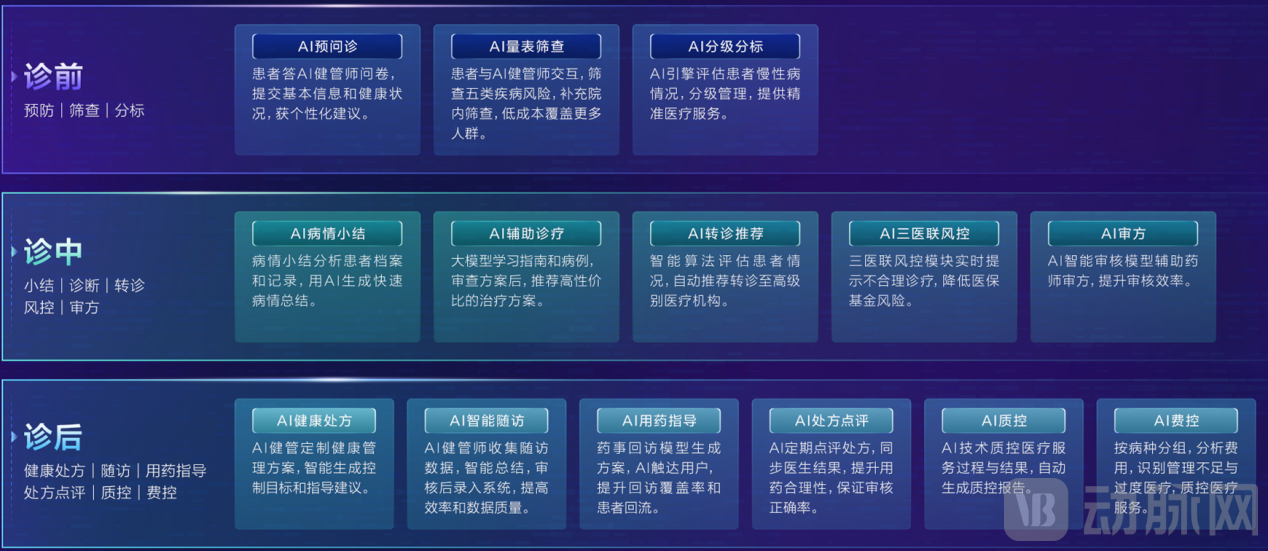 End-to-End Application of AI Technology at WeDoctor Shanghai AI Hospital, Source: Public Media Reports
Currently, the “AI+” initiative is being vigorously implemented across China, sparking a new wave of industrial transformation, with healthcare services being no exception. In 2024, “AI+” was included in the Government Work Report for the first time. The Beijing Action Plan for Promoting “AI+” (2024–2025), led by the Beijing Municipal Development and Reform Commission, proposes exploring collaborative mechanisms between physicians and medical AI agents, and advancing the upgrade of internet hospitals into AI-powered hospitals.
Developing AI-powered hospitals remains a key strategic priority for WeDoctor Holdings. The company plans to progressively transform its owned physical hospitals into AI-powered hospitals and support the upgrade of primary healthcare institutions collaborating within the Health Community model into AI-powered hospitals. Concurrently, it will work with partners to establish a standardized evaluation system for AI-powered hospitals.
From China’s first internet hospital, Wuzhen Internet Hospital, to the Digital Health Community, and now to the AI-powered hospital, WeDoctor Holdings has continuously driven technological innovation and transformation in the healthcare service system.
Despite the continuous upgrades in drive technology,WeDoctor Holdings adheres to the core strategic model of the Health Community, using it as a vehicle to implement a value-based healthcare payment system. This approach fulfills health accountability while achieving a four-way win for patients, hospitals, governments, and enterprises.
As early as 2020, WeDoctor Holdings began promoting its proprietary Community Health Consortium model in Tianjin. This model requires the coordination of medical institutions at all levels within the region to establish an online-plus-offline and in-hospital-plus-out-of-hospital health management service system, while implementing capitation-based and value-based payment mechanisms for health management services.
According to public media reports, Tianjin’s Integrated Healthcare Delivery System has covered 266 community health service centers and over 2,000 stations and clinics across the city. While strengthening the standardized service capabilities of primary healthcare institutions, it has established 238 chronic disease management centers. With diabetes as the entry point for chronic disease management, the system has explored capitation-based global budgeting and promoted reforms oriented toward health outcomes, thereby achieving the “two increases and one decrease” goal: improved population health indicators, enhanced primary healthcare service capabilities, and a reduced growth rate in medical insurance expenditures.
Data from the prospectus indicates that the Tianjin Health Consortium achieved significant improvements in diabetes management health indicators. From January 2023 to June 2024, the rate of glycated hemoglobin (HbA1c) target attainment among enrolled diabetic members rose from 17.8% to 44.2%, the blood pressure target attainment rate increased from 19.5% to 61.5%, and the lipid profile target attainment rate grew from 24.8% to 27.9%. During this 18-month management period, the average medical insurance quota per diabetic patient at partner healthcare institutions realized a surplus.These positive outcomes have enabled WeDoctor Holdings to expand its capitation and value-based payment models to a broader range of chronic disease areas.
In December 2023, WeDoctor Holdings partnered with the Xiqing District Government of Tianjin to expand its disease management model from single-disease to multi-disease management. As of June 30, 2024, WeDoctor Holdings had established collaborations with 11 primary healthcare institutions and two hospitals within Xiqing District; subsequently, the company extended this model to three additional districts in Tianjin.
As of June 30, 2024, the Tianjin Health Community had provided multi-disease and diabetes care services to approximately 900,000 members.
Due to its outstanding achievements, the Tianjin Digital Health Community was listed among China’s “Top Ten New Initiatives for Advancing Healthcare Reform and Serving Public Health” in 2020 and 2023, respectively, for its initiatives of “Building the ‘Four Clouds’ Platform to Promote the Development of Grassroots Digital Health Communities” and “Advancing Capitation-Based Global Budget Payment for Family Doctor Contract Services.”
Healthcare payment methods are undergoing continuous reform, with the essence of iteration or innovation trending toward value-based payment. This approach aims to control the growth of healthcare expenditures and insurance costs while ensuring effective treatment and rehabilitation outcomes. For patients with chronic diseases—who represent a large population and require long-term management through both in-hospital and out-of-hospital measures—value-based payment is undoubtedly an ideal model.
As early as 2021, the “14th Five-Year Plan for National Medical Security” issued by the General Office of the State Council pointed out that capitation-based payment for general outpatient services at primary healthcare institutions should be promoted in combination with family doctor contract services; capitation-based payment should be implemented for chronic diseases with clear diagnostic and treatment protocols and evaluation indicators, such as diabetes, hypertension, and chronic renal failure, so as to strengthen chronic disease management.
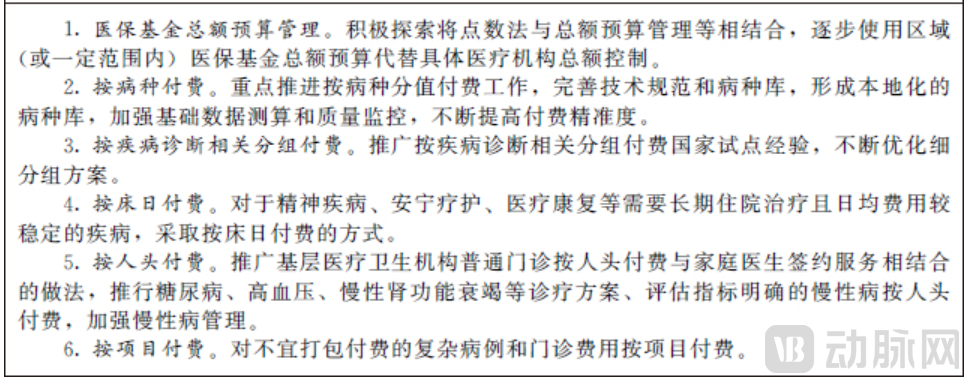 Major Types and Reform Directions of Diversified Composite Health Insurance Payment Methods, Including Capitation for Chronic Disease Management and Pay-for-Performance
Image source: "14th Five-Year Plan for National Medical Security"
WeDoctor Holdings, after years of practice,Aligning with the direction of healthcare reform and leveraging the Healthcare Community, it has carved out a unique business path within the industry. According to Frost & Sullivan data, WeDoctor Holdings is the only AI-powered healthcare solution provider in China that operates on a capitation and value-based payment model.
An Overview of WeDoctor Holdings' Competitiveness in the Market: Its Core Advantages Lie Primarily in Technology and Business Model
From a technical perspective, WeDoctor Holdings’ AI foundational capabilities and products are derived from deep learning on large-scale, multi-scenario data, and are simultaneously applied to diverse real-world service scenarios.
The prospectus reveals that, after years of accumulation, WeDoctor Holdings has amassed a substantial volume of high-quality de-identified data from medical institutions, including 46 million de-identified clinical consultation records, diagnoses, and prescriptions, thereby providing a solid foundation for the training and effective application of AI models.
The extensive service offerings encompassed by the two major business segments—AI-powered medical services and digital health platforms—provide rich application scenarios for AI products. This fosters a mutually reinforcing cycle between AI research and development and its practical application, truly realizing an approach that originates from real-world use cases and returns to them.
At the model level, WeDoctor Holdings has established a benchmark for the Healthcare Community in Tianjin, demonstrating strong replicability. Meanwhile, the construction and operation of such a Healthcare Community result from a series of measures, including a profound understanding of the essence of healthcare reform, comprehensive coordination of medical, pharmaceutical, and insurance resources, and integrated management of complex factors such as personnel, finances, and materials. With high entry barriers and long development cycles, this model is difficult for other enterprises to replicate.
Technical capabilities and model advantages reinforce each other: empowered by AI, the Health Community is taking root across various regions at a faster pace and lower cost, further generating economies of scale and reducing operational expenses and pharmaceutical supply chain costs. Meanwhile, AI technologies and products continue to iterate during the implementation and operation of the Health Community, delivering greater practical value.
In short, what sets WeDoctor Holdings apart in the industry is that it delivers to its clients or users not merely a technology-driven project aimed at improving efficiency, nor just a service-oriented product designed to enhance convenience, but rather a comprehensive service system centered on health outcomes.
While generating social benefits amid the new wave of healthcare reform, the commercial value of WeDoctor Holdings has become increasingly clear: by leveraging the Health Community to unlock the 2H2C commercialization pathway, it has established a closed-loop AI healthcare business model.
One manifestation of commercial value is the explosive growth in revenue data, while another key indicator stems from profitability. As the effects of AI applications on improving quality and efficiency, as well as reducing costs, become evident, WeDoctor Holdings’ adjusted net loss from continuing operations has gradually narrowed, decreasing from RMB 1.354 billion in 2021 to RMB 505 million in 2023, and further to RMB 128 million in the first half of 2024, a year-on-year decline of 50.3%, bringing the company close to profitability.
According to the prospectus, WeDoctor Holdings will continue to strengthen and enhance its existing AI product capabilities, improve the diagnostic accuracy of its models, and enable earlier detection of disease progression. This strategic shift moves the focus upstream from diagnosis and treatment to prevention and screening, thereby building a full-lifecycle management service covering prevention, screening, diagnosis, treatment, and rehabilitation, and further advancing the implementation of value-based healthcare. Additionally, the company will develop a medical AI development platform to provide the industry with MaaS-level services featuring medical AI agents and specialized models, continuously driving the upgrade and efficiency improvement of the healthcare service system.
In line with policy guidelines, WeDoctor Holdings will continue to expand the implementation scope of its AI-powered Healthcare Community. In addition to supporting the Tianjin government in accelerating the development of healthcare communities across all districts of Tianjin, the company has signed strategic agreements on healthcare communities with Guiyang and Ningxia, and is actively advancing the implementation of collaborations in regions such as Shanghai.
Previously, ten departments, including the National Health Commission and the National Healthcare Security Administration, clarified in the “Guiding Opinions on Comprehensively Promoting the Development of Close-Knit County-Level Medical Communities” that close-knit county-level medical communities would serve as the implementation vehicle for advancing reforms in healthcare insurance payment methods.
In September 2024, the Sanming Healthcare Reform initiated the upgrade from “Medical Consortia” to “Health Consortia,” leveraging medical insurance payment as a link to integrate public health functions such as disease prevention and health management, thereby providing the public with integrated health services encompassing “prevention, healthcare, treatment, rehabilitation, and health management.” This marks another key measure in Phase 3.0 of the Sanming Healthcare Reform. In recent years, the state has vigorously promoted the nationwide adoption of the Sanming model, indicating that the Health Consortium model will play a catalytic role in the broader dissemination of the Sanming Healthcare Reform across China.
It is evident that, under the guidance of the new healthcare reform, the Health Community model has fertile ground for expansion and growth.
According to Frost & Sullivan, China’s AI healthcare solutions market is projected to grow from RMB 9.7 billion in 2023 to RMB 138.7 billion in 2030, representing a compound annual growth rate (CAGR) of 46.2%. As the Healthcare Community model is replicated across China, WeDoctor Holdings’ market prospects are expected to become increasingly clear and promising.