

2025 VBEF Future Healthcare & Pharma 100 Expo Officially Opens Recruitment to Meet Comprehensive Needs of Medical Innovation Enterprises
Standing in 2025 and looking back at the healthcare industry in 2024, market entrants shared a common perception of facing significant challenges.
The data offers a glimpse into the trend. VCBeat’s analysis of financial reports from 496 A-share listed healthcare companies revealed that 224 companies achieved year-on-year growth in net profit attributable to shareholders during the first three quarters of 2024, representing a decrease of 33 companies compared to the 257 listed firms that recorded such growth in 2023.
Among them, the combined net profit attributable to shareholders of 496 A-share listed medical companies totaled RMB 141.2 billion in the first three quarters of 2024, compared with RMB 153.4 billion in the same period of 2023, representing a year-on-year decrease of 8.64%. Thisindicating a decline in the overall profitability of listed healthcare companies.
Not to mention investment and financing, the pharmaceutical index has fallen for three consecutive years.The number and total volume of primary market investments and financings have dropped by more than half compared to the peak in 2021.Data from the VCBeat database shows that in the first half of 2024, a total of 415 primary market financing deals were completed in China’s healthcare industry, with cumulative funding amounting to approximately $4.8 billion. Compared with the same period in 2023, the number of healthcare financing transactions and the total amount in China decreased by 32.3% and 12.2%, respectively, in H1 2024. In comparison with the global healthcare market, the contraction in both volume and value was more pronounced.
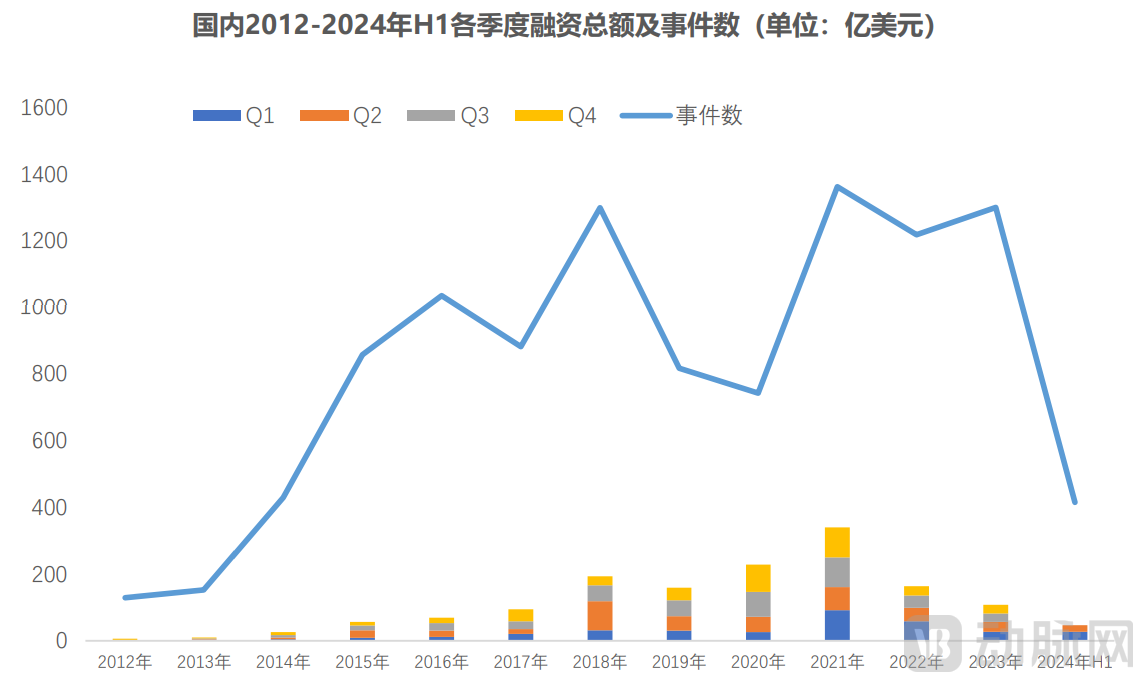
Amid the industry downturn, all subsectors—including innovative drugs, innovative medical devices, and digital health—have been affected.
“With ‘difficulty’ defining 2024, we have had a particularly profound sense of the challenges and have strived to rise to them,” said Dai Jingmeng, Deputy General Manager of Guomao Health Technology and Chairman of Beijing Pault Medical, in an interview with VCBeat. “Taking the stapler niche as an example, the comprehensive rollout of the volume-based procurement model under the ‘National Centralized Procurement + Provincial Alliances’ framework has intensified market competition. Coupled with the profound transformations underway in the industry, developing more innovative products has become a top priority for the medical sector.”
Wang Yunan, General Manager of Beijing BOE Health Technology Co., Ltd., also stated, “We are facing numerous challenges at present, with a noticeable decline in consumer spending appetite—a trend we have keenly felt. Taking the myopia prevention and control sector, where BOE Health has recently entered, as an example, this segment has been affected by the broader macroeconomic environment. Moreover, as the industry is still in its early stages of development, it remains chaotic and unregulated. Under pressure to survive, some manufacturers have resorted to preemptively ‘harvesting’ valuable early-adopter customers through low-price strategies, thereby disrupting market order and undermining the sustainable development of the industry.”
Despite the numerous pressures, every respondent believed that,Pessimists are often right; optimists keep moving forward.: Amid the growing pains of industry transition, new opportunities are bound to emerge; only by immersing oneself in the field and continuously exploring new paths can one navigate the turning point.
Believe that once you weather this storm, the healthcare industry will see a bright new horizon.
Throughout the history of the global healthcare industry, every enterprise that has grown into a pharmaceutical and medical device giant has experienced a trough before achieving even greater growth.
As one of the world’s largest medical device companies today, Medtronic, founded in 1949, quickly rose to prominence as a market standout due to its revolutionary portable external cardiac pacemaker and implantable cardiac pacing systems. However, between 1970 and 1985, Medtronic lost its position as a technology leader owing to slow progress in technological innovation and increasing competition from emerging companies that captured market share with cutting-edge technologies.
Misfortunes never come singly. During the aforementioned period, Medtronic also faced two product quality crises, along with the challenges posed by the U.S. economy’s entry into stagflation. These events plunged Medtronic into its lowest trough since its founding: for the first time, its fiscal year 1985 annual report recorded negative revenue growth, and its market share dropped to a historic low of less than 30%.
Similarly, Eli Lilly has experienced multiple troughs throughout its more than 140-year history. The most recent occurred in the early 21st century, when patents for its major psychiatric drugs—Prozac, Zyprexa, and Cymbalta—expired, causing billions of dollars in value to vanish overnight and sending its stock price close to historic lows. Recalling that period, Eli Lilly’s CEO Dave Ricks stated bluntly that the industry was undergoing a wave of consolidation, and Lilly, facing both internal challenges and external pressures, was at significant risk of being acquired.
However, the rest of the story is well known: Medtronic has now become a global leader in medical devices, and Eli Lilly has become the world’s most valuable pharmaceutical company by market capitalization.
What, then, did these global giants actually do to successfully navigate the crisis and identify new opportunities for growth?
First,In concrete actions, always maintain idealism.Take Medtronic as an example. In 1985, Winston Wallin, who had served as President and Chief Operating Officer of Pillsbury, accepted a critical appointment to join Medtronic. Confronted with the company’s pressing challenges, Wallin decided to pursue a diversification strategy. However, unlike conventional corporate diversification paths, Wallin believed that Medtronic must uphold its revolutionary idealism by remaining firmly positioned within the medical device sector and deeply cultivating related niche segments, thereby enabling the company to escape its predicament.
Thus, while maintaining its core focus on pacemakers, Medtronic increased its R&D investment. Over the course of ten years, Medtronic not only continuously launched new pacemaker models but also gradually established five major business units: bradycardia pacing, tachycardia management, cardiovascular surgery, vascular therapies, and neuromodulation. Its market share in pacemakers gradually recovered to 50%, paving the way for subsequent rapid growth.
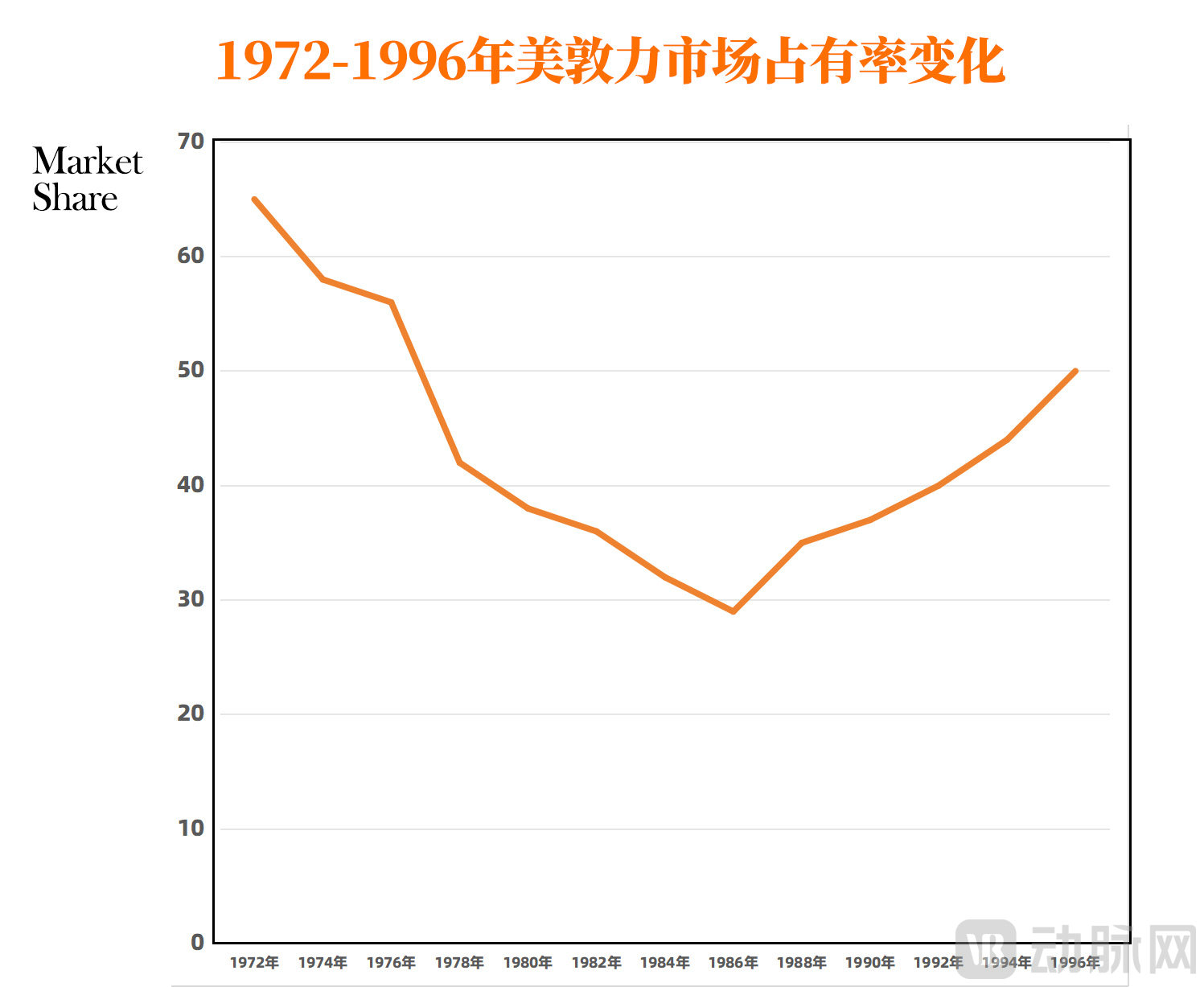 ▲From 1972 to 1996, Medtronic’s market share exhibited a “deep V” shape
Source: MedFlow Technology
Beyond idealism, grounded realism is equally important.For instance, when confronted with the aforementioned industry challenges, Eli Lilly did not shy away from the issues. Instead, it implemented bold, detailed reforms: on one hand, it pursued self-rescue through large-scale layoffs, organizational restructuring, mergers and acquisitions, and collaborations; on the other hand, it actively engaged multiple partners to share R&D costs and risks.
From 2009 to 2015, Eli Lilly partnered with Incyte to co-develop the JAK1 and JAK2 inhibitor baricitinib, collaborated with Boehringer Ingelheim on the development of several glucose-lowering drugs for diabetes, and signed an agreement with Innovent Biologics to jointly develop the PD-1 inhibitor sintilimab in China. In addition to collaborating with innovative companies on drug development, Eli Lilly has also actively invested in research and development.
Hard work pays off. Eli Lilly gradually accelerated its product launch cadence, introducing the VEGFR2 monoclonal antibody Cyramza (ramucirumab) and the GLP-1 receptor agonist dulaglutide in 2014; the EGFR monoclonal antibody Portrazza (necitumumab) in 2015; the IL-17A monoclonal antibody Taltz (ixekizumab) in 2016; the CDK4/6 inhibitor Verzenio (abemaciclib) in 2017; Reyvow (lasmiditan) in 2019; and the dual GIP/GLP-1 receptor agonist tirzepatide in 2022, among other innovative drugs. This steady stream of novel therapeutics ultimately translated into tangible commercial success, enabling Eli Lilly to navigate through challenging times and propelling its market capitalization to nearly $1 trillion in 2024.
It is evident that in the face of the industry’s downturn, maintaining revolutionary romanticism alongside down-to-earth realism may well be the answer to navigating through the trough.
In the realm of innovation, sustaining rapid and robust growth has long been a goal that industry participants strive to achieve. This is no easy feat; numerous research reports indicate that, broadly speaking, only about 10% of companies can maintain their growth trajectory, with the proportion being even lower in the field of medical innovation.
Therefore, when confronted with industry challenges, corporate anxiety is easily amplified amid slowing growth and sharply rising operational pressures.
However, anxiety is a negative emotion that has no positive impact on an organization; it neither solves nor can solve any problems. In such situations, taking action is the best remedy for alleviating anxiety.
In response, every company surveyed by VCBeat is moving forward with optimism: from strategy to tactics, and from business models to product planning, all are actively making adjustments.
For exampleAt the strategic and operational levelsMs. Zhang Xinyan, Founder and CEO of Huimei Digital Technology, told VCBeat that, given the continuous strengthening of policy and regulatory oversight, the establishment of a compliant data management ecosystem has become an indispensable key component in the healthcare industry. The company is actively integrating ESG principles into its corporate strategy and operations. In particular, within the pharmaceutical commercialization process, it has developed a comprehensive solution platform for physician-patient management that integrates academic engagement, scientific research, and patient management, thereby accelerating pharmaceutical commercialization and achieving omnichannel digital integration of physicians and patients.
“With increasingly stringent regulatory oversight in the healthcare sector, many hospitals have imposed stricter requirements on third-party collaborations,” said Zhang Le, Head of Marketing at Weimai. “In response to these industry shifts, we have adopted a more open approach to our partnerships with hospitals. By collaborating with a broader range of enterprises, platforms, and individual partners, we aim to better serve both hospitals and patients, achieving win-win outcomes for all stakeholders. Meanwhile, we have made flexible adjustments to our service fee structures to align with the current healthcare landscape, reasonably and compliantly increasing the proportion of service-based revenue for medical institutions—a direction supported and encouraged by multiple national policies. Additionally, since 2024, we have been helping hospitals deliver operational services to their entire user base without requiring additional investment, rather than serving only a small subset of paying users. This capability has become a core competency valued by a growing number of hospitals.”
InIn terms of specific strategies and changes in indicators, many companies have developed new strategic perspectives. Ding Zhaoliang, Founder and CEO of Knowledge Matrix, stated that the company will accelerate its forward momentum. Whether in the precision marketing of general health content or the exclusive licensed operation of Class II medical device brands, the primary objective will be sales revenue to maintain healthy cash flow. “In this industry, stable revenue must remain the core focus; one should not pursue quick success and instant benefits by making excessive investments that are not immediately necessary. Survival is more important than anything else. Fortunately, our business scale expanded rapidly in 2024.”
Similarly, Xiang Fei, General Manager of Shuyu Medical, told VCBeat that in response to the challenge of clients in the clinical research sector becoming more cautious and hesitant about funding clinical research projects, the company has been deepening its efforts in two key areas to break through: first, leading cost reduction and efficiency improvement through technological innovation by actively introducing cutting-edge artificial intelligence technologies such as large language models, thereby lowering the threshold and costs for clients while enhancing the efficiency and output of scientific research; second, shaping long-term value through service innovation by gaining insights into clients’ research needs and transforming individual research requests into systematic and sustainable research plans.
Accelerating product updates and iterations is also a crucial path for innovative companies to consider when seeking breakthroughs.Lv Chenchong, founder of Shukun Technology, stated, “In response to the slowing growth of overall radiology AI projects, Shukun has strategically deepened its presence in the field of intelligent ultrasound equipment over the past five years. By the first quarter of 2025, we will achieve dynamic, real-time AI detection for ultrasound examinations across all anatomical regions. At that point, full-system intelligence for ultrasound devices will be realized. In addition to generating revenue from the radiology AI sector, Shukun will also gain new growth momentum from the ultrasound AI sector.”
As one of the representative enterprises in the field of high-end ophthalmic devices, Dr. Li Bing, Co-founder and CEO of Intalight (Saiwei), believes that it is essential to persist in doing difficult yet correct things, continuously invest in innovative R&D, and take the development of breakthrough high-end products as its mission. By redefining core ophthalmic equipment and winning the market with product capabilities, services, and brand strength that far surpass previous standards, the company aims to achieve strong cash flow and establish a healthy and robust operational style.
Wang Yunan, General Manager of BOE Health Technology Co., Ltd., also stated that BOE Health would adhere to long-term and product-oriented thinking, deepen its engagement in the field of myopia prevention and control, and provide new approaches for preventing and controlling myopia among children and adolescents. First, the company will continue to invest in technological and product innovation for the BOE Health Yuanwang Learning Screen, retaining customers through high-quality products and positive word-of-mouth. Second, it will maintain ongoing collaborations with key opinion leaders (KOLs), including authoritative medical and educational experts, to fulfill its responsibilities in the education market. Finally, it will adapt to changing times and needs by selecting marketing channels with higher consumer trust, engaging in deep cooperation to enhance efficiency and reduce marketing costs.
Some innovative enterprises are also continuously promoting deeper cooperation with ecosystem partners across multiple dimensions.“We have engaged in deep collaboration with Huawei Cloud, leveraging our experience in building over 300 internet hospitals and our accumulated resources in the healthcare industry. We have significantly strengthened our partnership with Huawei Cloud in areas such as medical cloud security and the joint operation of medical big data sharing. Together, we have launched a series of innovative digital solutions for internet healthcare, including ‘Yi Dian Tong’ for chain pharmacies, ‘Yi Dian Tong’ for pharmaceutical e-commerce, and an ‘Emergency Rescue Platform’ for physical medical institutions. These initiatives have delivered tangible results in cost reduction, efficiency improvement, quality enhancement, and volume growth for the operation of internet hospitals across diverse industry sectors,” said Wan Yaohua, Chairman of Guangzhou Yuankangjian Technology Co., Ltd.
Undoubtedly, through proactive initiatives, every medical innovator is driving change, steadily strengthening their competitive advantage, and finding the key to navigating the trough.
Beyond the practices of industry participants themselves, as a dedicated partner deeply embedded in the healthcare innovation sector,VCBeat will host the Future Healthcare & Pharma Top 100 Conference and Future Healthcare & Pharma Ecosystem Exhibition, themed “The Now: Tipping Point” (hereinafter referred to as “2025 VBEF”), from May 8–10, 2025. At this pivotal moment, the event aims to create an optimal platform for industry peers to secure funding, forge partnerships, and uncover new opportunities.
Specifically, inVCBeat, VCBeat has always been the preferred platform for investment and financing matchmaking in the field of healthcare innovation. On one hand, based on over a decade of accumulated experience, VCBeat covers more than 90% of investors in China's healthcare and pharmaceutical sectors, with over 80% of these investors having participated in the Future Healthcare & Pharma 100 list and the VBEF conference; on the other hand, VCBeat has reported on approximately 10,000 healthcare innovation companies in the past, achieving a 70% first-report rate for investment and financing activities.
At the 2025 VBEF, VCBeat will leverage its extensive investment and financing resources to build an efficient matchmaking platform, hosting specialized series of events across various sub-sectors, including innovative medical devices, digital health and healthcare services, innovative pharmaceuticals, biomanufacturing, technology transfer, and laboratory instruments.Through on-site demonstrations, presentations, and one-on-one negotiations, participating companies can directly showcase their innovative products, cutting-edge technologies, and market potential to investment institutions, thereby accelerating the financing process.
InFind Partnerships, VCBeat has established a collaborative platform for business development, supply chain transactions, and finished product trading, leveraging its understanding and insights into the healthcare innovation industry.
In terms of business development (BD), VBEF 2025 will, first, invite over 1,000 representatives from multinational corporations (MNCs) as well as leading Chinese medical device and pharmaceutical companies who are seeking BD collaborations on high-quality projects, product portfolios, and technologies; second, it will facilitate on-site matchmaking and networking sessions for exhibitors with clear BD collaboration needs during the conference, thereby expanding their business scope and jointly exploring new blue-ocean market opportunities.
In terms of industrial and supply chain transactions, the 2025 VBEF will comprehensively cover all segments of the medical and pharmaceutical industry, including investment, project initiation, R&D, licensing, manufacturing, supply chain localization, sales, product portfolio transfer, and product collaboration. The event will host over 5,000 founders and decision-makers from medical and pharmaceutical innovation enterprises, more than 1,500 distributors and hospital Principal Investigators (PIs), over 2,000 medical device professionals and 2,000 heads of pharmaceutical industrial and supply chains, as well as more than 1,500 R&D personnel, procurement specialists, and production staff from pharmaceutical companies, CROs, R&D teams, and healthcare institutions. Exhibiting companies will have the opportunity to engage in direct face-to-face discussions with over 20,000 medical device manufacturers, pharmaceutical companies, supply chain enterprises, and distribution agents from both domestic and international markets, efficiently exploring opportunities for business collaboration and transactions.
In terms of finished product transactions, as the premier launchpad for innovative medical and pharmaceutical products in China, the 2025 VBEF Conference will bring together over 1,000 innovative medical and pharmaceutical products on-site. According to incomplete statistics, 67% of medical device and pharmaceutical distributors have a clear demand to seek new products for distribution. Furthermore, more than 2,000 distributors, hospital Principal Investigators (PIs), and pharmaceutical procurement professionals are expected to attend the 2025 VBEF, providing a high-quality, efficient, and convenient negotiation platform for buyers and sellers, and offering exhibiting companies direct opportunities for finished product transactions.
InSeek New OpportunitiesVCBeat has always been among the earliest observers, witnesses, and companions of industry trends. From identifying the advent of the “eye of the storm” in internet healthcare at the first VCBeat Insight Conference, to presenting “China’s Story” at the sixth edition, and further upgrading the Top 100 Future Healthcare Companies Conference into the VBEF Future Healthcare Ecosystem Expo, VCBeat has accurately captured every major industry shift, offering unique insights and actionable solutions for the sector ahead of others.
For instance, in response to the surging wave of Chinese companies expanding overseas over the past two years, VCBeat has emerged and continues to assist Chinese enterprises in exploring international markets. To date, VCBeat has established in-depth resources in more than 20 key countries and regions, including the United States, Europe, the Middle East, North Africa, Japan and South Korea, Southeast Asia, Russia, and Brazil. The 2025 VBEF will also host an Overseas Expansion Conference, attracting over 1,000 attendees, including consular officials, international buyers, overseas distributors, and cross-border service providers. The event aims to identify optimal partners for Chinese companies seeking to establish global production bases, secure international financing, achieve global market access, foster global supply chain collaboration, and promote worldwide product sales. Furthermore, the exhibition will organize international buyer delegations, providing exhibitors with face-to-face communication opportunities with overseas purchasers to facilitate their expansion into international markets.
It is evident that the 2025 VBEF Conference stands as one of the premier platforms for Chinese medical and pharmaceutical exhibitors to comprehensively address their multi-level needs, including investment and financing, business development (BD) partnerships, supply chain transactions, finished product trading, and overseas market expansion.
We believe that during the downturn in the medical innovation industry, it is undoubtedly the greatest fortune to move forward hand in hand with positive and optimistic partners.
“Go fast alone, go far together.” Here, we welcome everyone to attend the Top 100 Future Healthcare and Pharmaceutical Conference and the Future Healthcare and Pharmaceutical Ecosystem Exhibition, to jointly witness the industry’s turning point toward renewed prosperity.
 For inquiries about exhibiting and attending, please scan the QR code in this image.
They, Boosting Confidence in the Industry:
“At present, we must prioritize revenue as the core focus and avoid short-sighted, excessive investments that are not essential at this stage. Survival is more important than anything else.” — Ding Zhaoliang, Founder and CEO of Knowledge Matrix
"We believe that once the direction is correct, we need only keep our heads down and focus on product development and research; dawn will surely appear. We also believe that although the road is long and arduous, perseverance will lead to success." — SinoStar
“We hope that practitioners in the medical innovation industry will refine their products and optimize corporate operations and management during the industry’s downturn, ultimately navigating through the cycle to make sustained contributions to China’s healthcare cause.” — Tupai
“In the short term, challenges are severe and require perseverance; in the long run, the sector you are engaged in is the future. Do not give up—persistence is victory!” — Lv Chenchong, Founder of Yizhun
“This capital winter is both a challenge and an opportunity. The current difficult times are akin to the Battle of Moscow, as well as an opportunity for survival of the fittest in the industry. We cherish this opportunity to comprehensively improve ourselves. We believe that gold will eventually shine, and we continue to achieve breakthroughs.” — Li Bing, Co-founder/CEO of Intalight
“During these challenging times, we should uphold the spirit of ‘doing good deeds without worrying about the future,’ focusing on strengthening internal capabilities, solidifying our professional foundation, and actively seeking resource integration through various strategies such as business synergy, complementary advantages, and mergers and acquisitions. We must have the confidence that ‘a time will come to ride the wind and cleave the waves, to set my cloud-white sail and cross the blue sea,’ and forge ahead with determination.” — Dai Jingmeng, Deputy General Manager of Guomao Health Technology and Chairman of Beijing Pert Medical
Every innovation in the healthcare industry paves the way for a healthier future for humanity. Therefore, we believe: “Though the road may be long, you will reach your destination if you keep walking; though the task may be difficult, you will surely succeed if you take action.” — Wan Yaohua, Chairman of Guangzhou Yuankangjian Technology Co., Ltd.
References:
1. “Medtronic’s 70-Year Rise and Fall” – Yiliu Technology
2. “Eli Lilly: Charging Toward the Pinnacle of a Trillion-Dollar Market Cap?” — Tong Xieyi