

Fluid Biomed Secures $27M Series A Funding to Advance ReSolv, the World’s First Absorbable Flow-Diverting Stent for Brain Aneurysms
Fluid Biomed
Developer of Bioabsorbable Polymer Stents
Recently, Canadian medical device startup Fluid Biomed completed a $27 million (approximately RMB 200 million) Series A financing round. The funds will be used to drive the commercialization of its bioresorbable flow-diverting stent, ReSolv, while continuing to expand its operations and R&D departments.
This round of financing was led by Amplitude Ventures and another undisclosed company. Co-investors included IAG Capital Partners, LifeArc Ventures, ShangBay Capital, and METIS Innovative.
Fluid Biomed was co-founded by two physicians from the Cumming School of Medicine and Harvard University. The founders possess extensive clinical surgical experience and laboratory R&D expertise, with a long-standing focus on the treatment of cerebral aneurysms and stroke.
Fluid Biomed completed a $4.7 million seed funding round in 2021, co-led by METIS Innovative and ShangBay Capital, with support from more than ten corporate and institutional investors, demonstrating market recognition of Fluid Biomed’s bioresorbable flow diverter stent technology among its partners.
Cerebral Aneurysm, also known as intracranial aneurysm, refers to a sac-like structure formed by abnormal dilation of the arterial wall within the cranium.
The danger of cerebral aneurysms lies in their highly "insidious" nature. Unruptured aneurysms may be asymptomatic; most small aneurysms carry a low risk of rupture and typically do not cause noticeable symptoms. However, once a cerebral aneurysm ruptures, it leads to subarachnoid hemorrhage, causing severe harm to the body, with nearly one-third of patients dying immediately.
To reduce the risk of rupture, cerebral aneurysms are commonly treated via surgical clipping, coil embolization, or flow-diverting stent implantation. Among these, the latter two techniques are increasingly widely used in clinical practice due to their advantages of lower complication rates and reduced surgical risk.
Compared with coils, flow-diverting stents do not need to enter the aneurysm. They primarily achieve durable and complete embolization by altering blood flow direction, thereby reducing the risk of aneurysm rupture and exhibiting a lower recurrence rate.
Based on the stent material, commonly used flow-diverting dense-mesh stents can be classified into two categories: cobalt-chromium alloys and nickel-titanium alloys.
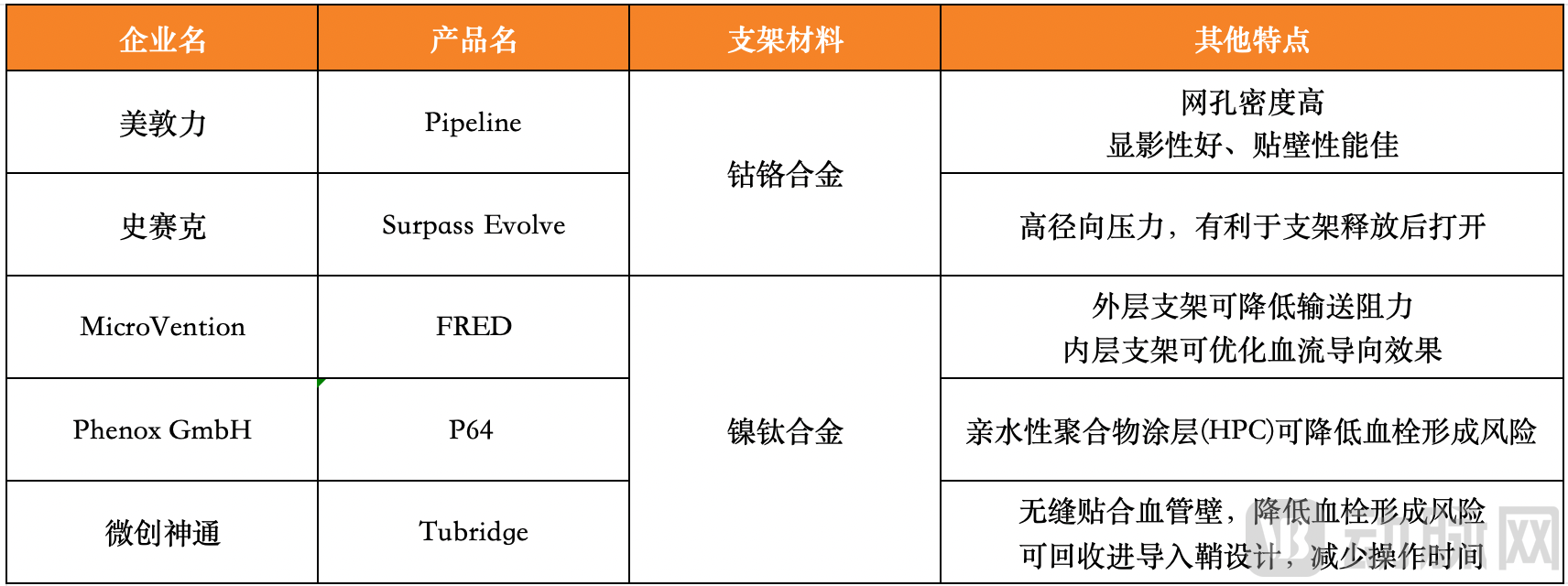
(Public information; graphic by VCBeat)
It is worth noting that, regardless of the stent material, they all share one common feature:Made of non-absorbable metal materials, their inherent physical properties will have a certain impact on the stent.:
First, metallic materials have a higher propensity for thrombus formation.To prevent complications such as thromboembolism, patients require long-term administration of antiplatelet or anticoagulant medications. However, these drugs are a "double-edged sword"; prolonged use may lead to complications including gastrointestinal discomfort, hepatic impairment, and even hemorrhage.
Secondly, it may interfere with postoperative CT/MR examinations, necessitating invasive procedures for the patient.In CT/MR examinations, metal implants produce significant artifacts that interfere with image interpretation by physicians, and may even render interpretation impossible.
Furthermore, during clinical deployment, some flow-diverting stents may encounter difficulties in delivery. During the procedure, the flow-diverter must be advanced through a microcatheter to the target vascular location. When navigating tortuous and complex vasculature, the distal tips of certain struts of the flow-diverter may rub against the inner wall of the microcatheter, resulting in increased resistance and compromised deliverability.
Fluid Biomed’s ReSolv product addresses the aforementioned drawbacks of metallic materials, enabling patients to undergo routine examinations without the need for lifelong anticoagulant therapy.
Breaking the Tradition of Metal Consumables.ReSolv is composed predominantly of absorbable polymers, with metals constituting only a minor fraction. According to the official website of Fluid Biomed, ReSolv promotes rapid endothelialization of the aneurysm neck and formation of a neointima, thereby accelerating vascular healing. Once the aneurysm is cured, ReSolv is absorbed by the body and gradually integrates into the vessel wall, leaving virtually no trace. Consequently, it causes minimal interference with subsequent CT and MRI examinations, sparing patients from undergoing invasive angiography.
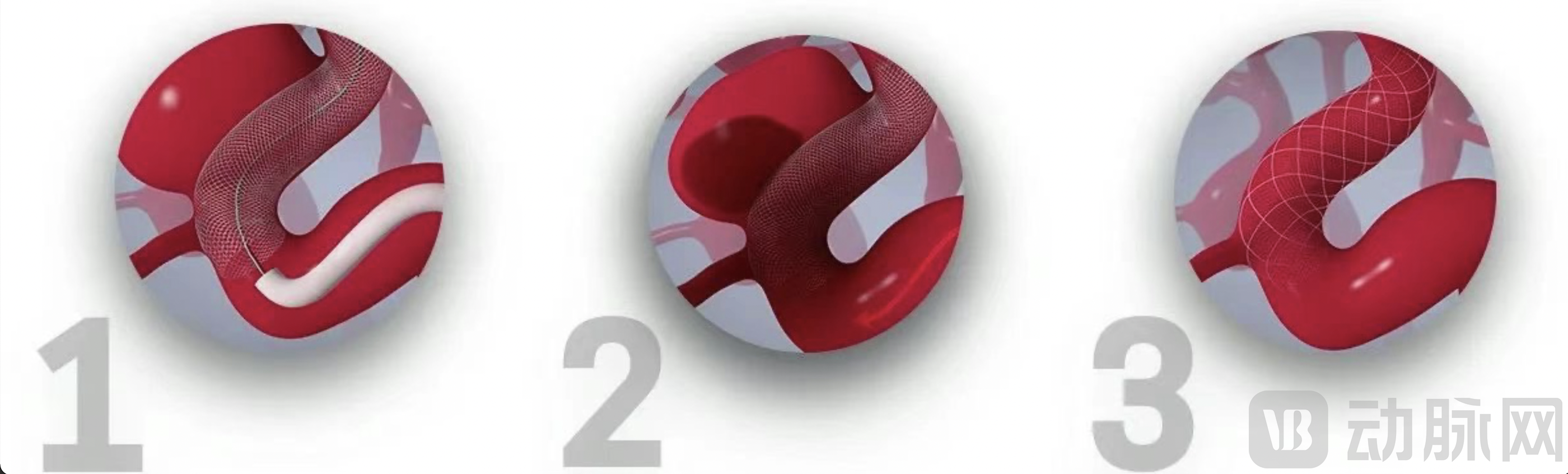
(ReSolv product, image source: Fluid Biomed official website)
The proprietary stent delivery system safeguards patients.ReSolv features a proprietary stent delivery system that easily navigates around aneurysms under angiographic guidance. According to the official website, ReSolv is flexible and self-expands upon deployment, eliminating the need for balloon expansion.
The unique stent structure endows ReSolv with excellent flow diversion performance.Following ReSolv implantation, blood flow within the weakened vascular region is slowed, promoting gradual thrombosis of the aneurysm over time, thereby protecting patients from the risks of rupture and stroke.
ReSolv has demonstrated clinical safety and feasibility. In June 2023, Fluid Biomed Inc. conducted a human clinical trial named “REDIRECT” to evaluate the safety and technical feasibility of ReSolv in its first phase. The results showed no adverse effects 30 days after implantation of the ReSolv device, successfully providing a new option for the treatment of cerebral aneurysms.
Amid an aging society, the incidence of cardiovascular and cerebrovascular diseases in China has been rising year by year. According to data from Zhongshang Industry Research Institute, China’s vascular interventional device market has experienced rapid growth, with its market size increasing from RMB 19.9 billion in 2015 to RMB 55.9 billion in 2023, representing a compound annual growth rate (CAGR) of 13.77%.
Flow-diverting stents are a category of neurointerventional devices. Neurointervention refers to the diagnosis and treatment of neurological diseases through minimally invasive techniques. Due to its advantages of minimal trauma and high efficiency, it is hailed as the “crown jewel” of interventional procedures. Neurointerventional surgeries typically require various high-value consumables. Flow-diverting stents are expensive, representing the “top-tier” among high-value consumables.
From the perspective of the competitive market landscape, foreign flow-diverting stent products have been developed earlier, with multiple products already approved for clinical treatment. For instance, Medtronic’s Pipeline Embolization Device, Balt Extrusion’s Silk Vista Flow Diverters (SFD), Stryker’s Surpass Evolve Flow Diverter, and MicroVention’s (now Terumo Neuro) FRED device are mainstream products used domestically and internationally for the treatment of cerebral aneurysms.
With the advent of China’s era of normalized volume-based procurement, high-value medical consumables, including flow-diverting stents, will follow the “volume-for-price” logic, helping domestic manufacturers of flow-diverting stents increase their market share. This year alone, companies such as JiaChuang TongQiao, MicroPort NeuroTech, Aike Medical, and Sino Medical have accelerated product development and pushed for regulatory approvals.
In March 2024, MicroPort NeuroTech’s self-developed “Tongqiao Qilin” flow-diverting dense-mesh stent received marketing approval, becoming the first domestically produced fully radiopaque distally closed dense-mesh stent. In August, MicroPort NeuroTech’s next-generation flow-diverting dense-mesh stent, Tubrighe Plus, was officially approved, further enriching its product portfolio in the field of cerebrovascular disease treatment. Additionally, Sinomed’s coated dense-mesh stent has completed clinical trials and is approaching commercialization. It is foreseeable that in the near future, Chinese domestic brands will achieve greater “import substitution” through continuous technological breakthroughs.
Article reference:
1. Fluid Biomed Official Website
2. No “Price Floor”! Centralized Procurement for Vascular Intervention Launched — “CielBlue Medical Devices”