

China's VR/AR Medical Device Sector Takes Off with First Class III and Innovative Device Approvals
VR (Virtual Reality) / AR (Augmented Reality, including MR Mixed Reality) has long been recognized for its immense potential in medical applications, but significant progress was only made recently. VCBeat’s analysis reveals that in 2024, this sector achieved major breakthroughs in regulatory approvals, with a substantial increase in the number of approved products, as well as the first-ever Class III certification and Innovative Medical Device designation for an AR product. There were also multiple advancements in application scenarios.
VR/AR + Healthcare: A Gentle Breeze Has Begun to Blow—Will You Miss It?
As the two primary forms of XR (Extended Reality) technologies, VR isolates users from their physical surroundings via headsets, immersing them in a purely virtual digital environment generated by computers. AR, on the other hand, enhances real-world experiences by overlaying or removing interactive virtual objects or information generated in real time by computers within the physical environment.
VR/AR is widely regarded as a promising solution to address business pain points across all stages of disease prevention, diagnosis, treatment, rehabilitation, education, and innovation. This potential stems from its ability to deliver standardized interventions and novel content remotely in a highly immersive and realistic manner, while also being customizable for diverse clinical settings. Existing explorations have already demonstrated its efficacy and significant potential.
According to publicly available FDA data, the FDA approved the first AR-based medical device as early as 2015.By 2020, the FDA had approved 21 medical devices based on VR/AR technologies, whereas only six such products had been approved in China at that time. Since 2021, the number of VR/AR medical devices approved by the FDA has grown rapidly, reaching double digits annually. As of June 2024, the FDA had approved a total of 69 VR/AR medical devices.。
Among the application areas of FDA-approved VR/AR medical devices, medical imaging (radiology) and orthopedics are the most prevalent, with 28 and 25 products respectively, accounting for nearly 80% of the total.In addition, six products in the field of physical rehabilitation have been approved, while other products fall under the categories of ophthalmology, cardiology, otolaryngology, neurology, and general and plastic surgery.
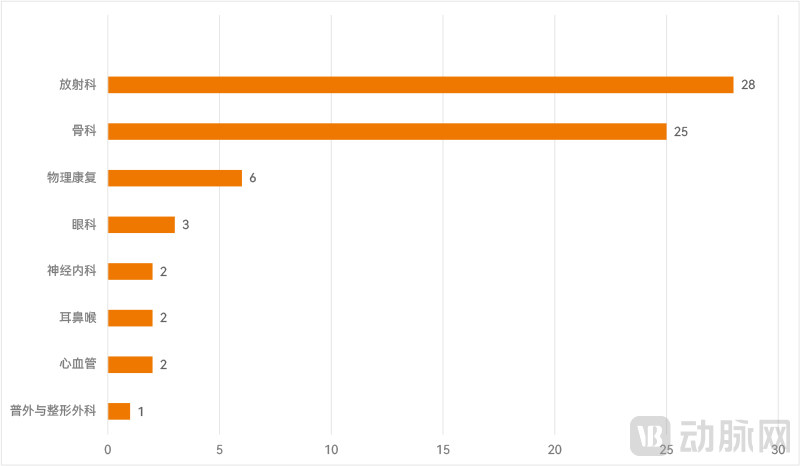
FDA-Approved VR/AR Medical Devices by Application (Chart by VCBeat)
In contrast, China started relatively late in this field. According to statistics compiled by the High-End Medical Device Institute’s Data Center based on disclosed data regarding the structural composition of approved medical devices, it was not until 2018 that an imported VR medical device obtained a medical device registration certificate in China (which has since expired). Domestically produced VR/AR medical devices emerged even later, with the first corresponding products gaining approval only in 2020. In the subsequent years, only a handful of such products were approved annually—Prior to 2023, the total number of VR/AR medical devices approved in China had not reached double digits.。
However, the situation has changed significantly since 2023. In June of that year, Apple released its first mixed reality product, the Apple Vision Pro, causing a sensation. At the end of August, five Chinese government departments jointly issued the "Three-Year Action Plan for the Innovative Development of the Metaverse Industry (2023–2025)," which mentioned "actively and steadily promoting clinical research on technologies such as digital twins, and supporting metaverse companies to strengthen R&D collaboration with medical institutions."
As a result, the number of VR/AR medical devices approved in China that year exceeded single digits for the first time, reaching 10.
In 2024, this trend continued to intensify, with 14 VR/AR medical devices approved throughout the year, representing a further increase of up to 40% compared to 2023. This has brought the total number of approved domestically produced VR/AR medical devices to 32, significantly narrowing the gap with the FDA in terms of approval numbers compared to previous years.。
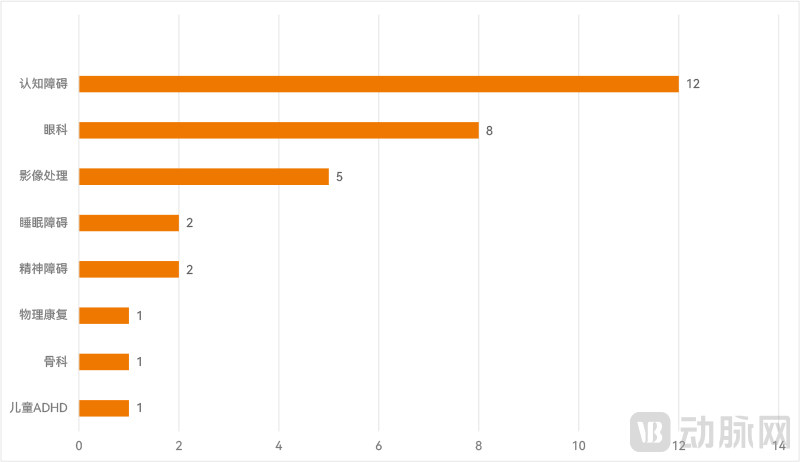
Domestically Approved VR/AR Medical Devices by Application Direction (Chart by VCBeat)
Among these,Cognitive disorders and ophthalmology are the most heavily represented fields, with 12 and 8 products, respectively. Image processing ranks third, with five products. These three application areas account for the vast majority of currently approved products.. In addition, corresponding products have been approved for sleep disorders, psychiatric disorders, physical rehabilitation, pediatric ADHD, and orthopedics.
Feedback from VCBeat’s interactions with the industry also reveals that regulatory authorities have gradually increased their recognition and enthusiasm for VR/AR technologies in recent years. Qin Lu, CEO and founder of Fanju Technology, stated that local drug administration departments have paid close attention to the approval of its VR/AR medical devices: “We are quite well-known at the local approval center, where review experts engage with us frequently and provide substantial assistance. Regulatory authorities offered numerous recommendations starting from the initial design phase and encouraged us to meet high standards and stringent requirements for evidentiary support, hoping our case could serve as a benchmark for local reviews and pave the way for future approvals of VR/AR medical devices.”
Beyond mere quantity,In 2024, China approved its first Class III medical device certificate, along with several innovative medical devices, achieving breakthroughs in clinical application exploration.。
On April 17, 2024, Linyan Medical (Shanghai Linyan Medical Technology Co., Ltd.) successfully obtained the Class III medical device registration certificate for its “Spinal Surgery Navigation System” (Holonavi S), making it the first spinal surgery navigation system in China to utilize AR technology.
The field of surgery has long been regarded as an ideal application scenario for VR/AR in healthcare. This is because traditional surgical reference based on two-dimensional images suffers from critical limitations, including poor clarity, inaccuracy, and incomplete visibility. Endoscopic images rely on surface imaging, resulting in a narrow field of view and lack of subcutaneous information; ultrasound images are based on cross-sectional echo imaging, which is prone to significant noise interference and lacks three-dimensional information; X-ray images rely on perspective projection imaging, where overlapping structures from multiple tissues obscure details and three-dimensional information is absent, among other issues.
VR/AR largely addresses these pain points. Taking Linyan Medical’s Holonavi S as an example, its most distinguishing feature compared to traditional surgical navigation robots is the use of augmented reality technology to enable first-person perspective interaction between virtual and real elements for surgeons. This significantly shortens the learning curve for spinal surgery, while its proprietary intraoperative registration technology reduces overall usage costs and enhances surgical precision and efficiency.
With the assistance of Holonavi S, surgeons can achieve visualized and quantitative assessments during preoperative planning, intraoperative treatment, and postoperative verification. Its use in surgery also helps both physicians and patients avoid significant exposure to intraoperative imaging radiation. These advantages enable surgeons to better control surgical risks, reduce wound area and exposure time for patients, and help shorten the physiological recovery period.
“Keenly perceptive” imaging AI companies have also recognized the immense potential of VR/AR in medical surgical navigation and are proactively increasing their investments in this cutting-edge field.
Infervision collaborated with the team of Academician Wang Jun from the Department of Thoracic Surgery at Peking University People’s Hospital to complete the first thoracoscopic radical resection for lung cancer assisted by Apple Vision Pro in 2024. This marks the first application of artificial intelligence and Apple Vision Pro in the field of thoracoscopic surgery in China, demonstrating its significant supportive role during surgical procedures.
SenseTime Medical is also exploring the application of AR technology in 3D surgical planning simulation to achieve precise, patient-specific 3D surgical planning.
Compared with AR, VR’s unique advantages in creating immersive and controllable environments are continuously expanding its scope of application, enabling it to play a role in the treatment of an increasing number of diseases.
In May 2024, Fanju Technology (Zhejiang Fanju Technology Co., Ltd.) received approval for its VR-based virtual reality rehabilitation training software designed for children with Attention Deficit Hyperactivity Disorder (ADHD). The product had entered Zhejiang Province’s special approval pathway for Class II innovative medical devices in June 2022. After more than a year of rigorous clinical trials and several months of administrative review, the approval was granted over a period of nearly two years.
This product integrates VR technology with neuroscience, creatively proposing the theories of “integrated assessment and training for situational neurofeedback based on active tasks” and “integrated assessment and training for situational cognitive-behavioral therapy based on active tasks.” It creates a comprehensive immersive therapeutic environment for children with ADHD, pioneering a novel intervention model.
According to data from the High-End Medical Device Institute’s Data Center, Mind Island Technology (Shandong Mind Island Artificial Intelligence Technology Co., Ltd.)’s “Mental Disorder Auxiliary Assessment Software (Based on Virtual Reality Technology)” also entered the local special approval process for Class II innovative medical devices in 2021 and was ultimately approved.
These are also the only two innovative medical devices currently utilizing VR/AR technology.
VR/AR is, by nature, a technology that primarily interacts with the eyes; therefore, it has long held a place in the field of ophthalmology. In 2024, VR/AR achieved another breakthrough in ophthalmic treatment.
As early as 2020, China approved VR medical devices for visual function training. In the rehabilitation training for amblyopia and strabismus, such technologies primarily improve treatment compliance in pediatric patients by providing novel immersive environments and gamified therapeutic approaches. In the field of myopia management, VR accommodative training combined with digital DOT technology and VR visual function training can reduce accommodative lag, while digital defocus technology based on ray tracing reduces contrast in the peripheral retinal field, thereby slowing axial elongation.
However, VR headsets still have certain limitations in terms of wearing comfort and application scenarios. In recent years, far-view screens based on AR freeform surface technology have emerged to address these issues. These devices allow children to view large-screen images that appear several meters away while maintaining a close physical distance to the display, effectively shifting visual focus from “near” to “far.” This helps relax the ciliary muscles, thereby slowing the onset and progression of myopia caused by prolonged near-work activities. Furthermore, such solutions effectively mitigate vision strain associated with close-range tasks, including online classes and reading or writing on paper.
Furthermore, as early as 2020, Deepwise Medical led a consortium of multiple top-tier domestic research and clinical institutions in jointly applying for the National Key R&D Program’s special project on “Proactive Health and Technological Responses to Aging,” specifically the project titled “Research and Development of Intelligent, All-Weather, Multi-Scenario Vision Impairment Training and Visual Enhancement Technologies and Products.” The project was successfully accepted in 2024 and has yielded numerous outcomes.
Among these, the multi-sensory guide dog assistance and AR visual aid devices, designed and developed to address the differentiated impairment characteristics of visually impaired individuals, have filled a market gap in China for intelligent wearable assistive devices. Meanwhile, the project has also designed and developed a VR amblyopia training system for patients with lazy eye. All these products have completed clinical effectiveness evaluations and third-party safety testing.
VCBeat conducted an incomplete statistical analysis of publicly available data from the Chinese Clinical Trial Registry, revealing a substantial increase in the number of clinical trials involving VR/AR in recent years.The number of virtual reality-related clinical trials in 2022 nearly doubled compared to 2021; this figure rose further in 2023 and 2024, reaching 43 cases in each year. Clinical trials involving augmented reality also saw a significant increase starting in 2023, with a more than fourfold rise from the previous year.。
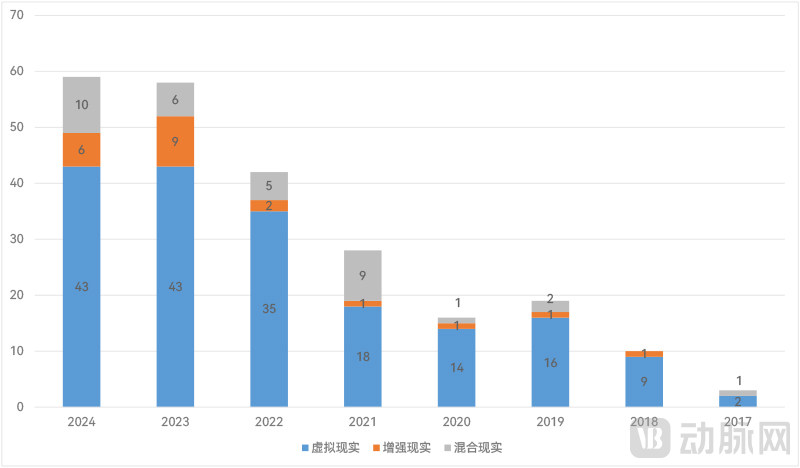
Classification of Domestic VR/AR Clinical Trial Applications by Technology and Year (Chart by VCBeat)
The results of these application explorations and clinical trials will gradually materialize in the future, with more breakthroughs on the horizon.
Admittedly, China’s VR/AR + healthcare sector has made considerable progress in recent years. However, through in-depth exchanges with industry stakeholders, we have identified several pressing issues that must be addressed to facilitate further development of VR/AR + healthcare.
First, as an emerging digital technology, VR/AR still has significant room for improvement in market education.。
Liu Yang, founder and chairman of Lin Yan Medical, stated that even if we look beyond medical scenarios to the broader VR/AR landscape, the number of people who are aware of or have experienced this technology remains small, let alone those familiar with its applications in the medical field.
“This is a matter of market education. VR/AR has certain hardware requirements and cannot be experienced anytime, anywhere. Many experts have not had the opportunity to experience VR/AR, so they tend to harbor some skepticism toward this unfamiliar new technology. However, many young clinicians are highly open to adopting and trying out new technologies; having likely encountered VR/AR in their daily lives, they exhibit a higher level of acceptance. This situation is similar to our previous experiences offering VR/AR demonstrations to physicians abroad, where acceptance rates were roughly split 50-50.”
Qin Lu also resonates deeply with this sentiment: “Public awareness in this area remains limited. Whenever I meet new people and explain that virtual reality is a form of digital therapeutics capable of treating diseases, modulating the nervous system, and obtaining medical device certification, their astonishment is evident. Many become highly interested and ask for further details. To some extent, this underscores the current lack of public understanding.”
However, as more similar products continue to be launched and iterated, this issue is expected to improve significantly over time.
Secondly, there is currently a lack of unified evaluation standards for VR/AR medical devices.。
In an interview with VCBeat, Liu Yang noted that people’s understanding of new technologies varies, leading to misconceptions: “Some have never experienced the relevant technology and struggle to grasp how AR actually works. Others have only tried VR and assume AR shares certain characteristics with it, such as motion sickness. Still others are overly optimistic about new technologies, making demands that defy the natural progression of technological development in their desire for immediate, comprehensive solutions. All these factors make it more difficult to reach consensus, creating a significant gap in product testing and regulatory registration.”
“When reviewing new technologies in the future, it may be beneficial to provide more opportunities to younger professionals who possess greater familiarity with and enthusiasm for these innovations, thereby encouraging innovation,” he added.
Due to the lack of unified evaluation criteria, disparities between regions may be even greater.。
Qin Lu commented that the VR/AR healthcare sector is currently in its early stages of development, with significant disparities in quality and standards: “Zhejiang Province may enforce relatively strict requirements. Due to the lack of unified standards, regulatory requirements in some regions may be comparatively lenient, and clinical trial requirements vary substantially. If product efficacy and quality cannot be guaranteed, a poor reputation among physicians and patients during this nascent stage could lead to a ‘bad money drives out good’ scenario, which would be detrimental to the industry’s subsequent development.”
“Accordingly, the requirements for innovative medical devices are relatively stringent. Taking adverse event reporting as an example, conventional medical devices are only required to report serious adverse events that may result in severe injury or death. In contrast, innovative medical devices are subject to much more frequent reporting obligations: not only must all adverse events, regardless of severity, be reported, but a semi-annual summary report on the monitoring, analysis, and evaluation of product adverse events must also be submitted to the national monitoring agency. Furthermore, while expert review meetings are not mandatory for all medical devices, they are a requisite step for innovative medical devices,” she added.
On January 3, the General Office of the State Council issued the “Opinions on Comprehensively Deepening the Reform of Drug and Medical Device Supervision to Promote High-Quality Development of the Pharmaceutical Industry,” proposing improvements to the review and approval mechanism, full support for major innovations, and explicitly calling for the coordinated use of national and provincial drug regulatory resources. The Opinions emphasize allocating more review and approval resources toward innovative drugs and medical devices to further enhance the efficiency of the review and approval process.
For VR/AR medical devices with significant innovative value, this is clearly a positive development.
Finally, the implementation of VR/AR in healthcare faces significant challenges regarding reimbursement.。
Qin Lu stated that although his product, as an innovative medical device, has overcome numerous obstacles and gained regulatory approval by meeting rigorous standards for efficacy and safety, it faces significant challenges in being included in the price catalog.
“In my view, there is still room for optimization in the current price declaration system. For our products to be adopted by hospitals, they must first be included in the local medical service price catalog. However, the review process for adding new items to this catalog occurs only once a year, with submissions limited to qualified hospitals and subject to strict quotas. Priority is given to products that meet the criterion of ‘widespread use,’ which brings us back to the initial challenge of hospital adoption, creating significant barriers. I understand the regulatory authorities’ rigorous approach to healthcare, but innovation is not easy. Innovative medical devices, developed at substantial cost and having passed safety and efficacy reviews, are unable to rapidly access the ‘hospital’ channel to generate revenue. This creates a paradox where greater innovation leads to greater difficulties, inevitably constraining future investment. This may not be conducive to sustained innovation in the healthcare sector,” she explained to VCBeat.
Of course, this is not a problem unique to VR/AR. In fact, the vast majority of digital health technologies, including AI, face payment bottlenecks.
Relevant institutions are also striving to improve the payment environment. Not long ago, the National Healthcare Security Administration successively issued the “Guidelines for Project Initiation of Rehabilitation Medical Service Price Items (Trial)” and the “Guidelines for Project Initiation of Radiological Examination Medical Service Price Items (Trial),” which for the first time included artificial intelligence assistance as an extended item. This direction has also brought new hope to digital health enterprises, stimulating their enthusiasm for continuous research and development.
VR/AR + healthcare, still in its early stages of development, faces numerous challenges. It is important to recognize clearly that these challenges cannot be resolved overnight. Liu Yang believesThe most important thing is to create a relatively relaxed environment that encourages innovation.“The healthcare industry is indeed unique. From a risk perspective, it is a highly conservative sector that is inherently resistant to innovation; yet it undeniably requires continuous innovation to drive medical progress. Striking the right balance is certainly challenging. However, I believe that, under the premise of ensuring efficacy and safety, we could adopt slightly more flexible requirements for genuinely innovative products, allowing these technologies to be introduced into clinical practice first for initial adaptation and refinement.”
Qin Lu, however, believes thatEstablishing unified standards and guidelines at the earliest opportunity may well be a prudent course of action.She stated that guidance is essential for companies in the VR/AR sector: “I had to feel my way across the river by groping for stepping stones, learning step by step—a deeply felt experience. If I could travel back in time a few years to offer guidance to my former self, I would have avoided many detours, and the pace of product R&D would have been significantly faster. Many digital health companies initially lean more heavily toward digital technologies while having limited understanding of healthcare; thus, they are in particular need of guidance from standards and guidelines.”
Compared to the past, the progress of VR/AR in the last year or two has been encouraging, gradually moving toward the expectations people originally had for it. By cross-integrating VR/AR with artificial intelligence to combine data-driven analysis with immersive medical diagnostics, the future of VR/AR in the healthcare sector looks promising.
Practitioners have also been greatly encouraged by this progress. Liu Yang expressed his aspirations as follows: “With the development of artificial intelligence, VR/AR is undoubtedly poised to become an extremely critical technology in the future. China must not fall behind; instead, it should continue to increase investment and foster innovative applications. As one of the early entrepreneurs to enter the VR/AR sector in China, I am not only hopeful but also confident that we can elevate this field, catching up with or even surpassing Europe and the United States.”
VCBeat will continue to closely monitor developments in these fields. We welcome industry professionals to contact us and share their insights, so that we can jointly advance digital health technologies for the betterment of healthcare.