MicroTao Bio's In Vivo CAR-T Candidate GT801 Shows 100% ORR and 75% CR in Relapsed/Refractory B-NHL Patients at ASCO 2026

Vivacta Biotechnology
Cell Therapy Research Firm

Grit Biotherapeutics
Developer of Immunotherapy Drugs for Solid Tumors
Recently, IVACTA Biotechnology (Shanghai) Co., Ltd. (“IVACTA”), a spin-off of Beijing Gravel Biotherapeutics Co., Ltd. (“Gravel Bio”) focused on the in vivo CAR-T platform, presented poster data from its first-in-human study at the 2026 American Society of Clinical Oncology (ASCO) Annual Meeting. The study evaluated GT801, IVACTA’s core product, in patients with relapsed/refractory B-cell hematologic malignancies. GT801 utilizes lipid nanoparticle (LNP) delivery technology targeting T cells to achieve in vivo T-cell transfection, thereby generating CD19-directed CAR-T cells within the patient’s body without requiring ex vivo cell manufacturing or lymphodepleting preconditioning.
As of May 15, 2026, a total of four patients with relapsed/refractory B-cell non-Hodgkin lymphoma (B-NHL) received GT801 treatment, including one patient with marginal zone lymphoma (MZL), one with diffuse large B-cell lymphoma (DLBCL), and two with follicular lymphoma (FL). The patients had previously received a median of 2.5 lines of therapy.
Efficacy Results
Preliminary efficacy data showed that the objective response rate (ORR) was 100% in four patients, three of whom ultimately achieved complete response (CR). All patients achieved partial response (PR) at the initial efficacy assessment, with subsequent deepening of response: Pt.03 and Pt.04 achieved CR at month 4, and Pt.01 achieved CR at month 6. As of the data cutoff date, all three patients remained in continuous CR.
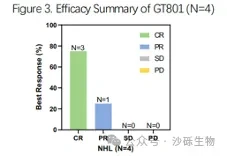
(ASCO 2026 - GT801)
Meanwhile, GT801 demonstrated rapid and efficient in vivo CAR-T cell generation. Studies showed that CAR-T cells were detectable in peripheral blood as early as 4 hours post-administration, reaching peak transduction on Day 1, with the peak proportion of CAR+ T cells in peripheral blood exceeding 90%. High-level expression was sustained following repeated dosing. Furthermore, CAR expression in monocytes was observed to be less than 3%, indicating excellent target specificity.
Pharmacokinetics
GT801 demonstrates potent peripheral blood B-cell depletion at ultra-low doses (0.01–0.03 mg/kg); all subjects underwent bone marrow or lymph node biopsy, and profound B-cell depletion was observed in the corresponding biopsy tissues from each patient.Meanwhile, CAR-T cells were detected in bone marrow samples collected on Day 22 after the first dose (Days 5–7 after the third dose) in multiple patients, indicating that GT801-induced CAR-T cells exhibit favorable tissue infiltration capability and excellent in vivo persistence.
Safety Results
GT801 demonstrated good tolerability.No infusion-related reactions were observed with GT801, and cytokine release syndrome (CRS) was controllable at Grade 0–1 with premedication.The vast majority of treatment-emergent adverse events (TEAEs) were Grade 1–2. All Grade 3 or higher adverse events were reversible hematologic toxicities, including lymphopenia, leukopenia, and neutropenia, which all returned to normal after symptomatic treatment. No dose-limiting toxicities (DLTs), neurotoxicity, or organ failure events were observed during the study.
Based on the safety and efficacy profile of GT801 demonstrated in this study, IVACTA Biotechnology will further expand the exploration of GT801 across multiple indications in autoimmune diseases, with additional data from these indications expected to be released in the future.
About GT801
GT801 is an innovative anti-CD19 in vivo CAR product based on T cell-targeted LNP technology. Leveraging Tianze Yuntai’s ionizable cationic lipid and CLAMP technology platform, GT801 employs a unique T cell-targeting VHH antibody with site-specific, quantitative conjugation to LNPs. This design enhances targeting efficiency while avoiding non-specific uptake, thereby achieving highly efficient in vivo CAR expression. GT801 generates potent and durable CAR-T cells in patients, supports repeated dosing, and offers a low-cost, highly efficacious, and user-friendly clinical solution, with the potential to overcome the commercialization bottlenecks of ex vivo cell therapies associated with high costs and lengthy manufacturing cycles.
About IVACTA Biotechnology

IVACTA Biotechnology is a biotech company focused on innovating in vivo CAR-T cell therapies, dedicated to
Providing disruptive therapeutic solutions for patients with cancer and autoimmune diseases. The company was established on June 25, 2025, as a spin-off from the in vivo CAR-T platform of Beijing Shali Biopharmaceutical Co., Ltd.
IVACTA Biotechnology’s in vivo CAR-T therapy, developed based on a targeted LNP delivery system, is dedicated to providing innovative treatments for hematologic malignancies and autoimmune diseases. This approach enables direct CAR expression within patients’ T cells, eliminating the need for cell separation, expansion, and lymphodepletion preconditioning associated with traditional autologous CAR-T therapies. By fundamentally addressing the three core challenges of autologous CAR-T therapy—high cost, prolonged timelines, and significant toxicity—it promises to substantially shorten the treatment cycle, facilitate the evolution of cell therapy into off-the-shelf pharmaceuticals, and greatly enhance patient accessibility. Its flagship product, GT801, a next-generation in vivo CAR-T therapy, has demonstrated significant therapeutic potential for hematologic malignancies and autoimmune diseases in early-stage clinical studies.