SoonHeal Medical's Innovative Bioadhesive Platform Targets Comprehensive Surgical Trauma Solutions
With the increasing number of surgical procedures, heightened healthcare awareness, and advancements in tissue engineering and regenerative medicine, the prospects for bioadhesives are becoming increasingly promising.
Compared with traditional wound repair methods such as hemostatic patches, sutures, surgical zippers, and staplers, bioadhesives offer superior ease of use and wound closure efficacy, along with biodegradability. They have demonstrated significant clinical value in various fields, including visceral sealing and orthopedic fixation, holding promise for providing novel solutions to persistent clinical challenges in trauma repair.
Guangzhou Xunhe Medical Technology Co., Ltd. (hereinafter referred to as “Xunhe Medical”) is an emerging player in this sector. Established in Guangzhou in 2021, the company’s name is derived from the words “rapid” and “healing,” encapsulating the two most fundamental needs in the field of wound repair. With this as its starting point, Xunhe MedicalPursuing a path of independent innovation, we have pioneered the development of novel bioadhesive materials, dedicated to providing comprehensive solutions for major surgical trauma.。
1More than 50% of the team members hold PhDs, addressing the challenge of achieving both biocompatibility and adhesive strength in bioadhesives.
Xunhe Medical leverages the National Engineering Research Center for Functional Reconstruction of Human Tissues, the Medical Device Testing Center of South China University of Technology, and the Guangdong Institute of New Biomaterials and High-End Medical Devices. With robust support from advanced software and hardware resources in R&D, it removes barriers to the commercialization of innovative products and accelerates the product development and manufacturing process.
Furthermore, the National Engineering Research Center for Functional Reconstruction of Human Tissues has established an industry-academia-research alliance comprising more than 30 Grade A tertiary hospitals. This enables Xunhe Medical to maintain close communication with clinicians throughout the entire process, from front-end product design to back-end clinical trials, thereby accurately identifying clinical pain points and enhancing both the clinical benefits of its products and the likelihood of regulatory approval.
Xunhe Medical Co., Ltd.
Xunhe Medical’s core founding team hails from South China University of Technology, comprising professors and doctoral supervisors at the university, as well as holders of Ph.D. degrees in Materials Science and Biomedical Engineering. Over 50% of the team members hold doctoral degrees, and the team possesses comprehensive resources spanning the entire chain of medical device R&D, testing and inspection, product registration, and clinical applications. With outstanding capabilities in research and development and technology transfer, the team is well-positioned to facilitate the rapid commercialization of scientific achievements. Currently, the team’s research findings on bioadhesives have been published in top-tier SCI journals in the materials science field, including Nature Biomedical Engineering, Nature Communications, and Advanced Materials.
Xunhe Medical Co-Founder/General Manager Xuan ChengkaiXuan Chengkai holds a Ph.D. in Materials Science from South China University of Technology and is a Senior Engineer, with eight years of experience in the research and translation of bioadhesive materials. Discussing the rationale behind founding Xunhe Medical, Mr. Xuan stated that, in addition to the team’s extensive expertise in tissue trauma repair, the venture was driven by a strong desire to address unmet medical needs and alleviate clinical pain points in this field.
According to Xuan Chengkai, currently available bioadhesive products on the market are primarily categorized into two types based on their physical properties: jelly-like and plastic-like. Jelly-like materials, represented by fibrin sealants and polyethylene glycol (PEG) adhesives, consist of 80%–90% water. They exhibit good biocompatibility and significant hemostatic efficacy, but suffer from poor mechanical strength and suboptimal sealing/fixation performance. Plastic-like materials, represented by α-cyanoacrylate (medical-grade “super glue”), are anhydrous. They offer high bonding strength, rapid curing, and excellent sealing properties; however, their degradation products include formaldehyde, they generate considerable heat during polymerization, and they have inferior biocompatibility. Additionally, their high brittleness limits their approved use to superficial wounds.
In addition, some novel biological adhesives utilize animal-derived extracts, which pose a risk of viral transmission and make safety difficult to guarantee; light-cured adhesives rely on irradiation with specific wavelengths of light, limiting their applicability in certain minimally invasive surgical scenarios.
Overall, existing bioadhesive products exhibit a polarized landscape, failing to achieve both biocompatibility and adhesive strength simultaneously. Recognizing this critical pain point,Xunhe Medical has developed a biodegradable bioadhesive with excellent biocompatibility (safety) and high adhesive strength (efficacy)—a medical-grade, biodegradable polyurethane adhesive.
In terms of material selection, modifying existing materials offers limited improvement in product performance and fails to address the root cause of the problem. Conversely, adopting novel materials such as polypeptides and dopamine presents challenges due to unclear toxicity and toxicological profiles. Therefore, Xunhe Medical chose to screen materials from the "Medical Device Classification Catalog" to develop a bioadhesive. Ultimately, the team focused on polyurethane. On one hand, polyurethane has already been used in medical devices such as wound dressings, catheters, and stents, with its safety clinically validated. On the other hand, as a common industrial adhesive, it exhibits excellent bonding properties. More importantly, polyurethane possesses favorable mechanical properties and tunability, laying a solid foundation for performance enhancement and expansion of its indications.
2Master the complete synthesis processes from small-molecule chemical reagents to polymeric adhesives, enabling precise control over material hydrophilicity/hydrophobicity, mechanical properties, and degradation rates.
The Xunhe Medical team has accumulated years of research expertise in the field of tissue repair materials, with a long-term focus on the research, development, and translational application of implant-grade materials. Throughout this process, the team has placed significant emphasis on two key aspects:
1. Compatibility between materials and target tissues“This aspect was deeply inspired by Academician Wang Yingjun’s concept of ‘biological adaptability.’ Repair materials must not only match tissues in microstructure but also adapt to them in mechanical properties. Furthermore, the degradation rate of the materials must align with the pace of tissue repair,” explained Xuan Chengkai.
Second, the degradation products are non-toxic and non-irritating.. Currently, Xunhe Medical has achieved precise design of material degradation products, with the degradation byproducts of its bioadhesive being non-toxic and non-irritating substances such as amino acids and CO2. “To achieve this, we indeed incurred significant costs, conducting extensive structural design and optimization during the early-stage material development,” introduced Xuan Chengkai.
Furthermore, processing the designed chemical molecular structures into high-purity adhesive products also presents a significant challenge. Currently,Xunhe Medical has achieved independent synthesis and processing of biodegradable polyurethane adhesives, with 100% domestically produced raw materials and equipment, thereby avoiding the risk of supply chain bottlenecks., which is also a major advantage of Xunhe Medical. “Many companies in the market produce implant-grade medical materials through toll manufacturing. While this approach is indeed faster from a commercialization perspective, it involves controlled raw materials and low technical barriers, making it susceptible to imitation and substitution. In contrast, Xunhe Medical has achieved independent innovation at the raw material stage,” added Xuan Chengkai.
Xunhe Healthcare conducts molecular structure design, chemical synthesis, and purification from the source. The entire manufacturing process, comprising dozens of steps, is independently completed in-house, thereby establishing a unique technological barrier. Furthermore,The company is capable of reverse-engineering the molecular structure of adhesives based on their degradation end products, and has mastered the complete synthesis process ranging from small-molecule chemical reagents to polymeric adhesives.。
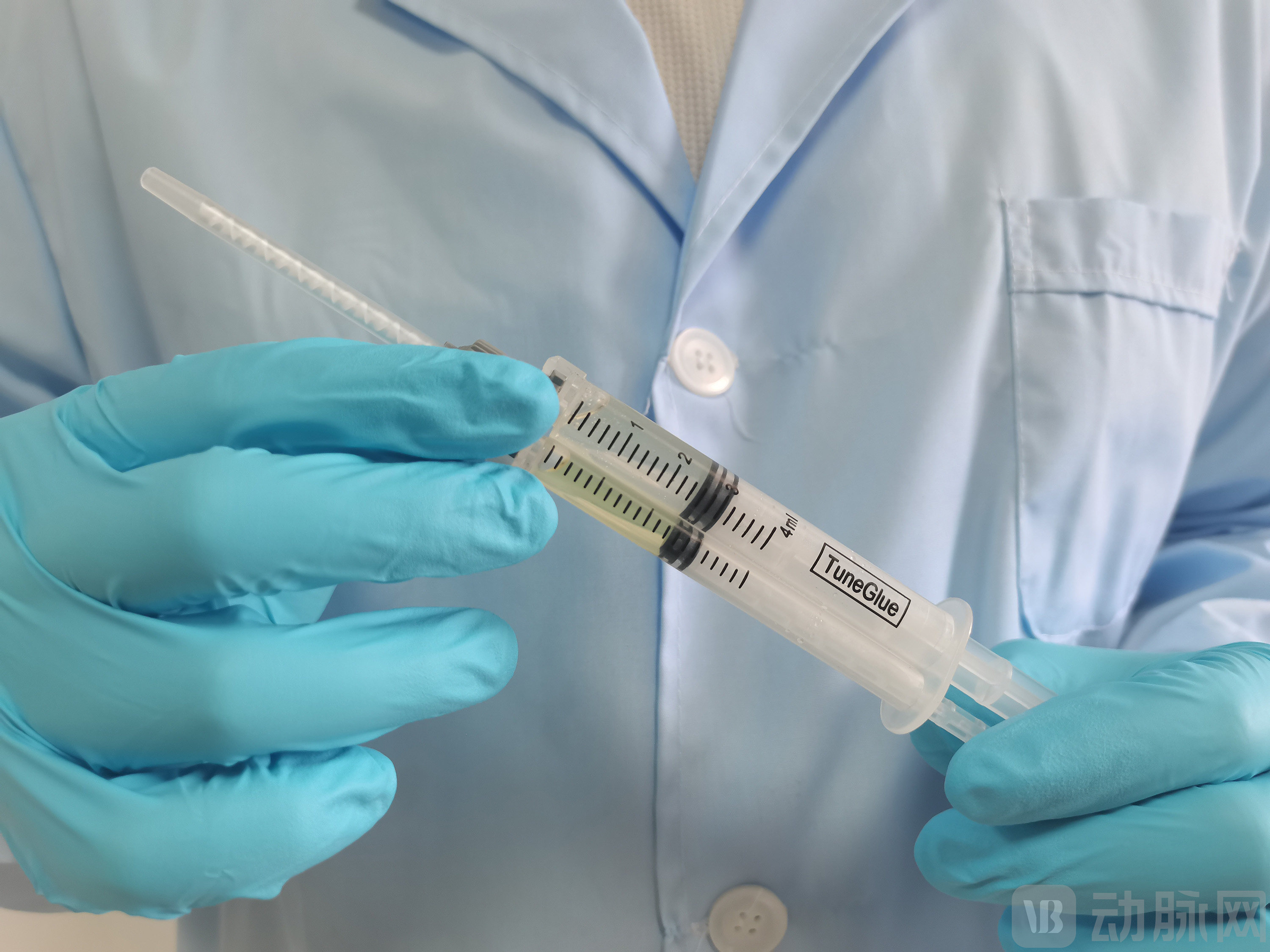
Xunhe Medical Biological Glue Product
Furthermore, with the hardware and software support of the National Engineering Research Center for Functional Reconstruction of Human Tissues, Xunhe Medical’s team of seven to eight master’s and doctoral researchers spent five to six years establishing a comprehensive library of bioadhesive formulation materials. Currently, the library contains five to six types of Component A and three to four types of curing agents. By adjusting the ratios of different types and proportions of prepolymers and curing agents, the hydrophilicity/hydrophobicity, mechanical properties, and degradation rate of the materials can be regulated. This enables compatibility with more than 20 types of soft and hard tissue organs, thereby meeting the differentiated needs of various injured tissues. As a result, Xunhe Medical is able to break through the performance limitations of existing bioadhesive products and expand their clinical indications, which is expected to increase the overall market size for bioadhesives.
3Lung sealant products offer 3–5 times the adhesive strength of existing solutions at just one-tenth the cost.
Xunhe Medical expands its product line with biological adhesives as the core, launching lung sealant as its first flagship product.
According to 2024 statistics from the World Health Organization, lung cancer has become the most frequently diagnosed cancer globally, with 2.5 million new cases. In China, approximately 800,000 patients undergo pulmonary parenchymal resection surgeries annually due to conditions such as pulmonary nodules and lung cancer. Following suturing or anastomosis in these procedures, there remains a certain probability of air leakage leading to pneumothorax, particularly in patients with moderate-to-severe conditions, where the air leakage rate exceeds 50%. This necessitates the use of reinforcement materials at the suture or staple lines, indicating a significant clinical need. However, currently available biological glues for sealing pulmonary air leaks on the market exhibit insufficient strength, resulting in persistent postoperative air leakage rates that may require chest tube drainage for observation or even secondary surgical intervention, thereby imposing substantial psychological and economic burdens on both physicians and patients.
TuneGlue, an adhesive developed by Xunhe Medical, not only exhibits excellent biocompatibility but also delivers 3–5 times greater bonding strength to lung tissue than competing products on the market, significantly improving the success rate of sealing pulmonary air leaks.. Furthermore, TuneGlue is a synthetic material with fully independent proprietary technology, thereforeIts production cost is approximately 10–20% of that of competing products.. Thus, it is expected to improve treatment efficacy while reducing patients' treatment costs.
Currently, TuneGlue® Lung Sealant has completed animal studies, achieving a 100% success rate in sealing pulmonary air leaks. Given the stringent performance requirements and significant technical challenges associated with lung sealant materials, Xunhe Medical plans to leverage this breakthrough as a foundation to systematically expand the application of its bioadhesives to other types of tissue trauma.

Xunhe Medical Cleanroom Facility
With the support of the Guangdong Institute of Novel Biomaterials and High-End Medical Devices, after obtaining regulatory approval for its pulmonary sealant product, the company plans to expand its indications to areas such as arterial hemostasis, gastrointestinal sealing/adhesion prevention, cerebrospinal fluid leak sealing, and visceral hemostasis, thereby gradually perfecting its soft tissue adhesive product pipeline. In the second phase, Xunhe Medical will extend its product line into the orthopedic and cardiovascular fields. Previously, Xunhe Medical has established collaborations with leading enterprises in these sectors, laying a solid foundation for the expansion of commercialization channels following the future market launch of its products.
“Benefiting from robust research and development systems, favorable commercialization environments, sound regulatory mechanisms, and the advancement of biotechnology and the chemical industry, European and American countries have achieved a certain lead in the field of bioadhesives,” introduced Xuan Chengkai. Due to the relatively smaller clinical application and market size of bioadhesives compared to orthopedic consumables and cardiovascular stents, there are fewer domestic enterprises specializing in bioadhesive R&D. Many companies follow the path of imitating Western products without sustaining technological updates and iterations. Furthermore, these imitation-oriented enterprises generally possess weaker R&D capabilities, typically focusing on bioadhesive development for only specific tissues, resulting in limited indications.
andXunhe Medical focuses on the biological adhesive sector, adhering to a path of independent innovation. Centered on its self-developed and proprietary library of biological adhesive formulation materials as a core technological platform, and driven by the needs of general surgery, the company is expanding its product portfolio to achieve broader indication coverage, with the potential to carve out a “large market” within a “niche segment.”We look forward to seeing what new achievements Xunhe Medical will attain in the future.
Guangdong Institute of Novel Biomaterials and High-End Medical Devices
Guangdong Institute of Novel Biomaterials and High-End Medical Devices is a demonstration base for the transformation of achievements from the National Innovation and Cooperation Platform for Biomaterials, jointly established by four national ministries and commissions: the National Medical Products Administration (NMPA), the Ministry of Science and Technology (MOST), the Ministry of Industry and Information Technology (MIIT), and the National Health Commission (NHC). It is a provincial-level public welfare institution dedicated to regulatory science research and committed to promoting the market-oriented transformation of innovative medical device achievements.
Under the leadership of Academician Wang Yingjun of the Chinese Academy of Engineering, the Institute for Advanced Medical Devices aggregates high-end resources with international characteristics across the full translation chain of medical devices, including the National Engineering Technology Research Center, regulatory science research bases and key laboratories under the National Medical Products Administration (NMPA), and the GHWP (Guangzhou) College. It has established a CRMI innovation achievement translation model led by regulatory science and centered on “regulatory innovation, technological R&D, translation services, clinical promotion, data support, and investment-driven growth,” thereby advancing the development of a highland for advanced medical device innovation and achieving self-reliance and controllability in China’s high-end medical device sector.
Currently, Xunhe Medical has needs for connections in investment and financing, distributors, and upstream and downstream supply chains. If you are interested in Xunhe Technology's medical technologies and solutions, please contact us: