

China's First Digital Therapeutics Company, BrainAurora, Rings the Bell on HKEX

BrainAurora
Cognitive Rehabilitation Cloud Platform Provider
Today, Zhejiang BrainAurora Medical Technology Co., Ltd. (hereinafter referred to as “BrainAurora”) was officially listed on the Hong Kong Stock Exchange, with the stock code 06681. After more than a year of listing preparations,BrainAurora Finally Becomes China’s “First Digital Therapeutics Stock”, also bringing good news to China’s digital therapeutics industry at the start of the new year.
In this IPO, BrainAurora issued 181,112,000 shares in the Hong Kong market at HK$3.22 per share, with total proceeds expected to reach HK$583 million. Additionally, it will offer 163 million shares in the international placement and has granted a 15% over-allotment option.
On January 7, the stock closed at HK$3.21 in after-hours trading, down 0.31% from the offer price of HK$3.22.
BrainAurora is the owner of the well-known brand “66 Brain” and began product research and development after its establishment in 2012,As early as September 2018, BrainAurora’s “Brain Function Information Management Platform Software System” obtained the Class II Medical Device Registration Certificate from the NMPA, making it one of the first digital therapeutics to receive certification in China. Currently, this product has achieved commercialization.
In 2020, this digital therapeutic product significantly expanded its indications, enabling the solution—which integrates clinical expertise in brain science with deep neural network algorithms—to provide diagnosis, treatment, and outcome management for patients with cognitive, speech, and neuropsychiatric impairments resulting from brain disorders, including vascular cognitive impairment, Alzheimer’s disease, aphasia, depression, schizophrenia, sleep disorders, attention-deficit/hyperactivity disorder (ADHD), and autism spectrum disorder.
As the core product of BrainAurora, the Brain Function Information Management Platform software system primarily comprises virtual human technology and a psychometric scale library for initial assessment, a training task library based on psychological paradigms, and a Deep Neural Network (DNN)-based recommendation algorithm, thereby enabling the adjustment of training protocols according to patients’ cognitive deficits and treatment progress.
Patients with symptoms of cognitive impairment should consult a physician before initiating use of the system, and the physician may decide to employ the system for cognitive assessment. Subsequently, with the assistance of the system, the physician will identify the specific type of cognitive dysfunction and direct the system to assign relevant cognitive training tasks.
The daily training performance evaluation of the patient is fed back into the DNN model to determine the next day’s training tasks. After a period of cognitive training, the patient undergoes follow-up cognitive assessments to evaluate whether impaired cognitive functions have improved. The resulting feedback is used to readjust the training tasks, thereby further enhancing the effectiveness of cognitive training.
Virtual human technology and AI technology are the core underlying technologies of this product.
Traditionally, screening for cognitive impairment requires healthcare professionals to administer neuropsychological scale assessments to patients. This process presents several challenges. First, the scales comprise hundreds of questions and typically take more than 30 minutes to complete; consequently, few patients are willing to fill them out during the screening phase. This also places high demands on professionals, thereby prolonging the training period. Second, the scales require a certain level of education from the subjects; if their educational attainment is insufficient, difficulty in understanding the questions can compromise the objectivity of the assessment.
Virtual human technology overcomes several limitations of neuropsychological scale assessments through techniques such as natural language processing and image processing, thereby accurately determining responses to patient-inputted information. In terms of assessment efficiency, virtual human technology enables simultaneous communication and medical evaluation with a large number of patients, significantly improving assessment efficiency. This allows healthcare professionals to assess multiple patients at once, thereby markedly enhancing the efficiency of the evaluation process.
In terms of therapeutic efficacy, the AI deep neural network algorithm used for task recommendation can analyze patients' response times and accuracy during use. It flexibly adjusts training protocols and difficulty levels from millions of combinations formed by over 300 training modules, enabling highly customized and adaptive training courses for each patient. This approach also enhances the enjoyment of training, thereby improving patient compliance. According to preclinical study results, patients who completed AI-enabled adaptive training courses demonstrated a more than 60% greater improvement in cognitive function compared to those who completed non-adaptive training courses without AI enablement.
In addition to this core product,Between 2022 and 2023, BrainAurora successively obtained approvals for its Basic Cognitive Ability Test Software, Cognitive Function Auxiliary Screening and Assessment Software, and Dyslexia Auxiliary Screening Management Software. According to the prospectus, these three products are currently undergoing commercialization, with full-scale commercial launch expected in the second half of 2025. Its software for treating cognitive impairments also received EU CE certification in 2022 and is planned for commercial release in 2026.。
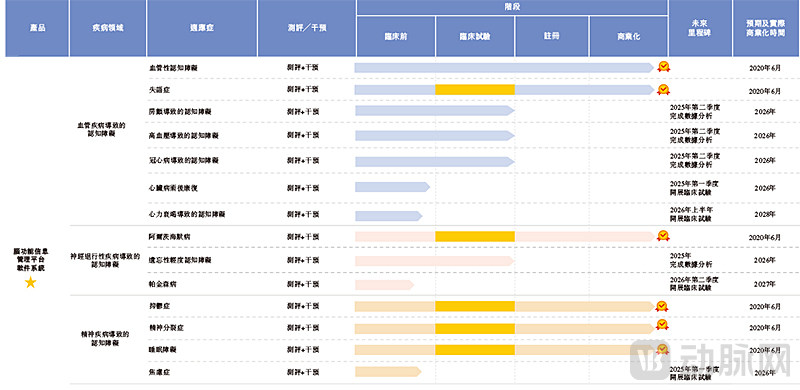
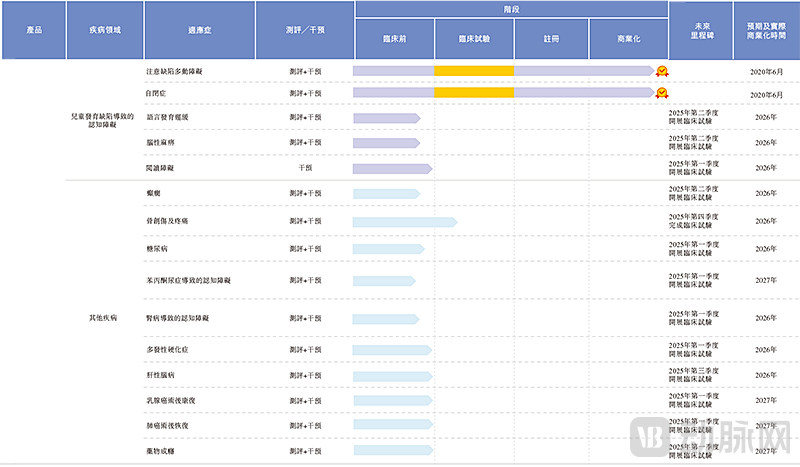
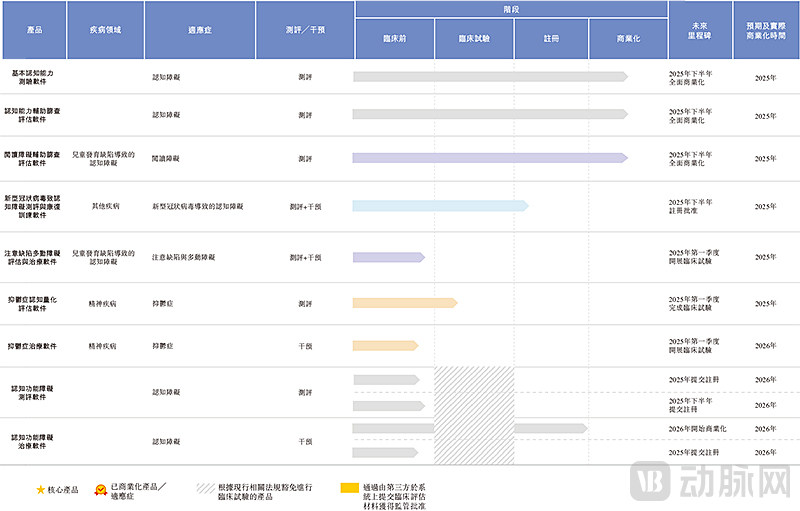
BrainAurora’s Product Pipeline (Screenshot from the Prospectus)
With multiple pipelines currently under development, BrainAurora has established a digital therapeutic product portfolio for cognitive impairment that is second to none in China.
BrainAurora has completed seven rounds of financing since its inception, with cumulative funding reaching approximately RMB 532 million.
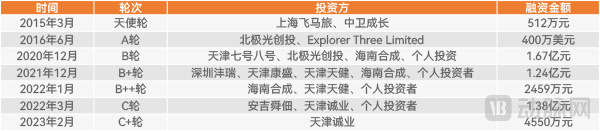
BrainAurora’s Financing History (Chart by VCBeat based on prospectus)
Since then, BrainAurora has been preparing for its initial public offering (IPO), submitting its prospectus three times in August 2023, March 2024, and October 2024, respectively, and passing the Hong Kong Stock Exchange listing hearing on August 22, 2024.
Compared with the initial draft of the prospectus, the final version has updated the market size forecasts for digital therapeutics for cognitive impairment based on actual market conditions—while most forecast indicators were revised downward, a few were increased.
According to Frost & Sullivan, the market size of digital therapeutics for cognitive impairment in China reached RMB 268.6 million in 2023, is projected to increase to RMB 1.0467 billion in 2025, and will reach RMB 8.9274 billion by 2030. The compound annual growth rate (CAGR) from 2022 to 2025 was 97.4%, while the CAGR from 2025 to 2030 is expected to reach 53.5%.
In the initial prospectus, the market size for digital therapeutics for cognitive impairment in China was projected to reach RMB 340 million in 2023, RMB 1.9522 billion in 2025, and RMB 9.5682 billion in 2030, with a compound annual growth rate (CAGR) of 135.5% from 2022 to 2025 and 37.4% from 2025 to 2030.
On December 31, 2024, the National Health Commission led the drafting and, in conjunction with 14 other departments, jointly released the “National Action Plan for Addressing Dementia in Older Adults (2024–2030).”, proposing to increase the public’s awareness rate of dementia prevention and treatment knowledge to 80% by 2030, raise the initial cognitive screening rate among individuals receiving health management services for the elderly to 80%, improve the intervention guidance rate for those who test positive in initial cognitive screenings to 80%, and boost the medical consultation rate for individuals with suspected cognitive impairment to 50%.
Prior to this, in 2020, the National Health Commission issued the “Work Plan for Exploring Specialized Services for the Prevention and Treatment of Dementia in the Elderly.” The most critical component of this plan was the “Two 80s” targets—namely, increasing public awareness of dementia prevention and treatment knowledge to 80% and raising the rate of cognitive function screening among elderly individuals in communities (villages) to 80% by 2022.
A comparison of the two policies reveals that the timelines for multiple indicators have been postponed to 2030. Consequently, the downward revision of market size forecasts is reasonable.
Moreover, the competitive landscape of the industry has undergone significant changes over the past year or so. The initial prospectus noted that there were 30 approved digital therapeutic products for cognitive impairment in China at that time; however, in the final version, this figure rapidly surged to 100.
Furthermore, the final prospectus also noted that while digital therapeutics for cognitive impairment are currently classified as Class II medical devices, there is a possibility of stricter future regulation, potentially reclassifying them as Class III medical devices. However, this may not necessarily be detrimental to BrainAurora, which has established a solid foundation in product R&D and secured an early-mover advantage in the market.
The good news is that BrainAurora’s financial performance has improved significantly since the submission of its initial prospectus. According to Frost & Sullivan,In 2023, BrainAurora held a 25% market share in China’s digital therapeutics (DTx) market for cognitive impairment and a 91.6% market share in China’s medical-grade DTx market for cognitive impairment, based on revenue.。
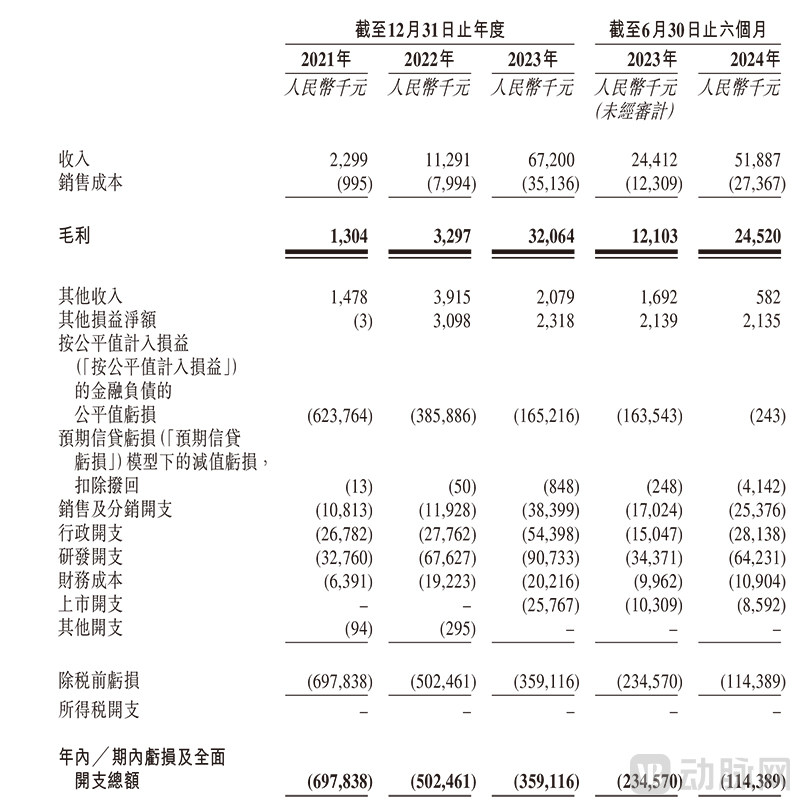
BrainAurora's Revenue Status (Screenshot from the Prospectus)
In 2021 and 2022, its revenue was RMB 2.3 million and RMB 11.29 million, respectively,In 2023, its revenue surged to RMB 67.2 million, representing a nearly sixfold increase compared to 2022. Meanwhile, gross profit saw an even more substantial rise, climbing nearly tenfold from RMB 3.297 million in 2022 to RMB 32.06 million.。
In the first half of 2024, BrainAurora generated revenue of RMB 51.887 million, with a gross profit of RMB 24.52 million. This represents a significant year-on-year increase compared to the same period in 2023 and approaches the company’s full-year figures for 2023.。
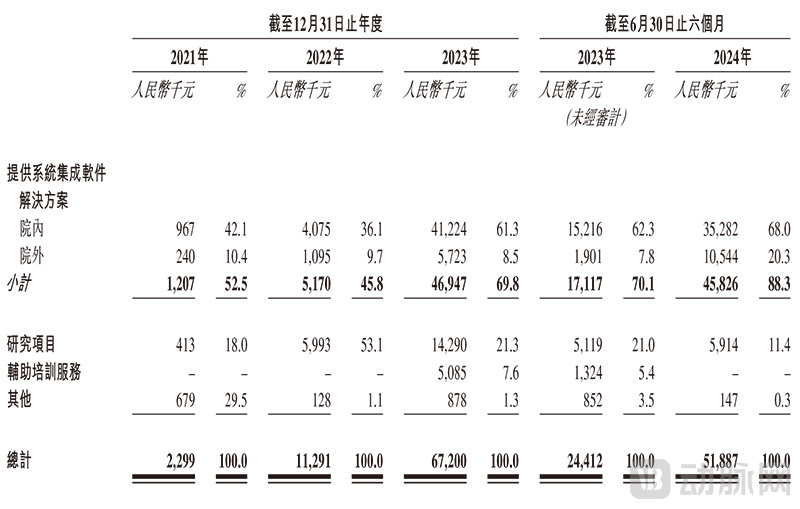
BrainAurora Revenue Classification (Screenshot from the Prospectus)
In terms of revenue composition, the proportion contributed by core digital therapeutics products (which provide system integration software projects) has been steadily increasing. In 2021 and 2022, this segment accounted for 52.5% and 45.8% of total revenue, respectively, approaching the shares held by research projects and ancillary training programs.
In 2023, the revenue share of system integration software projects reached 69.8%, significantly outpacing other project categories. By the first half of 2024, this proportion continued to climb to 88.3%.Notably, the proportion of its digital therapeutics sales generated outside hospital settings appears to have achieved a breakthrough in 2024, surging from a long-standing level of below 10% to 20.3%.。
Whether this trend can be sustained in the future warrants close attention. Nevertheless, it has at least brought a glimmer of hope to the digital therapeutics industry.
BrainAurora continues to invest heavily in research and development (R&D), with R&D expenditures reaching RMB 32.76 million in 2021, RMB 67.627 million in 2022, and RMB 90.733 million in 2023. In the first half of 2024, its R&D spending amounted to RMB 64.231 million, nearly double the figure for the same period in 2023.
Coupled with continuously expanding expenditures,BrainAurora is still incurring losses, but the deficit is gradually narrowing.. From 2021 to 2023, its net losses were RMB 700 million, RMB 500 million, and RMB 359 million, respectively. The net loss for the first half of 2024 was RMB 114 million, lower than that in the same period of 2023. Based on this trend, the full-year net loss is likely to be lower than that of 2023.
According to the prospectus, BrainAurora’s core products have been included in the provincial medical insurance reimbursement catalogs of 30 provinces in China. It is also the first undertaking entity for a project initiated by the National Health Commission, assisting more than 2,100 public hospitals across China in establishing cognitive centers (with over 120 already completed). This serves as one of the key drivers for its future growth.
Since its initial IPO filing in 2023, BrainAurora has finally become the first publicly listed digital therapeutics company in China. This is undoubtedly a milestone event for the digital therapeutics industry. Its substantial revenue growth has also brought hope to an industry struggling with commercialization.
How will BrainAurora perform in the future? Can digital therapeutics seize this opportunity to usher in a new trend? VCBeat will continue to monitor these developments closely.