

2025 Kickoff Highlight: Biomanufacturing Industry Analysis Report – In-Depth Exploration of Ten Critical Issues
2024: The Dawn of the Era of Biomanufacturing
2025: Biomanufacturing Will Welcome a New Round of Growth Opportunities.
With continuous technological breakthroughs and growing market demand, biomanufacturing is gradually emerging as a new engine driving economic development. However, various links in the industrial chain are facing numerous challenges and issues. This report provides an in-depth analysis of ten core problems in the biomanufacturing industry chain, offering detailed insights from multiple perspectives, including raw material supply, production technology, product applications, and market expansion. It aims to provide valuable references and insights for industry practitioners, supporting the sustainable development of the biomanufacturing sector.
1What Problems Has AI Solved for Synthetic Biology?
The deep integration of intelligent technologies—such as artificial intelligence, machine learning, and smart manufacturing—with synthetic biology constitutes the core of Biomanufacturing 5.0. This convergence drives a comprehensive transformation from traditional biomanufacturing toward intelligent, precise, and highly efficient paradigms, accelerating innovation and development across key stages of the biomanufacturing industry chain, including R&D, pilot-scale amplification, and commercial production. In particular, the fusion of BT (biotechnology, specifically synthetic biology) and IT (information technology, specifically artificial intelligence) has brought about revolutionary changes to biomanufacturing, ushering in a new era for the industry.

“BT+IT”-Driven Synthetic Biology Solutions for Biomanufacturing
Source: Expert interviews; graphic by VBInsight
The Development and Utilization of Existing Enzymes Have Gradually Become IndustrializedIn the field of biomanufacturing, in vitro enzymatic processes represent a critical approach. The core of this method lies in working backward from the final product to identify pathways and associated enzymes capable of synthesizing the target compound. Artificial intelligence (AI) has achieved industrial-scale application throughout the entire biosynthetic process, including exploring synthetic routes, discovering novel enzymes, and engineering existing ones. By integrating AI technology with synthetic biology, the research and development cycle as well as the industrialization timeline for vanillin have been significantly shortened, decreasing from five years to 1.5 years. Meanwhile, both R&D costs and end-product costs have been reduced by approximately half, substantially enhancing manufacturing competitiveness.
Breakthrough Progress in De Novo Protein DesignDavid Baker, the “pioneer” of protein design, announced in a publication that generative artificial intelligence was used for the first time to design entirely novel antibodies from scratch. The design process mainly involves the following three steps: First, artificial intelligence is employed to generate new protein structures; second, the ProteinMPNN algorithm is used to generate amino acid sequences, a step that significantly improves computational efficiency and design quality; finally, the AlphaFold system is used to independently evaluate whether these amino acid sequences can fold into the expected protein structures. Through this workflow, researchers in the laboratorySuccessfully synthesized a new protein with the expected function。
Novel proteins obtained through protein design will be widely applied in multiple fields, including: novel vaccines, proteins containing non-natural amino acids, novel drug delivery carriers, smart therapies, and high-performance biomaterials.
Genetic Circuit Design and Metabolic Pathway Design Are Breaking Through. The design and engineering of cell factories involve the design, construction, and modification of genetic circuits and metabolic pathways in existing living systems. This process includes structural optimization and circuit assembly of various genetic elements, such as promoters, transcription factors, and regulatory elements. These factors makeThe construction process of cell factories has become more complex., and related research is still in its early stages. Currently, research is primarily focused on the engineering of biological parts and codon optimization,Core design areas for cell factories, such as genetic circuit design and metabolic pathway engineering, still require more time for accumulation and research.。
In addition,AI has played a significant role in sequencing, biological component optimization, database construction, and literature mining, achieving a series of accomplishments.However, there remains vast scope and potential for the deep integration and innovative development of “AI + synthetic biology” in the future.
2Can Non-Grain Feedstocks Really Reduce Costs?
Currently,China's annual industrial grain consumption exceeds 80 million metric tons, accounting for approximately 9.64% of the country's total grain consumption.Among them, corn, soybeans, and the "three tubers" have become important raw materials for industrial sectors such as fuel ethanol, food, and pharmaceuticals.
As the demand for industrialization of biomanufacturing continues to grow, the demand for grain raw materials has become enormous.
Based on the average price of high-value products, the current market size of bio-manufacturing is approximately 280 million tons of products. If it is assumed that all raw materials are corn and calculated based on the minimum unit consumption, thenThe required amount of corn will exceed two-thirds of global corn production。
Visible, using grain as the mainstream carbon source can no longer support the large-scale development of the bio-based industry, addressing the bottleneck in raw material accessibility has become critical.Developing non-grain feedstocks and broadening the range of raw materials has become an inevitable path.。
By Category,Non-grain feedstocks can be classified into non-grain biomass feedstocks and non-biomass feedstocks.。Non-grain biomass feedstocks include: cellulosic feedstocks, such as crop straw, corn cobs, and forestry waste. Among these, agricultural waste amounts to approximately 960 million tons annually, while forestry waste totals around 360 million tons;Livestock and Poultry Manure, as well as Organic Household Waste, China's livestock and poultry farming generates over 3.8 billion tons of manure annually, while approximately 130 million tons of kitchen waste are produced each year;Discarded Marine Biomass, such as algae and shellfish.Non-biomass feedstocks are primarily gaseous feedstocks., mainly including CO, CO2etc., China generates approximately 1 trillion cubic meters of industrial exhaust gas and 4,000 tons of vehicle exhaust emissions annually.
Based on differences in raw materials and utilization methods during the biomanufacturing process, it can be divided into three generations:The first generation was the era of grain-based raw materials., is the primary means of biomanufacturing at the current stage;The Second Generation: The Era of Non-Food Biomass Feedstocks, with technological expertise now largely consolidated, multiple enterprises have taken the lead in converting straw into higher-value products; in the coming years, further breakthroughs are expected in the bio-based manufacturing and utilization of non-food biomass.The Third Generation: The Era of Gaseous Raw Materials, such as CO2, CO, etc., but their technical routes are not yet mature; they are still in the early stages and remain some distance away from large-scale industrial application.It is expected that it will take at least ten years to mature.。

Technical Routes for Different Raw Materials in Biomanufacturing
Source: Shanxi Securities, public information; chart supplemented by VBInsight
Can Non-Grain Feedstocks Really Reduce Costs? Does the Economics Add Up?
Currently, the utilization of non-grain biomass resources is primarily focused on crop straw, while in terms of non-biomass feedstocks, the focus is mainly on CO2utilization. Regardless of the pathway for non-grain conversion, cost-reduction calculations in many cases are based onIdeal-case accounting, with most cost reduction rates ranging from 10% to 30%.。
Taking straw-derived sugars as an example, the cost of producing fuel ethanol is somewhat lower compared to using corn as the feedstock. The cost of producing ethanol from corn is approximately RMB 7,000–8,000 per ton, whereas the cost of producing fuel ethanol from straw-derived sugars ranges from RMB 5,000 to 6,200 per ton, representing a cost reduction of approximately 30% relative to corn-based production.
with CO2For example, the production cost of coal-to-methanol is approximately RMB 2,000–2,700 per ton, and ionic liquid-mediated electrochemical reduction of CO2Methanol production, under optimal process conditions, incurs a cost equivalent to 88% of that of conventional methanol, representing a cost reduction of approximately 12%.
Furthermore, experts predict that with continuous technological breakthroughs and increased investment from numerous enterprises,CO2Raw Materials Poised to Be Among the First Achieving Commercial Utilization。
It can be seen that,Non-food feedstocks have not yet truly entered the commercialization stage in biomanufacturing, or rather, from an economic perspective, they have not yet reached a cost-effectiveness equilibrium.The application of non-grain feedstocks in biomanufacturing is a protracted process, during which several issues remain to be considered and addressed: Will the utilization of non-grain feedstocks increase process complexity and costs? How can technical bottlenecks in the decomposition or enzymatic hydrolysis of non-grain feedstocks be overcome? Is it necessary to use non-grain feedstocks for high-value-added biomanufacturing products? Among bulk commodities, which products are more suitable for production using non-grain feedstocks? When will the peak period for the utilization of non-grain feedstocks arrive? These questions still require concerted efforts from multiple stakeholders for continued exploration.
3How to Solve the Bottleneck of Fermentation Optimization and Scale-Up?
Pilot-scale production is considered the “valley of death” in biomanufacturing., encompassing two stages: fermentation optimization and scale-up, and downstream processing. Among these, fermentation optimization and scale-up is a key step to achieving exponential increases in yield and is regarded as a critical link in the commercialization process, while downstream processing serves as the primary means of ensuring the purity and quality of the final product.
Currently, from the perspective of the overall implementation of fermentation,Downstream processing of fermentation, based on years of accumulated experience, features equipment and process technologies that can nearly meet the current demands for industrial-scale biomanufacturing., and given its inherent characteristics such as fragmentation, shared production lines, and heavy reliance on manual labor, there is a significant possibility of implementing automation and intelligence for single devices and single-line equipment in the short term.
During the optimization and scale-up of fermentation processes, numerous challenges arise when scaling to pilot or industrial scales, such as: reduced heat and mass transfer efficiency in bioreactors; difficulties in the acquisition, processing, analysis, feedback, and control of process data; and a lack of effective linkage and coupling between process data and the metabolism of engineered strains. Among these,Mass and heat transfer issues during scale-up constitute a complex disciplinary field. Currently, there is no fundamental gap between domestic and international practices in this area.。Therefore, the device itself is not an issue that requires immediate resolution; rather, it demands long-term accumulation and exploration.。
“Process Data Processing and Automated Intelligent Control” is considered the most effective approach currently available for addressing challenges in fermentation scale-up.
Engineered bacteria and enzymes possess highly complex metabolic networks. The fermentation process generates a vast amount of data, including temperature, pH, dissolved oxygen, agitation speed, pressure, substrate concentration, product concentration, metabolic by-products, and off-gas composition. These parameters provide critical insights into the real-time status of the fermentation strains/enzymes and bioreactors. Industry practitioners have noted thatDuring fermentation scale-up, once the number of concurrent fermentation batches exceeds ten, the complexity of manual operations and the likelihood of errors increase significantly.Therefore, data science algorithms must be leveraged to facilitate the rapid generation of intuitive visual insights, identify rational optimization and control strategies, and thereby enable precise and reliable execution.
By leveraging advanced sensing systems, algorithms, computing platforms, and computation systems tailored to fermentation expertise, while integrating techniques such as machine learning and digital twins, a closed-loop integration of perception, decision-making, and execution systems can be established. This enables automated analysis, feedback, and execution, thereby effectively addressing the bottlenecks in fermentation optimization and scale-up, and bridging the “Valley of Death” in biomanufacturing.
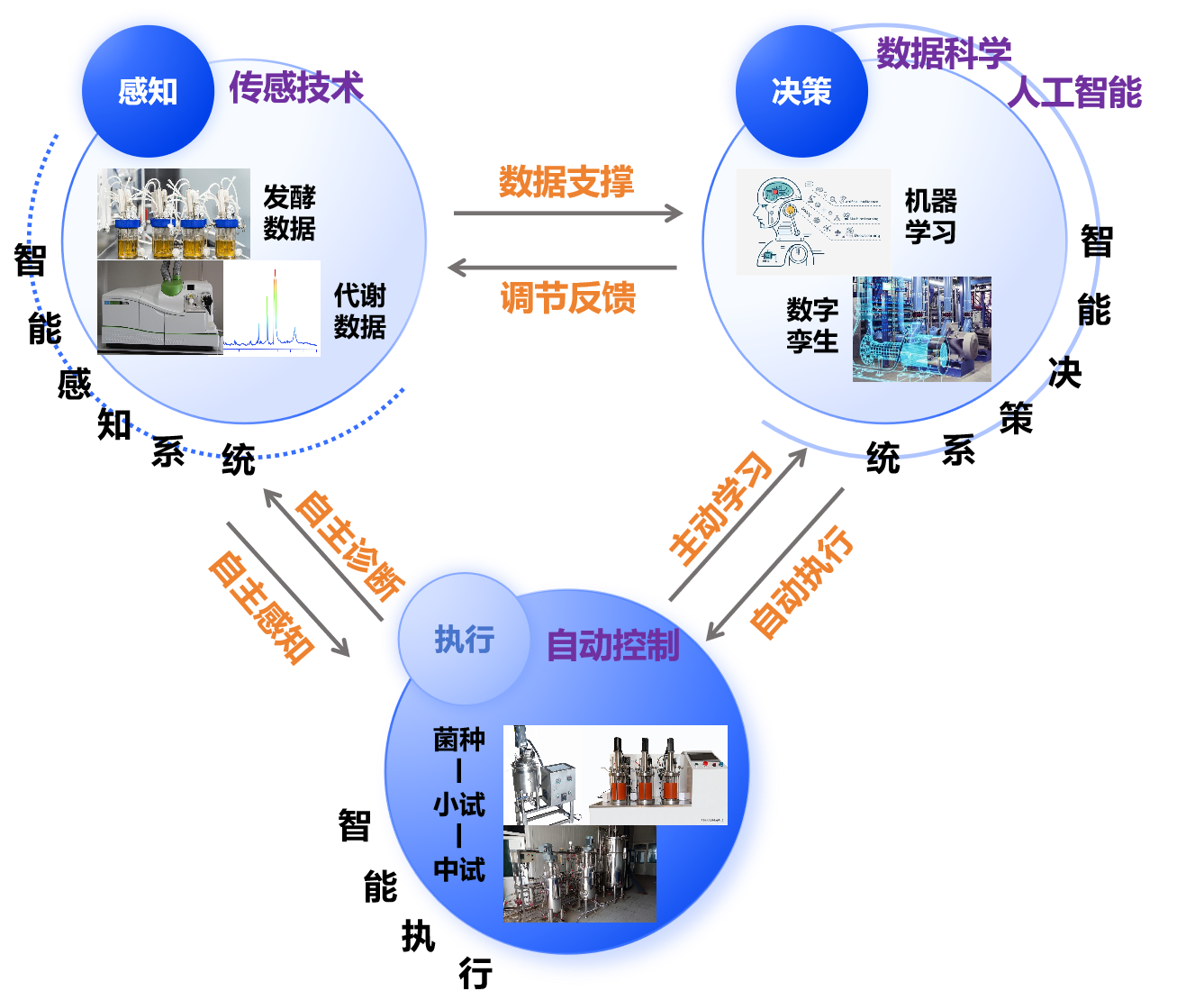
Process Data Processing and Automated Intelligent Control Network for Fermentation Optimization and Scale-up
Source: Expert interviews; graphic by VBInsight
Furthermore, talent capable of integrating technology, processes, and industry serves as a key driver in overcoming bottlenecks in fermentation optimization and scale-up. Specifically, such professionals can effectively link upstream R&D, pilot-scale scale-up, and market demand. From strain design at the source to process optimization and scale-up during pilot trials, and further to market demand analysis, they provide comprehensive support to the industry.
4How to Identify the Market Segment of a "Blockbuster Product"?
Finding “blockbuster products” begins with identifying the right track, precise positioning within the product track is the key to commercial success. The core of corporate product selection lies in understanding its demand volume, incremental market potential, unit value, and the core challenges faced. Based on the volume of end-product demand and unit value,Biomanufacturing products can be categorized into three types: low-volume high-price, medium-volume medium-price, and high-volume low-price.Different product categories possess distinct characteristics, levels of commercialization, and challenges faced; these factors are all critical considerations in making choices within relevant niche markets.

Classification, Characteristics, and Related Sub-sectors and Niche Areas of Biomanufacturing Products
Source: Public information, BCG; chart by VBInsight
Annual demand for low-volume, high-priced products is typically at the kilogram level, with some even reaching the gram level, while their selling prices are often quoted per milligram. These products primarily target the high-end market and offer substantial profit margins.. However, they demand substantial investment in innovative technologies and R&D funding, often requiring a prolonged period to achieve commercialization. Furthermore, the market capacity is relatively limited, with downstream products primarily consisting of biologic innovative drugs and functional proteins/peptides for specialized applications. Such products are better suited for enterprises possessing strong brand influence and robust technological barriers.
Annual demand for mid-volume, mid-priced products ranges from hundreds of thousands to several million tons. These products span a wide range of applications, and the market competition is relatively intense.These primarily include active pharmaceutical ingredients (APIs) and pharmaceutical intermediates in the biopharmaceutical sector; sweeteners, flavors and fragrances, and nutritional additives in the food and nutrition sector; biological breeding and biopesticides in the agricultural sector; and functional small molecules in the consumer personal care sector. Due to intense market competition, relevant enterprises must possess strong market sensitivity and the ability to make timely adjustments. Therefore, products or technologies should exhibit good scalability. For example, the gene-editing technology CRISPR-Cas9 has been widely applied across multiple fields, including medicine, agriculture, food, and basic research. In addition, product applicability and safety are critical factors. Many products may face a waiting period before industrialization due to restrictions imposed by laws, regulations, or industry standards.
High-volume, low-cost products typically have an annual demand exceeding millions of tons, sometimes even reaching the scale of hundreds of millions of tons. The mass production of such products imposes extremely high requirements on cost control and industrialization capabilities.. These primarily include bio-based chemicals, bioenergy, biofertilizers, and alternative proteins. Due to the prohibitive capital costs and extended investment horizons that startups struggle to bear, breakthroughs in biomanufacturing technologies for such products are often rapidly monopolized by industry leaders. Meanwhile, these products face significant challenges in supply chain management, cost control, and marketing, resulting in particularly intense market competition.
The above content provides an interpretation of selected issues in the report concerning technology, raw materials, processes, and products. In addition, the report explores the following key topics:
What is the definition of biomanufacturing?
What Value Does Biomanufacturing Offer?
What Is the Implementation Path for the Era of Bio-Manufacturing 5.0?
Which link in the value chain is more important?
How to Effectively Reduce the Cost of Biomanufacturing?
And what are the development trends of biomanufacturing across various fields?
Due to space constraints, this article cannot present all content in full detail. For further information on related issues and detailed analysis, please download the complete report.
Given the complexity of the industry, we look forward to engaging with more professionals. Tonight at 7:00 PM, a live broadcast will be streamed on VCBeat’s WeChat Channels account, featuring an in-depth interpretation of the core issues from this report, along with an annual review of biomanufacturing and outlook for the coming year.Reserve your spot for the live broadcast now and join the discussion online →


The above is an excerpt from the main content of the report. Scan the QR code to join the group and obtain the full version of the report.
Jointly Released by: VCBeat, Trautec Medical
Report Supporting Organizations: Shangke Biotech, Xiushi Biotech, Bloomage Biotech, Zhiyu Life Sciences, Weiyuan Synthetic Biology, iCapital
Introduction
I. Unveiling the Mysteries of the Industrial Chain: What Exactly Is Biomanufacturing?
1. Biomanufacturing: A Key Force Driving the Bioeconomy
2. Production Process: The Complete Path from Laboratory to Application
3. Industrial Structure: Deep Integration of Market Demand and Application Scenarios
II. The Value Trio of Biomanufacturing: Improvement, Innovation, and Sustainability?
1. Improvement: Striking a Balance Between Performance Enhancement and Cost-Effectiveness
2. Innovation: Transforming the Unmanufacturable or Difficult-to-Manufacture into the Manufacturable
3. Sustainability: Leading the Eco-Friendly Green Manufacturing Revolution
III. Innovation-Driven Biomanufacturing: Pathways to Realizing the 5.0 Era?
1. Development History: Technological Innovation and Industrial Transformation from 1.0 to 5.0
2. The 5.0 Era: The Path of Integrated Innovation in “BT + IT”
IV. The Value Chain of Biomanufacturing: Which Segment Is More Critical?
1. Value Chain Analysis: Identifying the Key Drivers of Industrial Upgrading
2. Commercialization Implementation: Identifying the Key to Selecting the Right Track
V. Raw Materials: When Will the “Non-Grain Bio-Manufacturing Era” Arrive?
1. How are different carbon sources utilized?
2. What is the cost-reduction potential and utilization hierarchy of non-grain feedstocks?
3. What are the pain points and trends of non-grain raw materials?
VI. Technology: In Which Stages Can AI + Synthetic Biology Reduce Costs and Improve Efficiency?
1. What problems has AI solved for synthetic biology?
2. What Industrialization Opportunities Does AI Bring to Biomanufacturing?
VII. Process: How to Address Bottlenecks in the Scale-Up of Fermentation Optimization?
1. What are the bottlenecks in fermentation optimization and scale-up?
2. What is needed to break through optimization and amplify bottlenecks?
3. What are the current strengths and weaknesses, and what are the future trends?
VIII. Blockbuster Products: Where Are the “Blockbusters” in Biomanufacturing?
1. Where are the high-priced, low-volume “blockbuster products”?
2. Where are the mid-priced, mid-volume “blockbuster” products?
3. Where Are the High-Volume, Low-Price “Blockbuster” Products?
IX. Cost Reduction: Are Large-Scale Biofoundries the Primary Pathway?
1. Facility Optimization: Cost Reduction Across Multiple Links, from Variable Costs to Plant Utilization
2. Tank Size: Larger tanks help reduce the unit product cost
3. Scalable Strains: Maximize the Development of Industrial-Grade Strain Families
X. Trends: What are the development trends in different fields of biomanufacturing?
1. Market Retrospective: Commercialization Status of Products Across Different Sectors
2. Future Outlook: Product Development Trends Across Different Fields
Case Column
1. Trauma Medical
2. Shangke Biology