

WeDoctor Holdings Gains Capital Favor Through Membership-Based Health Services That Root AI Healthcare in Real-World Impact
Recently, WeDoctor Holdings filed its prospectus with the Hong Kong Stock Exchange. More than three years after its initial attempt at an IPO in Hong Kong, WeDoctor Holdings has become China’s largest provider of AI-driven healthcare solutions.
According to Frost & Sullivan, WeDoctor Holdings ranked first among China’s AI healthcare companies by revenue in 2023, capturing a 10.6% market share in the AI healthcare sector—exceeding the combined market shares of the second- and third-ranked players.
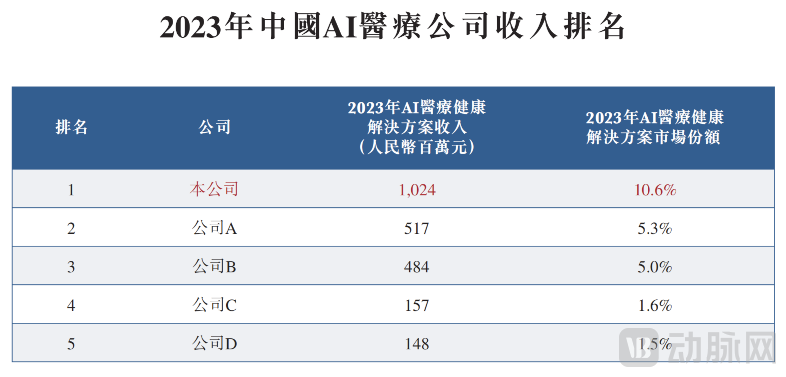
Source: WeDoctor Holdings Prospectus
WeDoctor Holdings established China’s first internet hospital in 2015 and has continued to lead the development of the digital healthcare industry, recognized as a pioneer in business model innovation and commercialization. In April 2021, WeDoctor Holdings pursued an initial public offering (IPO) in Hong Kong, but voluntarily terminated the IPO process several months later.
Industry analysts note that in its renewed push for an IPO, WeDoctor Holdings has not only demonstrated stronger financial performance but also leveraged its “value-based healthcare” business model—exemplified by its Health Community Consortium (Jian Gong Ti)—which has been refined over years of deep engagement in the medical services sector. This model has achieved multi-party win-win outcomes with primary care institutions, physicians, patients, health authorities, and public medical insurance funds during the process of supporting healthcare reform, thereby establishing a commercialization path centered on “value co-creation.”
In Sync with Healthcare Reform: A Multi-Party Win-Win for Commercial Value and Livelihood Improvement
Prospectus of WeDoctor Holdings: Our cost-effective AI-driven healthcare solutions address critical pain points in healthcare more efficiently, creating a win-win scenario for primary care institutions, physicians, patients, health authorities, and public medical insurance funds. Our AI capabilities empower primary care institutions to manage a larger volume of patients with chronic diseases, improve health outcomes at lower costs, and deliver value-based healthcare services.
WeDoctor Holdings has independently developed an industry-leading large language model specialized for the medical sector. Based on this foundation, it has created four intelligent agents—“AI Physician,” “AI Pharmacist,” “AI Health Manager,” and “AI Intelligent Control”—which are uniformly deployed across healthcare consortium institutions to provide end-to-end AI support throughout the pre-consultation, intra-consultation, and post-consultation phases. Specifically, during the pre-consultation phase, AI assists with patient information collection, preliminary assessment, and triage guidance; during the intra-consultation phase, it supports auxiliary diagnosis, treatment plan recommendations, and prescription review; and in the post-consultation phase, it facilitates follow-up management, medication guidance, and health education.
Based on the Health Community model, AI has demonstrated significant efficacy in enhancing the quality and efficiency of medical services. According to prospectus data, from January 2023 to June 2024, the Tianjin Health Community, co-developed by WeDoctor Holdings, saw the HbA1c compliance rate among managed diabetes members rise from 17.8% to 44.2%, the blood pressure compliance rate increase from 19.5% to 61.5%, and the blood lipid compliance rate grow from 24.8% to 27.9%. During this 18-month management period, the per-capita budget for diabetes members at partner medical institutions achieved a surplus. According to statistical data released by Tianjin municipal government departments in August 2024, outpatient visits at primary healthcare institutions in Tianjin increased by 23% to 50% as a result.
In just over a year, the Health Community ModelTo achieveachieved the “two increases and one decrease” outcomes: improved patient health indicators, enhanced primary care service capacity, and a reduced growth rate of medical insurance expenditures.As it aligns with the national healthcare reform objectives and has demonstrated significant effectiveness, this model has also become a clearly supported approach in the nation’s efforts to deepen healthcare reform.An innovative model for support and promotion.
In 2022, the Cyberspace Administration of China, the Ministry of Agriculture and Rural Affairs, the National Development and Reform Commission, the Ministry of Industry and Information Technology, and the National Administration for Rural Revitalization jointly issued the “Key Points for Digital Village Development in 2022,” which explicitly proposed “guiding localities to explore the establishment of grassroots digital health communities.” In August 2024, the National Health Commission clearly set a goal to achieve full coverage within five years by promoting the Sanming experience. The future direction of Sanming’s healthcare reform will focus on upgrading from “medical consortia” to “health communities,” advancing the transition from purely medical care to comprehensive health management through measures such as establishing a “collaborative management system for six major diseases.”
Patients Pay for Efficacy: Membership-Based Services Help AI Healthcare Take Root
WeDoctor Holdings’ current business comprises two segments: AI-powered healthcare services and a digital healthcare platform. The AI-powered healthcare services leverage the Healthcare Community Consortium to provide solutions for medical institutions at all levels, primarily including health management membership services, cloud pharmacies, and value-added services. The digital healthcare platform mainly encompasses digital healthcare services, offline medical center services, and corporate membership services. The Healthcare Community Consortium can be understood as the core model through which WeDoctor delivers AI-driven healthcare solutions to medical institutions at all levels.
Particularly noteworthy is that,Distinct from the traditional fee-for-service model in healthcare and the later drug-selling profit model of e-commerce, WeDoctor Holdings has created a health membership service model based on the Health Community, featuring capitation and value-based pricing.By deeply cultivating this sector, WeDoctor Holdings neither takes a share of the diagnostic and treatment revenues from partner medical institutions nor relies solely on online pharmaceutical sales. Instead, it generates revenue by helping hospitals manage patient health, drawing from the surpluses in capitated global budget payments under the medical insurance fund.In other words, thistoC...model, in which patients pay for the effective health management they receive within the Health Community.
As stated in its prospectus: As an AI-driven healthcare technology company, we foster a tight-knit alliance among all medical institutions within the Healthcare Community by building digital infrastructure, standardizing operations, and connecting primary care facilities with higher-level hospitals. Our health management membership services adopt a capitation payment model, delivering health management services to our members through collaborations with primary care institutions. Acting as the coordinator of the Healthcare Community, we directly settle members’ medical expenses incurred within a fixed budget with public health insurance funds, and distribute any budgetary surpluses to medical institutions in accordance with our agreements.
It is evident that WeDoctor Holdings has established a multidimensional “value symbiosis” relationship with medical institutions at all levels, patients, and health insurance funds.Through collaboration with medical institutions at all levels,AI empowerment enables the joint provision of more efficient health services to patients, who, as end-users, then validate the services andby the individual and their contributed medical insurance fundPayment of fees has formed a complete commercial closed loop.In promoting the capitation-based global budget payment reform for diabetes, the Tianjin Healthcare Community encourages primary healthcare institutions to provide corresponding services in accordance with a standardized health management service package. Patients may choose accredited institutions for registration and file establishment, whereby the registering institution provides comprehensive chronic disease management services throughout the course of care.
The health outcomes generated by health management include not only the medical insurance surplus achieved through capitation-based global budgeting, but also the effective prevention of complications in patients whose health indicators have improved, thereby alleviating their financial burden and physical suffering.This innovative approachThe toC business model, while seemingly reliant on government-backed Health Communities and heavily dependent on policy, has in fact successfully tapped into the consumer market.The broad health management needs of users.
This is not only an economic ledger but, more importantly, a livelihood-oriented one. The Health Community model creatively integrates technological advancements in the healthcare industry into China’s medical reform and improvements in public welfare, driving the implementation of value-based healthcare through “payment for outcomes,” thereby achieving both social benefits and a sustainable business cycle. AI medical technologies are increasingly taking root in primary healthcare institutions, connecting with the broadest user base. By improving patients’ health outcomes, this approach has enabled efficient utilization of medical insurance funds and optimized allocation of social resources.
Digitalization Brings Disruption in the Digital Age, enterprises need to shift from a competitive logic to a symbiotic logic, through connection andCollaboration to achieve common development among organizations and individuals, enterprises and customers, and enterprises and partners.WeDoctor Holdings is undoubtedly the pioneer that first mastered the key to “value symbiosis.” The widespread acceptance of its business by multiple stakeholders, which in turn drove rapid revenue growth, is clearly rooted in this underlying logic.
The prospectus reveals that WeDoctor Holdings’ AI-powered medical services have provided multi-disease and diabetes management services to approximately 900,000 individuals through the Tianjin Health Community. Meanwhile, the Health Community model has become a strong driver of WeDoctor Holdings’ performance growth. Financial data shows that the company’s revenue reached RMB 962 million, RMB 1.368 billion, and RMB 1.863 billion in 2021, 2022, and 2023, respectively. In the first half of 2024, revenue hit RMB 1.818 billion, representing a year-on-year increase of 107.4%, with income from AI medical services amounting to RMB 1.44 billion, accounting for nearly 80% of the total. Benefiting from the rapid expansion of its core AI medical services business, WeDoctor Holdings has achieved rapid revenue growth.
With strong policy support and the deepening of healthcare reform, WeDoctor Holdings is poised for leapfrog development. Currently, WeDoctor Holdings has established Health Community collaborations in multiple regions across China, excluding Tianjin. According to the prospectus, in February 2024, WeDoctor Holdings signed a strategic agreement on Health Community development with the Guiyang Municipal Government; in November 2024, it entered into a strategic agreement with the Yinchuan Municipal Health Commission to establish a Health Community. Furthermore, similar agreements are expected to be signed with several district governments in Shanghai during the first half of 2025. Meanwhile, WeDoctor Holdings is focusing on municipalities directly under the central government and provincial capitals, actively exploring and negotiating cooperation opportunities.