

Yangqi MedTech's Optical Surface Guidance System 'QVision' Receives NMPA Class III Approval

Yangqi Medical
Medical Device Developer
Recently, “QVision,” a fully domestically developed Surface Guided Radiation Therapy (SGRT) product independently researched and developed by Shenzhen Yangqi Yixin Intelligent Technology Co., Ltd. (hereinafter referred to as “Yangqi Medical”), has passed the review for Class III medical device certification by the National Medical Products Administration (NMPA) and been approved for market launch.
This system is designed for target volume monitoring, precise patient positioning, posture verification, treatment tracking, and navigation during conventional radiotherapy (RT) and high-dose stereotactic radiosurgery (SRS/SBRT) for oncology patients.
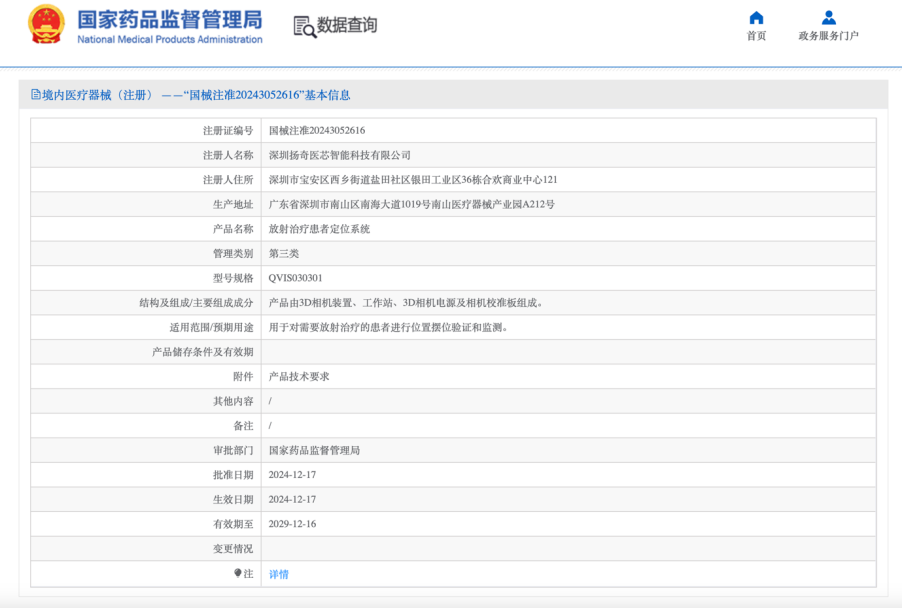
It is reported that QVision by Yangqi Medical achieves real-time monitoring of patient positioning (with an accuracy of within 0.2 mm) through non-invasive, radiation-free image guidance technology, enabling high-precision preoperative setup and real-time organ and tumorMotion management makes the clinical application of high-dose stereotactic radiosurgery possible.It effectively addresses critical pain points in clinical practice, including time-consuming and error-prone pre-treatment positioning, coarse treatment planning, lack of real-time monitoring during radiotherapy, difficulties in managing patient motion errors, challenges in implementing high-precision radiotherapy techniques, and prolonged treatment courses. This represents an innovative solution in the field of precision radiotherapy.
It is worth mentioning that Yangqi Medical isThe only domestic company to have fully achieved localization of software and hardware production and manufacturing in this field.enterprise. Among the components in this NMPA Class III registration, in addition to the common long-distance models, it also includesIndependently developed the world’s smallest close-range optical surface monitoring device, and pioneered its embedded installation within the gantry of a linear accelerator.,Enabling Respiratory Gating Functionality on Ring-Gantry Linear Accelerators, providing more diverse options to address clinical pain points in radiotherapy. In addition to conventional linear accelerators, the QVision system can also be integrated with various particle therapy modalities, including proton and heavy ion systems, and has passed testing for neutron radiation, electromagnetic compatibility, and other assessments. The complete system has now completed full-process clinical trials at leading cancer centers and has been officially launched on the market.
Radiotherapy is one of the three major modalities for cancer treatment. Conventional radiotherapy typically employs fixed-beam irradiation, which struggles to fully conform to the irregular shapes of tumors and may cause significant damage to surrounding healthy tissues during treatment. Compared with conventional radiotherapy techniques, precision radiotherapy offers superior efficacy and faces strong market demand. According to Frost & Sullivan data, calculated by revenue, the market size of precision radiotherapy in China reached RMB 41 billion in 2022,It is projected to reach RMB 74.1 billion in 2026, with a compound annual growth rate (CAGR) of 15.9% from 2022 to 2026.
Meanwhile, the influx of overseas giants, domestic manufacturers, and capital in recent years has further boosted the development of the radiotherapy sector. Not only have overseas giants such as Siemens and GE Healthcare accelerated their presence in this field, but collaborations among manufacturers and financial support have also created more possibilities for equipment innovation, drivingContinuous Expansion of the Radiotherapy Industry Chain, giving rise to a series of solutions such as proton therapy, linear accelerators, surface monitoring systems for radiotherapy, target delineation software, and cloud-based radiotherapy platforms.
The industry is optimistic about the growth prospects of radiotherapy, driven by substantial patient demand, a current shortage of radiotherapy equipment resources in China, and favorable policy support.
Data shows that China ranks first globally in both the number of new cancer cases and cancer-related deaths. The total number of new cancer cases in China is projected to reach 5.1 million by 2025. More alarmingly, the five-year survival rate for cancer patients in China is only 40.5%, significantly lower than the approximately 70% survival rate observed in developed countries.
This can be partly attributed to the low rate of radiotherapy utilization in tumor treatment. In fact, the per capita availability of radiotherapy equipment in China is far lower than that in developed countries; compared with a global radiotherapy coverage rate of 62%, China’s rate stands at only 15%.
Facing the yet-to-be-fully-developed radiotherapy market in China. On June 29, 2023, the National Health Commission issued"14th Five-Year Plan for the Allocation of Large-Scale Medical Equipment", specifying the planned allocation quantity and access standards for large-scale medical equipment during the 14th Five-Year Plan period.During this period, 3,645 large-scale medical devices were planned and allocated nationwide. By the end of the 14th Five-Year Plan period, China will have a total of 5,518 radiotherapy devices.This also means that in the next three years, the potential market demand for nearly 1,000 linear accelerators annually for radiotherapy in China is urgent to be released.
The approval of Yangqi Medical’s QVision brings technological innovation and new opportunities to the field of radiotherapy, effectively filling the gap in domestically produced optical surface monitoring systems in China and further unlocking the market potential for linear accelerators.
During radiotherapy, four major pain points exist: coarse treatment planning, insufficient procedural precision, lack of real-time intraoperative monitoring, and prolonged treatment courses. Meanwhile, radiotherapy techniques such as Stereotactic Body Radiation Therapy (SBRT) demand extremely high precision, which can only be achieved with the aid of high-precision navigation equipment.
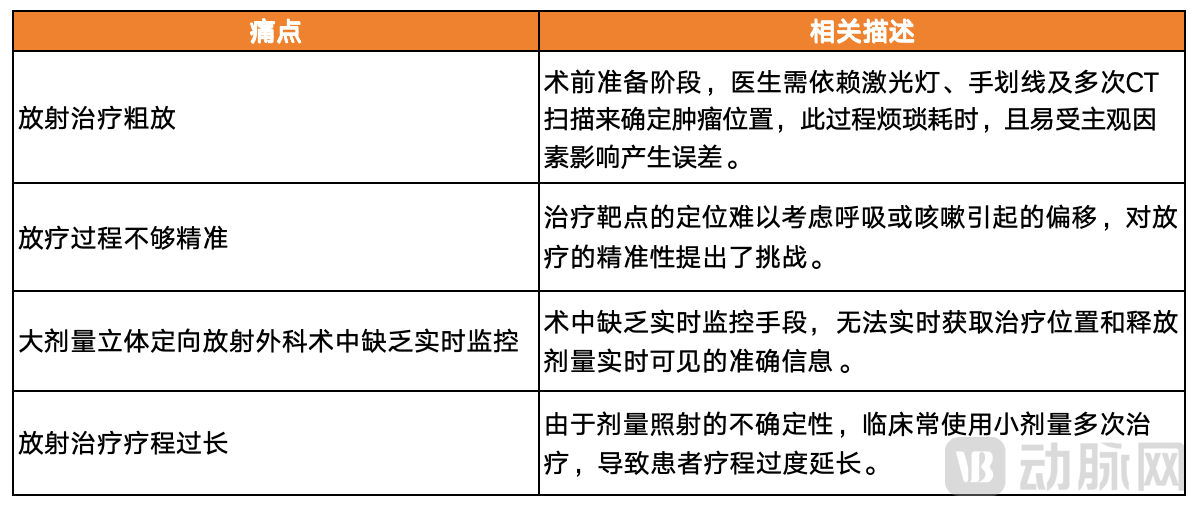
Clinical Pain Points in Radiotherapy
In this context, the Yangqi Medical team developed “QVision” to address clinical pain points.
As a non-invasive, radiation-free image-guidance technology, “QVision” can acquire patient positioning with high precision in real time through 3D surface imaging, provide six-degree-of-freedom error monitoring data, and perform real-time monitoring and modeling of the patient’s body surface.0.2mmsubtle movements within, with a full-frame acquisition frequency of up to15Hz. It interfaces with radiotherapy equipment to intelligently control the operation of the linear accelerator (motion control and energy control), enabling adaptive radiotherapy under optical surface monitoring and enhancing the precision of radiotherapy.
Its value in enabling accurate and rapid preoperative positioning, real-time and precise intraoperative monitoring, and promoting the widespread adoption and application of advanced radiotherapy techniques can enhance the precision and efficiency of radiation therapy.
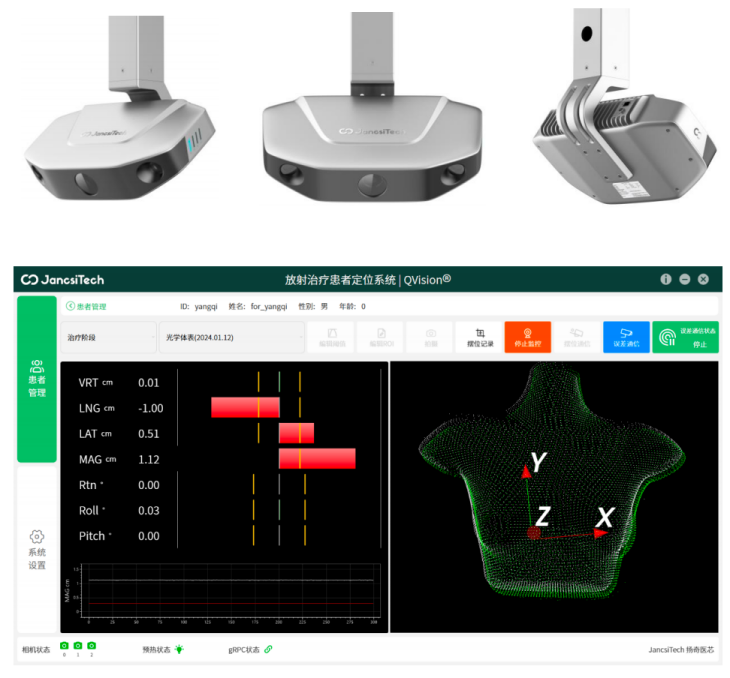
QVision
Moreover, “QVision” boasts a wide range of application scenarios. It can be used in various clinical settings, such as deep inspiration breath hold (DIBH) for breast cancer, stereotactic radiosurgery (SRS) for brain tumors, and stereotactic body radiation therapy (SBRT) for body tumors including liver cancer, cervical cancer, and prostate cancer. This effectively shortens treatment time and reduces radiation dose to normal tissues. Additionally, “QVision” can be extended to surgical fields such as puncture procedures and interventional digital subtraction angiography (DSA).
“QVision” was able to achieve innovative breakthroughs ahead of its competitors, primarily due to the technical expertise accumulated by the Yangqi Medical team.
Specifically, the system can simultaneously project hundreds of thousands of light spot markers onto the human body, achieving comprehensive surface monitoring. This innovative design enables “QVision” to monitor patients’ respiratory movements in a non-contact manner and to effectively monitor highly deformable curved surfaces, such as the breast.
In terms of precision, compared with traditional fixed-target monitoring methods, “Qishi QVision” can provide non-contact, dense, and high-precision data through hundreds of thousands of monitoring points reconstructed by the system. Meanwhile, the company’s technical accumulation in optical path design, algorithm development, radiation physics, and radiotherapy scenarios also enables the system to demonstrate advantages in high-frequency data acquisition and 3D modeling, featuring high-precision, real-time response monitoring capabilities.
Yangqi Medical possesses comprehensive capabilities in software and hardware product R&D, big data and machine learning, medical product registration, as well as manufacturing and production.
Not only does it effectively break the foreign technological monopoly, ensuring the company’s autonomy and controllability at the technical level. Leveraging a stable domestic supply chain, it achieves localized R&D and manufacturing of both hardware and software, accelerating product updates and iterations. Furthermore, through rapid local response and quick maintenance services, it provides high-quality support for the clinical application of radiotherapy products.
More importantly, leveraging its core technologies, Yangqi Medical has successfully launched an embedded optical body surface monitoring system, whichIts dimensions are the smallest in the world, allowing it to be seamlessly integrated into radiotherapy machines.
After all, achieving this technological breakthrough requires the company to possess an exceptionally high level of in-house hardware R&D capability. Embedding an optical surface monitoring system into a radiotherapy linear accelerator demands extreme miniaturization, integration, and intelligence. Without robust in-house R&D capabilities, it would be impossible to design and manufacture such highly miniaturized cameras. Leveraging its comprehensive in-house hardware R&D capabilities and accumulated expertise in algorithm technology, Yangqi Medical has established core technical barriers in the field of optical surface monitoring. This has enabled the company to achieve breakthroughs in system design and performance, thereby developing multiple product pipelines.
It is reported that Yangqi Medical's product pipeline primarily revolves around two core areas.First, the optical surface navigation system centered on “QVision”; second, superficial radiotherapy machines. These two product lines together form the strategic layout of “Navigation + Terminal.”
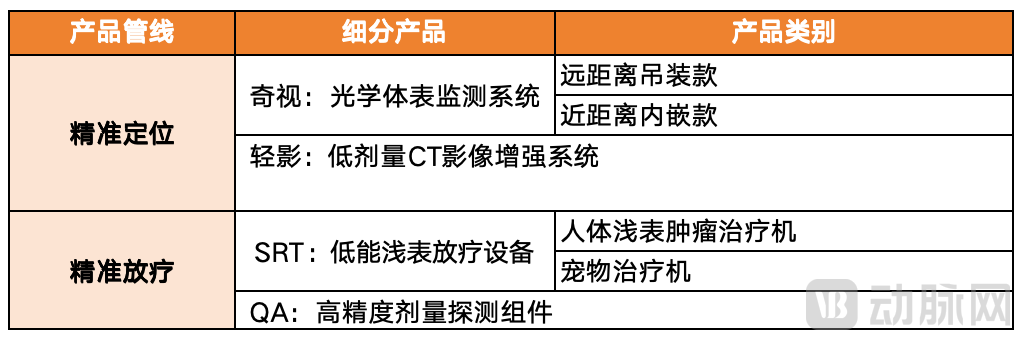
Yangqi Medical Product Pipeline
Among these, the optical surface navigation system pipeline, anchored by “QVision,” focuses on addressing challenges in precise preoperative and intraoperative localization. Currently, both the “QVision” and “QImaging” products have received approval from the National Medical Products Administration (NMPA) and achieved relevant commercial progress. The second product line, centered on superficial radiotherapy devices, is dedicated to treating superficial tumors, keloids, burns, and dermatological conditions.
It is worth noting that, as a medical device utilizing low-energy X-rays for radiotherapy of the skin surface or superficial tissues, superficial radiotherapy equipment offers lower radiation energy compared to traditional large-scale radiotherapy systems. This results in enhanced safety for internal tissues and organs, along with advantages such as flexible dose adjustment, a broad treatment field, and ease of operation. However, there is currently a gap in the domestic market for superficial radiotherapy machines in China, which remains almost entirely monopolized by imported products.
Yangqi Medical's self-developedSuperficial Radiotherapy Machines Have Lower Radiation Energy,Pioneering continuous, autonomous adjustability across multiple energy levels from 20 keV to 200 keV. Compared with foreign competing products, it offers higher radiotherapy efficiency, andAI-Guidedmaking treatment more convenient and precise. Meanwhile, the radiotherapy machine delivers significant therapeutic effects, with a short cure cycle that is rapid and painless. Furthermore, it has a wide range of applications,Applicable to over 20 indications,It can also be combined with surgery to deliver prophylactic scar irradiation to the postoperative area. Moreover,This radiotherapy machine also offers customized radiotherapy consumables, which modulate dose distribution through beam shaping to meet personalized treatment needs.
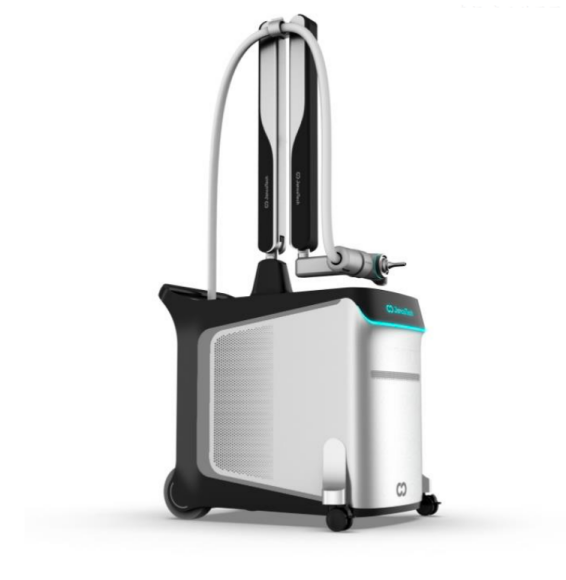
Yangqi Medical Superficial Radiotherapy Device
Of particular importance,In addition to clinical applications, superficial radiotherapy devices can also be rapidly deployed and expanded into the pet care and medical aesthetics markets.
Currently, Yangqi Medical has completed the development of a prototype for pet Stereotactic Radiation Therapy (SRT) and has signed agreements with leading Chinese research institutions and multiple top-tier veterinary hospitals to jointly initiate animal trials. The company plans to simultaneously launch its products in the domestic and overseas pet oncology markets in 2025. This innovation further addresses critical pain points in current treatments, such as the limited efficacy of laser and thermal ablation therapies, the inability of elderly pets to undergo frequent high-intensity anesthesia, and the significant functional impairment often caused by surgical resection—the primary treatment for periodontal, perianal, mammary tumors, and mast cell tumors in pets. By enabling non-invasive, painless, and low-cost treatment, Yangqi Medical brings a new breakthrough to the global field of pet oncology therapy.
Ultimately, this series of innovative breakthroughs is attributable to Yangqi Medical’s in-depth exploration and accumulated expertise in the fields of nuclear medicine and AI technology.
From a technical perspective, the company has assembled experts in the fields of nuclear medicine and artificial intelligence. The CTO previously conducted X-ray research at the SLAC National Accelerator Laboratory in the United States. As a postdoctoral fellow at Stanford University, he studied under Professor Perry Giannini, a Fermi Award laureate and member of the U.S. National Academy of Sciences, deepening his expertise in X-ray research. Furthermore, he holds a joint Ph.D. in Science from the Chinese Academy of Sciences and Stanford University, as well as a Bachelor’s degree in Nuclear Science and Nuclear Technology from the University of Science and Technology of China, demonstrating profound academic achievements. In addition, the company’s technical team also brings togetherNuclear medicine, nuclear physics, clinical experts in tumor radiotherapy, and numerous artificial intelligence algorithm experts.
Moreover, the company boasts a team with extensive market experience. From the technical team to sales and marketing, and further to software architecture support, each department is led by professionals hailing from top-tier international manufacturers, radiologists, or research institutes. The company’s team exhibits a high degree of complementarity, ensuring close alignment between its products and clinical practice.
In the later stages of development, the company’s team was even stationed on-site.China's Top Cancer Hospitals, co-refining products with frontline physicians. It is precisely for this reason that Yangqi Medical has been able to overcome core technical challenges, build a robust product pipeline, and develop clinically valuable products that fill gaps in the Chinese market.
With the approval of “QVision” and the deployment of low-energy superficial radiotherapy devices for veterinary use, the company has officially entered the commercialization phase. Currently, the nuclear medicine and precision radiotherapy sectors continue to unlock their commercial potential. Looking ahead, the Yangqi Medical team will deliver more precise and efficient treatment solutions for clinical practice and patients through sustained product innovation and deepened R&D efforts.