

Yinghe Yimai Launches Proprietary Medical Imaging Foundation Model 'Yinghe Miyah': Smart Imaging Pioneering Precision Medicine

Medical Image insights
Medical Imaging AI Provider
On January 10, Yinghe (Shanghai) Medical Technology Co., Ltd. held the grand launch event of its medical imaging foundation model, themed “Smart Leadership with Benevolence · Building the Foundation for the Future,” at the People’s Health Hotel in Beijing. The company unveiled “Yinghe Miya™,” an L0 medical imaging foundation model independently developed in-house, injecting strong momentum into the development of AI in medical imaging.
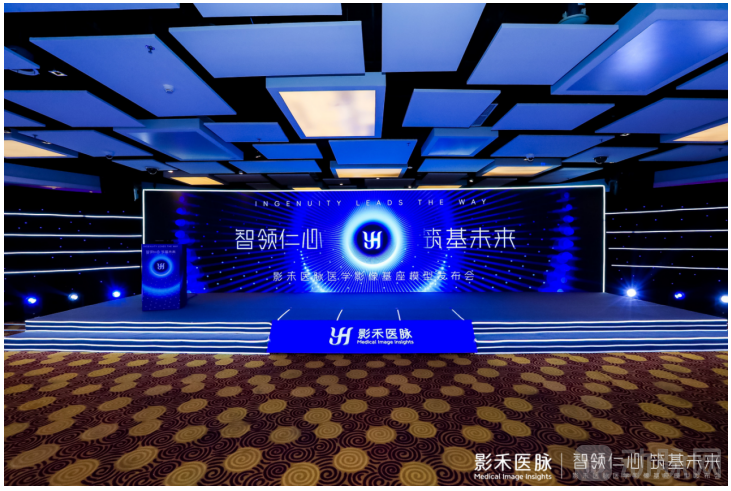
This release marks the public debut of “Yinghe Miya.” The base model, L0-V1.0, successfully achieved convergence through self-supervised training on medical imaging datasets across multiple anatomical regions. Subsequently, downstream task training was conducted using anatomical structure data annotated under the Hetu Project, further enhancing the anatomical structure segmentation capabilities of the preceding version.
At this press conference, strategic partners of Yinghe Medical—including Beijing Tiantan Hospital, Capital Medical University; Yimai Yangguang Medical Imaging Group; The First Affiliated Hospital of Nanchang University; Ruijin Hospital, Shanghai Jiao Tong University School of Medicine; Ande Yizhi Technology; Ant Group; and West China Hospital, Sichuan University—jointly witnessed the power and efficiency of the “Yinghe Miya” L0 foundation model for medical imaging in its research and development paradigm, demonstrating its robust capabilities during validation demonstrations.
“Yinghe Miya” Medical Imaging L0 Foundation Model does not adopt the common industry practice of redeveloping general-purpose large language models. Instead, it is built on Yinghe Yimai’s fully independent R&D, making it a true native medical imaging model. Yinghe Yimai addresses data source limitations through its unique “Living Water Model,” constructing a large-scale, high-quality dataset. The data undergoes standardized processing to ensure usability and consistency, providing a solid foundation for model training.
“Yinghe Miya” leverages an internal large-scale medical imaging dataset comprising tens of millions of images, employing advanced training methodologies such as self-supervised learning and Masked Autoencoders (MAE) for extensive self-supervised pre-training, thereby enabling the model to automatically learn imaging features. Continuous optimization of the model architecture and algorithmic workflow has facilitated a streamlined fine-tuning process across diverse datasets, enhancing overall model performance.
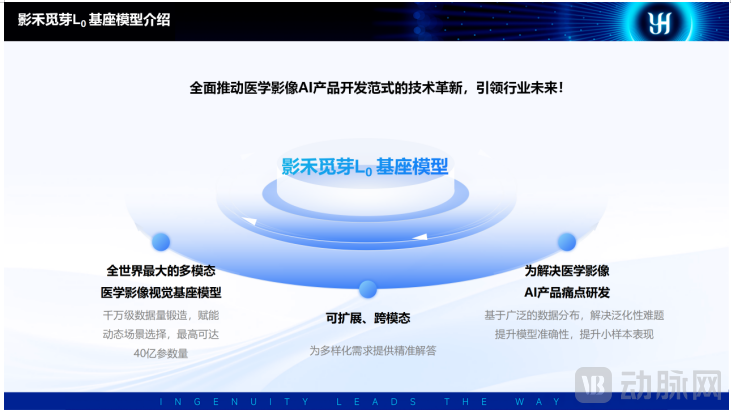
“Yinghe Miya” was specifically developed to address the pain points of AI products in medical imaging. Leveraging extensive data distribution, it overcomes generalization challenges to enhance model accuracy and performance with small samples. Currently, “Yinghe Miya” demonstrates outstanding performance across various downstream tasks. In experiments conducted on the MSD dataset and the Hetu Project dataset, it achieved excellent results in image classification, segmentation, and object detection, with metrics in certain tasks surpassing global state-of-the-art levels, thereby showcasing its robust generalization capability.
Furthermore, the “Yinghe Miya” L0 foundation model for medical imaging serves as the underlying layer with high scalability, enabling users to develop higher-level foundation models based on it and directly supporting specific medical imaging tasks.
As a globally leading, scalable, cross-modal foundational model for medical imaging vision, “Yinghe Miya” can accurately process medical imaging data across multiple modalities, including CT, MRI, X-ray, ultrasound, and nuclear medicine. It supports the entire workflow from image acquisition to diagnostic report generation, pioneering the construction of an AI foundational model in the field of medical imaging that truly achieves report-level learning and generation capabilities with modality scalability. In practical application scenarios, the “Yinghe Miya” foundational model demonstrates broad applicability and can be utilized for various medical imaging tasks, including disease detection, lesion segmentation, risk assessment, and surgical planning.
At this press conference, it was demonstrated that the “Yinghe Miya” foundational model, version L0-V1.0, achieved state-of-the-art (SOTA) performance in anatomical segmentation tasks on public datasets, fully showcasing the model’s robust capabilities.
Yinghe Medical Pulse will leverage the “Yinghe Miya” foundational model for medical imaging as its cornerstone to accelerate the deployment of its four core AI product modules (MIIA-iSpacs, MIIA-iData, MIIA-iResearch, and MIIA-AI) across hospitals at all levels throughout China. By seamlessly integrating artificial intelligence into diverse real-world clinical scenarios, the company aims to continuously lead innovative advancements in medical imaging AI technology, drive transformative breakthroughs in the healthcare industry, and contribute to safeguarding human health.