

Kojun Pharma's Next-Gen Antiplatelet Drug Benzenesulfonic Acid CG-0255 Receives IND Approval in China, Ushering in a New Chapter of Clinical Development
Recently, Shanghai Kejun Pharmaceutical Technology Co., Ltd. (“Kejun Pharma”) announced that two formulations of its self-developed, innovative, first-in-class antiplatelet drug, CG-0255 besylate, have successively received official Investigational New Drug (IND) approvals from the Center for Drug Evaluation (CDE) of the National Medical Products Administration.
CG-0255 besylate is an innovative P2Y12 receptor antagonist, primarily indicated forReducing the Risk of Perioperative Thrombotic Events in Patients with Acute Coronary Syndrome Undergoing Percutaneous Coronary Intervention (PCI), promising to improve the accessibility of antiplatelet drugs for clinical use in emergency settings. The product has already entered Phase III clinical trials in the United States; its recent approval for clinical trials in China underscores Kejun Pharma’s commitment to expanding its presence in the Chinese cardiovascular and cerebrovascular disease market, marking a new chapter in the overall clinical development of this product.
Previously, the results of Phase I clinical trials of CG-0255 besylate in both injectable and oral formulations conducted in the United States were invited for presentation at the 2023 American Heart Association (AHA) Scientific Sessions and the 2024 European Society of Cardiology (ESC) Congress, respectively. Clinical data demonstrated that CG-0255 besylate exhibitedExcellent safety profile, good tolerability, rapid onset of action, sustained efficacy, minimal inter-individual variability in antiplatelet effects, and availability in both injectable and oral formulations.Facilitating application across multiple clinical scenarios, it provides patients and physicians with more flexible and precise therapeutic options, demonstrating the potential to become a best-in-class agent for clinical antiplatelet therapy.
1The World’s First Hydrolytic Thiol Prodrug to Enter Human Clinical Trials: An Innovative Metabolic Pathway Addresses “Clopidogrel Resistance”
In recent years, cardiovascular and cerebrovascular diseases have become one of the leading causes of death worldwide. Among these, coronary artery disease (CAD) is the most common type of cardiovascular disease. Nearly ten million people die annually from acute and chronic coronary syndromes, and the number of prevalent patients has reached hundreds of millions, posing a serious threat to human health and life. According to data from the "Report on Cardiovascular Health and Diseases in China 2023," cardiovascular diseases rank first in the composition of disease-related deaths among both rural and urban residents in China. In 2021, they accounted for 48.98% and 47.35% of all deaths in rural and urban areas, respectively, surpassing cancer and other diseases.
Antiplatelet agents play a pivotal role in comprehensive clinical strategies for the prevention and treatment of coronary heart disease. By reducing platelet activity, these agents inhibit thrombus formation, thereby lowering the risk of myocardial infarction, unstable angina, stroke, and cardiovascular death in patients with cardiovascular disease.
Among various antiplatelet agents, clopidogrel, a P2Y12 receptor inhibitor targeting upstream pathways of platelet aggregation, is one of the most widely used antiplatelet drugs due to its high safety profile and proven efficacy.In 2011, clopidogrel became the world's best-selling drug, with annual global sales of $9.93 billion.
Clopidogrel is an inactive prodrug that must be metabolized by hepatic enzymes (primarily CYP2C19) into the active metabolite H4, which exerts antiplatelet effects.Current research indicates that a significant portion of the global population carries CYP2C19 loss-of-function alleles. This genetic mutation leads to slowed clopidogrel metabolism and diminished antiplatelet effects, resulting in the phenomenon known as “clopidogrel resistance.”
Loss-of-function CYP2C19 alleles are highly prevalent across all ethnic groups, including 21% of the Hispanic population and 25%–30% of the White population, and59% of the East Asian population. Therefore, the FDA has added a boxed warning to the clopidogrel prescribing information, stating the pharmacogenetic risk that “the effectiveness of clopidogrel is reduced in poor metabolizers” and recommending “the use of alternative antiplatelet agents or adjustment of the clopidogrel dosage.”
In 2024, the American Heart Association (AHA) also issued a scientific statement recommendingCYP2C19 Genotyping Should Be Performed Prior to Initiating Oral P2Y12 Inhibitor Antiplatelet Therapy. The statement summarizes a large body of prior observational studies, controlled trials, and meta-analyses, indicating that patients carrying CYP2C19 loss-of-function alleles exhibit significantly reduced levels of active metabolites after clopidogrel administration, along with an increased risk of ischemic events. In this population, the use of ticagrelor or prasugrel can reduce the incidence of ischemic events but may increase bleeding complications. Based on a comprehensive risk–benefit assessment, clinical conclusions support performing CYP2C19 genetic testing before prescribing oral antiplatelet P2Y12 inhibitors to patients with acute coronary syndrome or those undergoing percutaneous coronary intervention.
CG-0255 besylate, a new-generation antiplatelet drug, is a revolutionary product independently developed by Kejun Pharmaceutical through its proprietary targeted prodrug technology platform. It has achieved multiple world-first breakthroughs at the level of medicinal chemistry, becomingThe World’s First Hydrolyzable Thiol Prodrug to Enter Human Clinical Trials. Previously, multiple drug development efforts both domestically and internationally aimed to improve upon clopidogrel; however, these agents still rely on oxidative metabolic pathways to be converted into their active forms in vivo, resulting in significant interindividual variability, delayed onset of action, and the absence of an injectable formulation.
To address this issue at its source, Kejun Pharma has taken a novel approach,Based on an innovative hydrolytic prodrug metabolic pathway design, CG-0255 besylate is converted by carboxylesterase into the active metabolite H4, which is identical to the active metabolite of clopidogrel. This enables efficient, rapid, and consistent inhibition of platelet aggregation, thereby exerting its therapeutic effect.
Carboxylesterases are widely present and distributed in the human body. The innovative activation pathway enables CG-0255 besylate to bypass hepatic enzyme metabolism, thereby avoiding a series of clinical application issues such as drug resistance, low bioconversion rates, and drug–drug interactions associated with existing medications.
Furthermore, since CG-0255 besylate shares the same active metabolite (H4) as clopidogrel, and clopidogrel has accumulated over 20 years of publicly available clinical data and relevant large-scale studies, this may help optimize the clinical trial design for CG-0255 besylate and shorten its time to market.Currently, the FDA has agreed to conduct clinical studies of CG-0255 besylate via the 505(b)(2) new drug application pathway.
Publicly available U.S. Phase I clinical data show that CG-0255 besylateGood safety and tolerability; rapid onset of action, typically taking effect within approximately 15 minutes; irreversible binding to P2Y12 receptors, resulting in sustained antiplatelet effects, with platelet aggregation inhibition still evident at 24 hours post-dosing; no significant interindividual variability in platelet aggregation inhibition.This indicates that CG-0255 besylate has demonstrated clinical potential in addressing "clopidogrel resistance." The novel prodrug design of CG-0255 is highly efficient, and clinical data show that,CG-0255 at a dose equivalent to 1% of clopidogrel can produce the same pharmacodynamic effect as clopidogrel.
2The World’s First Antiplatelet Drug with Both Oral and Intravenous Formulations in Development, Poised to Fill the Gap in the ACS Injectable Market
Notably, CG-0255 besylate is available in both intravenous and oral formulations, making itThe World's First P2Y12 Receptor Inhibitor Developed in Both Oral and Injectable FormulationsClopidogrel can only be administered orally and is not available for intravenous injection. Its onset of action, which requires conversion to the active metabolite, takes approximately 2–8 hours, thereby limiting its clinical application in emergency settings. Globally, cangrelor is currently the only injectable antiplatelet agent approved in the United States, primarily indicated for preventing coronary artery thrombosis in adult patients undergoing percutaneous coronary intervention (PCI). Due to its short half-life and reversible binding to platelets, cangrelor is available only as an intravenous formulation, and intravenous administration must be immediately followed by bridging therapy with a 600 mg dose of clopidogrel.
Currently,CG-0255 besylate injection has completed Phase I clinical trials in the United States, with data demonstrating both rapid onset of action and a low risk of bleeding.Potential in Emergency Clinical Applications Such as First Aid and Surgery: In terms of onset time, CG-0255 besylate can rapidly inhibit platelet aggregation, typically taking effect within approximately 15 minutes, with platelet aggregation inhibition exceeding 90% within 20 minutes after intravenous administration. The platelet aggregation inhibitory effect of CG-0255 besylate is dose-dependent, with a clear dose-response relationship.
In long-term maintenance therapy, CG-0255 besylate is virtually free from drug-drug interactions in clinical practice, thereby enhancing convenience and accessibility for patients requiring concomitant medications.The dual-formulation regimen also offers new therapeutic possibilities for ACS/CCS, allowing for either separate administration or sequential intravenous-to-oral therapy, thereby meeting the clinical need for a flexible transition to long-term, chronic oral medication following PCI.
Furthermore, as an intravenously administrable antiplatelet agent, CG-0255 besylate will address the clinical needs of patients with concurrent dysphagia. According to the Chinese Guidelines for Rehabilitation Management of Dysphagia (2023 Edition), the incidence and prevalence of dysphagia increase with age, with a prevalence of 5.5%–8% in individuals aged over 50 years. The prevalence of dysphagia during the acute phase of stroke is approximately 42%, and can reach up to 80% in patients with brainstem lesions.
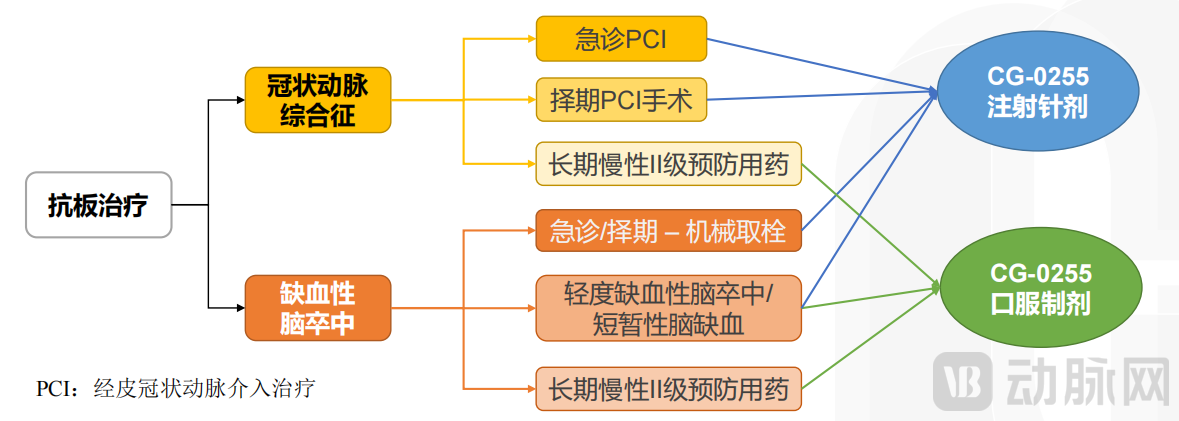 Indication Distribution of CG-0255 Besylate
3Poised to Become the World’s First Injectable Antiplatelet Drug for the Treatment of Ischemic Stroke
Public information indicates that the indications for expansion of CG-0255 besylate includeIschemic Stroke and Related Perioperative Antiplatelet TherapyAccording to the 2022 Global Stroke Data Report, stroke is the second leading cause of death worldwide, with ischemic stroke accounting for 60%–70% of all stroke cases. Globally, there are over 7.6 million new cases of ischemic stroke annually, and 3.3 million people die from ischemic stroke each year. In China, stroke has become the leading cause of death and disability among adults, with an overall upward trend in prevalence. Notably, the incidence rate of ischemic stroke increased from 117 per 100,000 population in 2005 to 145 per 100,000 population in 2019.
Based on previous studies and related guidelines, antiplatelet drugs have established a cornerstone role in the acute phase and long-term secondary prevention treatment of ischemic stroke.However, in the formulation of clinical treatment plans and the selection of antiplatelet agents, greater emphasis is placed on bleeding risks—particularly the occurrence of hemorrhagic transformation (HT)—in the management of ischemic stroke, sequential antiplatelet therapy following thrombolysis, and mechanical thrombectomy for stroke. Relevant studies indicate that hemorrhagic transformation may be part of the natural course of ischemic stroke or may result from the use of antiplatelet drugs, anticoagulants, or thrombolytic therapy.
According to the 2023 Chinese Guidelines for the Diagnosis and Treatment of Acute Ischemic Stroke, the incidence of hemorrhagic transformation after cerebral infarction is approximately 8.5%–30%. Most patients with post-infarction hemorrhage do not exhibit significant clinical worsening, which often leads to underrecognition. Continued use of medications that improve circulation may exacerbate bleeding, resulting in aggravated neurological deficits and increased intracranial pressure, or even brain herniation, thereby endangering life and adversely affecting prognosis, potentially increasing disability and mortality rates.
Therefore, precise control of dosage and bleeding risk is critical for novel antiplatelet agents. Phase I clinical data for CG-0255 besylate have fully demonstrated its safety, tolerability, pharmacodynamics, and pharmacokinetic profile. No bleeding events have been observed in subjects receiving the drug to date. More notably, the clinical data for CG-0255 besylate show a clear dose–response relationship, with drug effect exhibiting a strong linear positive correlation with the concentration of the active ingredient at the target site. This means that,In the future, for stroke-related indications, the development of multiple dosages will align with clinical needs, enabling differentiated treatment plans based on patients' actual conditions, bleeding risks, and other factors.
About Kejun Pharmaceutical
Kejun Pharma, established in 2018, possesses core platform technologies and efficient, independent innovation capabilities. The company currently focuses primarily on therapeutic areas such as cardiovascular and cerebrovascular diseases and antiviral treatments, striving to become an innovative pharmaceutical company rooted in China with a global footprint. Within five years, Kejun Pharma has built two core technology platforms: the Targeted Prodrug Technology Platform and the Nucleic Acid Drug Technology Platform. Leveraging its proprietary platform technologies, Kejun Pharma has developed multiple innovative pipeline drugs with broad market value and independent global intellectual property rights, and is actively advancing the clinical development of several candidates.
Kejun Pharma’s Targeted Prodrug Technology Platform leverages innovative chemical structure modifications to rapidly develop novel targeted prodrugs with significant improvements in pharmacokinetics/pharmacodynamics or safety, based on validated active substance targets. This approach efficiently generates candidate compounds with clinical development value. The platform’s pipeline aims to enhance various drug-like properties, including physicochemical characteristics, delivery and transport efficiency, enzyme selectivity, and compound stability. It may also enable targeted delivery to specific disease-affected organs (such as its broad-spectrum respiratory antiviral pipeline), thereby achieving an optimal balance between efficacy and safety.
Driven by its corporate mission and vision, Kejun Pharma has assembled a team of high-caliber scientists and overseas-returnee talents with a global perspective. Under the company’s comprehensive strategic layout, Kejun Pharma has successfully achieved rapid and efficient translation of R&D outcomes, with all candidates in its pipeline possessing the potential to become First-in-Class or Best-in-Class therapeutics.