Feiming Tech's First "Cervical Motion Assessment and Rehabilitation Training System" Receives Approval, Accelerating Market Expansion
Another Domestic Manufacturer of Virtual Rehabilitation Systems Obtains Certification.
On December 31, 2024, the “Cervical Motion Assessment and Rehabilitation Training System,” developed by Feiming Technology, an innovative enterprise specializing in intelligent rehabilitation products, received market approval (Registration Certificate No.: Chuan Xie Zhu Zhun 20242190413).。
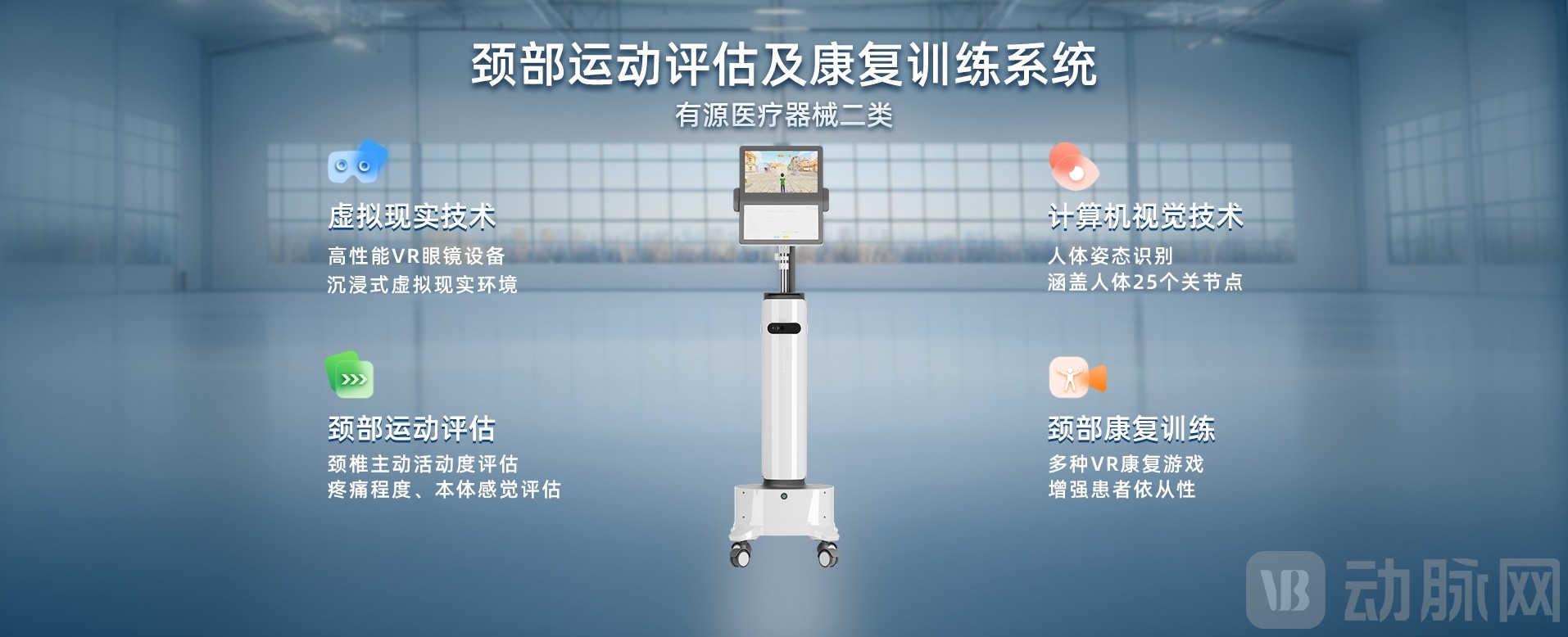 “Cervical Motion Assessment and Rehabilitation Training System,” image provided by the interviewee
According to the head of Feiming Technology, this system is China’s first cervical motion rehabilitation device that integrates virtual reality (VR) with computer vision technology. It is specifically designed for patients suffering from neck pain due to conditions such as cervical spondylosis of the neck type, cervical spondylotic radiculopathy, neck muscle pain, frozen shoulder, and rotator cuff injuries. By leveraging VR and computer vision technologies, the system enables patients to undergo precise, personalized cervical rehabilitation exercises in an immersive environment under guided prompts. This approach not only enhances the enjoyment and engagement of the rehabilitation process but also improves therapeutic outcomes by ensuring correct active movement training.
More Personalized, Precise, and Effective! The First VR Neck Rehabilitation Device Launches
Regarding the original intention behind product development, the head of Chengdu Feiming Technology Co., Ltd. told VCBeat that China’s rehabilitation medical device industry is still characterized by a wide variety of products, small revenue scales among participating companies, and a predominant focus on single product categories, creating an urgent need for the introduction of new products and technologies. Meanwhile,The rapid development of virtual reality (VR) technology has provided a brand-new perspective for rehabilitation therapy.。
This is a simulation technology that constructs a realistic virtual environment, enabling patients to achieve psychological relaxation and comfort. During the rehabilitation process, the integration of VR with rehabilitation robots provides patients with diverse training scenarios and modes. Patients can simulate activities such as walking and running within the virtual environment; this immersive experience not only enhances the enjoyment of training but also improves patient engagement. Furthermore, VR technology can assess and intervene in patients’ psychological conditions, helping them better cope with the psychological stress associated with the rehabilitation process.
To provide patients with more personalized, precise, and effective rehabilitation training programs, Feiming Technology has developed an innovative product that integrates VR technology and computer vision technology for cervical motion assessment and neck rehabilitation training. Through gamified training content design, the tedious treatment process is transformed into an engaging gaming experience. Patients can complete challenges and earn achievements within the game, thereby perceiving the recovery of their motor functions and shifting their attitude toward active rehabilitation from “having to do it” to “wanting to do it.” Moreover, the entire rehabilitation training process is automatically guided by the system, eliminating the need for direct therapist intervention.

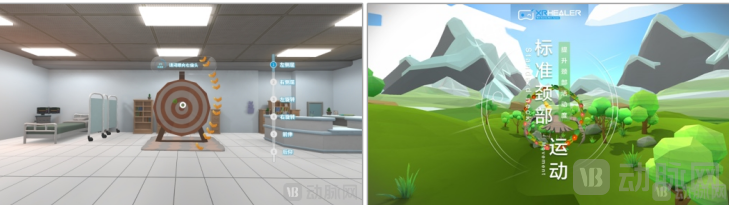
Image of a patient undergoing rehabilitation training while wearing VR; photo provided by the interviewee
However, having patients wear VR headsets for rehabilitation training constitutes a complex scenario. Chengdu Feiming Technology Co., Ltd. has taken into account multiple factors, including patient experience, medical efficacy, technical feasibility, safety, and reliability. Certain core elements of VR technology—such as resolution, field of view, battery life, weight, spatial positioning, body posture recognition, anti-3D motion sickness capabilities, wireless transmission, and computational power—can, to varying degrees, limit the implementation of specific rehabilitation exercises or game scenarios. Meanwhile, ensuring medical efficacy, technical feasibility, and user-friendly experience has become the greatest challenge for the R&D team.
To this end, the R&D team has been engaging in ongoing discussions with physicians to gain a deeper understanding of the underlying principles of movement-based therapy. The head of Chengdu Feiming Technology Co., Ltd. emphasized that all games are designed in accordance with the principles of serious games.Through in-depth discussions with the medical team, Feiming Technology’s game development process strictly adheres to the movement guidelines outlined in clinical protocols, ensuring that every in-game action delivers a clear therapeutic benefit to patients.. This process is not limited to the execution of specific actions or gameplay mechanics; rather, it focuses on leveraging technology to achieve therapeutic efficacy.
On the other hand, the R&D team has also integrated computer vision-based body pose recognition technology to achieve precise tracking of training data and real-time movement correction.A 1-megapixel TOF sensor and a 12-megapixel RGB camera, utilizing a rolling shutter CMOS sensor, ensure human pose sampling at over 30 frames per second, capturing every subtle movement.
To enhance patient convenience, Chengdu Feiming Technology Co., Ltd. has adopted wireless VR devices. These devices feature a high single-eye resolution of 1832×1920 and are equipped with an integrated 360° surround stereo sound system, delivering an immersive auditory experience. The lightweight strap design ensures the device is compact, portable, and easy to wear.
A representative from Chengdu Feiming Technology Co., Ltd. stated: “During training, patients only need to wear VR headsets, offering high flexibility. While ensuring a realistic and smooth virtual reality environment, the system provides real-time training guidance to patients, minimizing the need for extensive medical staff intervention and significantly freeing up therapist resources.。”
Accelerate Market Expansion Along Two Key Directions
Since 2017, Chengdu Feiming Technology Co., Ltd. has been deeply engaged in the fields of neuroscience and neurorehabilitation. By integrating cutting-edge computer technologies such as virtual reality (VR), big data, and artificial intelligence, the company has successfully developed a product line of rehabilitation devices with independent intellectual property rights, extensively covering the two major areas of spinal rehabilitation and neurorehabilitation. In 2021, Feiming Technology’s independently developed “Cervical Motion Assessment and Rehabilitation Training Device” was recognized as a provincial innovative medical device, and it was subsequently designated as a “Key Provincial Medical Device Project” the following year.
With the approval and market launch of the “Cervical Motion Assessment and Rehabilitation Training System,” Chengdu Feiming Technology Co., Ltd. is actively advancing its strategic layout in two key areas: marketing and sales, and technological innovation.
In terms of marketing and sales, Chengdu Feiming Technology Co., Ltd. adopts a two-pronged strategy. On one hand, it adheres to the traditional agency sales model for medical devices, actively engaging with agents and distributors, participating in various exhibitions and academic conferences, and further advancing sales efforts. On the other hand, given that cervical spondylosis has been listed as one of the key basic conditions prioritized for diagnosis and treatment in China’s township and community healthcare settings, Feiming Technology leverages its innovative advantages in the integration of physical exercise and medicine. Capitalizing on its products’ exceptional performance in operational convenience, patient compliance, and standardization of treatment protocols, the company is actively exploring new application scenarios such as community-based rehabilitation and rehabilitation clinics, while piloting innovative payment service models to expand its market boundaries.
Notably, Chengdu Feiming Technology Co., Ltd.’s “Cervical Motion Assessment and Rehabilitation Training System” won the Third Prize at the 1st Chengdu Sports Industry Innovation and Entrepreneurship Competition, sponsored by the “China Sports Lottery Cup · Vitality Chengdu,” and reached an intent cooperation agreement with Chengdu Sports Investment Group, further expanding its collaborative network in the rehabilitation medicine sector.
In terms of technological innovation, Chengdu Feiming Technology Co., Ltd. will continue to increase its R&D investment, dedicating itself not only to developing new products but also to iteratively upgrading existing ones. By reducing costs and improving efficiency, the company aims to provide more competitive rehabilitation medical device products. It is understood that Feiming Technology will explore an innovative model integrating “immersive virtual reality + motion capture systems + remote rehabilitation,” working closely with partner medical institutions to jointly promote dual innovation in both technology and clinical scenarios. Furthermore, Feiming Technology remains committed to a product diversification strategy, developing a variety of rehabilitation products in response to market demands to meet the diverse needs of patients.
Breaking Through Three Major Barriers, Virtual Rehabilitation Systems Accelerate Development
Currently, the domestic virtual rehabilitation market in China is entering a phase of rapid growth. Data from Boyan Consulting shows that by 2023, the market size of China's virtual rehabilitation system industry had surged to approximately RMB 12 billion, doubling from RMB 6 billion in 2020, and is projected to further expand to RMB 20 billion by 2025.
Against this backdrop, entrepreneurs have flocked in, and investors have also paid close attention. “However, the virtual reality rehabilitation industry still faces three major barriers: technology, capital, and policy.“The head of Feiming Technology told VCBeat. ‘The technical barriers are mainly reflected in how to effectively combine rehabilitation therapy with virtual reality technology, which not only requires strong R&D capabilities and profound technical accumulation but also necessitates in-depth cooperation with professional research institutions. The capital barrier stems from the huge financial investment required for the development and market promotion of rehabilitation equipment. In addition, policy barriers are an issue that cannot be ignored; the approval and regulation of medical devices are very strict, requiring companies to strictly comply with relevant regulations and standards.’”
The virtual rehabilitation systems sector is crowded with competitors; to achieve success, innovative enterprises must accelerate the development of their competitive advantages.As a technology-driven enterprise, Feiming Technology is strategically positioning itself across multiple dimensions, including technological innovation, product diversification, market education, and industry-academia-research collaboration.
Feiming Technology’s current R&D portfolio covers multiple indications and diverse application scenarios, ensuring comprehensive coverage across the three-tier healthcare delivery system comprising hospitals, community health centers, and home care. Meanwhile, in niche segments, Feiming Technology plans to launch differentiated products to meet rehabilitation needs at various stages. Notably, leveraging national policy support and the green channel for medical device approval, Feiming Technology will accelerate its product commercialization process. As technology continues to mature and market presence expands, Feiming Technology is poised to deliver efficient and convenient rehabilitation solutions to more patients in the field of virtual rehabilitation.
“Cervical Motion Assessment and Rehabilitation Training System” is now open for nationwide distributor recruitment in China. If you are a distributor interested in this medical product and solution, please scan the QR code below to contact us.