

75 Million USD Deal Marks Major Collaboration in China's Radiopharmaceutical Sector at the Start of the Year

Eckert & Ziegler AG
One of the largest suppliers of isotope technology for medical, scientific, and industrial use worldwide
On January 14 (local time), Eckert & Ziegler and Qi Kang Medical (a joint venture established by Eckert & Ziegler and Dongcheng Pharmaceutical) announced the conclusion of a strategic licensing agreement. Under the agreement, Qi Kang Medical is authorized to utilize Eckert & Ziegler’s cyclotron technology for the production of the radioactive isotope actinium-225 (Ac-225). In return, Eckert & Ziegler will receive a one-time payment of €10 million (approximately RMB 75.24 million), as well as royalties on Ac-225 sales.
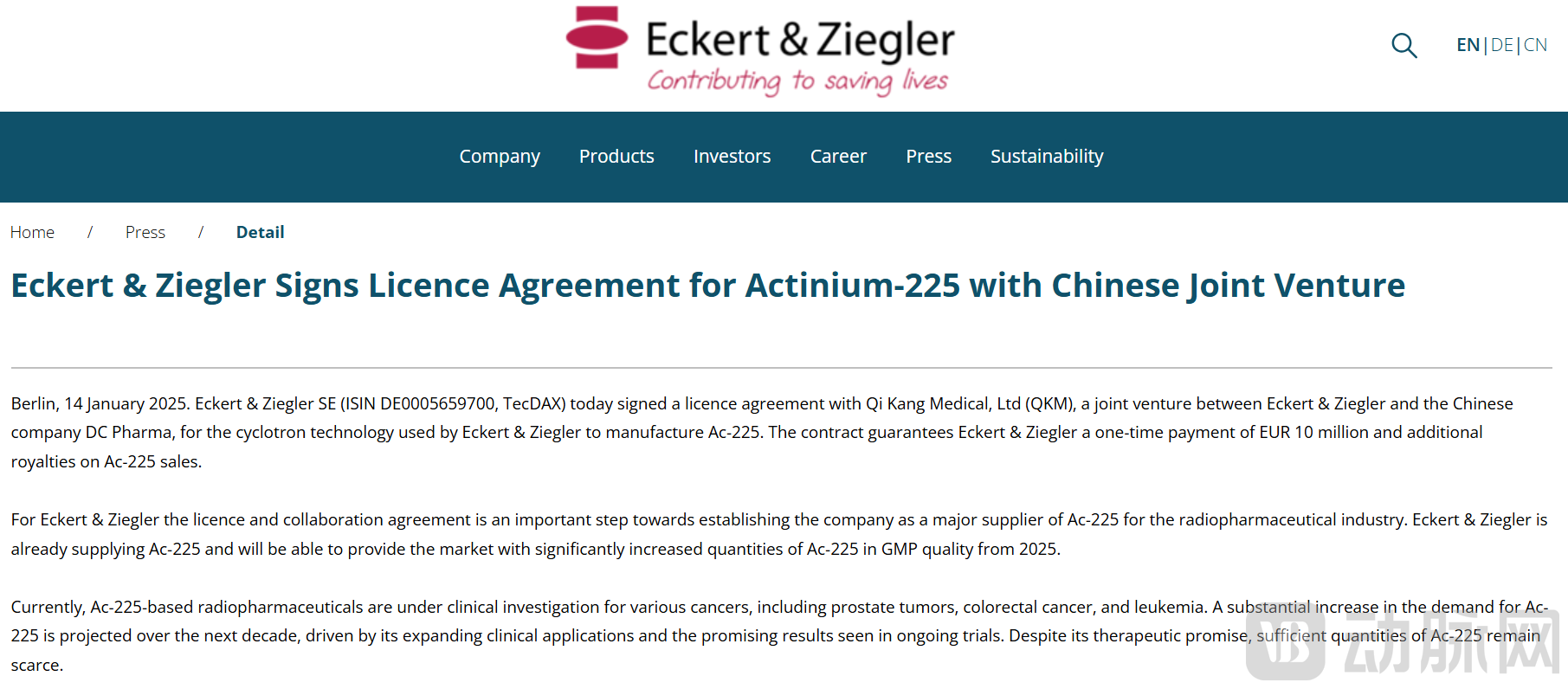
This collaboration, image source: Eckert & Ziegler official website
One of the partners, Eckert & Ziegler, was founded in 1997 and is headquartered in Berlin, Germany. It is one of the world’s largest providers of isotopes for medical, scientific, and industrial applications. Its predecessor was BEBIG Isotopentechnik und Umweltdiagnostik GmbH (BEBIG GmbH), established in 1992 by Andreas Eckert and Dr. Jürgen Ziegler, which initially focused on producing low-activity radioactive sources for industrial and medical use. Currently, Eckert & Ziegler’s core businesses include cancer therapy, industrial radiometric measurement, and nuclear medicine imaging, offering customers comprehensive services from early-stage development to commercialization.
The other partner, Qi Kang Medical (Qi Kang Yuan Medical Technology), is a joint venture established by Eckert & Ziegler and Dongcheng Pharmaceutical.In November 2023, Dongcheng Nuclear Medicine, a wholly-owned subsidiary of Dongcheng Pharmaceutical, signed a joint venture agreement with EZP, a subsidiary of Eckert & Ziegler. The two parties reached a consensus on Dongcheng Nuclear Medicine’s capital injection and equity stake in Qi Kang Medical Technology, as well as their collaborative development of medical isotopes. Prior to the capital injection, EZP held 100% of the equity interest in Qi Kang Medical Technology.Following the capital increase, its shareholding structure is as follows: EZP holds 50% of the equity, and Dongcheng Nuclear Medicine holds 50% of the equity.The transaction amount is EUR 20 million paid by each party.
In fact, since entering the radiopharmaceutical sector in 2014, Dongcheng Pharmaceutical has been focusing on building a comprehensive industry chain spanning from diagnostic to therapeutic radiopharmaceuticals, with a full-scale layout in integrated theranostics and precision medicine.
In addition to increasing its capital investment in Qi Kang Medical Technology, Dongcheng Pharmaceutical has, in recent years, acquired companies such as Chengdu Yunke Pharmaceutical, Shanghai Yitai Pharmaceutical, GMS (China), and Andike Zheng. These strategic moves have established a comprehensive layout covering diagnostic radiopharmaceuticals, therapeutic radiopharmaceuticals, and nuclear pharmacies. The company has built five major platforms: a stable radionuclide supply platform, a drug incubation platform, a translation service platform, a production and distribution platform, and a diagnosis-and-treatment marketing platform. This has essentially completed Dongcheng Pharmaceutical’s full-industry-chain layout in nuclear medicine—spanning raw material supply, R&D, clinical translation, production, and sales—thereby constructing a complete nuclear medicine ecosystem for Dongcheng Pharmaceutical.
Currently, Dongcheng Pharmaceutical has established nuclear medicine subsidiaries or branches in dozens of cities across China. According to data from Xin Kang Jie, Dongcheng Pharmaceutical holds a market share of approximately 21.6% in the nuclear medicine sector, ranking second only to China Isotope & Radiation Corporation.
For Dongcheng Pharmaceutical, both the previous capital increase in Qi Kang Medical Technology and the current collaboration between Eckert & Ziegler and Qi Kang Medical Technology have further laid a solid foundation for building its full industrial chain of radiopharmaceuticals. This comprehensively safeguards the company’s future supply needs for radionuclides used in integrated diagnostic and therapeutic radiopharmaceuticals, holding significant importance for enhancing its capabilities in the nuclear medicine industry and ensuring its strategic development. For Eckert & Ziegler, this collaboration represents a crucial step toward establishing itself as a major supplier of Ac-225 radionuclides.
Alpha-emitting radionuclide radiopharmaceuticals offer unique advantages in tumor therapy, including superior tumor eradication and a lower risk of recurrence. Due to their short path length, alpha emitters cause minimal damage to normal tissues with virtually no side effects, thereby ensuring a higher safety profile. Furthermore, while destroying cancer cells, alpha emitters can induce anti-tumor immune responses, creating a synergistic effect with immunotherapy that achieves an outcome greater than the sum of its parts.
Among alpha-emitting radionuclides, Actinium-225 (Ac-225) stands out with a half-life of 9.9 days, allowing formulated Ac-225 radiopharmaceuticals to maintain a shelf life of up to 120 hours. Furthermore, Ac-225-based drugs demonstrate significant therapeutic potential against widely disseminated micrometastases and are applicable in the treatment of conditions such as pancreatic cancer, prostate cancer, neuroendocrine tumors, and leukemia. Evidently, owing to its high linear energy transfer (LET), suitable half-life, short particle range, and favorable chelation properties, Ac-225 has become one of the most prominent focal points in alpha-radionuclide research and development.
Seizing on this trend, multinational corporations (MNCs) have aggressively expanded into the Actinium-225 (Ac-225) radionuclide sector in recent years. For instance, in December 2023, Bristol Myers Squibb (BMS) acquired radiopharmaceutical star RayzeBio for $4.1 billion; in March 2024, AstraZeneca acquired Fusion, a developer of novel radionuclide conjugate drugs, for $2.4 billion; in May 2024, Novartis acquired nuclear medicine biotechnology company Mariana Oncology for $1.75 billion; and also in May 2024, Eli Lilly entered into an $1.16 billion collaboration with Aktis Oncology to develop innovative radiopharmaceuticals. Underpinning all these deals is the prominent role of Ac-225.
According to incomplete statistics, there are 20 Ac-225 radiopharmaceutical pipelines in clinical development worldwide, with two drugs having entered Phase III clinical trials. According to Clairvoyance Research’s 2022 global market study, the annual demand for Ac-225 is projected to reach approximately 17 Ci in 2025 and 523 Ci in 2031.
Despite strong demand and heightened clinical development activity, the supply of the Ac-225 isotope remains extremely tight. This shortage has impacted the development and market launch of multiple drugs; for instance, clinical enrollment in RZY101, a pipeline asset from RayzeBio (acquired by BMS), was forced to pause due to the Ac-225 supply shortfall.
Currently, there are no mature suppliers of the Ac-225 nuclide in China.Radionuclides produced for radiopharmaceutical applications at China’s foundational nuclear power plants—such as those in Mianyang, along the Minjiang River, and at Qinshan—do not include Ac-225. Nevertheless, certain research institutions and enterprises have initiated early-stage R&D and production efforts. For instance, Panmeidi Holdings, established in 2023, has partnered with the Institute of Nuclear and New Energy Technology at Tsinghua University to enter the Ac-225 development arena. Additionally, a team led by Qin Zhi from the Chinese Academy of Sciences has successfully produced the medical isotope Ac-225 using domestically developed heavy-ion accelerator facilities.
Globally, the current annual production of the Ac-225 nuclide is approximately 1.8 Ci, primarily relying on a few entities such as Oak Ridge National Laboratory (ORNL) in the United States, Eckert & Ziegler, and NorthStar. In particular, no institution is currently capable of supplying high-purity, GMP-grade Ac-225. This scarcity in production has created a significant supply gap, earning Ac-225 the moniker “the rarest drug on Earth,” with its price once peaking at $1 million per mCi.
To address supply challenges, many large pharmaceutical companies have chosen to sign supply agreements with multiple reputable manufacturers to mitigate the risks associated with Ac-225 raw material shortages or delayed deliveries. For instance, Bayer has established supply agreements with Ionetix, PanTera, and NorthStar, while Telix has secured agreements with Eckert & Ziegler and Cardinal Health. Notably, Eckert & Ziegler, a partner in this current collaboration, also reached an agreement with Fulin Technology in January 2024 to supply high-purity Ac-225 isotopes for the development of next-generation therapeutic radiopharmaceuticals.
Eckert & Ziegler is also working to address the global shortage of the Ac-225 radionuclide. According to the announcement, this collaboration represents a significant step in establishing the company as a major supplier of Ac-225 in the field of radiopharmaceuticals. It is reported that Eckert & Ziegler will be able to provide large-scale, GMP-compliant Ac-225 to the market starting in 2025. It is also expected that as technical challenges in production processes are gradually overcome, the supply of Ac-225 will improve, and domestically produced radionuclides in China will eventually have the capacity to replace imports.
Reference: "Global Race for Radionuclides | On the Frontline"