

Silk Fibroin Breakthrough: Xingyue Bio's 19-Year Innovation Journey Yields Multiple Industry Firsts
Silk fibroin is a novel biomaterial with significant potential for regenerative applications.
In the healthcare sector, silk fibroin, as a biomedical material, possesses biocompatibility and biodegradability, making it suitable for manufacturing bone tissue repair materials, artificial skin, medical biological dressings, and microcapsules. In the skincare industry, silk fibroin offers advantages such as moisturizing properties and excellent film-forming ability, enabling its use in the production of facial masks, creams, sunscreens, and other skincare products.
The head of the team at Zhejiang Xingyue Biotechnology Co., Ltd. explained to VCBeat that silk fibroin itself possesses a range of excellent mechanical properties and physicochemical characteristics. It not only boasts superior flexibility and tensile strength, but also exhibits outstanding breathability, moisture permeability, and sustained-release performance. These properties enable silk fibroin to be processed into medical products in various forms, thereby meeting the needs of different tissue repair applications.
Therefore, the field of silk fibroin has also attracted a number of outstanding enterprises engaged in the research, development, and production of biomaterials. Zhejiang Xingyue Biotechnology Co., Ltd. is one such company.
Since its establishment in 2010, Xingyue Biotechnology has been dedicated to the extraction and medical translational applications of innovative silk fibroin biomaterials.To date, Zhejiang Xingyue Biotechnology Co., Ltd. has successfully applied silk fibroin in high-end sectors such as medical devices, medical aesthetics, and functional skincare. Meanwhile, the company is actively exploring the potential applications of silk fibroin in emerging fields including food, health supplements, and biochips, thereby further expanding its market boundaries.
Producing Medical-Grade Instant Silk Fibroin with 99.9% Purity at Ton-Scale, Achieving Digitalized Mass Production
Silk, this ancient and precious natural material, serves as the cornerstone of innovation for Zhejiang Xingyue Biotechnology Co., Ltd. Silk is composed of fibroin (accounting for approximately 72%–81% of total protein) and sericin (accounting for approximately 19%–28% of total protein). During the silk-spinning process, fibroin is secreted by the posterior silk gland to form robust fibers; as these fibers pass through the middle and anterior silk glands, sericin is secreted and uniformly coats them. The core component, fibroin, is a fibrous protein rich in 18 types of amino acids, including all eight essential amino acids required by the human body. Notably, glycine, alanine, and serine collectively constitute more than 80% of its total composition, endowing silk with unique biological activity and application potential.
However, throughout the development of silk fibroin, the stable mass production of raw materials has remained a key factor constraining industry growth. To break through this bottleneck, Xingyue Biotechnology addressed the issue at its source. In 2011, Xingyue Biotechnology established its first “Medical-Grade Silk Raw Material Base” in Qiandao Lake, Zhejiang Province. In 2018, the company further expanded its scale by adding a 100-mu medical-grade silk raw material base. This base covers the entire industrial chain—from mulberry tree cultivation and silkworm egg selection to cocoon rearing and silk processing—achieving a fully traceable, sustainable, and highly controlled production model.
In Yongkang, Jinhua, Zhejiang, Xingyue Biotechnology has established an automated production base featuring a Grade 10,000 GMP cleanroom workshop spanning over 10,000 square meters. Here, the company has independently developed the world’s first production line for medical-grade silk fibroin raw materials. Leveraging advanced automated, aseptic, and digital facilities, Xingyue Biotechnology achieves large-scale production of medical silk fibroin raw materials and related products.
Moreover, Xingyue Biotechnology has mastered core technologies including global high-purity silk fibroin extraction, molecular recombination, enzymatic degradation, and crystallization-based film formation. Notably, the flexible application of multi-functional modification technology enables Xingyue Biotechnology to customize and optimize various properties of silk fibroin according to actual needs, such as enhancing mechanical strength or regulating degradation rates. This capability facilitates the development of diverse silk fibroin material forms—including solutions, sponges, hydrogels, and membranes—precisely meeting the varied demands of the high-end medical sector.It is reported that, leveraging high-purity extraction technology, Zhejiang Xingyue Biotechnology Co., Ltd. has increased the purity of silk fibroin to 99.9% and established a digitalized, large-scale production line with an annual capacity of over 6 tons of medical-grade silk raw materials.
Multiple Firsts! Accelerating Market Expansion
On September 11, 2024, Zhejiang Xingyue Biotechnology announced that its silk fibroin composite gel product, Si An Yan® HAN01, had officially received approval from the National Medical Products Administration (NMPA). Composed of silk fibroin, sodium hyaluronate, and other components, this composite gel is the first silk fibroin-based composite gel product approved in China.
The highlight of Si’an Yan® HAN01 lies in the β-sheet structure of its silk fibroin microgels, which feature smooth surfaces and uniform particle size. By combining these microgels with non-cross-linked sodium hyaluronate gel in an optimal ratio, the product enables sustained, low-concentration stimulation to induce tissue regeneration over an extended period. Its semi-opaque, milky-white gel texture effectively prevents the Tyndall effect.
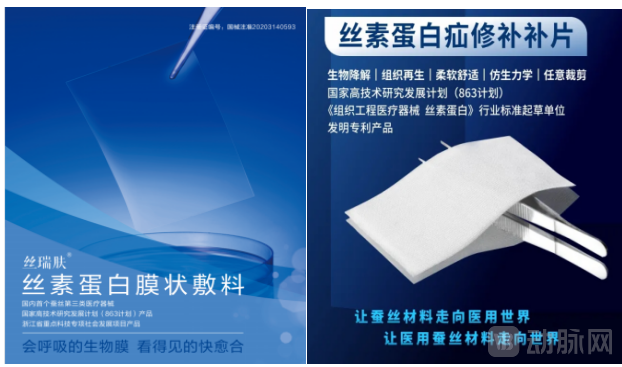
Xingyue Biotech’s medical device products, photo provided by the interviewee
In fact,Zhejiang Xingyue Biotechnology Co.,Ltd.'s strategic layout extends beyond high-end medical aesthetics brands.As early as June 2020, Zhejiang Xingyue Biotechnology Co., Ltd. had already achieved a major breakthrough in the field of medical devices—Its developed "silk fibroin membrane dressing," made from mulberry silk, has received approval from the National Medical Products Administration.This marks the first attempt to apply silk fibroin in the field of Class III medical devices.. This dressing utilizes purified silk fibroin molecules that partially crystallize to form a dense, transparent, and breathable membrane, providing a moist yet non-exudative healing environment for skin wounds and promoting the repair and regeneration of epithelial tissue.
In addition, Zhejiang Xingyue Biotechnology Co.,Ltd. has also launchedThe World’s First Multicenter Clinically Validated Silk-Based Hernia Repair Product—Silk Fibroin Hernia Repair Mesh. This product is manufactured from mulberry silk through processes including weaving, purification, and shaping. It is indicated for open preperitoneal repair of inguinal hernias. By providing mechanical support and gradually degrading as tissue repair progresses, the product ultimately achieves restoration through host-regenerated tissue, with favorable outcomes demonstrated in clinical trials. In addition, Zhejiang Xingyue Biotechnology Co., Ltd. has expanded its portfolio to include multiple regenerative medical products, such as silk fibroin gel dressings and scaffolds for articular cartilage regeneration.
To ensure efficient production of silk fibroin products and rapid market penetration, Zhejiang Xingyue Biotechnology Co., Ltd. has established an end-to-end value chain spanning basic research, raw material processing, and industrial commercialization. In terms of production, the company has built a 5,000-square-meter GMP-compliant manufacturing workshop and laboratory, equipped with advanced R&D and medical-grade production facilities, thereby positioning itself as a full-industry-chain platform enterprise for silk fibroin. For market promotion, Zhejiang Xingyue Biotechnology has launched multiple brands, including “Siruifu,” “Si’anyan,” and “Paji.” By adopting an integrated online-and-offline strategy, the company promotes its products on major e-commerce platforms and participates in academic and industry exhibitions to stimulate market demand.
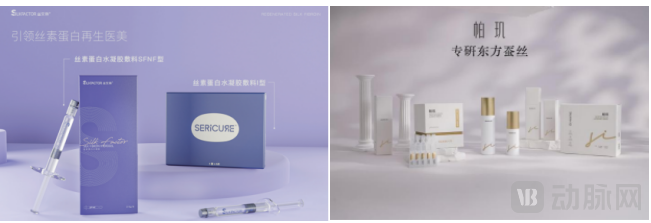
Xingyue Biotech’s medical aesthetics (left) and skincare (right) products. Photo provided by the interviewee
The head of Zhejiang Xingyue Biotechnology Co.,Ltd. revealed:“In recent years, Zhejiang Xingyue Biotechnology Co., Ltd. has witnessed a steady growth in sales within the biomedical materials sector, with its market share expanding year by year. Its customer base spans multiple sectors, including medical institutions, research organizations, and cosmetics companies, while market demand continues to rise.””
# Multi-Party Collaboration to Break Down Industry Barriers
Currently, the biomaterials industry is exhibiting a positive development trend, with continuous market expansion, technological innovation driving sectoral growth, and constantly broadening application fields. According to data from Zhiyan Consulting, the market size of China's biomedical materials industry has grown from RMB 173 billion in 2016 to RMB 664 billion in 2023.
It is worth noting that China’s biomedical materials industry remains characterized by fragmentation, disorder, and heterogeneity. This has led to intense and chaotic domestic competition, coupled with weak market innovation capabilities. Consequently, domestically produced biomedical materials are still predominantly low-end products, while the industrialization of high-end biomedical materials has progressed slowly. Imported products account for half of China’s high-end biomedical materials market.A representative from Zhejiang Xingyue Biotechnology Co., Ltd. stated that China’s biomaterials industry is currently facing multiple barriers, including technological, financial, and policy-related challenges.。
First, there are significant technical barriers. The biomaterials industry involves the intersection of multiple disciplines, including materials science, life sciences, and biology. This cross-disciplinary nature, combined with the need for high-precision manufacturing equipment, requires innovative enterprises to possess sustainable R&D capabilities and adhere to high-standard production and manufacturing processes. Second, there are capital barriers. Substantial financial investment is required from basic research to market promotion, covering expenses such as the procurement of R&D equipment and experimental materials, as well as clinical trial costs. Building brand trust and distribution channels demands the accumulation of time and resources, characterized by high input and long cycles. Furthermore, regarding policies and regulations, medical devices are closely linked to human life and health. Products must undergo rigorous approval and certification, involving extensive clinical trials and safety evaluations. With high difficulty in obtaining approval and lengthy review periods, companies are required to establish robust quality management systems and strictly comply with industry regulatory requirements.
Therefore, in terms of technological innovation, Zhejiang Xingyue Biotechnology Co., Ltd. builds on multiple innovation platforms, including the Zhejiang Provincial Key Enterprise Research Institute and the Zhejiang Provincial Key Laboratory, and has established close industry-academia-research collaborations with numerous universities. The company focuses on promoting the integration of regenerative medicine and tissue engineering with biotechnology, advancing the development and industrialization of novel high-biocompatibility medical materials, and achieving import substitution for medical device products.
It is reported that,Zhejiang Xingyue Biotechnology Co., Ltd. relies on independent research and development, has cumulatively filed nearly forty invention patents related to biomaterials, obtained national medical device registration certificates for multiple products, completed numerous master file registrations for medical device raw materials, and participated in the drafting of multiple industry standards, group standards, and international standards.
In terms of collaboration and brand building, the company partners with renowned domestic universities, research institutions, and authoritative hospitals to establish close industry-academia-research collaborations. Its business scope covers medical devices, medical aesthetics, and skincare, while continuously enhancing product visibility through promotional efforts.
Looking ahead, Zhejiang Xingyue Biotechnology Co., Ltd. will focus on developing a novel platform-type biomaterial that positions silk fibroin alongside synthetic polymers, metal alloys, and animal tissue-derived materials. The company also plans to expand its development efforts into the fields of food, health supplements, and biochips. As an industry explorer and pioneer in medical silk materials, Xingyue Biotech is committed to addressing the critical bottleneck issues facing medical biomaterials, facilitating the transformation of the traditional silk industry from “daily apparel” to “healthcare applications,” and driving the high-quality development of new quality productive forces in medical silk.