

United Imaging's Bold Bet: Doubling Down on Medical AI Amid Commercialization Challenges
United Imaging
High-end Medical Device Developer
Amid the turbulent times for medical imaging AI, United Imaging is making significant strategic investments.
At the end of last year, United Imaging and its early investors conducted an equity acquisition at a price of RMB 1 billion, propelling its sister company, United Imaging Intelligence, to a valuation of RMB 10 billion—far exceeding industry peers.
In less than a month, Shanghai United Imaging High-Tech Research Institute Co., Ltd. established another subsidiary, United Imaging Technology Innovation (Beijing) Co., Ltd., focusing on the development of foundational and application software for artificial intelligence, thereby further strengthening and integrating medical AI capabilities within its system.
Faced with the fact that imaging AI has yet to demonstrate a profitable business model, United Imaging’s extensive strategic investments amount to little more than another high-stakes gamble.
In 1998, after spending a decade in the United States, Xue Min decisively returned to China with a group of overseas students to establish Shenzhen Meditec, pioneering China’s first 1.5T magnetic resonance imaging (MRI) system despite the lack of any precedent to follow. Today, as times have changed, United Imaging, now boasting a market capitalization exceeding RMB 100 billion, appears confident in replicating that earlier success.
Prior to the recent frequent adjustments, United Imaging had already made in-depth strides in the AI sector.
At the end of 2017, the newly established United Imaging Intelligence was entrusted with the critical mission of driving the digital and intelligent transformation of medical imaging. The founding team boasted exceptional credentials: Co-founder Zhou Xiang previously served as the Global Head of Computer-Aided Detection and Diagnosis at Siemens Healthineers, while Co-founder Dinggang Shen is a tenured professor at the University of North Carolina at Chapel Hill. Indeed, United Imaging Intelligence started out at the pinnacle of the industry.
Furthermore, United Imaging Intelligence benefits from the substantial R&D and commercialization support provided by its parent company, United Imaging. The latter’s steadily increasing market share in medical imaging equipment not only supplies United Imaging Intelligence with richer clinical information and training data—enabling precise insights into clinical needs for the design of AI-assisted diagnostic tools and the rapid, accurate development of AI applications—but also facilitates the seamless integration of United Imaging Intelligence’s AI solutions into various imaging devices, thereby offering a low-cost, efficient pathway for commercial deployment.
With its substantial competitive advantages, United Imaging Intelligence has expanded rapidly in the field of AI-assisted diagnosis. As of December 31, 2024, United Imaging Intelligence had obtained 22 Class II and 12 Class III medical device registrations from China’s National Medical Products Administration (NMPA), with 15 applications receiving FDA clearance and 13 applications obtaining CE certification in the European Union, thereby establishing a significant lead over its competitors.
However, while AI-assisted diagnosis has assumed a pivotal role in the digital transformation of medical imaging, its applications have been almost exclusively confined to the diagnostic phase of the clinical workflow. Therefore, as United Imaging Intelligence engaged in hands-on exploration, United Imaging also established subsidiaries such as United Imaging Zhiron and United Imaging Zhiyuan to build an ecosystem powered by imaging AI.
Among these, United Imaging Intelligence represents a horizontal strategic extension of United Imaging, aiming to gradually expand diagnostic digital intelligence into a comprehensive, multi-modal intelligent ecosystem covering the entire diagnosis and treatment workflow. Consequently, its solutions encompass not only in-hospital testing and treatment but also out-of-hospital rehabilitation and prevention, thereby advancing United Imaging’s AI ecosystem from single-scenario empowerment in imaging diagnostics to holistic smart clinical diagnosis and treatment.
To date, United Imaging Intelligence has secured regulatory approvals for a wide range of surgical consumables and equipment, and has also obtained certification for three AI-powered solutions designed to enhance surgical procedures: the Neurosurgical Navigation and Positioning System, the Hip Arthroplasty Navigation and Positioning System, and the Joint Arthroplasty Surgical Planning Software.
With the integration of numerous AI-assisted diagnostic applications from United Imaging Intelligence, United Imaging’s closed-loop digital and intelligent diagnosis and treatment system has taken initial shape.
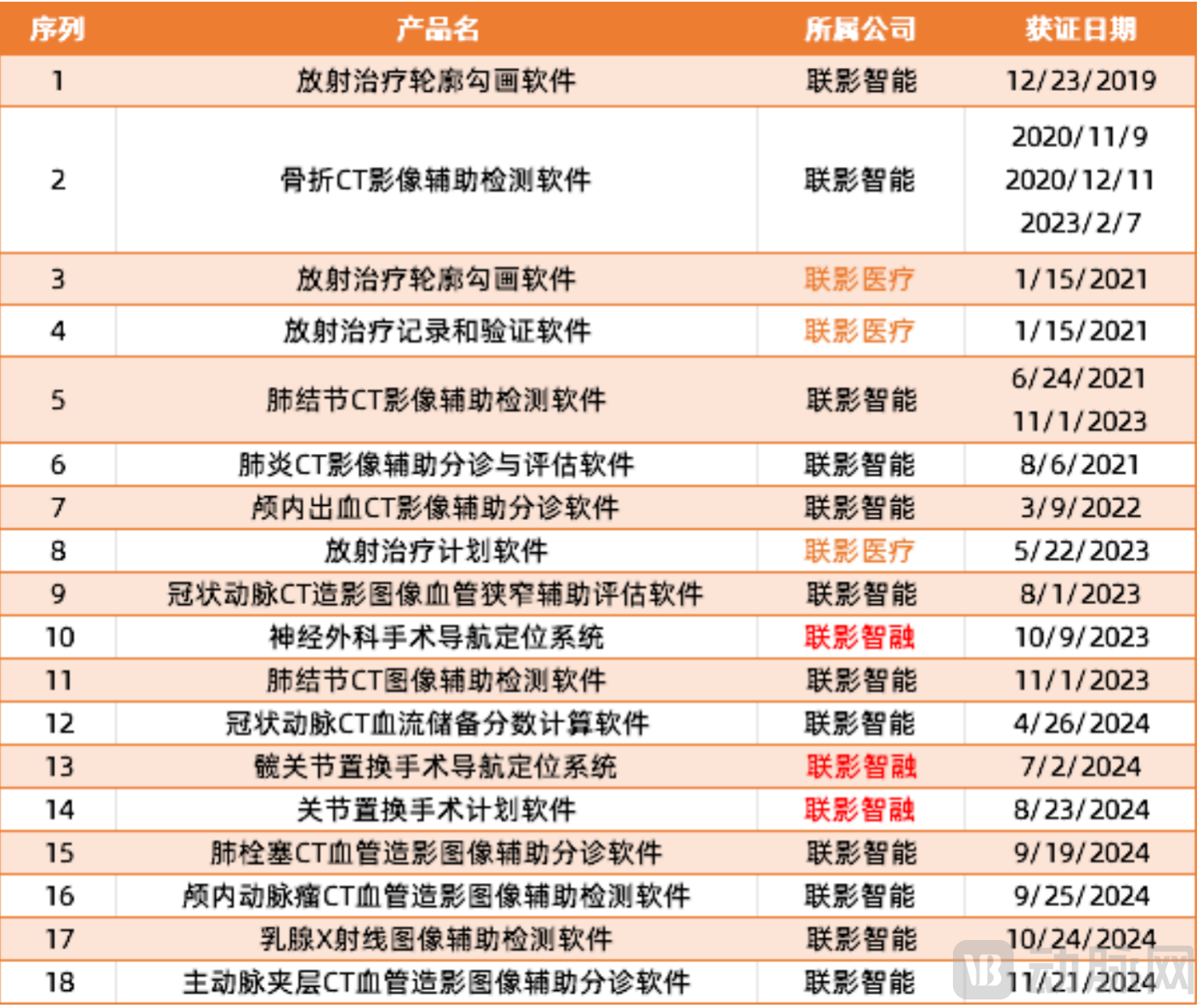
Statistics on AI Market Access Approval for United Imaging’s Subsidiaries
Although United Imaging’s AI ecosystem boasts both depth and breadth, surpassing most competitors in the market, significant issues remain evident in its actual operational data.
Public data shows that United Imaging Intelligence generated RMB 254 million in revenue for the full year of 2023, with a net loss of RMB 136 million. Other AI-related subsidiaries are also operating at varying levels of deficit, remaining considerably distant from profitability.
The underlying causes can be broadly categorized into two aspects.
First, domestic medical institutions have historically been reluctant to pay for software, and the economic downturn over the past two years has further weakened their willingness to do so. Under these circumstances, the price hospitals are willing to pay for imaging AI has remained low, failing to adequately cover R&D costs.
Secondly, the capabilities of current AI in medical imaging are limited; they focus on improving efficiency rather than enhancing quality, making it difficult for healthcare institutions and patients to pay for their value.
Currently, all image AI products that have passed registration and access on the market are single-disease AI, capable of providing intelligent diagnosis for a specific disease. However, what doctors need is an AI that can identify all potential diseases in medical images through a single operation. Even though self-built imaging platforms may already possess double-digit Class III certifications for AI, United Imaging Intelligence still struggles to cover all diseases related to a single organ. Hospitals must integrate applications from multiple companies to meet their needs.
Had this been a few years ago, United Imaging would have had ample time to gradually address these issues and help United Imaging Intelligence steadily enrich its AI pipeline. However, AI platforms centered around medical equipment manufacturers and provincial or municipal data centers have now emerged in large numbers. By integrating applications from numerous startups, these ecosystems have already matched or even surpassed United Imaging’s AI capabilities.
Breaking the Deadlock: United Imaging Has Many Paths to Choose From.
In the past, United Imaging Intelligence’s application ecosystem was relatively closed. By being deeply integrated with United Imaging Healthcare, United Imaging Intelligence benefited from dividends in AI product development and commercialization, but this also constrained its potential to integrate with other digital and intelligent applications.
Therefore, by establishing an ecosystem centered on United Imaging’s diverse medical equipment and integrating United Imaging Intelligence applications with other cutting-edge AI solutions, it is theoretically possible to rapidly deliver more precise, comprehensive artificial intelligence solutions tailored to organ-specific clinical scenarios.
Furthermore, United Imaging can also seek breakthroughs in its technological pathways.
Following the traditional AI development approach focused on single diseases, imaging AI can gradually cover all medium- to high-volume disease types. However, the spectrum of diseases affecting humans is vast; there are over 200 distinct pulmonary conditions and more than 1,000 neurological disorders alone, far exceeding the combined capabilities of existing AI companies.
Therefore, large language models may be the only viable path to realizing the ideal value of artificial intelligence.
Relevant studies have shown that large medical imaging models can efficiently perform various delineation and segmentation tasks through unsupervised learning, thereby significantly reducing the costs associated with medical imaging data governance. Furthermore, these large models are capable of fully leveraging small-sample datasets; for conditions with low patient volumes, they offer a cost-effective and high-efficiency pathway for model development and deployment.
As early as April 2024, United Imaging Intelligence released the uAI Yingzhi large model foundation at CMEF. United Imaging Intelligence stated:
The uAI Yingzhi large model possesses general foundational learning capabilities for medical imaging and demonstrates the ability to rapidly transfer to new disease types. It fully leverages correlations across different modalities and tasks, achieving superior performance in a wide variety of applications. For instance, in renal artery segmentation tasks, testing has shown that this large model achieves performance levels comparable to those of traditional small models trained on 201 datasets, using only 10 training cases.
Envisioning the future of large models in clinical practice, United Imaging Intelligence has further introduced the uAI NEXUS integrated platform. uAI NEXUS will serve as a comprehensive ecosystem integrating algorithmic models, data, and computing power. It not only possesses holistic, interconnected, and collaborative intelligent decision-making capabilities but also enables self-learning and evolution, holding the promise of achieving the ultimate form of medical AI large models.
Leveraging United Imaging’s extensive experience in medical imaging, the large imaging model incorporates a vast amount of real-world diagnostic images and medical knowledge across various scales, enabling flexible vertical disease diagnosis and capability expansion. For instance, in the detection of angiographic guidewires, the model achieved a 6% improvement in accuracy after being trained on diverse case data derived from massive amounts of simulation training videos generated by the large model.
Based on United Imaging’s historical choices, it is highly likely that United Imaging Intelligence will maintain its close integration with United Imaging Healthcare and seek breakthroughs along the technological path of large imaging models. Even if new ecosystem layouts are introduced, they will be centered around new foundation models.
After all, by leveraging large imaging models to enable “factory-style” medical AI R&D, United Imaging will create value far exceeding that of traditional ecosystem integration.
However, it is also important to note that the advent of large language models has significantly accelerated the iteration speed of artificial intelligence. Beyond United Imaging, other companies in possession of medical data can also rapidly create new AI product matrices through similar pathways.
In this new era of medical AI, any participant has the potential to win the AI gamble.