

NanoHive Medical Files for IPO Following $7M Series C to Advance Smart, 3D-Printed Soft Titanium Spinal Implants

NanoHive Medical
Developer of 3D-Printed Spinal Interbody Implants and Instruments
3D printing, also known as additive manufacturing, contrasts with traditional manufacturing methods, which are referred to as subtractive manufacturing. Over the past decade, the integration of 3D printing technology with metal lattice structures has garnered increasing attention, particularly in the field of medical implant manufacturing.
Titanium and its alloys have long been regarded as the materials of choice for biomedical implants due to their high specific strength, thermal stability, corrosion resistance, and low-temperature performance. Currently, 3D printing technology for titanium alloys has been widely applied in fields such as healthcare and mold manufacturing. The primary purpose of applying metal 3D printing to the fabrication of orthopedic implants is to mimic the complex structure of bone, thereby enhancing osseointegration of the implants.
However, titanium alloys also face a challenge:Stress Shielding——Due to the mismatch in elastic modulus between bone and implants, stress shielding frequently occurs in clinical practice, leading to implant failure or periprosthetic fractures.
Four-Week Bone Formation Rate Reaches 22.1%; NanoHive Focuses on Bioactive Titanium Spinal Fusion
NanoHive Medical (hereinafter referred to as “NanoHive”) is a developer of 3D-printed spinal interbody implants and instruments, dedicated to addressing the challenges associated with bioactive titanium devices in spinal fusion. The company was founded in 2014 by HD LifeSciences in Boston, Massachusetts, USA. In 2021, it was renamed NanoHive to advance the development and commercialization partnerships for its Hive™ interbody fusion device portfolio.
Ian Helmar, Founder and Chief Technology Officer of NanoHive, has played a pivotal role in the company’s development. A graduate of Rensselaer Polytechnic Institute—the first technological university in the United States—with a degree in Mechanical Engineering, Ian brings over a decade of project experience in the spinal market, specializing in the design of complex devices and 3D-printed spinal implants.
Since 2016, he has served as the Head of R&D at NanoHive Medical, leading the development of all product lines.The proprietary rhombic dodecahedron bionic lattice structure he developed serves as the foundation for NanoHive’s portfolio of interbody fusion devices.This structure, through an optimized balance of porosity and strength, can effectively support biomechanical loads while promoting bone ingrowth and reducing the stress shielding effect.
Compared with most titanium spinal implants on the market,Hive™ Bioactive Titanium Interbody Device Possesses Nearly “All the Advantages” of 3D-Printed Titanium Spinal ImplantsNanoHive’s spinal fusion implants utilize Soft Titanium technology (hereinafter referred to as “Soft Titanium”), which reduces implant stiffness to levels comparable to PEEK (polyether ether ketone), while providing load-bearing strength similar to that of bone.
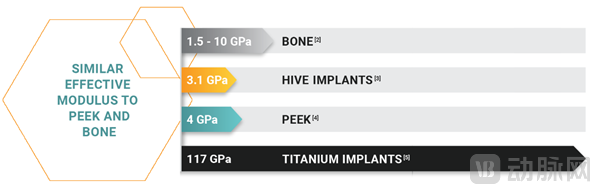 Comparison of Elastic Modulus. Image source: NanoHive Medical official website
In addition to reducing stiffness and providing load-bearing strength, the lattice structure of the Hive™ device features a biomimetic design based on human cancellous bone, with a porosity of 70%. Since human vertebral bodies are primarily composed of cortical and cancellous bone, and cancellous bone has a relatively loose structure with a porosity ranging from 75% to 90%, approaching this porosity range enhances osteogenic and angiogenic capabilities. According to NanoHive, the cancellous bone-mimicking lattice structure, enabled by 3D printing and soft titanium technology, promotes bone growth in vivo prior to being filled with autografts. The volumetric bone formation rate at 4 weeks reaches 22.1%, significantly higher than the 8.9% observed with PEEK materials.
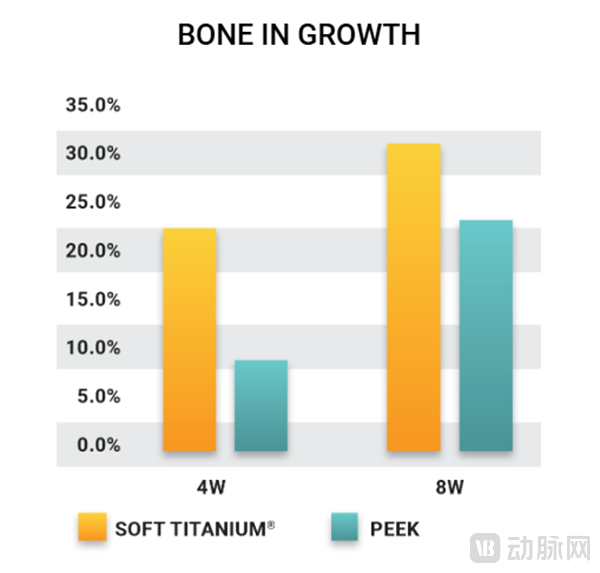 Comparison of Bone Formation Rates Between Soft Titanium and PEEK in Animal Studies. Image source: NanoHive official website
Furthermore, a critical manufacturing process for 3D-printed interbody fusion cages is surface roughening technology. This technique significantly enhances the friction and conformity between the cage and the vertebral endplates, thereby improving initial stability and reducing the risks of migration and subsidence. NanoHive’s spinal implants feature highly specific submicron surface topographies that interact with cells at the molecular level, promoting osteoblast adhesion and proliferation, and driving bone attachment and formation. Compared with untreated surfaces, this complex surface topology increases osteoblast accumulation and proliferation, enabling rapid bone ingrowth at both the endplate interface and throughout the entire lattice structure.
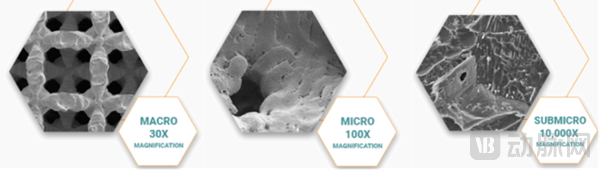 Internal Lattice Structure. Image source: NanoHive official website
Moreover, the complexity of the lattice structure often provides implants with more curved surfaces, thereby more effectively promoting integration between host bone tissue and the implant. The design of soft titanium lattices can also offer 20 times the surface area, enabling faster achievement of implant stability during growth at the host bone interface.
In terms of imaging quality, the low-density soft titanium lattice structure is clearly visible under X-ray, with reduced CT scan scattering and fewer MRI artifacts. This facilitates intraoperative and postoperative observation of the interbody fusion cage by physicians, allowing for assessment of spinal alignment, implant placement, and fusion status.
Proprietary System Enters FDA Fast Track, Products Covering Over 9 Million People
To adapt to the complex and dynamic clinical environment, based onSoft TitaniumTechnologyPlatform,NanoHive has also designed Hives in various sizes and specifications.TMInterbody fusion cage, to meet the needs of anterior lumbar interbody fusion (ALIF), transforaminal lumbar interbody fusion (TLIF), posterior lumbar interbody fusion (PLIF), and other surgical approaches,IncludingHiveTMC. TL&PL, AL, and Standalone AL Interbody Systems. Among them, the anterior lumbar interbody fusion cage adopts an independentALIF (Anterior Lumbar Interbody Fusion) System and AL Vertebral Body System, designed to provide intervertebral support and enhance stability.
AL Interbody System: Independent endplate design; load-bearing lattice core; optional implant sizes and lumbar lordosis angles; patented bone graft injection channel; secure inserter-implant connection, suitable for direct and oblique insertion.
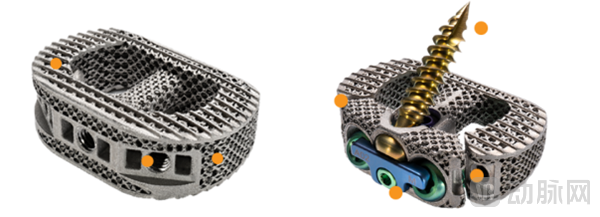 Anterior Lumbar Interbody Fusion Cage. Image source: NanoHive Medical official website
Standalone ALIF System: Reduced solid titanium structural elements; maximized porous lattice; bone graft injection channel; invasive bone screws; streamlined instruments; fixed baffles to prevent screw dislodgement; optional implant sizes and lumbar lordosis angles.
Posterior Lumbar Interbody Fusion Using the Hive PL&TL Interbody System: Offers PL (straight) and TL (curved) options; the PL system’s instrumentation and cage design allow for in situ rotation; available in multiple sizes and contact areas, including wide, long, and hyper-lordotic models; the load-bearing central core provides support to independent endplates, thereby reducing the need for stress-shielding design features; the bullet-shaped split tip facilitates insertion while preventing stress shielding effects.
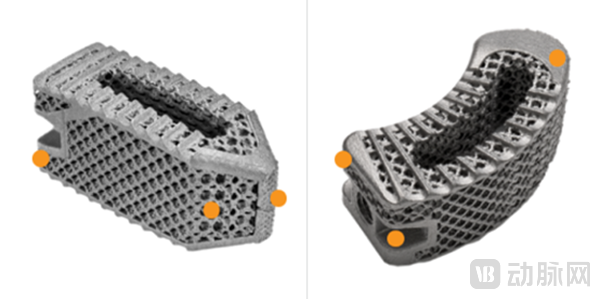 Posterior Lumbar Interbody Fusion Cage. Image source: NanoHive official website
For cervical interbody fusion, NanoHive offers the Hive™ C Interbody System and the Hive™ Standalone Cervical System.
Hive™C Interbody System: No rigid titanium structural plates, lowest stiffness interbody fusion cage, reduces subsidence risk, increases natural structural load bearing; optional implant sizes; streamlined instruments.
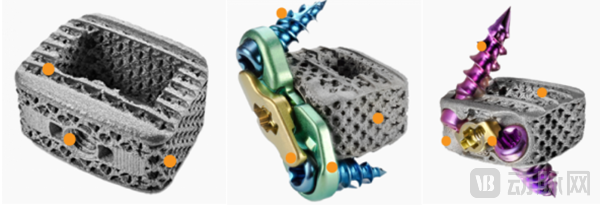
Cervical Interbody Fusion Cage. Image source: NanoHive official website
It is worth mentioning that,The Hive™ Standalone Cervical System for cervical interbody fusion received FDA 510(k) clearance in January 2023.The system features an electroplated structure with a rotatable and adjustable anterior plate, combined with a zero-profile design that effectively minimizes interference with blood vessels and surrounding tissues. Its overall streamlined contour closely conforms to the natural anatomy of the human cervical spine. Furthermore, the flexible insertion angle of its screws facilitates precise implantation in vivo. The lattice structure employed by the system is characterized by low stiffness and low density, which effectively reduces stress shielding and promotes bone tissue growth and fusion. Additionally, the Hive™ Standalone Cervical System is equipped with a one-step screw locking cap featuring haptic feedback, which not only simplifies the surgical workflow but also further enhances procedural safety and stability.
In April 2023, NanoHive entered into a partnership with the U.S. Department of Veterans Affairs (VA), under which its full line of Hive™ interbody fusion devices will be supplied to the Veterans Health Administration (VHA). The VA is the largest healthcare system in the United States, serving more than 9 million veterans.
Subsequently, in August 2024, NanoHive completed a $7 million (approximately RMB 49 million) Series C financing round. Reportedly, the funds will be used to further enhance its portfolio of soft titanium spinal interbody fusion devices.
Multiple MNCs Enter the Fray as 3D-Printed Medical Market Reaches $10.65 Billion
According toThe Insight Partners,The market size of 3D-printed medical devices is projected to increase from USD 2.93 billion in 2023 to USD 10.65 billion by 2031. The compound annual growth rate (CAGR) of the market is expected to reach 17.5% during the period from 2023 to 2031.
The 3D-printed spinal implant market holds immense potential, with multinational corporations (MNCs) such as Johnson & Johnson, Medtronic, and Stryker having already entered this sector through mergers and acquisitions as well as independent research and development.
Medtronic is one of the earliest pioneers in this market. In 2018, Medtronic launched the ARTiC-L Spinal System, a 3D-printed titanium spinal implant platform, along with its TiONIC 3D printing technology, which was used to manufacture the novel TiONIC 3D-printed titanium spinal implant, ARTiC-L. Made of titanium, this implant offers lordotic angles of up to 20 degrees to facilitate sagittal spinal alignment. According to a report by Spine Market Group, Medtronic maintained its leading position in the spinal market in 2023, holding a 24% market share.
Although China started relatively late in the field of 3D-printed orthopedic implants, it has experienced rapid development in recent years driven by policy support and market forces.
In 2018, 3D printing technology was included as one of the major special projects supported by the National Key R&D Program during the “13th Five-Year Plan” period, with explicit recognition of its prospects and market potential in medical applications. Subsequently, in 2021, eight ministries and commissions, including the Ministry of Industry and Information Technology and the National Development and Reform Commission, jointly issued the “14th Five-Year Plan for Intelligent Manufacturing Development,” designating 3D printing as a key component of intelligent manufacturing.
In February 2021, Hunan Huaxiang Additive Manufacturing Co., Ltd. and the Spine Surgery Team of the First Affiliated Hospital of University of South China jointly developedPorous Intervertebral Fusion Cage Approved by the National Medical Products Administration (NMPA), becomingChina's FirstA company applying Selective Laser Melting (SLM) technology to the industrialization of 3D-printed medical products.
Subsequently, multiple companies with independent R&D capabilities in this field have successively launched products that received regulatory approval for market entry. Notably, Nuopu Regenerative Medicine completed the enrollment of patients in the registration clinical trials for NPPM-01, its independently developed and manufactured 3D-printed regenerative bone graft, in March 2024. This milestone marks the emergence of China’s first fully self-developed bio-3D-printed regenerative bone graft and represents another significant clinical breakthrough following the U.S. FDA’s approval of CMFlex™, the first 3D-printed synthetic bone graft, in October 2023. The introduction of NPPM-01 not only demonstrates the therapeutic value of integrating biomimetic materials, tissue regeneration scaffold design, and precision 3D printing manufacturing technologies, but also signals substantial progress in China’s bio-3D printing technology sector.
According to incomplete statistics from VCBeat, seven 3D-printed medical products have received approval from the National Medical Products Administration (NMPA) in China to date. With policy support and growing market demand, more 3D-printed medical products are expected to gain approval for market launch in the future.