

Domestic Single-Use Endoscopes Achieve Breakthrough: Multiple Products Surpass RMB 100 Million in Sales
In 2024, the endoscopy market presented a stark contrast: sales volumes plummeted by half, sending chills through the industry, while revenues surged dramatically, creating a fervent atmosphere.
A research report released by Guosen Securities shows that in the first half of 2024, the winning bid amount for endoscopic equipment was approximately RMB 4.5 billion, a year-on-year decrease of 50%, with sales volume nearly halved.
In contrast, the disposable endoscope market is booming. According to research by VCBeat, companies such as Xingfu Factory, Pusheng Medical, and Ruipai Medical have each achieved single-product sales exceeding RMB 100 million for their disposable endoscopes.
A relevant official from Happy Factory previously stated on WeChat Moments: “Over the past five years, with the strong support of our supply chain partners and the relentless efforts of all our industry peers, Happy Factory has achieved its modest milestone of RMB 100 million in sales for a single product.”
Not only Xingfu Factory, but Ruipai Medical also achieved over RMB 100 million in sales for individual products. Among them, Ruipai Medical’s disposable flexible ureteroscopes and disposable cystoscopes both experienced better-than-expected growth in 2024, with the total sales volume of its disposable endoscopic products increasing by more than 80% year-on-year. To date, Ruipai Medical’s disposable endoscopic products have been adopted by more than 2,000 hospitals across China.
In addition to the aforementioned companies, other single-use endoscope manufacturers also achieved a surge in revenue in 2024. For instance, XinGuangWei Medical’s sales of single-use endoscopes increased by 119% year-on-year compared to 2023; since partnering with Hologic in April 2024, AkuYu has sold over 10,000 units of its single-use hysteroscopes in the United States; Huaxin Medical’s sales revenue grew by more than 50% year-on-year in 2024; and during the first three quarters of 2024, Nanwei Medical’s single-use endoscope business generated RMB 40 million in revenue from the European and American markets alone……
Amidst industry-wide challenges, how are single-use endoscopes achieving counter-trend growth? How will they reshape the competitive landscape? In the context of the rapidly expanding single-use endoscope market, who will emerge as the clear leader and claim the top spot?
The Domestic Disposable Endoscope Market Is Rapidly Developing.
According to Frost & Sullivan statistics, the market size of single-use endoscopes in China increased from RMB 11.2 million in 2016 to RMB 36.8 million in 2020, with a compound annual growth rate (CAGR) of 34.6%; it is projected to reach RMB 1.42 billion by 2025, representing a CAGR of 107.6% from 2021 to 2025.
Faced with the rapidly growing market for single-use endoscopes, relevant companies are unleashing their full capabilities and launching a fierce battle for market share.
In addition to conventional measures such as participating in academic conferences and industry exhibitions, hosting brand-related event series and technical training courses, and publishing clinical evidence, disposable endoscope companies also deployed innovative strategies in 2024.
Among them, disposable endoscope companies such as Nanwei Medical and Huaxin Medical have chosen to strengthen channel development and intensify customer acquisition efforts.
For example, in September 2024, Nanwei Medical issued an announcement stating that the company plans to use its own funds, not exceeding €36.72 million (approximately RMB 289 million), to acquire a 51% equity stake in CME. Upon completion of this transaction, Nanwei Medical will gain access to CME’s sales channels and product portfolio, thereby enhancing its international network layout and strengthening its product sales capabilities in the European region.
Data shows that CME is a medical device sales company, distributing products in the fields of gastroenterology, urology, respiratory care, and disposable endoscopes. Its sales volume ranges from €30 million to €35 million, with procurement totaling approximately €15 million. In 2023, revenue from endoscopic consumables and disposable endoscopes accounted for nearly 70% of CME’s total revenue.
In terms of sales channels, CME’s core business is concentrated in Western Europe, covering the United Kingdom, Spain, France, Germany, Belgium, and Luxembourg. France accounts for the largest share of the company’s revenue, followed by the United Kingdom, Belgium, Spain, and Germany. Across these top five countries by sales revenue, CME serves nearly 5,000 healthcare institution clients, including public hospitals, private hospitals, and clinics.
In addition to CME, Micro-Tech Medical has also acquired two distribution companies, located in Portugal and Switzerland respectively. These channels will serve as new leverage for its expansion into the European market.
Micro-Tech stated, “The European market is relatively fragmented and highly competitive. Due to the stringent regulatory requirements of the EU Medical Device Regulation (MDR), many small manufacturers have been adversely affected, leading to a clear trend of channel consolidation. The Company will align with this trend by acquiring high-quality distribution channels to further expand its market influence and coverage.”
In addition, Micro-Tech has established a European regional headquarters, which acts on behalf of the corporate headquarters to exercise regional management functions and coordinate business expansion, market planning, communication and coordination, and regional services across Europe.
Huaxin Medical is also strengthening its channel development and intensifying its market expansion efforts. In 2024, Huaxin Medical signed six new key accounts globally, onboarded 51 new distributors, achieved hospital admissions at more than 213 new institutions, and launched a new CDMO business line.
According to Huaxin Medical’s annual report: In 2024, the company saw a significant decline in various expenses, including sales, administrative, and R&D costs, while its cash flow situation improved. Production capacity steadily increased, processes were continuously optimized, annual product shipments achieved new breakthroughs, and the overall gross profit margin doubled. Strict “inventory reduction” measures were implemented, returning material rolling to normal levels, with inventory turnover ratio increasing by 76% year-on-year.
Beyond distribution channels, companies such as Ruipai Medical, Sinovision Medical, Micro-Tech Medical, and Pusheng Medical have opted for diversified product portfolios.On the one hand, a comprehensive product portfolio not only creates synergies and complementary advantages but also provides greater flexibility in production line adjustments, thereby offering better resilience against industry and policy risks compared to single-product manufacturers. On the other hand, a full suite of products facilitates procurement by healthcare institutions and enhances the company’s market competitiveness.
Specifically, Ruipai Medical initially offered only a single product; however, it has since developed a comprehensive product portfolio that includes disposable flexible ureteroscopes, disposable cystoscopes, disposable hysteroscopes, disposable choledochoscopes, and disposable gastrointestinal endoscopes.
It is worth noting that Ruipai Medical has independently developed advanced medical imaging algorithms, enabling its new-generation host systems to deliver ultra-high-definition images. The company has also applied intelligent assisted diagnosis and treatment technologies to the field of disposable endoscopes, helping physicians improve lesion detection rates and enhance work efficiency. Furthermore, based on insights into market demands, Ruipai Medical has iteratively launched disposable high-definition rigid cystoscopes and disposable high-definition flexible cystoscopes.
For another example, New Vision Medical has launched a comprehensive solution for urology, including disposable flexible ureteroscopes, biopsy forceps, stone retrieval baskets, and other ancillary consumables. Clinicians can use this solution to directly perform procedures such as renal lithotripsy.
Companies such as Nanwei Medical and Pusheng Medical are also strengthening their diversified product portfolios. For instance, after launching its single-use medical choledochoscope, Nanwei Medical introduced a single-use surgical choledochoscope in response to market demand. In 2024, Pusheng Medical obtained regulatory approvals and launched five products.
Moreover, domestic enterprises continue to innovate and iterate their disposable endoscope products in response to market demand.For example, Innovex Medical’s latest generation of single-use flexible ureteroscopes received market approval in January 2025. As the company’s fourth-generation product, this endoscope not only integrates the advantages of previous generations but also achieves significant breakthroughs and innovations. Compared with its predecessor, this single-use flexible ureteroscope features a slimmer outer diameter of only 7.5 Fr, which helps reduce intraoperative tissue trauma and accelerate postoperative recovery. With a working channel of 1.17 mm, it is compatible with a variety of surgical instruments. When paired with a 10/12 Fr deflectable negative-pressure sheath, it creates an optimal scope-to-sheath ratio, thereby enhancing surgical efficiency.
Fujian Zhide also announced on January 4 that its disposable bronchoscope had received marketing approval. Reportedly, the device’s distal tip features a miniature CMOS camera and dual LED light sources, offering a 120-degree field of view and a depth of field ranging from 3 to 100 mm, thereby ensuring clear surgical visualization. The distal tip’s spine enables upward and downward angulation of 180 degrees, providing strong maneuverability that allows the insertion section to access more bronchial branches.
Currently, innovative companies are exploring and attempting to enhance the resolution of disposable endoscopes to 4K standards. If this technology matures, disposable endoscopes are expected to expand into more application scenarios and be adopted by a wider range of hospital departments.
In 2024, disposable endoscope manufacturers not only achieved breakthroughs in the domestic market but also attained remarkable success in overseas markets.
For example, in the first three quarters of 2024, Nanwei Medical’s disposable endoscope business generated RMB 40 million in revenue in the European and American markets; AkuYu’s disposable hysteroscopes achieved sales of over 10,000 units in the United States; and Ruipai Medical achieved a breakthrough from zero to one in the U.S. market, while steadily expanding its presence in Southeast Asia and the Middle East.
Among these initiatives, Ruipai Medical has enhanced its brand influence and deepened collaborations with global clinical experts by participating in major international conferences, including the Annual Meeting of the European Association of Urology (EAU), the American Urological Association (AUA) Annual Meeting, Digestive Disease Week (DDW), MEDICA Germany, and the Congress of the Asian Society of Urology (ASU). Furthermore, the company promotes its products by supporting academic and industry events worldwide.
To date, Ruipai Medical’s single-use endoscope products have been sold to more than 50 countries and regions across North America, Europe, the Middle East, Southeast Asia, South America, and Africa, serving over 2,600 hospitals.
Micro-Tech Medical is expanding its overseas markets by increasing investment in sales channels and launching new products. In terms of sales channels, Micro-Tech Medical continues to recruit high-quality sales personnel and strengthen the education and training of clinicians across various markets.
Micro-Tech stated, “To address uncertainties in the global landscape, we have not only accelerated the construction of our factory in Thailand but also increased our investments in the European, Japanese, and Australian markets. It is projected that by 2025, the company’s international sales will surpass its domestic sales.”
Breakthroughs in Disposable Endoscopes Achieved Domestically and Internationally: Driven by Product Iteration, Academic Promotion, Product Value, and Clinical Demand, with Varying Growth Factors Across Different Disposable Endoscope Products
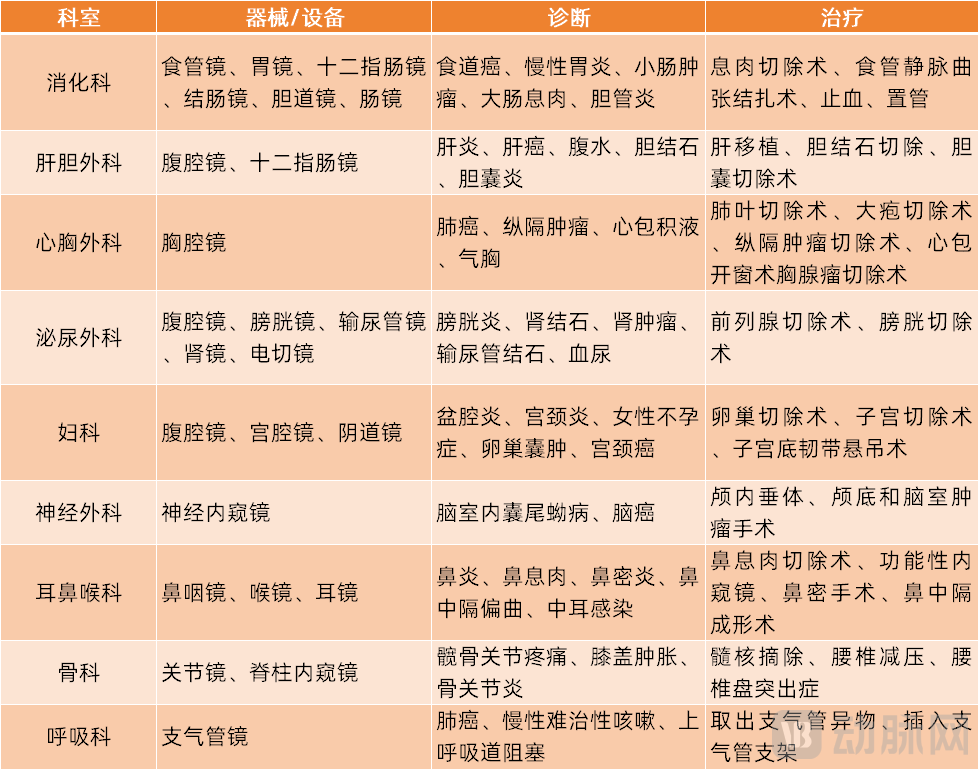
(Clinical Applications of Medical Endoscopes in Different Departments)
Taking the disposable ureteroscope commonly used in urology as an example, the most significant advantage of single-use endoscopes over reusable ones is the reduced risk of cross-infection, which aligns well with the infection prevention requirements in urology.
Meanwhile, disposable ureteroscopes launched by companies such as Ruipai Medical and Xingfu Factory offer advantages over traditional endoscopes, including shorter procedural times and lower overall surgical costs. Furthermore, their operability and application scenarios are comparable to those of traditional flexible ureteroscopes, enabling them to serve as viable alternatives.
Based on this, Chinese manufacturers of single-use endoscopes have taken the lead in achieving breakthroughs in urology. In 2023, sales of single-use flexible ureteroscopes in the Chinese market reached approximately 150,000 units, and continued to grow rapidly in 2024. Industry insiders predict that “the domestic market size for single-use flexible ureteroscopes will exceed RMB 400 million in 2025.”
Following the demonstration of disposable ureteroscopes, products such as disposable hysteroscopes, disposable cystoscopes, disposable bronchoscopes, disposable arthroscopes, and disposable gastrointestinal endoscopes have successively entered the market and are rapidly expanding across multiple clinical scenarios.
For example,In gynecology, companies such as Kangji Medical, Jiyuan Medical, and Akuyu have launched single-use hysteroscopes that are slimmer than traditional reusable hysteroscopes.When using such disposable hysteroscopes, physicians do not require instruments that increase patient discomfort, such as dilators and cervical tenacula, nor is anesthesia needed, allowing for painless and minimally invasive diagnostic and therapeutic procedures. Consequently, hospitalization is unnecessary, and patients may be discharged after a brief period of observation.
Compared with traditional hysteroscopes, single-use hysteroscopes offer simpler operation, eliminating the need for complex preprocessing and surgical steps. They feature shorter procedure times, enhanced safety, and improved patient comfort, making them particularly suitable for elderly patients, individuals with underlying comorbidities, nulliparous women, and those with allergies to anesthetic agents. Furthermore, the overall cost of single-use endoscopes is lower than that of traditional painless hysteroscopy performed under anesthesia. Driven by these product advantages and corporate promotional efforts, an increasing number of medical institutions are beginning to procure and adopt single-use hysteroscopes.
In the Department of Respiratory Medicine, single-use bronchoscopes can not only replace traditional bronchoscopes for the diagnosis and treatment of respiratory diseases but also, owing to their convenience and ease of use, be employed in certain specialized clinical settings, such as respiratory medicine, critical care, infectious diseases, anesthesiology, and emergency departments.。
Unlike traditional bronchoscopes, single-use bronchoscopes are portable, readily accessible, and can be deployed immediately in emergency situations. They require no reprocessing after use, thereby reducing cleaning and storage costs.
Notably, unlike other single-use endoscope products, single-use bronchoscopes have a longer history of application and enjoy greater clinical acceptance. As early as 2009, single-use bronchoscopes were employed for tracheal intubation in difficult airway management. During the COVID-19 pandemic, professional societies in countries such as the United States, Spain, and Argentina recommended their use due to the reduced risk of infection. Many experts in China have also developed an updated and deeper understanding of these devices through their use in diagnosing and treating relevant patients.
In addition, relevant authorities issued the “Work Plan for Medical Resource Preparedness,” which specified ICU equipment configuration standards, requiring that six disposable bronchoscopes be provided for every 10 beds. Benefiting from this policy, companies such as Huaxin Medical and Nanwei Medicine achieved strong sales of their disposable bronchoscopes.
In May 2024, the National Health Commission, together with seven other departments, jointly issued the “Notice on Printing and Distributing the Opinions on Strengthening the Construction of Critical Care Medical Service Capacity.” The main objectives are as follows: By the end of 2025, the number of critical care medicine beds nationwide (including general ICU beds and specialized ICU beds) shall reach 15 per 100,000 population, with convertible critical care medicine beds reaching 10 per 100,000 population. By the end of 2027, the number of critical care medicine beds nationwide shall reach 18 per 100,000 population, with convertible critical care medicine beds reaching 12 per 100,000 population.
Clinical experts believe that disposable bronchoscopes offer the distinct advantage of being readily accessible in emergency situations. Therefore, the Expert Consensus on the Application of Disposable Flexible Bronchoscopes in the ICU recommends that a certain number of disposable bronchoscopes be stocked in settings where emergencies involving difficult airway management may occur, such as emergency departments, ICUs, selected general wards, primary healthcare institutions, pre-hospital emergency ambulances, and disaster medical rescue supplies.
The Disposable Bronchoscope Market Is Expected to Expand Rapidly Alongside the Accelerated Development of Critical Care Medicine in China。
Overall, single-use endoscopes have been able to rapidly penetrate the market. On one hand, they meet clinical needs by offering imaging quality and resolution comparable to those of traditional reusable endoscopes, while being simpler and easier to operate with a lower learning curve. On the other hand, single-use endoscopes offer advantages such as lower procurement and maintenance costs, reduced overall procedural expenses, and broader application scenarios (including use in ICUs, emergency departments, and urgent rescue situations).
Looking back is to summarize experience and prepare for the future. In the new year, domestic disposable endoscope enterprises will embark on a new journey.
In 2025, we expect single-use endoscopes to focus on market expansionDepartments of Hepatobiliary Surgery, Gastroenterology, and OrthopedicsTaking hepatobiliary surgery as an example, the endoscopes commonly used in this department are laparoscopes and choledochoscopes. Currently, disposable choledochoscopes from companies such as Micro-Tech (Nanjing), Lionheart, Langxin Medical, and Innoview Medical have been approved for market launch. These disposable choledochoscopes meet clinical standards in terms of efficacy, safety, and performance indicators, and feature high resolution, high integration, and portability.
Compared with traditional reusable choledochoscopes, single-use choledochoscopes feature a larger working channel and a slimmer scope body, facilitating easier passage through strictures as well as simpler deployment and operation.
In addition, Zhuowai Medical’s disposable laparoscope (semi-disposable electronic laparoscope) was approved in 2024 to enter the Special Review Procedure for Class II Innovative Medical Devices, positioning it to potentially become the first approved disposable electronic laparoscope in China. In January 2025, Fujian Zhide’s disposable electronic endoscope for thoracoscopy and laparoscopy also successfully entered the Priority Review pathway for Class II medical devices.
In gastroenterology, commonly used endoscopes include esophagoscopes, gastroduodenoscopes (gastroscopes), duodenoscopes, colonoscopes, and enteroscopes. In late December 2024, Daichuan Medical announced that four of its single-use digestive endoscopes had obtained registration certificates from the National Medical Products Administration (NMPA), providing clinicians with a new solution and option. Ruipai Medical launched its single-use gastrointestinal endoscopy solution in 2024, which includes products such as single-use colonoscopes and single-use gastroscopes.
Ruipai Medical revealed that in 2025, it will focus on promoting its products in the fields of urology, gynecology, hepatobiliary surgery, and gastroenterology.
Orthopedics primarily utilizes arthroscopy and spinal endoscopy. Targeting this market, Newvision Medical has developed the world’s first single-use electronic spinal endoscope and China’s first single-use electronic joint endoscope. Meanwhile, companies such as Aide Technology have also entered the single-use arthroscope market.
For Xinguangwei Medical, gynecology is a key market focus in 2025. To address this specialty, the company has launched a comprehensive suite of single-use endoscopy solutions, including rigid, semi-rigid/semi-flexible, and fully flexible single-use endoscopes. Orthopedics represents a newly developed market segment, where the company plans to intensify its efforts to achieve further breakthroughs.