

WeDoctor Holdings Files for IPO, Marking a Breakthrough in AI Healthcare Commercialization
The resonance between policy and the market is rapidly drivingAI in Healthcare Enters a New Phase.
On December 25, 2024, to implement the decision-making arrangements of the CPC Central Committee and the State Council on launching the “AI+” initiative and to promote the deep integration of artificial intelligence with medical innovation, the General Office of the Shanghai Municipal People’s Government issued the *Shanghai Work Plan for the Development of Medical Artificial Intelligence (2025–2027)*. This plan supports the innovative development of AI in the medical field across five major areas, including enhancing capabilities for original innovation. Among the full-spectrum application scenarios, the plan highlights the deep integration of AI with multiple sectors, such as healthcare management, health insurance supervision, clinical care, traditional Chinese medicine, and public health.
Pioneers have already put this into practice. On December 31, 2024, WeDoctor Holdings, China’s largest AI healthcare company, filed its listing application with the Hong Kong Stock Exchange. Notably, in the first half of 2024, WeDoctor Holdings reported revenue of RMB 1.818 billion, a year-on-year increase of 107.4%. Of this, revenue from AI-powered medical services reached RMB 1.44 billion, accounting for nearly 80% of the total, bringing the company close to profitability.
AI in Healthcare Matures, Unlocking the Path to Commercialization
WeDoctor Holdings Files for IPO, AI Commercialization Breaks New Ground
Over the past two years, AI hype has surged wave after wave, yet commercial implementation has remained a persistent challenge. WeDoctor Holdings’ prospectus has caught the eye of many industry insiders.
A major highlight of WeDoctor Holdings’ performance is its rapid revenue growth. According to data disclosed in the prospectus, WeDoctor Holdings’ revenues from 2021 to 2023 were RMB 962 million, RMB 1.368 billion, and RMB 1.863 billion, respectively. In the first half of 2023 and the first half of 2024, revenues amounted to RMB 877 million and RMB 1.818 billion, respectively, representing a year-on-year growth rate of 107.4%.
Behind this significant growth momentum lies the steady expansion of core businesses.
According to the prospectus, WeDoctor Holdings’ revenue from AI-powered medical services amounted to RMB 228 million, RMB 628 million, and RMB 1.024 billion in 2021, 2022, and 2023, respectively. In the first half of 2023 and the first half of 2024, the revenue reached RMB 407 million and RMB 1.44 billion, respectively, demonstrating a significant upward trend. In terms of proportion, AI-powered medical services accounted for nearly 80% of the total revenue by the first half of 2024.
Losses are almost a common challenge for startups in the AI sector, given the need for continuous R&D investment and exploration of business models. However, WeDoctor Holdings’ losses are narrowing rapidly, bringing the company close to profitability.
Alongside robust revenue growth, WeDoctor Holdings has effectively controlled its losses. The prospectus reveals that the company’s adjusted loss from continuing operations decreased year by year from 2021 to 2023, amounting to RMB 1.354 billion, RMB 817 million, and RMB 505 million, respectively. In the first half of 2023 and the first half of 2024, the loss further narrowed to RMB 257 million and RMB 128 million, respectively. The adjusted loss ratio also declined from 140.8% in 2021 to 7.0% in the first half of 2024, indicating substantial progress in cost management and efficiency improvement.
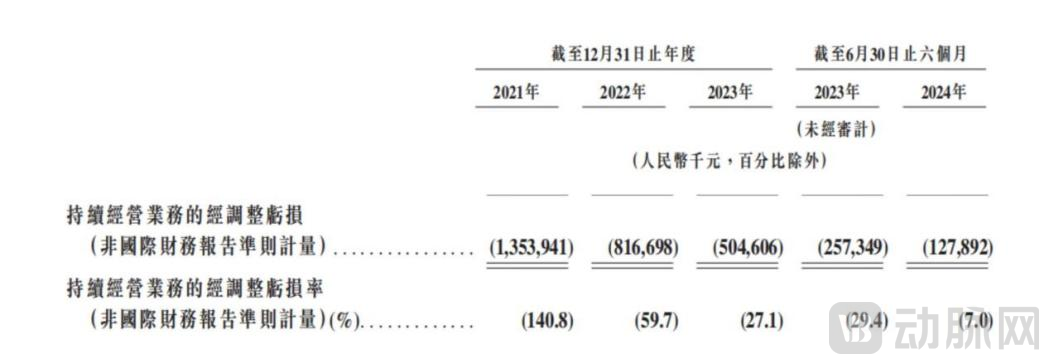 Source: WeDoctor Holdings Prospectus
According to the prospectus, WeDoctor Holdings’ continued improvement in operating performance is primarily attributable to two factors.
First, revenue has continued to grow, with the revenue for the first half of 2024 alone nearly matching that of the full year 2024. This growth is primarily driven by the steady development of the Healthcare Community. Second, expenses have continued to decline, as the company’s various expenditures have been effectively optimized thanks to business focus and cost-control measures. This “increase in revenue and decrease in expenses” is the reason behind WeDoctor Holdings’ consistently improving operational performance.
Furthermore, the value of WeDoctor Holdings’ leapfrog development is not confined to the AI healthcare sector; it also holds significant implications for addressing the commercialization challenges facing the broader AI industry.
Aligning with Healthcare Reform to Promote “Multi-Party Win-Win”
WeDoctor Holdings Has Overcome the Challenges of AI Commercialization, Thanks to Model Innovation. The Key Lies in Leveraging AI Capabilities to Enhance Quality and Efficiency, Enabling All Stakeholders to Achieve a Balance Between Efficiency and Benefits in Innovative Business Scenarios.
Its prospectus states: “Our cost-effective AI-driven healthcare solutions create a win-win outcome for primary care institutions, physicians, patients, health authorities, and public medical insurance funds by more efficiently addressing critical pain points in healthcare.”
WeDoctor Holdings has independently developed an industry-leading large language model specialized for the medical sector. Leveraging this foundation, it has created four intelligent agents—“AI Physician,” “AI Pharmacist,” “AI Health Manager,” and “AI Intelligent Control”—which are uniformly deployed across healthcare consortium institutions to provide end-to-end AI support throughout the pre-consultation, intra-consultation, and post-consultation phases. Specifically, during the pre-consultation phase, AI assists with patient information collection, preliminary assessment, and triage guidance; during the intra-consultation phase, it supports auxiliary diagnosis, treatment plan recommendations, and prescription review; and in the post-consultation phase, it facilitates follow-up management, medication guidance, and health education.
From January 2023 to June 2024, the Tianjin Health Community, co-developed by WeDoctor Holdings, saw the HbA1c compliance rate among its managed diabetes members rise from 17.8% to 44.2%, the blood pressure compliance rate increase from 19.5% to 61.5%, and the blood lipid compliance rate climb from 24.8% to 27.9%. During this 18-month management period, the per-capita budget for diabetes members at partner medical institutions achieved a surplus. According to statistical data released by Tianjin municipal government departments in August 2024, outpatient visits at primary healthcare institutions in Tianjin increased by 23% to 50% as a result.
In just over a year, the Medical Community model achieved the “two increases and one decrease” outcome: improved patient health indicators, enhanced primary care service capacity, and a reduced growth rate of medical insurance expenditures. Due to its alignment with national healthcare reform objectives and its significant effectiveness, this model has become an innovative approach explicitly supported and promoted by the state for deepening healthcare reform.
In 2022, the Cyberspace Administration of China, the Ministry of Agriculture and Rural Affairs, the National Development and Reform Commission, the Ministry of Industry and Information Technology, and the National Rural Revitalization Administration jointly issued the “Key Points for Digital Village Development in 2022,” which explicitly proposed to “guide localities in exploring the development of grassroots digital health communities.”
In August 2024, the National Health Commission explicitly set a goal to achieve full nationwide coverage of the “Sanming Model” within five years. The future direction of Sanming’s healthcare reform will focus on upgrading from “Medical Consortia” to “Health Consortia,” advancing the transition from pure medical care to comprehensive health management through measures such as establishing a “Six-Disease Co-Management” system.
Patients Pay for Outcomes: China’s Value-Based Healthcare Model Takes Root
The positive benefits brought by WeDoctor Holdings’ AI-driven Health Community model continue to “ferment.”
The prospectus reveals that WeDoctor Holdings fosters a close alliance among all medical institutions within the healthcare community by building digital infrastructure, standardizing operations, and connecting primary care facilities with higher-level hospitals. Its health management membership services adopt a capitation-based payment model, providing members with health management services through collaborations with primary care institutions.
Professional analyses point out that, unlike the traditional fee-for-service model in healthcare and the drug-sales-driven profit model of pharmaceutical e-commerce platforms, WeDoctor Holdings has created a health membership service model based on Health Communities that charges on a per-capita, value-based basis. This model neither takes a share of the clinical revenue from partner medical institutions nor relies solely on online drug sales; instead, it generates income by helping hospitals manage patients’ health effectively, drawing from the surplus of capitated global budget payments in medical insurance funds. In other words, patients pay for effective health management, making this an innovative business-to-consumer (B2C) model at its core.
The health outcomes generated by health management include not only the medical insurance surpluses achieved through capitation-based global budgeting, but also the effective prevention of complications among patients as their health indicators improve, thereby alleviating their financial burdens and physical suffering. This innovative consumer-facing (to-C) business model, while seemingly reliant on government-backed Health Communities and thus heavily policy-dependent, has in fact tapped into the widespread demand for health management among individual users, demonstrating considerable autonomy.
The Integrated Healthcare Consortium model creatively integrates industry technological advancements into China’s healthcare reform and the improvement of public welfare, driving the implementation of value-based healthcare through “pay-for-performance” mechanisms and achieving both social benefits and a sustainable business loop. AI medical technologies are increasingly taking root in primary care institutions, connecting with the broadest user base. By improving patient health outcomes, this approach has enabled efficient utilization of medical insurance funds and optimized allocation of social resources.
Achieving a dynamic balance between social benefits and economic returns is a notable highlight of WeDoctor Holdings’ Health Community model that cannot be overlooked.
The prospectus revealed that in February 2024, WeDoctor Holdings signed a strategic agreement on the establishment of a Health Community with the Guiyang Municipal People’s Government; in November 2024, it entered into a strategic agreement with the Yinchuan Municipal Health Commission to establish a Health Community. Furthermore, similar agreements are expected to be signed with several district governments in Shanghai during the first half of 2025. Meanwhile, WeDoctor Holdings is also focusing on municipalities directly under the Central Government and provincial capital cities, actively exploring and negotiating cooperation opportunities.
With strong policy support and the deepening of healthcare reform, WeDoctor Holdings is poised for broader growth opportunities.