

Niche Medical Polymer Sector Secures Over $7 Billion in Funding, Aiming to Break Foreign Dependence in High-End Implant Materials
Next, the iterative innovation of domestic medical devices will be primarily reflected in materials.. This represents an industrial consensus on the direction of medical device innovation in China; however, critical high-end medical-grade polymer materials remain a weak link in the domestic medical device innovation supply chain, with multiple types of such materials relying on imports.
Medical polymer materials are most widely applied in three major fields: medical devices, medical packaging materials, and medical interventional products.Currently, the more common medical-grade polymer materials on the market include medical polyolefins, medical polyether ether ketone (PEEK), medical silicone rubber, medical polyurethane, medical polycarbonate, and medical polytetrafluoroethylene (PTFE).
Domestic enterprises have established a dominant position in the low- to mid-end market for medical-grade polymer materials. For instance, Lanzhou Petrochemical’s polyolefin medical-grade resins, RP260 and RPE02M, are used in the manufacture of medical flexible bags and ampoules, capturing over 70% of the market share. Multiple suppliers also provide silicone rubber for surgical adjuncts, medical implants, and medical devices. Additionally, polypropylene used in face masks has achieved localized production in China.
However, in the high-end market, China remains heavily reliant on imports, particularly for materials such as thermoplastic polyurethane (TPU), medical-grade polyether ether ketone (PEEK), medical-grade high-molecular-weight poly(L-lactide-co-ε-caprolactone) (PLCL), expanded polytetrafluoroethylene (ePTFE), and ultra-high-molecular-weight polyethylene (UHMWPE).
Chinese companies are striving to reverse this trend. Recently, domestically produced high-end medical polymer materials have achieved breakthroughs, filling gaps in the domestic supply of several materials. Meanwhile, VCBeat statistics show that more than 10 related companies have secured financing, making high-end medical polymer materials one of the few sectors to see an increase in financing activities amid an extremely challenging capital environment.
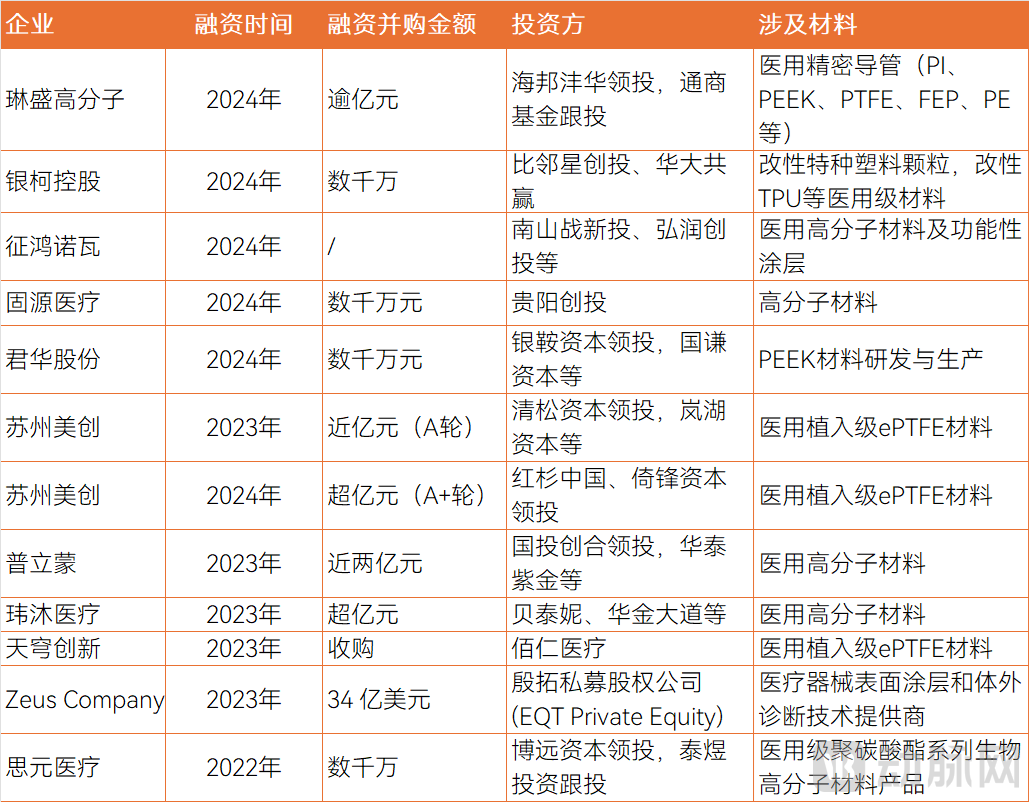
Statistics on Financing and M&A Activities in the Medical Polymer Materials Sector
It is evident from financing events that medical-grade implantable PEEK and ePTFE materials are the two most closely watched materials. These two materials serve as core raw materials for a variety of medical device products, with supply heavily reliant on imports.
Among them, polyether ether ketone (PEEK), developed by Imperial Chemical Industries (ICI) of the United Kingdom in 1978, exhibits excellent properties such as high heat resistance, radiation resistance, corrosion resistance, and superior electrical performance, along with outstanding processability.
PEEK is commonly used in bone repair. Compared with metallic materials, PEEK has a stiffness closer to that of human bone. As a non-metallic material, it does not produce artifacts on postoperative CT and MRI scans, thereby not affecting subsequent medical imaging diagnosis. Additionally, PEEK offers excellent machinability.
Currently, PEEK products have been used in artificial spinal implants, artificial joints, bone repair products, and other applications. Some domestic companies have achieved a production capacity of thousands of tons for PEEK, enabling the domestic supply of industrial-grade PEEK; however, medical implant-grade PEEK has not yet been widely adopted in China.
The key challenges lie in purity and large-scale mass production. Purity is one of the primary criteria distinguishing medical-grade PEEK materials from implantable-grade PEEK materials. This is because the synthesis of PEEK requires monomeric raw materials such as fluoroketones and phenols, along with catalysts like diphenyl sulfone. Consequently, the resulting PEEK material contains significant amounts of residual monomers, toxic additives, and various by-products, which pose substantial health risks to the human body.
Meanwhile, industry insiders stated, “Large-scale industrialization also presents significant challenges, as the chemical synthesis of PEEK on an industrial scale involves complex process parameters and critical control technologies. Globally, only a few companies have achieved PEEK production capacities at the thousand-ton level.”
The primary suppliers of implant-grade PEEK are Invibio and Evonik Specialty Chemicals. Chinese domestic enterprises are in the stage of filling market gaps, with multiple companies having laid out R&D efforts for implant-grade PEEK. In China, Class III medical device registrations based on domestically produced PEEK raw materials have already been obtained; Junhua Shares’ PEEK anchor interface screws and the “additively manufactured polyether ether ketone cranial defect repair prosthesis” jointly developed by Zhongyan Shares and Kangtuo Medical have both received Class III certifications.
Among the various types of medical-grade polymer materials, ePTFE (expanded polytetrafluoroethylene) is undoubtedly a highly prominent material. It plays an indispensable and critical role in numerous medical products, serving as the core raw material for artificial blood vessels, artificial heart wraps, ventricular septal defect occluders, and covered stents.
ePTFE (expanded polytetrafluoroethylene) materials play an extensive role in the medical field. The ePTFE membrane features a unique microporous structure that allows human tissue cells and blood vessels to grow within its pores, thereby forming tissue integration. Currently, ePTFE membranes have been successfully applied in various areas, including soft tissue augmentation in plastic surgery, heart valve procedures, small-diameter synthetic vascular grafts, and wound coverage materials.
ePTFE (expanded polytetrafluoroethylene) also relies on imported supply. Globally, W. L. Gore & Associates of the United States holds a pivotal position in the ePTFE sector. As the inventor of ePTFE material, Gore has continuously expanded its applications over the subsequent 50 years, extending it to more than 1,000 products across nine major categories. Notably, although a significant portion of these applications serve niche markets, Gore generates annual revenue exceeding $4.8 billion thanks to this material.
In the medical field, W. L. Gore & Associates has leveraged its technological advantages to launch a diverse portfolio of products, including vascular grafts, stent grafts, and cardiac patches. These products have demonstrated strong competitiveness in the market, maintaining a leading market share and earning widespread recognition from clinicians. For instance, in the fifth national centralized procurement of medical consumables, Gore’s peripheral venous stents ranked first in historical procurement volume, a statistic that fully underscores their status as the most widely used venous stents in China.
The manufacturing and processing of ePTFE membranes is a highly technical process, primarily involving two core aspects: stretching technology, and modification and composite processing. Among these, the stretching process for ePTFE membranes represents the most significant challenge within the entire industry chain.
In the process of localizing medical-grade ePTFE in China, domestic enterprises are actively exploring and are currently in the development and validation stages. Among them, companies such as BaiRen Medical, Fanya Weitou, and Suzhou Meichuang have made a series of positive advances in this area.
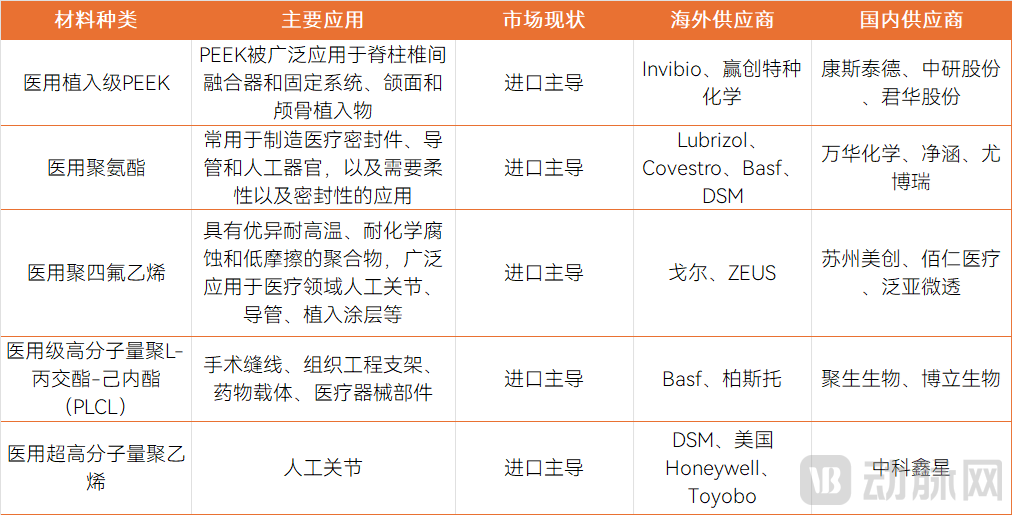
Incomplete Statistics on the Supply of High-End Medical Polymer Materials in China
Against the backdrop of the national strategy prioritizing the localization of high-end polymer materials, China’s high-end medical polymer industry has witnessed rapid growth. However, looking ahead, several critical barriers must be overcome to achieve breakthrough development in this sector.
First, it is necessary to overcome technical barriers and achieve stable large-scale production.Domestic companies still lag behind foreign enterprises in terms of technological accumulation. The core barriers in the polymer materials manufacturing industry include: exclusive access to specialized raw materials, the capability to independently design and modify tooling and equipment, as well as proprietary advanced formulations and processes. There is a significant gap between laboratory synthesis techniques for high-end medical-grade polymer materials and stable industrial-scale production; domestic companies still need to overcome the barriers to achieving large-scale, stable manufacturing.
Furthermore, another major gap lies in the types of product applications.Taking medical-grade thermoplastic polyurethane (TPU) as an example, two domestic companies, Wanhua Chemical and Jinghan Medical Materials, can supply medical-grade TPU. However, their raw materials are currently primarily used for medical catheters, whereas Lubrizol’s materials are widely applicable across multiple scenarios, including medical catheters, clear aligner orthodontics, medical dressings, and cardiovascular implantable products. Domestic enterprises need to continuously develop new processing technologies through technological innovation to meet the diverse needs of different markets and customers.
Third, there are regulatory barriers and customer-related barriers.. In terms of market entry barriers, medical device regulation adheres to a rigorous framework that imposes strict controls over all stages of enterprise operations, including research and development, manufacturing, and clinical use. Polymer materials must also comply with a series of high-standard, stringent quality specifications, thereby imposing demanding requirements on quality stability, product cleanliness, and technical service capabilities, while certification and substitution validation processes are lengthy.
Regarding customer barriers, downstream medical device manufacturers are reluctant to change suppliers easily in order to ensure stable product quality. These manufacturers exercise great caution when selecting medical materials, often preferring to collaborate with brands that have undergone long-term validation and enjoy a strong reputation. For new domestic medical material enterprises, it is extremely difficult to break this established trust and persuade downstream clients to try their products. Furthermore, switching suppliers may involve adjustments to production processes and fluctuations in costs. Consequently, downstream medical device manufacturers will not readily decide to switch suppliers unless there is conclusive evidence demonstrating the superior advantages of the new supplier.
Domestic manufacturers of medical-grade polymer materials can shorten the registration timeline by completing the registration of Medical Device Master Files. The "Announcement on Matters Concerning the Registration of Medical Device Master Files," issued by the National Medical Products Administration (NMPA) in 2021, aims to facilitate the selection of raw materials and key components by medical device manufacturers and streamline the registration application process. When different enterprises utilize the same raw materials, medical device applicants may submit a Letter of Authorization for the Master File, thereby avoiding duplicate submission and review of technical documentation and accelerating the time-to-market for medical device products.
Overall, medical-grade materials present high technical barriers, requiring substantial capital investment for research and development (R&D) and production. However, the niche segments within the medical materials market are relatively small in scale, attracting limited attention from enterprises. There is a wide variety of medical-grade polymer materials, most of which occupy niche markets; their R&D and production demand significant funding and involve long payback periods. From laboratory-scale R&D to pilot-scale scale-up, and finally to large-scale industrialized production, each stage requires robust financial support.
However, compared to some bulk polymer material sectors, the market size for medical materials is relatively small. This leads many enterprises, when weighing return on investment, to favor projects with larger market sizes and shorter payback periods, thereby resulting in insufficient corporate attention and investment toward the domestic substitution of medical polymer materials.
In recent years, attention to medical polymer materials has increased. However, domestic enterprises need to enhance their R&D capabilities for high-end products, as limited innovative achievements have constrained the industry’s sustainable development. Encouragingly, some Chinese companies are beginning to emerge as notable players in the field of medical polymer materials. It is hoped that these enterprises will not only achieve import substitution and provide strong support for related domestic industries, but also leverage their advantages and actively innovate to drive continuous industry progress, thereby fostering prosperity across the entire medical device sector.
References:
“Breaking the Deadlock” in High-End Medical Polymer Materials: How Is China Moving from “Chokehold Vulnerability” to “Autonomous Control”? — Biomimetic Materials and Interface Tissue Engineering
Fanya Weitou Prospectus
Professional Medical-Grade Polyurethane Raw Material Supplier — Yixiu Shenjieshuo