

Breaking Into the Blue Ocean: How Domestic Rehabilitation Robotics Companies Overcome Product Homogenization
“The rehabilitation robotics sector is currently a blue ocean market.”
Recently, VCBeat conducted a survey among frontline practitioners in the rehabilitation robotics industry. The prevailing feedback indicates that the sector is experiencing a golden period of rapid growth. However, beneath this prosperous facade lies a problem that cannot be overlooked: the increasing homogenization among domestic brands. “From the perspective of product types, the issue of homogenization is indeed quite pronounced,” frankly stated Dr. Chen Yan from Lizhi Medical during the survey.
Nevertheless, market data indicate that the rehabilitation robotics industry still boasts broad growth prospects. According to the latest report from Frost & Sullivan, the Chinese rehabilitation robotics market has demonstrated strong momentum since its inception in 2017. In 2018, the market size reached RMB 210 million, and it is projected to maintain a compound annual growth rate (CAGR) of 57.5% in the coming years. By 2023, the market size is expected to reach RMB 2.04 billion, and by 2026, it is anticipated to climb to RMB 7.95 billion.
Faced with this blue-ocean market brimming with opportunities and challenges, rehabilitation robotics companies stand at a critical juncture. Only by confronting the industry’s genuine challenges and addressing real-world problems can they distinguish themselves in fierce market competition. So, what exactly are these genuine challenges and real-world problems? How will the Chinese-made rehabilitation robotics industry evolve in the future? To explore answers to these questions, VCBeat combines relevant data with frontline industry observations to present readers with a clear and comprehensive portrait of the sector.
Therapeutic Rehabilitation Robots Are Diversifying
As a medical robot that assists the human body in performing limb movements and enables functions such as rehabilitative therapy and rehabilitative nursing, rehabilitation robotics represents a convergence of industrial robots and medical robots. It holds the second-largest market share within the overall medical robot sector, surpassed only by surgical robots, and constitutes an advanced rehabilitative medical technology that has emerged in recent years.
Its primary objective is to reduce the workload of rehabilitation therapists while enhancing treatment efficiency and precision. Leveraging a suite of intelligent technologies, rehabilitation robots can also promote active patient participation and provide objective assessments of the intensity, duration, and outcomes of rehabilitation training, thereby making rehabilitation therapy more systematic and standardized.
From a functional perspective, rehabilitation robots are primarily classified into two major categories: assistive and therapeutic.
Assistive rehabilitation robots focus on helping patients, the elderly, and individuals with disabilities better adapt to daily life and work by partially compensating for their impaired functions, thereby enhancing their quality of life.
Therapeutic rehabilitation robots, on the other hand, focus on restoring partial function in patients. It is understood that for patients with upper or lower limb motor dysfunction caused by stroke, brain injury, spinal cord injury, neurological damage, muscle injury, and orthopedic diseases, therapeutic rehabilitation robots can help patients regain control over limb movement through the remodeling of motor nerves in the brain, thereby improving their ability to perform daily activities.
VCBeat has reviewed the rehabilitation robot products approved in 2024 and found that therapeutic robots have become the mainstream of the industry. In terms of functionality, these robots not only possess the basic functions of rehabilitation training but also integrate a design concept that combines training with assessment. Additionally, they have incorporated active and passive training modes to meet the diverse rehabilitation needs of different patients.
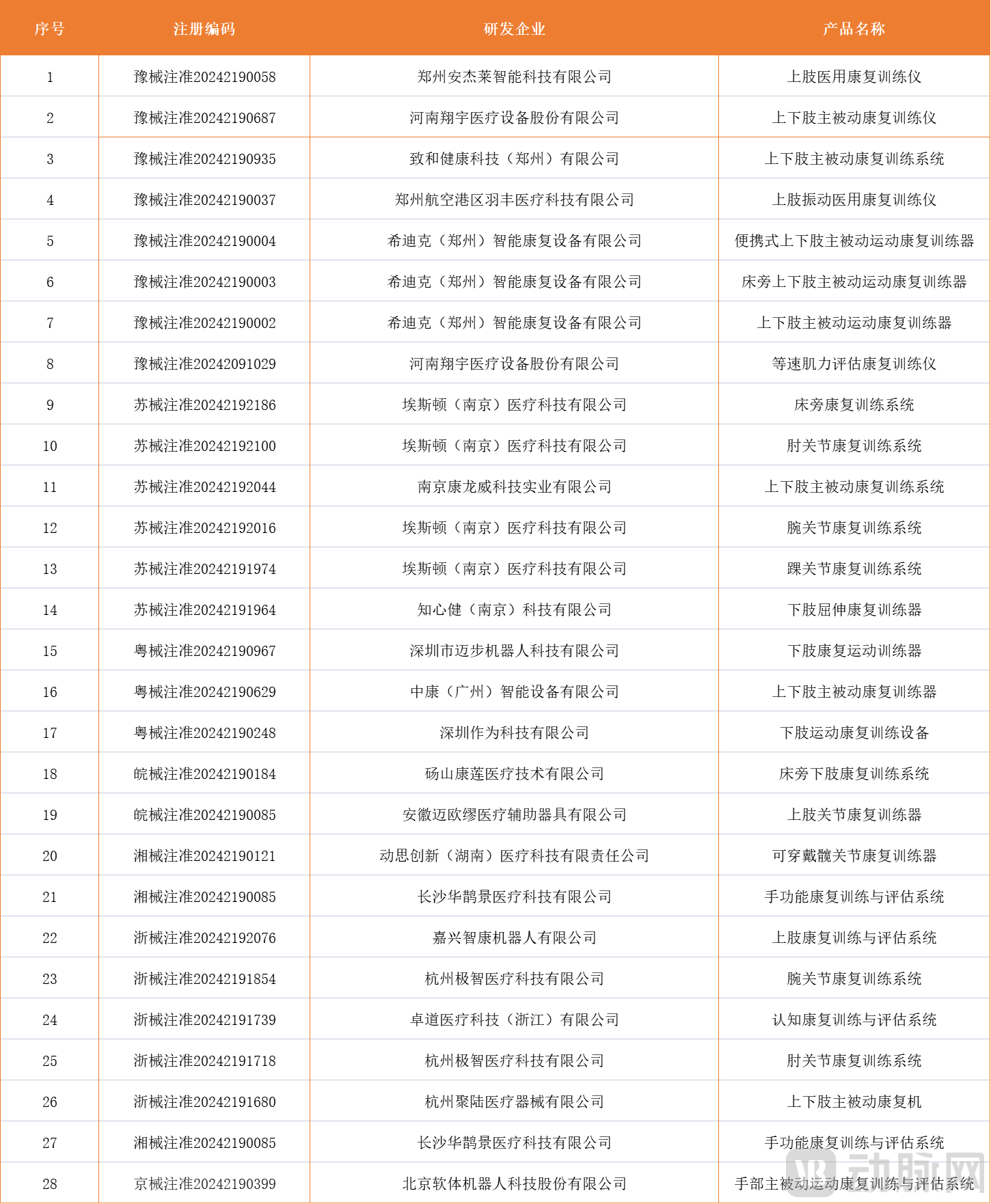 Rehabilitation Robots Approved in 2024, Chart by VCBeat
Taking the upper and lower limb active-passive collaborative rehabilitation training system developed by Xiangyu Medical as an example, this system conducts comprehensive motor training for multiple joints in the upper limbs, lower limbs, and even the entire body through circular motion trajectories. Patients can undergo active or passive training based on preset parameters or by relying on their own muscle strength, thereby achieving comprehensive and efficient rehabilitation outcomes. Meanwhile, Cidike’s portable upper and lower limb active-passive rehabilitation trainer offers patients a more flexible and convenient rehabilitation experience by intelligently switching between active and passive motion modes.
Furthermore, rehabilitation robots are continuously expanding their application scenarios. The emergence of innovative products, such as bedside lower-limb rehabilitation robots and sit-to-recline multi-joint lower-limb rehabilitation robots, provides patients with rehabilitation solutions that more closely align with their actual needs. Taking the Estun Nurt Bedside Lower-Limb Rehabilitation Training System as an example, this system is specifically designed for patients with disabilities, paralysis, and those in the early stages of ICU care. By accurately recording training movement data, supporting multiple capability assessments, and automatically generating rehabilitation trend charts, it offers robust data support throughout the rehabilitation process.
With the introduction and refinement of relevant policies and regulations, the rate of early rehabilitation intervention has become one of the performance evaluation metrics for tertiary hospitals, which will further promote the integrated development of clinical care and rehabilitation. However, the adoption of bedside rehabilitation robots in Grade A tertiary hospitals remains relatively low, and there is still a lack of effective solutions to address the differentiated early rehabilitation needs across various clinical departments.
Overall, in recent years, rehabilitation robots have become increasingly diverse in both product offerings and application scenarios. The path to commercialization has been arduous yet marked by innovation. Technologies, products, and business models are continuously being validated in this heating-up sector. With no highly valuable international benchmarks for commercialization, the market remains full of opportunities.
Currently in a blue-ocean market, but with risks of homogenization
In China’s rehabilitation robotics market, imported products have long dominated, with foreign companies firmly controlling market share, particularly in the high-end medical device sector. However, this landscape is quietly shifting. As domestic enterprises continue to increase their R&D investments and achieve a series of breakthroughs, Chinese-made rehabilitation robots are gradually emerging as significant contenders.
An industry insider pointed out that domestically produced rehabilitation robots demonstrate clear advantages over imported brands across multiple dimensions, particularly in terms of price, adaptability, and after-sales service. “In terms of pricing, domestic brands are more accessible, offering cost-effective solutions to a broader patient population. Regarding adaptability, domestically produced rehabilitation robots have been optimized and designed to meet the actual needs of Chinese patients, providing products and services better tailored to the local market. As for after-sales service, domestic brands have earned positive user feedback through their rapid response times and efficient maintenance.”
It is worth noting that domestically produced rehabilitation robots have achieved localization of core components. Whether electrically or pneumatically driven, the core components of current rehabilitation robots mainly include servo motors and reducers. Breakthroughs have been made in the localization of these key components, which are no longer a "chokehold" issue constraining the development of domestic robots. Although there is still a certain gap between domestic and imported products in terms of details such as noise, lifespan, and weight, domestic components fully meet functional requirements and offer advantages in cost control.
It is understood that among Chinese medical robotics companies, those specializing in rehabilitation robots and assistive robots each account for more than 30% of the market. Over ten domestic rehabilitation robotics companies have completed one or more rounds of financing, with approximately 20–30 companies operating in this sector overall. Product homogenization is relatively severe, and there is a lack of products with significant differentiation and competitive advantages. Dr. Chen Yan from LiZhi Medical stated, “Competition among domestic companies primarily focuses on product categories and technological innovation.”
The founder of another domestic rehabilitation robotics company also disclosed to VCBeat, “Some enterprises have encountered numerous challenges and difficulties during the R&D process. The technical barriers are high, and key technologies such as brain-computer interface (BCI) still require further breakthroughs.”
Brain-computer interface (BCI) technology, as a novel paradigm for active rehabilitation training, establishes an information pathway between the patient’s brain and external devices. By enabling control of peripheral equipment such as robotic arms through neurofeedback, it facilitates “top-down” neural plasticity. This technology overturns traditional passive rehabilitation models by genuinely engaging patients’ cognitive initiative.
Numerous industry giants both in China and abroad are exploring the application of brain-computer interface (BCI) technology; however, few projects have achieved true commercial deployment and mass production, particularly in the field of rehabilitation. Beyond technical barriers such as neural signal processing and BCI bandwidth configuration, the design and safety of BCI devices are directly critical to their clinical applicability.
In 2023, Siyi Intelligence launched the Yisheng Brain-Computer Interface (BCI) Rehabilitation Training and Assessment System, the first BCI-driven soft robotic hand for functional rehabilitation in China to obtain medical device registration certification and achieve clinical implementation. By employing elastic fabrics and pressure-free sewing technology, the system ensures uniform force distribution across the patient’s hand, preventing skin injury, while offering multiple sizes to accommodate diverse hand shapes. This system enables patients to undergo multidimensional, multi-scenario, and active rehabilitation therapy, significantly improving clinical rehabilitation efficiency and effectively reducing disability rates.
Furthermore, Li Zhi Medical has successfully developed a new generation of multimodal brain-controlled rehabilitation robots by leveraging its complete technological chain, which integrates intelligent sensing, artificial intelligence algorithm models, and human-robot collaboration. By utilizing proprietary modular signal recognition and control technologies for physiological electrical sensors, such as electroencephalogram (EEG) and electromyogram (EMG) sensors, along with personalized rehabilitation treatment plans, this robot can significantly enhance patient recovery outcomes. This innovation shifts the rehabilitation paradigm from the traditional “peripheral–central–peripheral” model to a “central–peripheral–central” model, thereby achieving more efficient neural plasticity.
However, the domestic rehabilitation robot market still faces multifaceted challenges. Due to factors such as long R&D cycles and high costs, the penetration rate of rehabilitation robots remains low, and the market is still in its early exploratory stage. Meanwhile, limited insurance coverage for rehabilitation robots has hindered their widespread adoption in medical institutions and households. Furthermore, clinical promotion of rehabilitation robots is subject to certain constraints, with awareness and acceptance among some medical institutions and patients yet to be improved. In the face of these challenges, domestic rehabilitation robot enterprises need to continuously innovate and break through to meet market demands and drive industry development.
Advancing into the Future: Simultaneous Deployment of Technology and Sales
With Continuous Innovation by Domestic Rehabilitation Robot Brands, How Can They Capture a Larger Market Share?
In response, the industry generally recognizes two viable paths: first, to strengthen innovation in rehabilitation robotics; and second, to expand sales distribution networks.
To enhance innovation, expanding the indications and functionalities of rehabilitation robots is key.
In recent years, innovative products have continuously emerged in the field of rehabilitation robotics, such as single-lower-limb rehabilitation robots for patients with hemiplegia and soft robots for hand rehabilitation. These innovations have not only enriched the application scenarios of rehabilitation robots but also signaled that the sector may be on the verge of an explosive period of innovation.
First, in terms of indications, rehabilitation robots are not only deployed in the fields of upper limb, lower limb, joint, and hand rehabilitation, but are also gradually extending to areas such as spinal rehabilitation and osteoporosis treatment.
Among these, AngelRehab’s product portfolio includes single-limb lower extremity exoskeletons, single/double ankle-foot orthoses, upper limb rehabilitation robots, hand function rehabilitation robots, pediatric cerebral palsy rehabilitation robots, trunk rehabilitation robots, and balance training robots. As AngelRehab’s first approved product, the LiteStepper® single-limb hemiplegia rehabilitation robot adopts a globally pioneering single-limb configuration. It provides patients with comprehensive, active, efficient, personalized, and movement-induced “central–peripheral–central” closed-loop neurological rehabilitation, enabling them to regain complete neuromuscular control of the affected limb within a short period.
In the field of spinal rehabilitation, Harbin Institute of Technology Robotics Group has launched the Xiaoyu Robot, which reduces labor requirements by enabling automated spinal conditioning without the need for manual operation or consumable products. This approach represents a model of rapid health intervention, suitable for individuals with various spinal conditions as well as those in a sub-health state. Furthermore, its functionalities will be integrated and expanded, such as extending from pure rehabilitative therapy to assisting individuals with mobility impairments, thereby achieving an integration of assessment and training.
Secondly, from a technical perspective, enhancing the perception, creativity, execution capabilities, and comfort of rehabilitation robots represents a key direction for future corporate development. In terms of sensing systems, it is necessary to adopt novel materials to improve perceptual sensitivity, achieve close integration with the human body using lighter and more comfortable materials, and rationally arrange various modules to make the products more lightweight. For instance, the application of technologies such as non-contact visual sensors and non-invasive flexible epidermal sensors will significantly enhance the perceptual capabilities of rehabilitation robots.
In terms of control systems, it is necessary to explore intention recognition technologies to enhance creativity. This involves determining the user’s movement intentions through multiple modalities, such as inertial measurements, interaction forces, electroencephalography (EEG), and electromyography (EMG). By leveraging artificial intelligence, adaptive patterns can be identified through data integration and machine learning, tailored to the patient’s individualized movement profiles. Regarding drive systems, high-power actuators with rapid response capabilities must be developed to strengthen execution performance. While motor-driven mechanisms are currently predominant, future efforts should focus on exploring lighter, faster, and more flexible actuators. Furthermore, enhancing comfort is a key priority for rehabilitation robots, particularly those targeting the consumer market. Future rehabilitation robots should incorporate emotional companionship features, such as encouraging patients and boosting their confidence, thereby truly assuming the role of a professional rehabilitation therapist.
In terms of sales layout, domestic rehabilitation robot brands are also actively exploring new market strategies. Taking Lizhi Medical as an example, the team is committed to rapidly building comprehensive product solutions and providing one-stop supporting services for the rehabilitation departments of secondary hospitals and community hospitals. Through strong academic support, Lizhi Medical helps end users gain a deeper understanding of the application value and clinical operation standards of its products, thereby enhancing their application efficiency. To date, Lizhi Medical’s business has covered eight major regions in China, with plans to expand its market to all provinces across China next year. As its product line continues to improve, Lizhi Medical will also attempt diversified market strategies and take the lead in exploring emerging markets such as Eastern Europe, launching its overseas expansion plan.
To further expand their market presence, domestic rehabilitation robot brands must make substantial efforts in innovation and sales deployment. By continuously advancing technological innovation, expanding indications and functionalities, and implementing proactive market strategies and sales layouts, Chinese-made rehabilitation robot brands are poised to capture a larger share of the future market.