

Arvinas IPO Prospectus: Pioneering PROTAC Platform and Strategic BD Collaborations with Pfizer, Novartis, and Beyond
Arvinas
Developer of drugs in the fields of oncology and neurodegenerative diseases
In 1998, at an academic conference, Professor Craig Crews of Yale University and Professor Ray Deshaies of the California Institute of Technology met by chance, giving rise to the concept of protein degradation therapy.
Years later, protein degradation therapy has sparked a surge of interest in both academia and industry, ushering in a golden age of rapid development. Arvinas, the company founded by Professor Craig Crews to develop Proteolysis-Targeting Chimeras (PROTACs), has also emerged as a prominent player in the market, attracting significant attention. In 2021, Arvinas entered into a $2 billion collaboration with Pfizer, followed by another partnership worth over $1 billion with Novartis in April 2024.
From a technological standpoint, Arvinas is undoubtedly a pioneer in the development of PROTAC technology. Beyond its technical prowess, the company’s success in business strategy is equally noteworthy. Since its founding in 2013, Arvinas has secured partnerships with four pharmaceutical giants within just a decade. More importantly, the types of deals it has struck are comprehensive, reflecting its evolving characteristics at different stages of development. These collaborations with pharmaceutical majors vary in depth and form, encompassing patent collaborations, R&D partnerships, product license-in/license-out agreements, and joint venture (JV) agreements for commercialization, among others. These partnerships fully demonstrate the company’s agility and adaptability at various stages of growth, as well as its deep and diversified relationships with major pharmaceutical companies.
An Accidental Academic Discussion Leads to a Multi-Billion Dollar Partnership Between Pfizer and Novartis
Prior to founding Arvinas, Inc., Professor Craig Crews had dedicated many years to the field of protein regulation, focusing on leveraging the cell’s innate “recycling system”—the ubiquitin-mediated protein degradation system—to develop novel anticancer therapies.
At a 1998 academic conference, an in-depth conversation between Professor Craig Crews and Professor Ray Deshaies led them to realize that tagging disease-causing proteins for degradation via this system could not only effectively treat diseases but also tackle “undruggable” targets that are difficult to address with traditional approaches. More than 90% of known human disease-causing proteins remain inaccessible to conventional therapies, providing broad application prospects for the emergence of PROTAC technology.
Based on this concept, two professors jointly published a paper in 2001, proposing a design strategy for a novel molecule featuring a small-molecule ligand at one end capable of binding to the target protein and a peptide at the other end capable of binding to an E3 ligase. The study revealed that this molecule could “recruit” the target protein to the vicinity of the E3 ligase, thereby facilitating its degradation via the ubiquitin-mediated proteasomal degradation system. Professor Craig Crews named this molecule “PROTAC (PROteolysis TArgeting Chimera).” Subsequently, the team further optimized the design by replacing the peptide moiety with a small molecule to enhance cell membrane permeability and drug-likeness.
To accelerate the development of PROTACs, Professor Craig Crews founded Arvinas in 2013. Compared with traditional small-molecule inhibitors, monoclonal antibodies, siRNA, CRISPR, and other biological approaches, PROTAC molecules offer significant advantages. They can target the degradation of “undruggable” proteins and drug-resistant proteins, support multiple administration routes including oral, injectable, and infusion-based sustained-release formulations, penetrate the blood–brain barrier, exhibit tissue-targeting potential, demonstrate broad in vivo distribution, and are amenable to scalable synthetic manufacturing.
Arvinas has pioneered the adoption of a series of advanced technologies in PROTAC development. In ligand selection, the company has accumulated extensive experience with E3 ligase ligands, leveraging high-throughput screening and DNA-encoded library (DEL) technologies to develop ligands targeting specific proteins. In molecular design, Arvinas integrates computational models and proteomics knowledge to optimize compound selectivity and degradation efficiency. Furthermore, by modifying the physicochemical properties of its compounds, the company has achieved faster synthesis speeds, with a 95% success rate in protein degradation for its designed compounds.
In 2019, Arvinas’ two candidate therapies entered clinical trials for the first time, and achieved proof-of-concept in the clinic the following year.
In 2021, the company further announced positive data showing that ARV-471, its estrogen receptor-targeted degrader, reduced estrogen receptor expression levels in patients’ tumor tissues by an average of 62%. Based on this molecule, the company entered into a collaboration with Pfizer valued at up to $2 billion.
Another investigational therapy for prostate cancer, ARV-766, has also been licensed to Novartis for collaborative development in a deal valued at up to $1.01 billion. Previously, Arvinas’ proprietary platform technology had attracted collaborations with multiple major pharmaceutical companies, including Genentech and Bayer.
Achieve diverse business development deals of varying types and values, tailored to product characteristics at different stages
Currently, Arvinas has successively entered into collaborations with industry giants Genentech, Pfizer, Bayer, and Oerth Bio. This not only demonstrates the development potential of PROTAC technology but also reflects the exceptional operational capabilities of Arvinas’ management team.
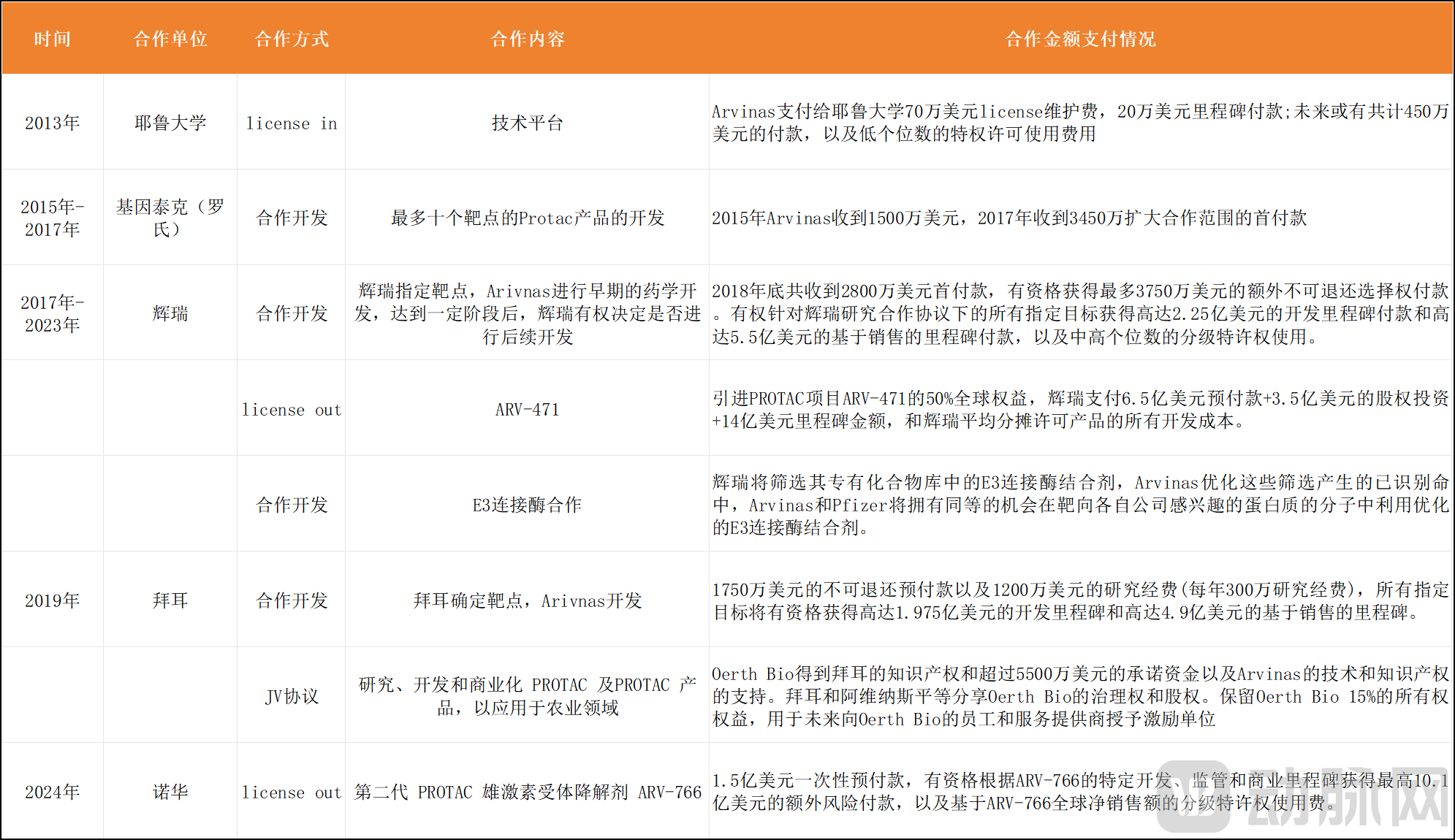
Arvinas' Deals
First, the founding of Arvinas stemmed from the in-licensing of core patented inventions by Professor Craig Crews, one of the company’s founders, from Yale University. In July 2013, Arvinas entered into a licensing agreement with Yale University, obtaining an exclusive global license for PROTAC technology. Under the agreement, Arvinas paid Yale University an upfront fee of $100,000 and was required to pay annual fees of varying amounts until the first sale of any licensed product to a third party. Regarding milestone payments, up to $3 million would be paid for the first licensed product, and up to $1.5 million for the second licensed product; no milestone fees would be payable for any licensed products beyond the first two. Additionally, under the agreement, Arvinas is obligated to pay certain sales-based royalties after product commercialization.
This is a typical agreement for the commercialization of university research outcomes, fully reflecting the process by which new technologies gradually increase in value as they evolve from patents to mature technologies and finally into specific products.
In September 2015, Arvinas entered into a collaborative development agreement with Genentech to develop protein-degrading drugs based on Arvinas’ proprietary PROTAC platform. Under this agreement, Genentech has the right to designate up to ten targets, with Arvinas responsible for conducting research on each target. Pursuant to the agreement, Genentech made upfront payments of $11 million in 2015 and $34.5 million in 2017. Early-stage research costs are borne by Arvinas, subject to a pre-agreed budget cap; any costs exceeding this cap are covered by Genentech. Upon successful commercialization, Arvinas is eligible to receive milestone payments totaling up to $44 million per target, or $52.5 million if two indications are approved. Additionally, Arvinas is entitled to receive mid-single-digit royalties on sales.
This agreement represents a typical collaboration model between a technology platform and Big Pharma, with both parties focusing on balancing risk and reward. Early-stage biotech companies possess cutting-edge, conceptual technology platforms but lack sufficient funding. In contrast, Big Pharma’s strength lies in its ample capital resources, yet it requires a continuous influx of innovative technologies. Against this backdrop, the logic of the agreement is for Big Pharma to provide R&D funding while the biotech company utilizes these funds to trial and error, thereby leveraging each other’s strengths through mutual cooperation.
In July 2021, Arvinas entered into a license agreement with Pfizer, granting Pfizer the global rights to develop and commercialize vepdegestrant (ARV-471). Under this agreement, Arvinas received a $650 million non-refundable upfront payment, plus $400 million in regulatory milestones and $1 billion in sales milestones. Both parties share equally (50/50) all development costs (including clinical), as well as profits and losses from commercialization and sales of ARV-471. Additionally, Pfizer made a $350 million equity investment in Arvinas.
This is a licensing agreement for a mature product, featuring a substantial upfront payment and total contract value, with strong alignment of risks and rewards between the parties. Furthermore, to reinforce commitment to the project, the agreement incorporates equity investment components. The execution of this agreement marked a milestone transaction for Arvinas.
Subsequently, in 2021, the company entered into a pipeline business development (BD) agreement with Pfizer and signed BD and joint venture (JV) contracts with Bayer. By 2023, the company further deepened its collaboration with Pfizer, sharing R&D resources.
In May 2024, Arvinas licensed ARV-766, its second-generation PROTAC androgen receptor degrader for patients with prostate cancer, to Novartis. Novartis is responsible for the subsequent clinical development, regulatory approval, and commercialization of the program. Arvinas also sold its preclinical AR-V7 program to Novartis. Arvinas received a one-time upfront payment of $150 million and is eligible for up to $1.01 billion in additional contingent payments based on specific development, regulatory, and commercial milestones for ARV-766, as well as tiered royalties on global net sales of ARV-766.
This collaboration involves the licensing of a more mature asset that had completed early-stage clinical trials with outstanding results and was poised to enter Phase III trials prior to the agreement. The deal also exemplifies Arvinas’ closed-loop business development (BD) model, demonstrating the replicability of its end-to-end strategy—from product R&D based on its proprietary PROTAC platform to BD licensing. The core focus of the transaction shifts to Big Pharma, with both parties prioritizing how to accelerate the product’s market launch and maximize sales revenue as the key benefits of their partnership.
In addition to project-based transactions, the company is also involved in asset transactions. In July 2019, Arvinas, Bayer, and Bayer CropScience LP (BCS) established a joint venture, Oerth Bio, with the aim of researching, developing, and commercializing PROTAC applications in the agricultural sector. Arvinas and BCS each held an initial 50% equity stake in Oerth Bio, representing 50% of ownership interests, with 15% of the equity reserved for equity incentives. Under this agreement, the consideration for the joint venture’s equity consisted of $56 million in cash and related intellectual property provided by BCS, while Arvinas contributed solely through its technology.
This transaction is particularly unique. On one hand, joint venture (JV) agreements are relatively niche. On the other hand, the expansion from human pharmaceutical technology into the agricultural sector is also highly distinctive, fully leveraging the value of all parties involved in the deal.
In summary, Arvinas leverages business development (BD) as a strategic fulcrum, adapting its BD strategies and organizational structures to the distinct characteristics of each development stage, thereby continuously mobilizing greater resources through diverse types of BD initiatives.
Traditional BD, Newco, Patent Financing... Broadening Your Mindset Is the "Only Solution"
Arvinas’s management team, leveraging its exceptional operational capabilities, has strategically positioned the company across multiple domains—including patent collaborations, R&D partnerships, license-in/out transactions, and joint venture agreements—achieving significant milestones through agile, high-leverage strategies. This flexible and adaptive collaboration model may offer valuable insights and lessons for business development professionals in China.
2024 was a landmark year for business development (BD) in China’s biopharmaceutical sector, with various innovative deal structures emerging. Among these, the NewCo model, which combines BD and financing attributes, has drawn particular attention, prompting many biotech companies holding early-stage innovative drug assets to actively explore this avenue. However, beyond objective factors such as target selection, data quality, and clinical progress, the NewCo structure—typically initiated and closed overseas—is susceptible to constraints imposed by established industry networks. Biotech firms outside these circles may face undervaluation of their assets, erosion of their equity interests, or even exclusion from negotiation opportunities altogether.
The significance of NewCo lies in its breakthrough from pharmaceutical companies’ obsession with secondary market financing, but this is not the only solution. In fact, while China is paying close attention to the NewCo model, U.S. biotech companies have already begun exploring a novel “patent right” financing model.
On November 4, 2024, U.S. biotech company Syndax announced a $350 million financing agreement with Royalty Pharma, centered on the promising drug Niktimvo. Under the terms of the agreement, Syndax will receive $350 million in cash from Royalty Pharma, which in turn will receive a 13.8% royalty on U.S. sales of Niktimvo until cumulative payments reach $822.5 million.
Niktimvo is an anti-CSF-1R antibody that received FDA approval on August 14, 2024, for the treatment of chronic graft-versus-host disease (cGVHD) in adult and pediatric patients weighing at least 40 kg who have failed at least two prior systemic therapies. Although multiple drugs for cGVHD are already available globally, Niktimvo is the first antibody targeting CSF-1R and is expected to launch commercially in the United States in early 2025. The collaboration between the two parties is driven by high expectations for Niktimvo.
Notably, this is not the first financing transaction Syndax has conducted around Niktimvo. As early as September 2021, Syndax entered into a global business development (BD) agreement with Incyte, licensing most of the global commercialization rights for Niktimvo to Incyte while retaining only a 50% equity stake in the U.S. market. In return, Incyte assumed 55% of Niktimvo’s R&D costs in the United States and all overseas R&D expenses, and paid Syndax an upfront payment of $117 million, potential milestone payments totaling $230 million, and double-digit royalties on overseas sales.
Unlike the equity settlement in the “NewCo” model, “patent right” financing does not involve the transfer of drug rights but is instead based on valuation adjustment mechanisms tied to the drug’s expected performance. Investors typically choose late-stage clinical products with high certainty to ensure success rates. This transaction structure minimizes risk for both parties. Through this approach, investment institutions can achieve multiples of profit with relatively small capital outlays, without needing to establish a dedicated commercialization team for the drug. Pharmaceutical companies, in turn, secure upfront funding for subsequent pipeline R&D, thereby reducing the risk of commercial failure. Once the drug’s sales meet the agreed-upon terms, the pharmaceutical company can reclaim the pledged rights, safeguarding the long-term interests of its shareholders.
Whether it is Arvinas’ exploration of the business development (BD) model or patent right financing as an emerging transaction mechanism, with the continuous maturation of the pharmaceutical industry, financing instruments in the future market will become increasingly diverse. Pharmaceutical companies need to adopt divergent thinking, structuring transactions of varying types and sizes tailored to different projects at different stages; early strategic positioning is the optimal approach.
References:
From a Serendipitous Spark to Billion-Dollar Partnerships with Pfizer and Novartis: How a Yale Pioneer in Protein Degradation Forged a Legend — WuXi AppTec
A Textbook for BD Transactions, a Role Model for Biotech Learning! — Fat Cat Life Medicine
NewCo Is So Weak: US Biotechs Are Embracing “Patent Rights” Financing — MedYao