

DeepSeek's Breakthrough Ignites a 'National Momentum Moment' for AI in Healthcare
DeepSeek has undoubtedly been one of the hottest topics during the Spring Festival of the Year of the Snake. This domestically developed large language model is directly challenging global tech giants such as OpenAI and Google, and has even single-handedly triggered a broad sell-off among leading U.S. AI stocks. NVIDIA, once considered an irreplaceable pillar of the AI ecosystem, saw its stock price plummet 17% on January 27 alone. By January 31, NVIDIA’s market capitalization had shrunk by $400 billion within a week.
Due to DeepSeek’s overly aggressive market posture, it even triggered bans from abroad. Led by the United States, multiple countries and regions swiftly implemented policies restricting the use of DeepSeek. Meanwhile, DeepSeek has been subjected to continuous cyberattacks from overseas. In response, China’s Permanent Representative to the United Nations explicitly expressed support for DeepSeek at a press conference held at the UN Headquarters.
In China, DeepSeek has also set off a massive wave—tech giants such as Huawei, JD.com, Baidu, Alibaba Cloud, and 360 have successively announced their integration with DeepSeek. Leading players in the healthcare sector have quickly followed suit, with top digital health companies including Fangzhou Jianke, Yidu Tech, Airdoc, and Wanda Information officially announcing their adoption of DeepSeek, thereby accelerating the practical implementation of AI in healthcare.
After nearly two years of exploration, generative AI based on large language models (LLMs) has gained recognition in China and been practically deployed in healthcare settings. Currently, what incremental benefits will DeepSeek’s sudden emergence bring to the application of domestic medical LLMs? Which innovative scenarios have already entered the planning stage or even been implemented? VCBeat has compiled this information based on publicly available data.
DeepSeek has garnered significant attention, closely tied to its high level of technological innovation.
Most importantly, it enhances architectural efficiency., compared with OpenAI's ChatGPT, DeepSeek adopts a Mixture of Experts (MoE) model, which can split tasks among multiple specialized sub-modules for processing, achieving higher resource utilization and significantly reducing the computational power requirements for training large models.
In terms of hardware-software co-optimization, DeepSeek, despite its relatively limited computing resources, has implemented extensive optimizations that significantly reduce hardware requirements for computation, storage, and communication. This has indirectly triggered a sharp decline in the stock prices of AI hardware infrastructure companies such as NVIDIA and Broadcom.
It is precisely for this reason thatDeepSeek's Training Costs Significantly Reduced. According to public information, its training cost only about $5.5 million, one-tenth of the training cost for ChatGPT with comparable performance, and the training time was also reduced to 55 days. The pricing for its application interface has also been significantly lowered, with the cost per million input tokens being only 2-3% of that of ChatGPT!
Compared with overseas large models,DeepSeek’s training data is predominantly in Chinese, enabling more precise handling of complex Chinese vocabulary and context. This results in text output that is more fluent and natural, aligning well with the Chinese linguistic environment. Meanwhile, its logical reasoning process is transparent, and it supports deep optimization for specific scenarios, including healthcare.。
On this basis,DeepSeek also adopts a fully open-source strategy, releasing both the code and model parameters of its large language models, thereby significantly lowering the barrier to AI deployment for small and medium-sized enterprises.As one of the developers of large language models specialized in the medical field, Wu Di, CEO of Fuxin Kechuang, considers DeepSeek’s MIT License to be highly favorable: “It allows users to freely use, copy, modify, and distribute the software, and encourages enterprises to adopt and integrate it into their products, fostering collaboration and innovation. I believe this will significantly drive the development of the entire ecosystem.”
“In addition to its cost advantage, DeepSeek offers relatively superior reasoning capabilities and problem-solving abilities for complex tasks compared to other common open-source models, and”Significantly reduced requirements for prompt engineering。”
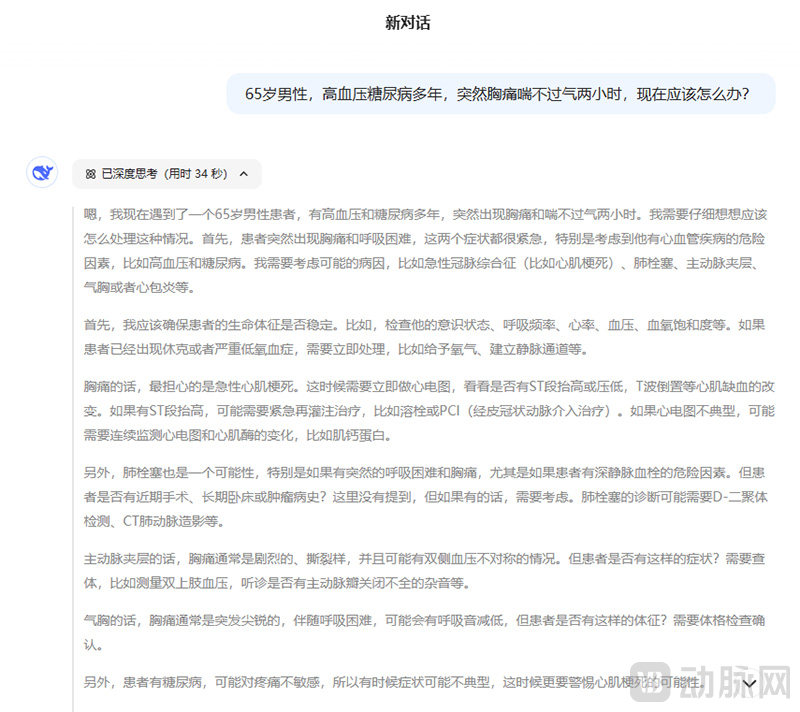
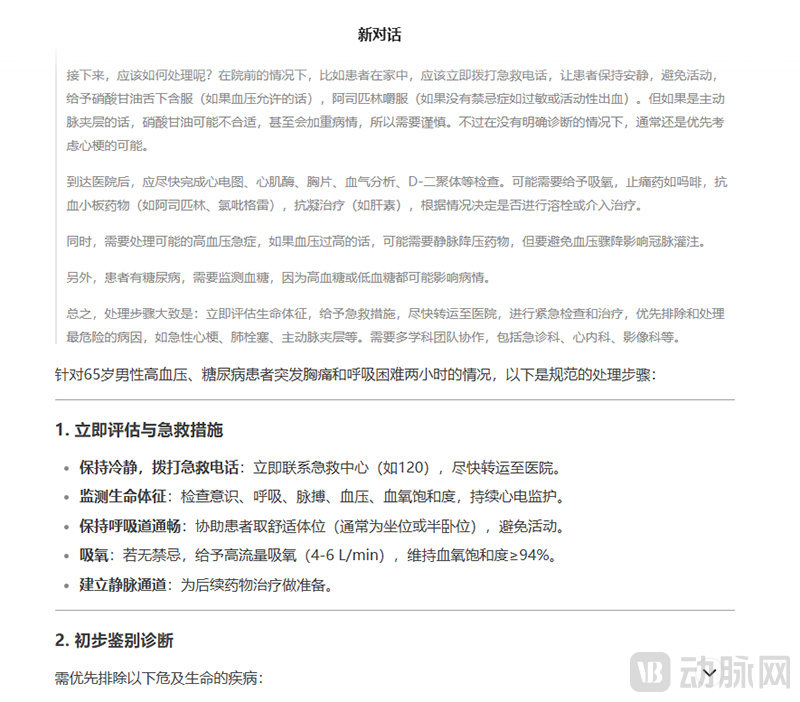
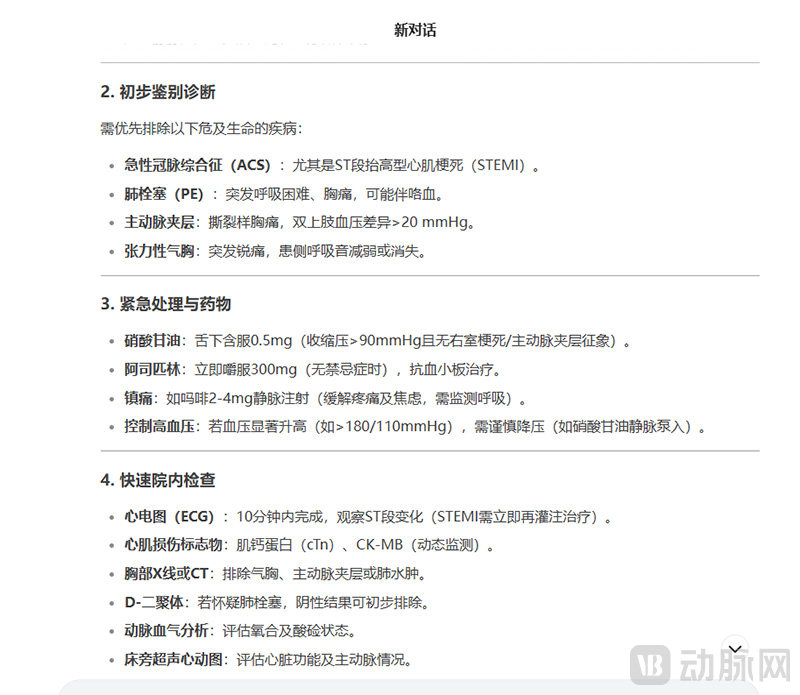
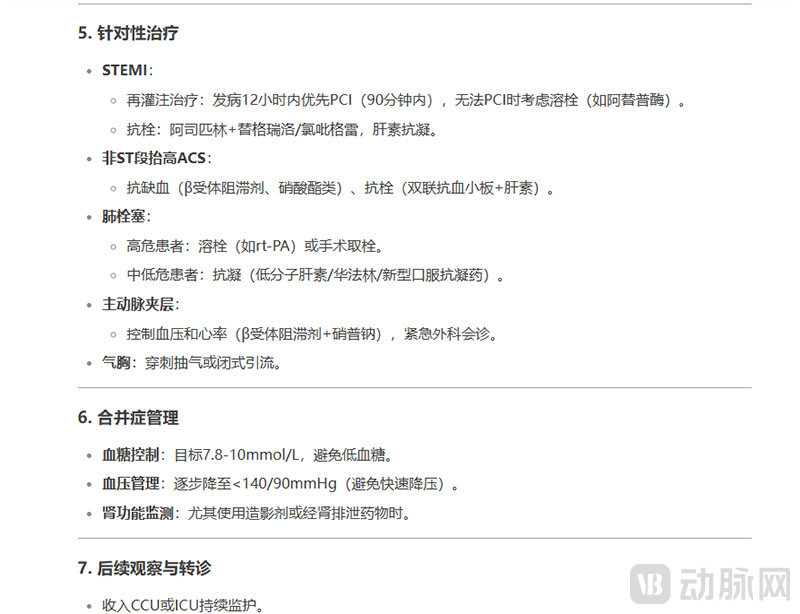
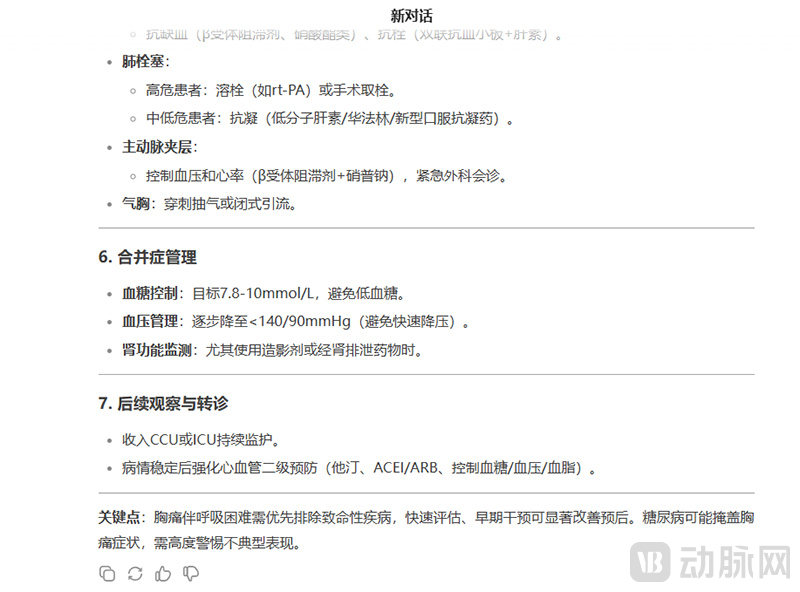
With just simple prompts, DeepSeek generated a rather professional response.
Wu Di further illustrated DeepSeek’s advantages in prompt engineering. When using basic prompts to query disease-related information, conventional models often require inputs in a highly structured format, such as: “Please analyze the following case: a 65-year-old male with a history of hypertension and diabetes, presenting with chest pain and dyspnea for two hours. Required: 1. List potential diagnoses and their rationale; 2. Recommend necessary laboratory tests; 3. Provide an emergency management plan; 4. Outline key points for differential diagnosis.” In contrast, DeepSeek allows for much more colloquial prompts, such as: “A 65-year-old man with long-standing hypertension and diabetes suddenly developed chest pain and shortness of breath two hours ago. What should be done now?”
“From this example, we can see that DeepSeek is capable of extracting key clinical features from vague chief complaints, autonomously constructing decision trees compliant with medical standards, providing defensive medical recommendations upon identifying potential risks, and ultimately transforming fragmented information into structured diagnostic and treatment plans,” he added.
“Furthermore, it offers valuable insights into reinforcement learning (RL) and achieves more optimized hardware utilization efficiency. I believe DeepSeek will soon spur the iteration of open-source large language models, and we will shortly witness a significant leap in the capabilities of generative AI within healthcare scenarios.”
Wu Di further believes that DeepSeek will have a profound impact on the application of large language models in healthcare scenarios: “Currently, large language models have permeated an increasing number of healthcare scenarios.The intense popularity of DeepSeek will further raise awareness of the capabilities of large language models, significantly facilitating their deployment in medical application scenarios.. Of course, from the perspective of practical application,DeepSeek’s powerful reasoning capabilities can enhance the accuracy and practicality of medical vertical models, strengthening their ability to handle complex and rare diseases under challenging conditions.。”
“EspeciallyIts emergence and success also demonstrate that domestic large language models are capable of competing with the world’s leading counterparts, which will significantly boost the confidence of investors, entrepreneurs, and users in China’s large language models. This is clearly a major boon for vertical-specific large language models in the healthcare sector.。”
Although only a few days have passed since the resumption of work after the holiday, many healthcare scenarios have already begun leveraging DeepSeek to enhance their capabilities.
The first is undoubtedly the consumer-side (C-end) personal health management scenario and internet healthcare, which will also be one of the scenarios most significantly impacted by the DeepSeek frenzy in the short term.。
For laypeople without medical expertise, using large language models (LLMs) such as DeepSeek to look up symptoms and treatment approaches is undoubtedly the most common application scenario. Particularly during the Spring Festival, when influenza A was highly prevalent, many “patients” likely consulted DeepSeek and found that it could provide reasonably professional answers. This experience is sufficient to help consumer-end users recognize the powerful capabilities of LLMs, thereby facilitating their broader adoption in other areas.
Of course, professionally fine-tuned large language models (LLMs) specialized for the medical vertical offer superior reliability and specificity. Taking Fangzhou Jianke’s “AI Personal Health Assistant” as an example, users can leverage the underlying medical LLM via its mobile application to conduct health self-assessments anytime and anywhere. The system provides data interpretation for up to 50 types of medical examination reports, using easy-to-understand “personalized translations” to help users comprehend their health status, and offers targeted medication guidance based on the report results.
This time, Ark Health has promptly integrated DeepSeek in its entirety and completed local deployment. Its robust data analytics capabilities enable in-depth analysis of patients’ verbal expressions, thereby uncovering deeper-level health management needs.
Second, there are medical AI “agents.” Wu Di stated that DeepSeek can currently be integrated with existing vertical medical models to enhance performance in several key application scenarios, including AI triage and AI pre-consultation, which are the most widely implemented large-model applications in the pre-diagnostic phase.。
“Agents” (i.e., AI agents powered by large language models) also emerged in 2024 as one of the hottest keywords in the field of large language models. LLM-based agents can simulate doctor–patient interactions with a significantly higher degree of anthropomorphism than ever before, providing preliminary triage based on patients’ descriptions of their conditions and intelligently recommending appropriate medical departments and suitable physicians.
Domestic digital health companies with rapid response capabilities have begun integrating DeepSeek to leverage its empowering potential. For instance, Qushui Technology has incorporated DeepSeek to deliver self-assessment and analysis services for sleep, helping users understand their sleep conditions and providing personalized recommendations for sleep improvement.
In November last year, Fangzhou Jianke released its “AI Agent Solution,” which includes an “AI Personal Health Assistant” designed for consumer users, as well as an “AI Academic Interaction Assistant” and an “Intelligent Medical Record Collection System” tailored for physicians. These three innovatively developed intelligent application scenarios provide the industry with a comprehensive smart solution covering patients, doctors, and the healthcare sector, representing a typical example of how large language models are currently empowering healthcare. With Fangzhou Jianke’s full integration of DeepSeek, its advanced and efficient reasoning capabilities will further enhance Fangzhou Jianke’s “AI Agent Solution.”
Third, scenarios that assist physicians, such as auxiliary diagnosis and medical record documentation.。
“Regarding AI-generated electronic medical records (outpatient and inpatient) that physicians focus on, DeepSeek will also be of significant assistance. Particularly for medical record quality control and complex cases, I believe there is an opportunity to derive additional benefits due to DeepSeek’s powerful reasoning capabilities,” Wu Di further added.
For physicians, the empowerment offered by large language models (LLMs) holds profound significance. For instance, in the context of assisted diagnosis, LLMs can not only efficiently analyze medical images to provide diagnostic support but also recommend the most appropriate medications and dosages by analyzing patients’ medical records and drug response data, thereby enhancing therapeutic outcomes.
For physicians, the demand for AI-assisted electronic medical record (EMR) documentation and quality control may be even greater. It can liberate doctors from the burdensome task of charting, allowing them to devote more time to patient observation, clinical diagnostic analysis, treatment planning, and the analysis and improvement of therapeutic outcomes.
In fact, such AI-assisted diagnostic tools have already become a reality abroad. An anonymous healthcare industry practitioner reported that during a recent visit to the United States, they observed that Stanford Hospital’s clinics had recently launched an application for AI-assisted generation of electronic health records (EHRs).
Fourth, as the era of large language models with strong reasoning capabilities gradually arrives, they will play an increasingly significant role in the personalized diagnosis, treatment, and scientific research of complex and rare diseases.。
Prior to this, patients had already attempted to leverage OpenAI’s latest reasoning model, ChatGPT o3, to investigate treatment options for craniopharyngioma. They concluded that the value generated by the $200 monthly subscription fee for ChatGPT o3 over a short period surpassed that of the $150,000 spent on private research teams.
Applications leveraging large language models to empower scientific research are already emerging in China. For instance, Ark Health’s “AI Academic Interaction Assistant” not only supports colloquial input but also provides search results in both Chinese and English, further accelerating the retrieval of professional literature and enhancing reading efficiency, thereby saving healthcare professionals over 80% of their search time. By integrating DeepSeek, which combines strong reasoning capabilities with real-time search, this feature is expected to drive a significant leap forward in the efficiency of medical scientific research.
After witnessing the powerful enabling role of large models in scientific research, research institutions are also proactively embracing them. The Changping Laboratory, which focuses on biomedical omics technologies, immunodiagnostic and therapeutic technologies, advanced imaging and intervention technologies, has begun recruiting talent familiar with biomedical applications of large models. It is exploring methods for using open-source large models to analyze multi-omics data (such as genomics, transcriptomics, and proteomics) to uncover gene regulatory network patterns and advance the discovery of disease targets.
Of course, these applications represent only a drop in the bucket of large language model (LLM) implementations in healthcare. The breadth of LLM applications is truly staggering; for instance, Fangzhou Jianke has leveraged LLMs to enhance the efficiency of short-video scriptwriting and content moderation in medical video production.
Large language models have demonstrated broad application prospects in the healthcare sector, playing a significant role in areas such as medical services, patient care, operational management, Traditional Chinese Medicine (TCM), pharmaceutical supply, clinical research, public health, smart health insurance, and health management.。
For instance, Jianlan Technology noted in its official WeChat account that its clinical decision support system, built on DeepSeek-R1, can complete multidimensional risk assessments for critically ill patients within 30 seconds, achieving a 42% higher accuracy rate than traditional methods. It also increases the detection rate of minute lesions to 97.3%, with generated diagnostic reports not only describing imaging features but also automatically providing differential diagnosis recommendations and comparative treatment plans. In hospital management, the system reduces emergency department length of stay by 28%, boosts operating room utilization by 35%, and saves over RMB 12 million in annual operational costs. At the research level, it can analyze real-world drug efficacy data within 72 hours, a task that traditionally requires six months.
This makes it easy to understand why“Big Tech” Companies in the Healthcare Sector Are Actively Embracing DeepSeek.
Among them, Hengrui Medicine, China’s leading pharmaceutical company, has made a bold “all-in” commitment. According to media reports, Hengrui issued an official document on the first working day after the holiday, mandating the comprehensive adoption of the DeepSeek application across the company, its branches, and subsidiaries to further enhance operational efficiency and management standards. The document reportedly requires internal departments to optimize business processes, improve work efficiency, and reduce operating costs by leveraging DeepSeek in accordance with their specific business characteristics.
Almost every day, a long list of familiar names is added to the roster. The new wave of large-model frenzy sparked by DeepSeek continues.
DeepSeek is merely the starting point of a new wave of large language model (LLM) enthusiasm, and it is believed that other LLM companies will quickly follow suit with rapid iterations. Currently, the application of LLMs in the healthcare sector already covers the entire chain from diagnosis and treatment to health management, demonstrating their technological advantages across the entire healthcare industry. In the future, as the technology further matures, LLMs are expected to achieve breakthroughs in more specialized fields, driving the intelligent and inclusive development of the healthcare industry.
VCBeat will continue to monitor developments closely and welcomes news tips from industry professionals.
References:
Da Chen, Pharma Economist: “Impressive: Hengrui Fully Adopts DeepSeek for Operations and Includes It in Performance Evaluations”
Li Nan, CHIMA: “How CIOs Can Secure a Voice Amid the DeepSeek Surge”
Jianlan Technology, Jianlan Technology: "DeepSeek-R1: The Super Intelligent Hub Reconstructing the Smart Healthcare Ecosystem! Building a New Paradigm of Smart Healthcare with the 'Health Brain + System'"
Zhao Yajie Lab, Human Genetics Network: [We Are Hiring | Zhao Yajie’s Research Group at Changping Laboratory is Recruiting Research Assistants/Interns in the Field of “AI + Multi-Omics”]
Qushui Technology: "Gifts at the End of the Article | Qushui Technology Partners with DeepSeek: AI Empowers Sleep, Pioneering Innovative Application Scenarios"
Li Jianzhong’s Research and Reflections: “Key Technological Innovations of DeepSeek and Their Impact on the AI Ecosystem”
Volcano Engine, RollingAI, Geek Media: "White Paper on the Commercial Implementation of Generative AI — A Tactical Guide to AI Transformation for CXOs"