

Trinomab's Global First-in-Class Tetanus Monoclonal Antibody XinTiTuo® Approved in China
February 11, 2025Zhuhai Trinomab Pharmaceutical Co., Ltd. (hereinafter referred to as “Trinomab”) announced that its independently developed, globally first-in-class recombinant monoclonal antibody drug against tetanus toxin, Xintituo® (generic name: Steptumab Injection), has officially received marketing approval from the National Medical Products Administration (NMPA) of China.This innovative drug will revolutionize the landscape of tetanus prevention, providing safer and more effective protection for patients worldwide.
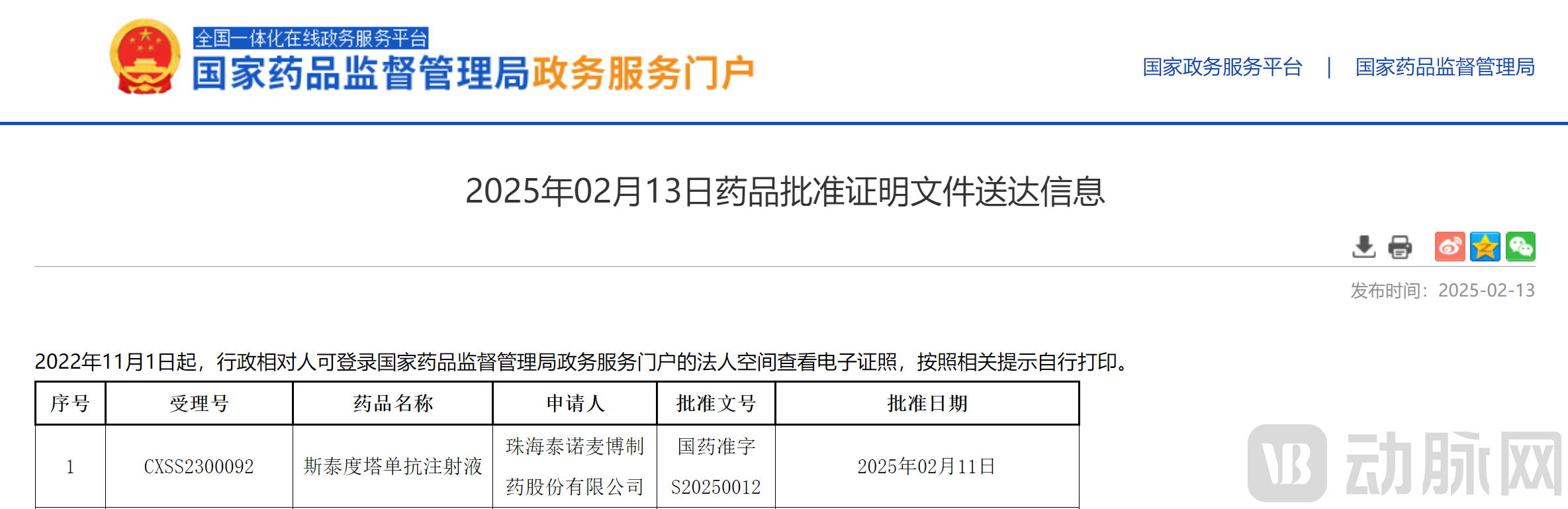
Staidumab is a Class I novel drug independently developed by Taenomeb. As an iterative product of tetanus passive immunization agents, it enables emergency tetanus prophylaxis in adults via intramuscular injection, with rapid onset and no need for complex procedures. No skin test is required, no observation period is needed (for outpatients), and there is no need to adjust for body weight or wound size. A single dose provides rapid onset and long-lasting protection.
It is reported that,Stedutamab is the world’s first fully human recombinant monoclonal antibody for tetanus prevention.Previously, stadumab was included in the Breakthrough Therapy Designation list by China’s Center for Drug Evaluation (CDE) and granted Fast Track designation by the U.S. Food and Drug Administration (FDA). Its market approval not only signifies that the major breakthrough in this field has gained unanimous industry recognition, but also accelerates the iterative advancement of therapeutics in this area.
Zheng Weihong, CEO and President of Taenoma Biopharma, stated: “The official approval and market launch in China of Xintituo®, the world’s first recombinant monoclonal antibody against tetanus toxin, is highly significant. On one hand, it substantially alleviates supply pressure on human plasma-derived products; on the other, it aligns with the World Health Organization (WHO)’s advocacy to accelerate the phase-out of equine plasma-derived products, which carry risks such as allergic reactions, thereby driving rapid iteration and upgrading of therapies in this field toward a more scientific and safe direction.”
There remains a significant unmet clinical need for tetanus disease.
Tetanus is an extremely serious, potentially fatal disease. Without medical intervention, the case fatality rate approaches 100%; even with aggressive comprehensive treatment, the global case fatality rate remains at 30%–50%. The World Health Organization (WHO) points out that tetanus continues to be a significant public health problem in countries and regions where immunization programs are not properly implemented.
Clostridium tetani is widely present in soil, dust, and animal feces. Once it enters the human body through wounds, it can cause severe infections. Therefore, timely and effective preventive measures are crucial. In the prevention and control system for tetanus, preventive measures are mainly divided into two major types: active immunization and passive immunization. Since routine booster vaccinations for tetanus are not conducted among adults in China, this has laid hidden dangers for tetanus infection, making the injection of tetanus passive immunization agents a necessary measure for tetanus prevention in China.
For tetanus passive immunization agents, those currently commonly used in clinical practice mainly include tetanus antitoxin (TAT) and equine tetanus immune F(ab')2) and human tetanus immunoglobulin (HTIG), making three types in total.
Tetanus Antitoxin (TAT) is extracted and prepared from horse serum, making it an equine-derived blood product. The human immune system recognizes it as a foreign antigen, which may trigger severe allergic reactions after injection. According to clinical statistics, the incidence of allergic reactions to TAT ranges from 5% to 30%, with a fatality rate of approximately 1 in 10,000, posing significant risks in clinical applications.【1】Furthermore, tetanus antitoxin (TAT) may induce serum sickness within several days after injection, primarily manifesting as urticaria, fever, and lymphadenopathy; in severe cases, it can lead to acute renal failure and may also cause damage to the respiratory, circulatory, nervous, and digestive systems. Consequently, in 1991, the World Health Organization (WHO) removed TAT from its Model List of Essential Medicines.
Equine Tetanus Immunoglobulin (F(ab')2) is based on the original process of producing TAT using horse serum, with an additional column chromatography purification step to reduce the content of high-molecular-weight proteins such as IgG and increase the effective component, the antibody fragment F(ab′)2.2the relative content, thereby significantly improving its safety profile compared to TAT.【2】However, the possibility of allergic reactions cannot be completely ruled out in clinical practice. Strict allergy testing must be conducted prior to administration, and patients’ responses should be closely monitored. Furthermore, the duration of protection is generally limited to 10 days, and its manufacturing process is relatively complex, posing significant challenges for quality control.

Although Human Tetanus Immunoglobulin (HTIG) is prepared from human plasma and has low sensitogenicity, it carries the risk of transmitting certain known or unknown blood-borne pathogens (such as HIV and hepatitis viruses). Furthermore, its clinical application is constrained by limited plasma supply, resulting in restricted accessibility. According to the *Expert Consensus on Tetanus Immunoprophylaxis in China*, the annual demand for HTIG in China exceeds 10 million doses, yet the actual supply meets less than one-third of this need. This substantial supply-demand gap, coupled with the limitations of traditional therapies, has spurred an urgent market demand for novel drugs that are safer, more efficacious, and more accessible.
Amidst the significant limitations of traditional passive immunization agents, the novel monoclonal antibody drug Xintituo® has emerged as a key breakthrough in tetanus prevention and treatment due to its clinical advantages.
Safe, Highly Effective, Controllable, and Accessible
Monoclonal antibody therapy has demonstrated significant advantages in the treatment of various diseases due to its high target specificity and low toxicity. Meanwhile, with the continuous maturation of manufacturing processes, the commercial infrastructure for monoclonal antibodies is becoming increasingly comprehensive, providing more options for clinical treatment.
As the world’s first approved recombinant monoclonal antibody against tetanus toxin, stedumab has demonstrated revolutionary breakthroughs in safety, superior efficacy, accessibility, and controllability. According to Phase III clinical trial data, the incidence of adverse events in the stedumab group was 12.3%, showing no significant difference compared with the placebo group (11.8%) and the human tetanus immune globulin (HTIG) group (13.5%). No serious allergic reactions were reported, indicating a favorable safety and tolerability profile.

Safety: In traditional drug administration protocols, complex steps involving “skin testing + multiple observations + dose adjustments” are typically required. This process is not only cumbersome but also carries the risk of anaphylactic shock or even death due to false-negative skin test results followed by drug administration. In contrast, stadumab does not require skin testing or post-administration observation. This feature not only simplifies the administration process and improves the convenience and efficiency of treatment, but also significantly reduces the severe risks associated with allergic reactions, thereby providing patients with a safer and more efficient therapeutic option.
Superior Efficacy: Stedutamab Injection demonstrates rapid onset of action. Phase III clinical trials showed that 95.4% of patients achieved protective levels within 12 hours post-administration, significantly higher than the HTIG group (53.2%), thereby fundamentally reshaping the traditional prevention and treatment landscape for tetanus. Compared with existing products, Stedutamab Injection not only sets a new industry benchmark with its substantially faster onset but also provides more durable protection, eliminating the risk of secondary infection in patients over the short term!
Controllable: Stedumab, developed using recombinant DNA technology, exhibits remarkable homogeneity and stability. Under a stringent quality control system spanning its entire lifecycle, it achieves high batch-to-batch consistency, significantly surpassing the average performance of similar products, thereby providing a solid guarantee for stable drug supply and clinical efficacy.
AccessibilityCompared with tetanus-specific immunoglobulin derived from human plasma, the production cycle of Staedtumab Injection is shortened to 2–3 months. Its raw materials are not subject to supply constraints, production capacity can be easily scaled up, and drug accessibility is significantly improved. Currently, Tynobio has completed preparations for the large-scale production of Staedtumab. The company has established a GMP-certified commercial manufacturing facility, achieving stable mass production. This effectively resolves the supply shortage traditionally associated with human tetanus immunoglobulin, often described as “difficult to obtain even a single dose,” and ensures ample and reliable medication supply for the market.
“The Chinese Solution” for Tetanus Prevention and Treatment: The Era of Fully Human Monoclonal Antibodies Has Officially Arrived
The advent of stadutugumab is built upon HitmAb, Taizhou Mab’s proprietary integrated technology platform for the development of natural fully human monoclonal antibodies.®. This platform provides a “Chinese solution” for tetanus prevention and treatment through its natural fully human antibody screening technology. Compared with traditional humanized antibodies (murine antibodies engineered via genetic modification), fully human antibodies are directly screened from human B cells and feature superior safety, high specificity, and high affinity, making them an inevitable trend in the development of therapeutic antibody drugs. According to Gminsights, fully human monoclonal antibodies accounted for 50.8% of the monoclonal antibody market share in 2022.

According to the introduction, HitmAb®The platform’s core capability lies in leveraging an integrated technological framework to screen and identify human blood samples containing antibodies against target antigens. Through single-cell isolation, single-cell antibody gene amplification, antibody gene sequencing, rapid construction of linear heavy- and light-chain gene expression systems, cellular expression, and functional validation, the platform obtains natural fully human monoclonal antibodies that truly represent human humoral immune responses.
Truly representative of the body’s highly efficient antibody-mediated immunity, natural fully human monoclonal antibodies developed using this technology platform have undergone rigorous screening, elimination, and optimization by the human immune tolerance mechanism. This process minimizes the risks of immunogenicity and immune reactivity to the greatest extent possible while fully leveraging humanity’s advantageous natural resources. These natural fully human monoclonal antibodies, which genuinely reflect in vivo antibody immunity, provide patients with maximum safety assurance.
From a market perspective, the launch of stadumab not only fills the gap in fully human monoclonal antibody products for tetanus prevention and treatment but also reshapes the competitive landscape of passive immunization agents for tetanus through its technological iterations and clinical advantages. According to the "2024-2030 Market Research and Development Prospect Forecast Report on the Passive Tetanus Prevention Industry," the global market size for passive tetanus immunization is projected to exceed USD 5 billion by 2025. As a region with a high incidence of traumatic injuries, China has a potential market demand of over 5 million doses annually.
Furthermore, as public health awareness rises and standardized post-trauma management guidelines become more widely adopted, global demand for efficient and safe tetanus prophylaxis will continue to grow. Through technological platform expansion and international collaboration, among other initiatives, Tianmai Biopharm has not only consolidated its leading position in the monoclonal antibody sector but also propelled fully human antibodies from “innovative products” to “industry standards,” accelerating the delivery of “Chinese solutions” to patients worldwide.
In the future, with the expanded application of stedumab in more regions and the research, development, and market launch of more innovative drugs based on natural fully human antibody technology, the “Chinese Solution” for tetanus prevention and control will exert greater influence globally and make greater contributions to the health and well-being of all humanity.
References:
1. Chinese Expert Consensus on Tetanus Immunoprophylaxis. *Chinese Journal of Surgery*, March 2018, Vol. 56, No. 3
2. Expert Consensus on Post-Traumatic Tetanus Prophylaxis and Management and the Construction of Vaccination Clinics. Chinese Preventive Medicine Association. Chinese Journal of Preventive Medicine, 2022,56(6) : 726-734.
✳Images in this article are provided by Tranomab