

Chinese MedTech Giants Mindray and United Imaging Secure Major Middle East Orders at Arab Health 2025
Mindray
Medical Device R&D Manufacturer
United Imaging
High-end Medical Device Developer
MGI
Gene Sequencing Instruments and Related Reagent & Consumables R&D Manufacturer

yuwell
Developer and Manufacturer of Basic Medical Devices
In 2025, the wave of Chinese medical device manufacturers expanding overseas continues to surge with undiminished momentum. The international market is projected to sustain the high-growth trend observed in 2024. Currently, a number of companies have successfully secured orders and gained a first-mover advantage in the Middle East, leveraging their keen market insights and robust product capabilities.
During the Spring Festival, two major medical exhibitions in the Middle East—Arab Health and Medlab Middle East—were held. Nearly a thousand medical device companies flocked to Dubai with their latest solutions.
At Arab Health, the presence of Chinese companies has become impossible to ignore. Firms such as Mindray and United Imaging have secured large exhibition spaces and won major orders.
An exhibitor at Arab Health stated, “The most striking impression from attending Arab Health is the dense foot traffic; it attracts clients from nearly all regions of the Middle East, demonstrating the event’s extensive influence and reach. However, this has also intensified competition. It is now difficult to find exclusive products, as most are contested by four to five companies.”
Arab Health has become a key platform for Chinese companies to showcase their global expansion. Several enterprises unveiled new products at the Middle East conference and concurrently held global distributor summits. Which companies were the first to secure orders in the Middle East?
Medical imaging equipment leads the overseas expansion, with United Imaging, Neusoft, Wandong Medical, Sinovision, and Anjian Technology showcasing their star products at Arab Health.
United Imaging Secures Orders from Multiple High-End Hospitals in the Middle East.The barriers to entry for high-end hospitals in the Middle East are relatively high, as these institutions tend to place greater trust in established global brands. United Imaging has secured orders from multiple high-end hospitals by adopting a “premium-first” strategy. This approach involves initially introducing globally leading technologies and products to gain recognition from prestigious Middle Eastern hospitals, and then leveraging their demonstrative effect to penetrate the broader regional market.
This strategic initiative yielded results at Arab Health 2025. During the exhibition, United Imaging Group signed strategic cooperation agreements with leading healthcare institutions from multiple countries, including Al Mana Healthcare in Saudi Arabia, Sezin Hospital in Turkey, and KPJ Healthcare in Malaysia, resulting in the installation of multiple high-end systems valued at tens of millions of yuan in premier hospitals.
Among them, Sezin, a leading medical institution in Turkey, has introduced innovative products from United Imaging, including the uMR Jupiter 5.0T whole-body MRI system, the world’s first 3.0T MRI with an ultra-large 75cm bore—the uMR Omega—and an ultra-high-end 640-slice CT scanner. The winning bid price for the uMR Jupiter in China was nearly RMB 50 million.
Neusoft also secured major orders at the exhibition. Having established its Middle East subsidiary 15 years ago, Neusoft showcased its “comprehensive high-end, full-stack intelligent” medical imaging solutions, including CT, MRI, DSA, and PET/CT, at Arab Health 2025.Through deep localization operations, Neusoft Medical secured dozens of orders for large-scale medical equipment from the Middle East, Africa, and the Asia-Pacific region at the exhibition.
IVD Market: Multiple Companies Strike Gold at Medlab Middle East
Mindray, a Benchmark for Global Expansion, Successfully Secures Multiple Key Accounts. Mindray has stated that its strategy for expanding the in vitro diagnostics (IVD) business in overseas markets involves deep localization, establishing overseas production bases, and accelerating entry into public hospitals and high-volume customer markets abroad, thereby driving rapid business growth.
Under this strategic guidance, Mindray has secured multiple large-scale clients in the Middle East.During the exhibition, Mindray signed cooperation agreements with leading laboratory institutions at the forefront of digital and intelligent innovation in the industry, including AI Borg Diagnostics, one of the nine members of the Global Diagnostic Network (GDN) and the largest multinational chain laboratory group in the Middle East, as well as PureLab, the largest chain laboratory operator with 150 branches across the United Arab Emirates. The IVD business has secured multiple high-volume clients, facilitating increased product sales volume. It is foreseeable that Mindray’s overseas business will continue its strong growth momentum.
Sequencing Market: MGI Secures Another Win in EgyptAs a dedicated player in the Middle East market, MGI established an office in the region as early as 2019 and forged partnerships with companies such as Prepaire Labs, a healthcare technology firm in the United Arab Emirates. MGI is currently building an ecological cooperation network in the Middle East. During the exhibition, MGI entered into a comprehensive partnership with AGITECH, an Egyptian biotechnology distributor, to jointly provide local customers with cutting-edge life science tools and better serve local clinical trials and research and development.
TIANLONG also received orders from Egypt, signing an exclusive cooperation agreement with Egyptian clients at the exhibition for the local distribution of the Biolum Pro ATP hygiene monitoring system, and plans to further collaborate in the fields of PCR molecular diagnostics and chemiluminescence immunoassay.
In the home medical device market, yuwell announced a strategic investment and partnership with U.S.-based Inogen at Arab Health. yuwell subscribed to privately placed shares of Inogen for approximately $27.12 million, accounting for about 9.9% of Inogen’s issued ordinary shares after the investment.
In the respiratory care market, Yuwell is a leading domestic manufacturer of stationary oxygen concentrators, while Inogen is the world’s leading provider of portable oxygen concentrators. Their collaboration will enhance Yuwell’s international competitiveness in the respiratory sector. Through this partnership, Inogen will leverage Yuwell’s distribution channels to access the vast Chinese market, while Yuwell’s respiratory products will better penetrate European and American markets by leveraging Inogen’s brand and channel strengths.
According to public information, in addition to directly securing partnerships, numerous Chinese exhibitors at the two major medical device exhibitions in the Middle East received multiple expressions of interest for collaboration.
An exhibitor told VCBeat, “We received numerous expressions of interest in collaboration at Arab Health. By comparison, Europe’s MEDICA seems to have lost its former luster, while Arab Health still holds a clear advantage in terms of cost-effectiveness.”
The two major medical device exhibitions in the Middle East attracted over 1,000 Chinese companies. The appeal of the Middle Eastern market lies in its status as an emerging market with immense potential and relatively low entry barriers.
Among the revenues of major global medical device giants, the Middle East market accounts for less than 10%, but it is growing rapidly. According to public data, in the fourth quarter of Medtronic’s fiscal year 2023, revenue growth in the Middle East approached 20%, making it one of the fastest-growing emerging markets.
Data on Chinese companies’ overseas expansion also confirms the impressive growth rate of the Middle East market. According to data from the China Chamber of Commerce for Import and Export of Medicines and Health Products, China’s medical device industry demonstrated outstanding performance in exports in 2024, with export value reaching USD 48.75 billion, a year-on-year increase of 7.3%. Data from the China Association of Medical Equipment shows that in 2024, exports of Chinese medical devices to 16 Middle Eastern countries amounted to USD 2.039 billion, a year-on-year increase of 13%, hitting a record high. The United Arab Emirates and Saudi Arabia, as major export markets, have become key strategic hubs for many companies to expand their business.
Although the Middle East market holds significant potential, the entry barriers for medical devices in this region are not particularly high.
Regarding market entry barriers, VCBeat has compiled the medical device regulations of major countries in the Middle East. In the more developed regions of the Middle East, medical device regulations are similar to those of the European Union. Chinese enterprises without local offices typically need to rely on local partners to complete registration.
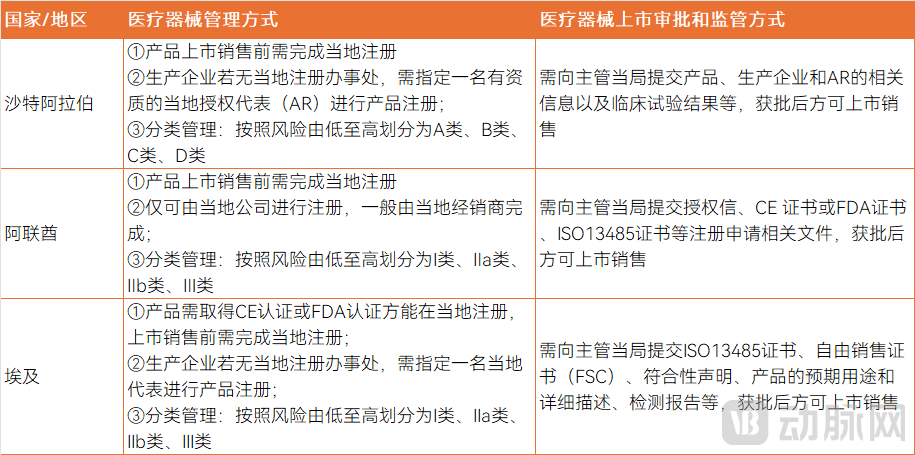
Registration Requirements for Medical Devices in Key Middle Eastern Markets
Wu Guangjin, Manager of the Key Accounts Department at Jiyuan Medical’s International Sales Center, stated, “Compared with other major overseas markets, the market access difficulty in the Middle East is similar to that in Southeast Asia and lower than that in Latin American markets represented by Brazil.”In the United Arab Emirates, the medical device registration process is relatively efficient; we obtained our certificate in just three months. In Saudi Arabia, the registration cycle completed through our distributor took approximately 6–8 months. Furthermore, in the Iraqi market, certain medical devices can be sold without requiring additional certifications. Overall, the Middle East market has relatively friendly entry barriers, offering convenient market access conditions for medical device companies; holding CE or FDA certification is generally sufficient to meet local market access requirements.
In terms of market barriers, the Middle East has weak local manufacturing capabilities and low trade protection barriers. The market is dominated by multinational corporations (MNCs), while local medical device manufacturers are limited to producing basic, low-value consumables such as masks and gauze. The limited strength of local manufacturers reduces trade protection barriers, making it easier for Chinese brands to enter the Middle Eastern market.
In competition with multinational corporations (MNCs), Chinese medical device companies are gradually reversing the traditional perception of their brands in the Middle East market.In the past, Chinese brands in the Middle East market were primarily perceived as suppliers of low-value consumables. However, during the COVID-19 pandemic, numerous Chinese medical device companies leveraged their stable supply chain advantages to support overseas markets, thereby establishing an initial foundation of trust in the Middle East. Subsequently, as Chinese medical device enterprises have continued to increase their investment in the Middle East market, their products have gradually gained recognition due to their high cost-performance ratio and technological innovation. A trend of Chinese-made products replacing European and American counterparts is taking shape, particularly in categories such as patient monitors, ultrasound systems, CT scanners, and disposable endoscopes. For instance, domestically produced disposable flexible ureteroscopes have achieved significant market share in countries such as the United Arab Emirates and Turkey.
What Did Companies That Successfully Secured Orders in the Wealthy Middle Eastern Market Do Right?
First, the product and its quality must gain market recognition.It is not difficult to observe that companies securing orders in the Middle East also hold a leading share in the domestic market. Most enterprises have won contracts in the Middle East by competing directly with imported brands, earning customer recognition through superior product quality.
For instance, Jiyuan Medical’s disposable electronic hysteroscope successfully won the bid for the Latifa Hospital project in the United Arab Emirates (UAE). Wu Guangjin stated that the product obtained regulatory approval in the UAE in September 2023 and received high praise from physicians during its trial period at national hospitals under the UAE Ministry of Health. During the bidding process, Jiyuan Medical’s product competed directly with European and American counterparts, standing out due to its superior performance and ultimately securing the contract.
Secondly, enterprises should precisely identify core markets and target countries, and formulate corresponding market strategies based on different stages of development.Finally, domestic medical device companies need to gradually explore and establish their brands. The further they penetrate the high-end market, the higher the demands on brand equity become.
“An industry insider stated, ‘It is extremely difficult for high-end hospitals in the Middle East to be penetrated. When selecting products, these hospitals consider not only price but also brand reputation as a critical factor. A strong brand conveys messages of reliable product quality and superior service, thereby facilitating consumer trust and recognition. However, brand advantage remains a weak point for domestic medical device manufacturers.’”
Brand strength is a test of comprehensive capabilities. To successfully enter high-end hospitals, relying solely on superior product quality is far from sufficient. Companies must also possess robust digital product capabilities and a professional, efficient local technical support team. These soft-power elements are also key to building brand recognition in the Middle East market.
Of course, brand building is not exclusive to large enterprises; smaller innovative companies can also prioritize and advance their brand development in the early stages.
As Chinese medical device companies transition from early-stage foreign trade exports to globalized operations, they face multidimensional demands. Only a tripartite integration of product, brand, and strategy can enable these enterprises to better penetrate the Middle East market.
In the Middle East, a market with high growth potential, Chinese medical device companies also face certain challenges.
During the process of internationalization, the most prominent challenge faced by Chinese medical device companies is building a professional international sales team. It is extremely difficult to find talents who are proficient in Arabic and possess medical expertise.
The second major challenge is cultural differences. Compared with China, the Middle East features a unique cultural background and religious beliefs, which significantly influence the operational models of the local healthcare market and the acceptance of medical products. For instance, work efficiency in the Middle East is relatively lower than in China, and strict religious beliefs and cultural traditions impose clear restrictions on medical practices. Taking hysteroscopy as an example, while this procedure is routinely and maturely performed in outpatient clinics in Europe and the United States, it is generally not permitted in clinic settings in the Middle East due to religious and cultural factors. Therefore, companies must adapt to local conditions by developing products and market strategies that align with the local cultural context and regulatory requirements.
The Middle East offers unparalleled growth opportunities, positioning itself at the forefront of the global health transformation. Meanwhile, Chinese enterprises possess a robust technological foundation in the digital integration of medical devices. We are already witnessing a deepening engagement between Chinese medical device companies and the Middle Eastern market, marked by a shift from early-stage, simple foreign trade models to in-depth localized operations. We look forward to seeing more Chinese enterprises participate in the development of healthcare infrastructure in the Middle East.
Reference Article:
United Imaging Wins 48 Million Bid for the 5.0T MRI Project at the First Affiliated Hospital of Chongqing Medical University — Medical Radiology Information
How Expensive Can It Get? A Review of the Winning Bid Prices for PET Equipment in 2024 — Nuclear Medicine Home
Connecting Dubai, Embarking on the Future of Digital and Intelligent Healthcare — Mindray
SOE Updates | United Imaging Group Signs Contracts with Multiple Middle Eastern Healthcare Institutions, “Intelligent Manufacturing in China” Achieves a Strong Start — Shanghai SASAC
Highlights from the Middle East Trip: MGI’s SEQ ALL Makes Its Debut, Furthering Localized Expansion – MGI
First Exhibition of the New Year, Receiving Continuous Likes! TIANLONG Showcases Innovative Products at Dubai Medlab 2025——TIANLONG
Fenghe Medical Prospectus