

Chinese CBCT Manufacturers Launch Global Expansion as Domestic Leaders File IPO
As a landmark innovation in the history of the dental industry, the emergence of dental CBCT (Cone Beam Computed Tomography for oral and maxillofacial applications) made digital orthodontics and implantology possible, thereby revolutionizing clinical diagnosis and treatment workflows and ushering the industry into the era of digital development.
Looking back more than a decade ago, China’s dental imaging market was still a “technological lowland.” At that time, imported manufacturers such as Germany’s KaVo and Italy’s NewTom nearly monopolized the domestic CBCT market, with each unit priced at over RMB 1 million. Such prohibitive costs meant that only specialized dental hospitals and the dental departments of large general hospitals could afford these devices, resulting in very low equipment penetration rates.
A Decade of Transformation: Chinese Manufacturing Has Achieved a Remarkable Breakthrough in the CBCT SectorOver the past decade, Chinese manufacturing has staged an impressive breakthrough in the cone-beam computed tomography (CBCT) sector. A wave of innovative enterprises—including Meyer Optoelectronic, LargeV Instrument, Fussen Technology, Born Dental, Eight Teeth, and Youfang Medical—has emerged, capable of independently producing various CBCT models. This progress has driven the domestic replacement rate to exceed 60%.
SameAt this juncture, the global expansion roadmaps of certain enterprises are coming into focus, as they gradually initiate head-to-head competition with global giants.For instance, in January this year, Bak Tooth’s FinScan F350K device obtained dual certification from the NMPA (National Medical Products Administration) and the FDA (U.S. Food and Drug Administration), signifying that Chinese CBCT systems have gained market access to North America. Meanwhile, Meyer Optoelectronic has secured 13 international certifications, including TUV-CE, Australian TGA, and Japanese PMDA, with its overseas distribution network covering 23 developed-country markets.
It can be said that expanding into overseas markets will be key to whether domestic CBCT brands can capture a larger market share in the next phase.
“In clinical practice, CBCT is widely used, including in oral and maxillofacial surgery, endodontics, orthodontic treatment, and dental implant surgery,” an orthodontic specialist at a chain dental clinic in Shanghai told VCBeat. “This equipment can also help doctors assess patients’ bone density and alveolar bone morphology, thereby providing more accurate surgical plans and evaluations of treatment outcomes.”
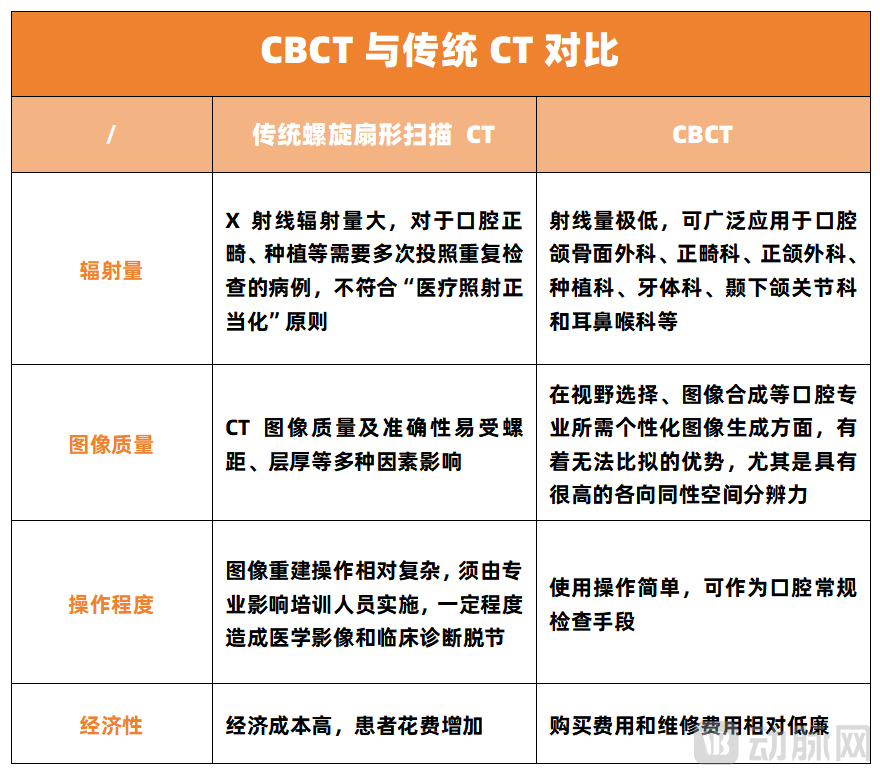
▲Source: Gongyan Industry Consulting, China Postal Securities Research Institute
Taking orthodontics as an example, CBCT can assess the orientation of tooth roots and their relationship with adjacent teeth. When integrated with orthodontic software such as 3Shape and ExoCAD, it enables clinicians to pay closer attention to the thickness, height, and functional remodeling of the labial and lingual bone plates during treatment, thereby ensuring higher-quality outcomes for orthodontic cases.
The aforementioned dental specialist revealed,CBCT has become an essential imaging device in dental institutions.“For example, traditional CT uses two-dimensional fan-beam scanning to reconstruct two-dimensional image data, resulting in significant artifacts; whereas CBCT employs three-dimensional cone-beam X-ray scanning to acquire hundreds of distinct projections, which are reconstructed directly into three-dimensional images with reduced metal artifacts, demonstrating clear advantages.”
However, CBCT systems are not inexpensive. More than a decade ago, the domestic market was largely monopolized by foreign brands, with most products priced in the millions of yuan. For instance, CBCT systems from Germany’s KaVo ranged from RMB 600,000 to RMB 3 million, while those from Italy’s NewTom were priced between RMB 1 million and RMB 2 million.
The shift occurred in 2012. In January of that year, the CBCT under Meyer Optoelectronic obtained national medical device approval; in April of the same year, the CBCT developed by Beijing LargeV received a medical device registration certificate. Since then, domestically produced CBCT has officially entered the market.
In the initial path, “price” served as the “sharp blade” for domestic brands to rapidly capture the market.According to statistical data collected by Huajing Industry Research Institute, the price of CBCT equipment in China has shown a year-on-year downward trend since domestic CBCT units entered the market. The average price per unit was RMB 383,000 in 2013; it dropped to RMB 296,000 in 2017, entering the RMB 200,000 range; and further decreased to RMB 229,000 per unit in 2020.
It is worth noting that China’s dental market is predominantly composed of private small- and medium-sized clinics, and the sustained decline in prices has undoubtedly enabled an increasing number of dental institutions to adopt CBCT.
However,Price cannot be the sole advantage of domestically produced CBCT; achieving technological breakthroughs is key to the industry’s sustained and healthy development.
First, as a core component, the flat-panel detector is the key factor determining whether CBCT can provide high-quality three-dimensional imaging. In this regard, domestically produced CBCT flat-panel detectors have made significant progress in recent years in terms of technological research and development and industrial application. For instance, in terms of integrated and modular design, some domestic detectors have achieved wireless data transmission, simplifying installation and maintenance processes. Furthermore, by employing dual-energy or multi-energy detection technologies (which require coordination with specialized X-ray sources), preliminary tissue differentiation has been realized, such as distinguishing between teeth and filling materials.
Furthermore, in the development of 3D image reconstruction and interface interaction, many domestic brands are accelerating the research and development of core algorithms through independent innovation or collaboration with Chinese universities, thereby gradually narrowing the gap with imported products.
From the perspective of clinical practitioners, key areas of focus include imaging quality, imaging speed, field of view, and radiation safety.The aforementioned dental specialist stated, “In recent years, the user experience of domestically produced CBCT has shown visible improvements in these metrics.”
It is understood that Meyer Optoelectronic’s CBCT devices are renowned for their high-definition imaging, Born Dental’s CBCT excels in metal artifact correction, Youfang Medical’s CBCT features industry-leading algorithms, and Bakeya’s CBCT demonstrates advantages in rapid imaging...
Certainly, domestic brands have not stopped there; multiple industry insiders provided feedback to VCBeat,In the CBCT sector, leading companies continue to increase their investments, with comprehensive deployments across various types of CBCT systems.
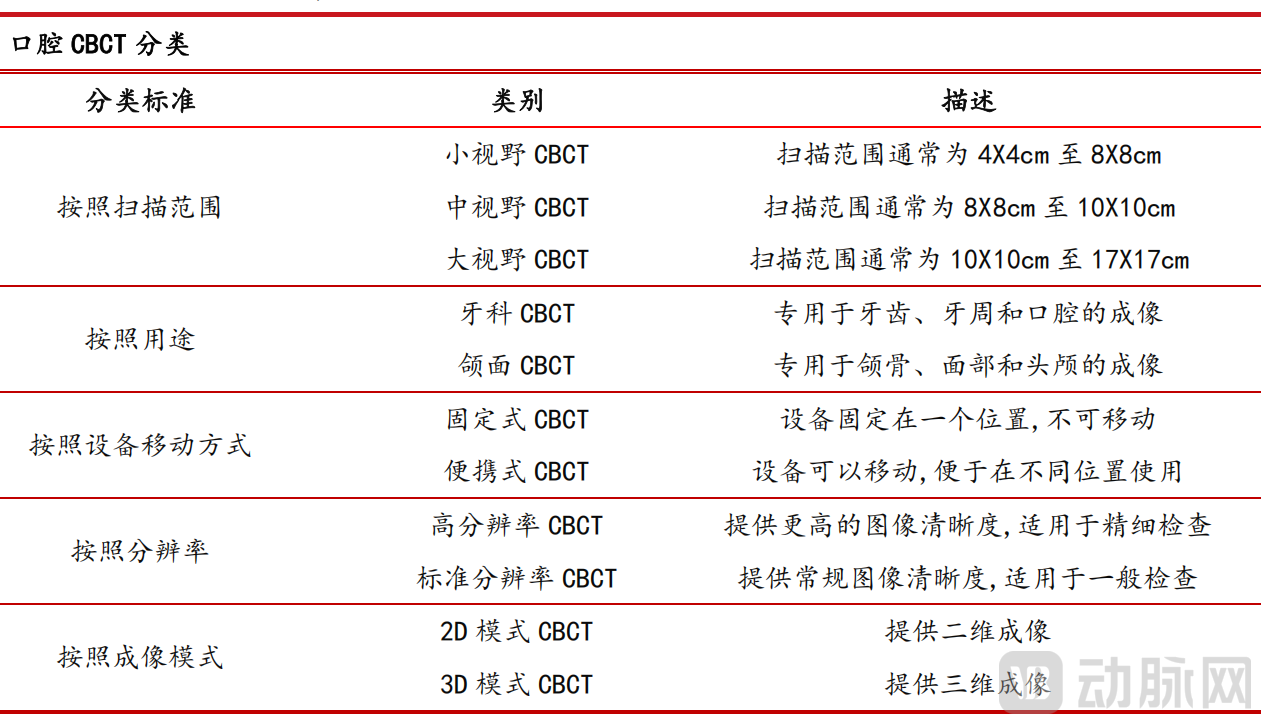
▲Image source: China Post Securities Research Institute
After all, when dental institutions have sufficient budgets, higher-performance CBCT systems become the preferred choice. According to a 2024 survey by Zhongcheng Medical Devices on the current status of CBCT procurement projects, high-performance dental CBCT units are highly favored in the market. For instance, in a procurement project by the Yinzhou District Health Bureau of Ningbo City last year, the unit price for one dental CBCT system slated for purchase was RMB 1.1 million; furthermore, the budget indicated in Xiangya Hospital of Central South University’s procurement intention form for dental CBCT reached as high as RMB 2.25 million.
As with the industry development narratives in other medical device sectors, once domestic CBCT brands established a firm foothold in the Chinese market, they also began expanding overseas to seek greater market potential.
What Is the True Appeal of Overseas Markets?
According to the analysis in "Next Move Strategy Consulting Statista 2022," the overseas CBCT market size is projected to reach $1.74 billion by 2030, with a compound annual growth rate (CAGR) of approximately 10% from 2020 to 2030. As a steadily growing market, it undoubtedly offers significant growth potential for innovative enterprises seeking a second growth curve.
Therefore, when global expansion becomes a mandatory imperative rather than an optional choice, the questions of where to expand and how to do so become the primary challenges that enterprises must confront.
Li Lin (a pseudonym, at the interviewee’s request), an investor focused on the oral care sector, believes that the choice of overseas markets is directly linked to product positioning. “If cost-effectiveness is the key selling point, markets such as Southeast Asia and the Middle East are suitable; if the product is positioned as high-end, it can go head-to-head with global giants in Europe and the United States.”
It has become an industry consensus that Chinese brands should first break into peripheral markets in Asia, Africa, and Latin America by establishing a strong foothold with high cost-performance products, and then gradually expand into mid-to-high-end segments to penetrate core markets in Europe, the United States, and Japan.
But from the perspective of investor Li Lin,The performance of domestically produced CBCT in the European and American markets has drawn greater industry attention, accompanied by increased pressure and challenges.
On one hand, CBCT has been developing for decades and is a mature track where technological iterations rarely create significant generational performance gaps, making it extremely difficult for domestic brands to challenge international giants in core European and American markets. This is because international giants such as KaVo from Germany, Morita from Japan, and NewTom from Italy started their CBCT businesses earlier, have higher brand recognition, and possess extensive sales channels and a relatively solid user base, resulting in high customer switching costs.
On the other hand, after-sales service is key to ensuring a positive user experience for products such as CBCT. Due to cultural differences across countries and regions, innovative enterprises must undertake in-depth localization adjustments when expanding into new markets, including adaptations to physicians’ usage habits, product compatibility, and service models.
“Generally speaking,After identifying the target markets, innovative enterprises should simultaneously secure local market access approvals and accelerate their participation in various trade shows and other activities to enhance brand visibility.“Investor Li Lin stated.”
In terms of certification, FDA and CE approvals impose the most stringent requirements. They not only enforce strict safety and efficacy standards regarding usage methods and functionalities but also place significant emphasis on whether CBCT radiation doses comply with international safety standards and whether the image quality produced by the equipment is sufficiently precise. After becoming the first to secure both NMPA and FDA certifications for its CBCT product this year, Bayueya’s FinScan F350K device has gained access to the North American market, a move that other innovative enterprises are bound to follow in due course.
In their efforts to enhance brand awareness, companies are continuously expanding their strategic presence. For instance, Meyer Optoelectronic has repeatedly showcased its digital products, including dental CBCT systems, at prominent dental exhibitions such as the International Dental Show (IDS) in Cologne, Germany, aiming to boost overseas product recognition and accelerate export growth. Born Dental has also actively participated in events like the Arab Exhibition for Equipment, Dental Supplies and Technology (AEEDC DUBAI) with its CBCT product line, inviting international clients to tour its manufacturing facilities. Another innovative enterprise, Eight Teeth, has traveled to the Middle East to attend exhibitions such as the 2025 Dubai International Dental Exhibition.
Additionally, establishing distribution networks through agents or localization partners, collaborating with overseas medical institutions, and providing customized solutions are also important means to enhance brand exposure.
“It is particularly important to note that, under the current geopolitical landscape, innovative enterprises expanding overseas should diversify their market presence to avoid overreliance on any single region. At the same time, establishing assembly plants or technology centers abroad can help circumvent trade restrictions through localized production,” said investor Li Lin.The core takeaway in one sentence: the quality of localization services is the key to successful global expansion.”
From Domestic Substitution to Global Expansion: China’s CBCT Sector Tells a Compelling Story of Industrial Innovation.
But as the story unfolds to the present, some challenges and changes are on the horizon.First, the domestic market has gradually transitioned into a stock market, where the underlying logic and strategic approaches differ significantly from those in an incremental growth market. Furthermore, as more Chinese brands enter developed markets, the key challenge lies in how to compete effectively against international giants.
In short, whether in China or abroad, CBCT market entrants must brace themselves for a tough battle amid fierce competition.
“Although challenges differ between China and abroad, the fundamental solution remains unified: building long-term technological reserves.“Investor Li Lin told VCBeat that, according to his team’s research, domestically produced CBCT systems are facing continuous pressure from rising costs due to supply chain and other issues, and only through innovation can this impasse be broken. ‘Only technology can dig the deepest moat.’”
This is because only by being deeply rooted in technology can domestic brands truly establish brand equity, thereby breaking the entrenched perception of Chinese-made CBCT equipment brands as being confined to the low-to-mid-end segment of the domestic market. Only with established brand equity can products achieve healthier gross profit margins, which in turn support high-investment R&D needs such as continuous product optimization and upgrades, as well as new product development, ultimately creating a virtuous cycle.
In fact, a review of the development of global medical technology companies reveals that all major international players have followed a path of long-term technological accumulation. For instance, Planmeca, the pioneer in CBCT technology, has consistently released new versions of its CBCT systems and recently launched the OP 3D × DTX STUDIO™ intelligent digital ecosystem CBCT. According to the company’s official press release, this device is no longer confined to the traditional competitive focuses of field-of-view expansion or resolution improvement that have characterized the CBCT market for years. Instead, it features a “digital core”—a system that integrates various devices into interconnected, shared terminals while supporting additional software applications to unlock greater potential.
Specifically, the OP 3D × DTX STUDIO™ intelligent digital ecosystem CBCT integrates five core functional modules—DTX Studio™ Core, DTX Studio™ Clinic, DTX Studio™ Implant, DTX Studio™ Lab, and DTX Studio™ Go—to connect various teams (physicians/assistants/consultants/technicians), data sets (initial consultation/treatment/follow-up), equipment (CBCT/intraoral scanners/dental X-ray devices/cameras), and workflow stages (acquisition/diagnosis/planning/fabrication/implementation), thereby synchronizing all information in real time.
However, it is crucial to fully recognize that the path toward global high-end products through technological accumulation is by no means easy. In addition to requiring firms to demonstrate firm determination and the courage to sustain investment, it also demands concerted efforts from upstream and downstream supply chain partners and ecosystem collaborators.
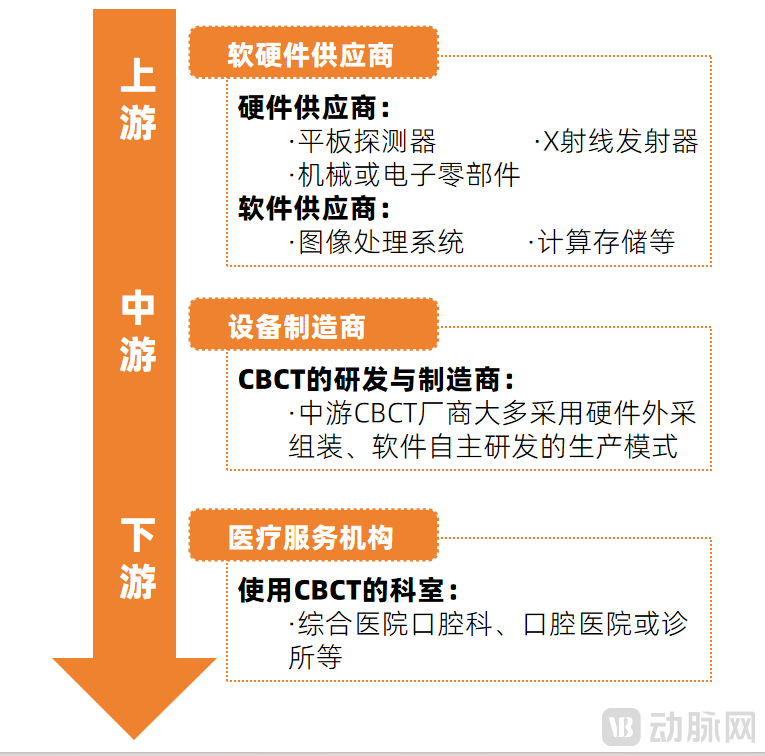
▲Upstream and Downstream of the CBCT Industry Chain | Chart by VCBeat based on public information
For instance, in terms of industry ecosystem, the upstream sectors of the dental CBCT industry primarily include electronic component manufacturing, high-precision machining, computer software development, and medical imaging equipment manufacturing.
In terms of downstream application industries, the primary customers for dental CBCT are dental service providers. Upstream breakthroughs in electronic components and processing design are of significant importance to dental CBCT manufacturers, while the downstream emphasis on digitalization is a crucial factor in sustaining long-term robust demand for dental CBCT sales.
We believe that as domestic CBCT brands continue to advance into the future, the gap with imported brands will continue to narrow, marking a significant step toward becoming global enterprises.
References:
1. “Domestic Production Rate Surges to 76.03%! This Type of Imaging Equipment Becomes the ‘New Favorite’ of Private Medical Institutions” – Zhongcheng Medical Devices
2. “Industry Research | What Is the Potential of the Dental CBCT Industry?” — Hangshi Asset Management