

VITALERTER Files IPO Prospectus: Pioneering AI-Powered, Non-Contact Health Monitoring for Global Aging Populations

Vitalerter
Provider of Medical Monitoring Information Solutions
The global aging process is accelerating. According to World Health Organization projections, the global population aged 60 and above will reach 1.4 billion by 2030. In China, data from the National Bureau of Statistics shows that as of the end of 2023, the population aged 60 and above had reached 296.97 million, accounting for 21.1% of the total national population.
This aging trend has brought about enormous demand for medical care and elderly support; however, traditional care models still face numerous challenges, such as labor shortages, high costs, and low efficiency. How to leverage technological innovation to achieve “health prevention,” provide “precision care,” attain “cost reduction and efficiency improvement,” and deliver “remote services” has become a core issue that the industry urgently needs to address.
With the introduction of the “Action Plan for the Development of the Smart Health and Elderly Care Industry (2021–2025),” the integration of next-generation information technologies with the health and elderly care sector has become increasingly prominent, leading to a continuous expansion in the variety of smart products for health management, rehabilitation assistance, and elderly monitoring.
Israel’s Vitalerter seized early industry opportunities and successfully entered the market with its contactless health monitoring technology. By deeply integrating biosensors with artificial intelligence algorithms, the company provides 24/7 continuous monitoring solutions for elderly care facilities, geriatric hospitals, and home-based care settings. Its innovative technology has not only expanded the boundaries of health management but also demonstrated the potential of “technology-enabled elder care” across multiple global markets.
Currently, Vitalerter has expanded its operations across Europe, the Americas, and Australia. Since establishing its presence on Guangzhou International Bio Island in 2019, the company has laid out its strategic footprint in cities including Guangzhou, Beijing, Shanghai, Wuhan, and Chengdu.
Addressing the Core Pain Points of the Elderly Care Industry,
Reduced fall incidents in nursing homes by 53% and eliminated 2,311 unnecessary manual repositionings
In the field of elderly care, traditional contact-based monitoring devices (such as dynamic electrocardiographs and pulse oximeter finger clips) rely on manual operation and have three major limitations:
First, it is highly invasive. It requires frequent physical contact with the user, which can easily trigger resistance among the elderly;
Second, high costs. The high expenses for equipment procurement and maintenance limit its applicability to critical care settings such as the ICU;
Third, data gaps. Reliance on intermittent monitoring makes it difficult to capture early signals of health deterioration.
Meanwhile, the shortage of caregiving personnel is becoming increasingly severe. Data from the "2024 Research Report on the Occupational Status of Elderly Caregivers" shows that China faces a supply gap of 5.5 million elderly caregivers, with an attrition rate of 40% to 50% among newly recruited staff. The combination of high-intensity workloads and cumbersome administrative tasks further exacerbates the burden on the industry.
In this context, non-contact, automated, and continuous health monitoring technologies have become an essential industry requirement. To fill this gap in the market, Vitalerter has developedVitals Non-Contact Health Box.
This system integrates two core technologies, the first of which is compact and lightweight biosensor technology.
Leveraging this technology, the product seamlessly integrates with small furniture items such as beds, wheelchairs, and sofas, transforming ordinary furniture into intelligent health monitoring systems. By simply lying on a bed or sitting in a chair, elderly users can undergo non-contact vital signs monitoring, with the system capturing key health metrics in real time, including heart rate and respiratory rate trends. Upon detecting adverse events, the system immediately issues voice alerts in Chinese to promptly notify caregivers to take intervention measures, effectively reducing risks such as falls, pressure ulcers, and sepsis. Furthermore, the sensor supports Wi-Fi connectivity to the cloud without requiring any special infrastructure.
The second core technology focuses on the innovative application of artificial intelligence in the field of personal data processing for the elderly.
Supported by this technology, the system can conduct in-depth analysis of patients’ continuous vital signs data and employ algorithms to accurately identify early signs of health deterioration. This enables the system to predict potential health risks in advance and promptly send preventive alerts to caregivers, including physicians, nurses, professional caregivers, and even family members. Data updates occur at a frequency of up to once per second and can be viewed across multiple devices, such as smartphones, tablets, and smart TVs.
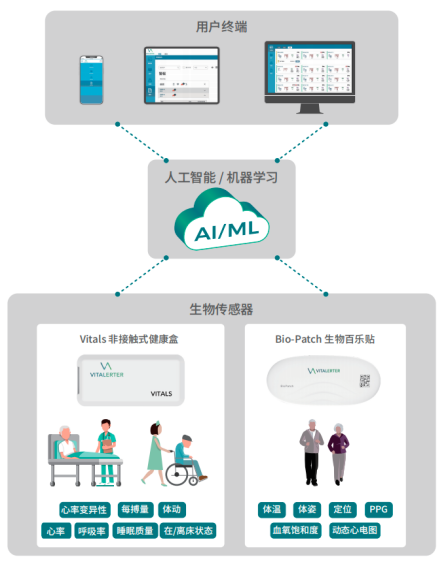
Vitalerter’s implementation of continuous, remote, real-time health monitoring and assessment has not only significantly improved the quality of life for older adults but also effectively reduced medical costs and user burdens, thereby decreasing the frequency of hospital admissions. Furthermore, this solution enhances the operational efficiency of care facilities.
Overall, the implementation of this protocol successfully reduced falls in nursing homes by 53% and eliminated 2,311 instances of unnecessary manual repositioning (official clinical trial data from the UK Department of Health and Social Care/NHS).
AI-Driven "Unobtrusive Monitoring,"
Innovative “Smart Nursing Card” Enhances Hospital Management Efficiency
Specifically, Vitalerter’s core product, the “Vitals Contactless Health Box,” employs ballistocardiography (BCG) technology to capture nanoscale vibrational displacement signals from the human body through bed frames or wheelchair structures. It enables real-time monitoring of 15 vital signs—including heart rate, respiratory rate, body movement, and in-bed/out-of-bed status—with data updated at a frequency of once per second. Its technological advantages are reflected in three aspects:
First, high-precision algorithms and dynamic learning capabilities.
By leveraging machine learning models, the system can filter out environmental noise (such as variations in bed material and external vibrations) to extract valid vital signs data. Compared with ECG devices, the heart rate error rate is less than 5%. The algorithm dynamically learns user behavior patterns, gradually establishing personalized health baselines to enable early risk warning.
Second, end-to-end automated management.
The system developed by Vitalerter encompasses monitoring, early warning, care plan execution, and data report generation. For instance, when caregivers wear a “smart care card,” the system automatically records service duration and content, generating electronic reports to reduce administrative workload.
Third, data privacy and compliance.
The system employs end-to-end encryption technology and complies with the GDPR (EU), HIPAA (US), and China’s Personal Information Protection Law. User personal information is stored exclusively on the client’s local servers, while Vitalerter Cloud processes only de-identified device IDs and vital signs data, ensuring privacy and security.
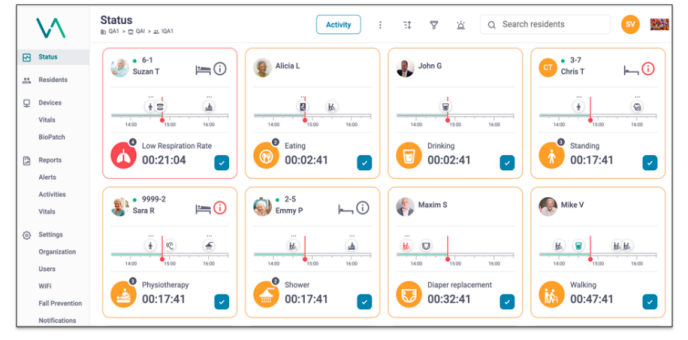
Moreover, Vitter has innovatively developed the “Smart Care Card.” When the Vitals Health Box detects the signal from the smart care card carried by a caregiver, the system displays that the caregiver has arrived to provide care for the elderly and automatically clears the alert upon completion of the care activity.
Administrators can view the usage of smart nursing cards in the system backend, including caregivers' service start and end times, service duration, working hours, and the patients served during their shifts. This data assists administrators in allocating human resources and serves as a basis for daily operational management.
Global Expansion,
Covering over 300 elderly care institutions globally, serving more than 25,000 beds
It is reported that Vitalerter, in partnership with Deloitte, won a competitive tender issued by the Israeli Ministry of Health. Its digital solution enhances the quality of care in elderly care institutions, covering 300 geriatric hospitals with a total of 25,000 beds. Furthermore, since entering the Chinese market in 2019, Vitalerter has collaborated with leading enterprises such as Poly Health Investment and Yuexiu Yinxing to accelerate the application of its Vitalerter Smart Health Cloud Protection System and related products.
In the future, the company also plans to continuously optimize its core products and expand its product portfolio to comprehensively realize smart elderly care. Meanwhile, it will leverage its platform management system to effectively enhance the operational efficiency of medical institutions.