

Saluda Medical Secures $100 Million Funding for FDA-Approved Closed-Loop Spinal Cord Stimulator Evoke

Saluda Medical
Developer of Chronic Pain Treatment Devices

Redmile Group
Healthcare Venture Capital Firms

Wellington Management
Investment Management Institution
Saluda Medical, the world’s first company to receive FDA approval for a closed-loop spinal cord stimulator, recently completed a $100 million financing round.
Saluda Medical (hereinafter referred to as “Saluda”) was founded in 2013 and is an Australian medical device company dedicated to transforming patients’ lives through neuromodulation solutions. In 2022, the Evoke System received FDA approval.
Saluda’s latest financing round was led by Redmile Group, with participation from Wellington Management, TPG Life Sciences Innovation, Fidelity Management & Research, and other investors. The funds will be used to accelerate the commercialization of its flagship product, the Evoke closed-loop spinal cord stimulator (Evoke spinal cord stimulator), further solidifying Saluda’s leadership in the emerging field of neuromodulation therapies.
The Evoke spinal cord stimulator is currently primarily used for the treatment of chronic pain. According to data from the International Association for the Study of Pain, approximately one-fifth of the global population suffers from chronic pain, with elderly patients significantly outnumbering younger ones.
Driven by the unique innovativeness of its products and substantial market demand, Saluda has undergone six rounds of financing since 2015, raising a total of $399.5 million.
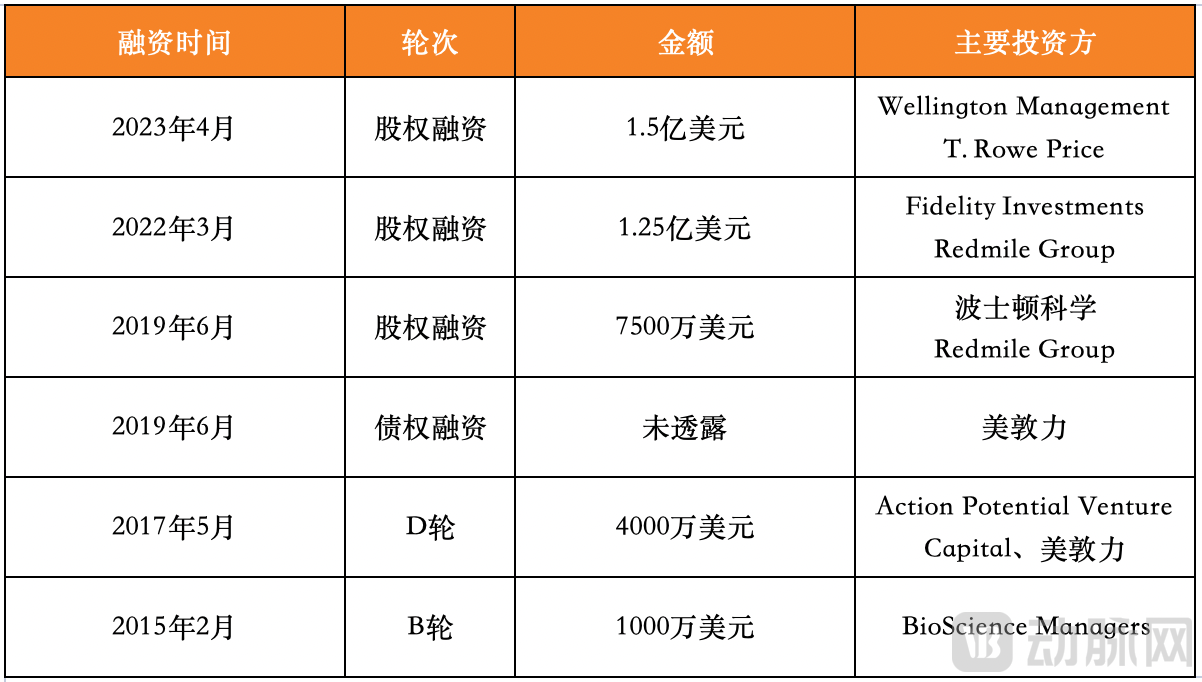
(Public data, chart by VCBeat)
Pain is a warning signal of bodily injury or disease invasion and is a common clinical symptom, whereas chronic pain is an independent disease.
Chronic pain refers to pain that persists or recurs for more than three months. It encompasses a wide variety of conditions, including failed back surgery syndrome, postherpetic neuralgia, and complex regional pain syndrome.
Pharmacological therapy remains the mainstream approach for pain management; however, analgesic medications are associated with certain adverse effects. For instance, opioids and nonsteroidal anti-inflammatory drugs (NSAIDs) are commonly used therapeutic agents. Long-term use of opioids carries a high risk of dependence, while NSAIDs can cause gastrointestinal injury and hepatic dysfunction. Due to these adverse effects, pharmacological treatment fails to fully meet the current pain management needs of patients.
Implantable Spinal Cord Stimulation (SCS) is an emerging therapy for chronic pain, particularly suitable for patients who have not achieved adequate relief with conservative treatments. The therapeutic mechanism involves placing electrodes in the epidural space of the spinal canal to deliver electrical stimulation to the spinal cord, thereby blocking the transmission of pain signals to the brain and effectively managing pain.
It is worth noting that current SCS products mostly adopt an open-loop design.Specifically, the electrical stimulation parameters of the device (frequency, pulse width, amplitude, etc.) are set by the surgeon at the time of implantation, and patients return to the hospital for adjustments every 3 to 12 months.
Tracing the evolution of spinal cord stimulation (SCS) technology, Melzack and Wall proposed the “gate control theory” of pain as early as the 1960s, which became the theoretical foundation for SCS. The first fully implantable SCS system was introduced in 1970. In 1989, the U.S. Food and Drug Administration (FDA) approved SCS for pain management.
Despite decades of development, open-loop spinal cord stimulation (SCS) technology still presents certain clinical challenges. For instance, open-loop SCS does not monitor any variables that may affect therapeutic efficacy and delivers stimulation with fixed parameters. Under this static stimulation mode, the number of action potentials generated by spinal cord stimulation fluctuates significantly when patients cough, lean backward, bend forward, or lie down, thereby compromising treatment outcomes.
To improve the current situation, numerous medical device companies have begun to overcome the clinical challenges associated with open-loop spinal cord stimulation (SCS) technology, among which Saluda Medical is one.
The closed-loop real-time feedback mechanism of the Evoke system specifically addresses the aforementioned clinical pain points, effectively helping patients maintain relatively stable pain relief.
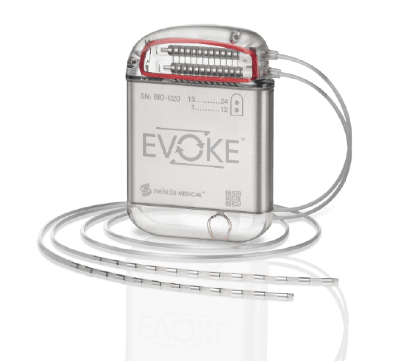
(Evoke Spinal Cord Stimulator, image source: Saluda official website)
The primary distinction between closed-loop SCS and open-loop SCS lies in the ability to automatically adjust stimulation current intensity.The Evoke closed-loop system can automatically adjust the stimulation current to maintain the excitability of sensory fibers in the spinal cord target area within an appropriate range. This prevents insufficient stimulation or overstimulation caused by changes in electrode position (such as changes in the distance between the electrode and the stimulation target area when patients bend over or cough), thereby achieving stable and effective analgesic effects.
The core technology of the Evoke system, SmartLoop, can automatically adjust stimulation intensity based on neural feedback.It is understood that Evoke can automatically adjust stimulation parameters up to 250 times per second, with more than 4 million automatic adjustments per day. This enables it to adapt in real time to changes in the patient’s posture and activity during treatment, thereby achieving more precise and personalized therapeutic outcomes.
Saluda’s official website also disclosed efficacy validation data for patients using the Evoke System after 36 months. Reportedly, this dataset represents the longest follow-up evidence from an Investigational Device Exemption (IDE) trial in the history of spinal cord stimulation (SCS) in the United States. Over 90% of patients reported very high satisfaction, and 78% indicated a pain reduction exceeding 50%. Furthermore, no implants were removed due to loss of efficacy after 36 months of closed-loop therapy, demonstrating superiority over open-loop therapy across all measured aspects.
Evoke goes head-to-head with Medtronic’s Inceptiv closed-loop rechargeable spinal cord stimulator. The device received FDA approval on April 26, 2024, for the treatment of chronic pain.
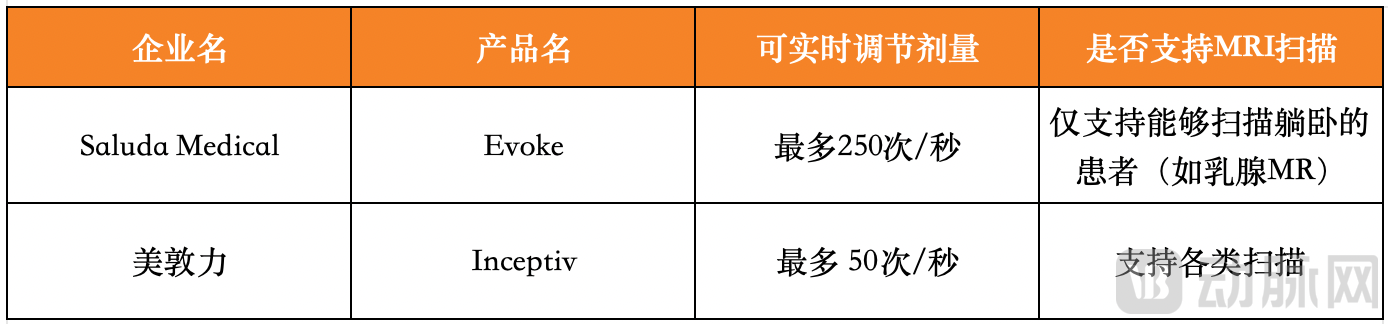
(Public information, graphic by VCBeat)
Furthermore, Inceptiv is more lightweight. With a thickness of only 6 millimeters, it is the world’s thinnest SCS device. The system’s battery can charge from empty to full in approximately one hour.
Neuromodulation technology is considered the future of chronic disease treatment. In particular, the rapid aging of the global population will drive demand for spinal cord stimulation devices.
However, neuromodulation devices are a class of high-end medical devices with high industry entry barriers, including certain technical, R&D, capital, and regulatory qualification hurdles. Foreign companies such as Medtronic, Boston Scientific, and Abbott started early and have already dominated the market.
Driven by rising demand, supportive government policies in China, and technological innovation, China is also making significant strides, giving rise to neuromodulation device manufacturers including PINS Medical, Suzhou Jingyu, Hangzhou Chengnuo, Regentech, and Medpace.
In recent years, as AI technology in China continues to empower innovation in the medical field, a range of intelligent and digital Spinal Cord Stimulation (SCS) products have come into the spotlight. For instance, NewStim, developed by Xinyun Medical, is China’s first AI-driven closed-loop implantable spinal cord stimulator. This product achieves innovative breakthroughs in several core technologies, including AI-enhanced Electrically Evoked Compound Action Potential (ECAP) closed-loop technology. It can automatically and in real time adjust electrical stimulation parameters based on changes in patient posture and neural activity demands, thereby improving the stability and reliability of clinical analgesia.
According to the “Analysis Report on Market Share and Investment Prospects of the Implantable Spinal Cord Stimulator System Industry in China,” the market size of SCS in China was approximately RMB 1.5 billion in 2023, and is expected to reach RMB 2.5 billion by 2025, with a compound annual growth rate of about 16%. The rapid volume expansion of domestically produced spinal cord stimulation products is just around the corner.