

Hanbang Technology Reports Resilient Growth Amid Market Headwinds, Driven by Global Expansion and Strong Product Portfolio
On February 10, 2025, information disclosed by the Shanghai Stock Exchange indicated that Jiangsu Hanbon Science & Technology Co., Ltd. is scheduled to undergo review by the Exchange on February 21 for its proposed listing on the STAR Market.
According to public information: Jiangsu Hanbon Science & Technology Co., Ltd. (hereinafter referred to as “Hanbon Tech”), as a core enterprise in the field of chromatographic separation and purification equipment in China, has continued to consolidate its leading position in the biopharmaceutical industry chain in recent years by leveraging its technological advantages and market insights. The company’s operating revenue has demonstrated a steady growth trend, with its revenue scale jumping from RMB 320 million in 2021 to RMB 600 million (full-year forecast for 2024) in the first half of 2024, representing a compound annual growth rate (CAGR) of over 30%. Its growth logic and sustainability characteristics are worthy of attention.
Core Business Driver: Building a Moat Through Technological Barriers
As a leading enterprise in the field of chromatographic separation and purification equipment in China, Hanbon Technology has been deeply engaged in the industry for over two decades, building a full-lifecycle product portfolio that covers everything from drug R&D to industrial-scale production. With chromatography technology at its core, the company has established two pillar businesses: small-molecule drug separation and purification equipment, and large-molecule drug separation and purification equipment. In the first half of 2024, these two segments collectively accounted for 94.6% of total revenue, further solidifying its technological barriers and market position.
Breaking it down by segment, production-grade small-molecule equipment remains the core revenue driver for the company, generating RMB 192 million in the first half of 2024, a year-on-year increase of 20.4%. This growth was primarily fueled by rising demand for capacity expansion in GLP-1 peptide drugs. Relevant data indicate that the global market size for GLP-1 drugs is projected to exceed USD 90 billion by 2030. Domestically, late-stage clinical development of products such as semaglutide and liraglutide has spurred a surge in equipment procurement. The company’s CS-Prep series of industrial preparative liquid chromatography systems have been deployed in the production lines of enterprises including Gan & Lee Pharmaceuticals and Asymchem. In 2023, revenue from peptide drug-related equipment accounted for 59.8% of the total.
Revenue from production-grade macromolecule equipment reached RMB 91 million in the first half of 2024. Despite slight year-on-year fluctuations, the company has achieved continuous breakthroughs in the fields of monoclonal antibodies and vaccines: the domestic market size for macromolecule chromatography equipment is approximately RMB 2.5 billion, and the company’s market share increased from 3.4% in 2021 to 8.8% in 2023. The Bio-Pro series of automated chromatography systems has been integrated into the supply chains of customers such as the Shanghai Institute of Biological Products and GenScript.
The company boasts robust technical reserves, with new products such as supercritical fluid chromatography and nucleic acid synthesis systems gradually being commercialized, further broadening application scenarios and enhancing product value-added.
Market Structure Optimization: Global Layout Unlocks Growth Potential
The company implements a dual-track strategy of “deepening local presence and expanding overseas.” In the first half of 2024, overseas revenue accounted for over 30%, an increase of 26 percentage points compared to 2021, demonstrating significant progress in its internationalization efforts. Overseas markets have become a new engine for growth. In addition to leading pharmaceutical companies in India, a major generic drug producer, the company achieved a breakthrough in the European market in 2024 by securing an order from a Norwegian rare earth giant, supplying multiple high-pressure preparative chromatography systems for rare earth element purification. This order validates the technical extensibility of the company’s equipment beyond the pharmaceutical sector, laying the foundation for expansion into new materials and fine chemicals markets.
Growth Sustainability: Balancing Demand Expansion and Customer Stickiness
The long-term prosperity of the downstream pharmaceutical industry supports demand for equipment. Trends such as the explosive growth in the global market size of GLP-1 drugs (projected to reach $90 billion by 2030), capacity expansion following the volume-based procurement of insulin, and the import substitution of contrast agents continue to drive equipment procurement demand. In the long run, driven by factors including advancements in chromatography technology, reduced costs of chromatographic purification, stricter requirements for purity and impurities in drug production, and heightened environmental standards, market demand for liquid chromatography systems will continue to grow.
According to the data submitted by Hanbon Technology, the domestic demand for production-grade liquid chromatography equipment will primarily stem from the manufacturing of GLP-1 drugs, antibodies, vaccines, insulin, and related CDMO services. In summary, based on factors such as the unit price of production-grade chromatography systems across different application scenarios, the number of newly added instruments (estimated by considering the penetration rate of chromatography purification systems, the number of production lines required per product, and the system configuration per production line), and the number of newly approved drugs (projected from clinical trial data from three years prior), the company has projected the market demand for production-grade chromatography equipment in key pharmaceutical application scenarios over the coming years as follows:
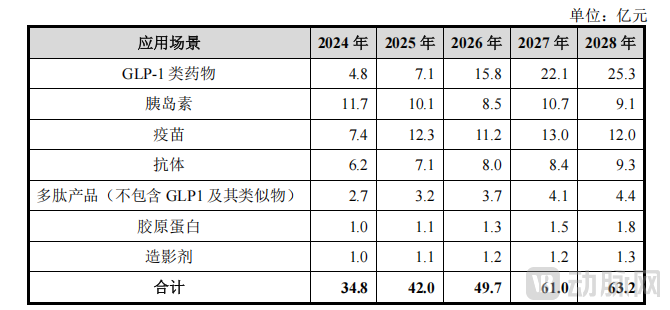 (For the quantitative analysis process of the market space for production-grade liquid chromatography equipment listed in the table above, please refer to the response content in Section “2.1 Market Space,” subsection “(I) Quantitative Analysis of the Impact of Factors Such as New Drug Approvals, Process Upgrades, Environmental Requirements, and Increased Penetration of Chromatographic Purification Methods on the Market Space for Production-Grade Liquid Chromatography Equipment” in this response report.)
The company has established deep ties with leading clients such as Stellite and Gan & Lee Pharmaceuticals. The cooperation period with its top ten clients exceeds five years, among which clients like Stellite and Asymchem have made consecutive purchases for three years, reflecting the company’s strong customer stickiness. As of the end of October 2024, orders on hand reached RMB 615 million, covering revenue for the next 6–12 months, indicating high performance certainty.
In Closing
Jiangsu Hanbon Science & Technology Co., Ltd. leverages technological innovation as its spear and market demand as its shield, securing a first-mover advantage in the localization and globalization of biopharmaceutical equipment. The sustainability of its revenue growth is driven not only by industry tailwinds but also by its technical barriers, customer ecosystem, and strategically forward-looking global footprint. As the global pharmaceutical supply chain undergoes restructuring and domestic innovative drugs rise, the company is poised to further expand its growth potential and emerge as an international benchmark in its niche sector.