

The Biggest Winner Emerges Amid Dramatic Shifts in the Dental Implant Market
Over the past two years, consumer demand for dental implants has surged significantly. This growth on the service side has transmitted upstream, leading to an explosive increase in product supply.
According to publicly available statistics, the number of dental implant restoration products approved by the National Medical Products Administration (NMPA) in 2024 surged to 172, including dental implants and implant systems, abutments and abutment systems, customized implant frameworks and accessories, and surgical navigation systems for dental implants; the total number of newly approved products for the year was eight times that of five years ago.
In this context,The market landscape has undergone more significant changes: in 2024, domestically produced Class III devices for implant-supported prosthetic restoration accounted for over 80% of newly approved products for the first time, compared to only about 30% five years ago.
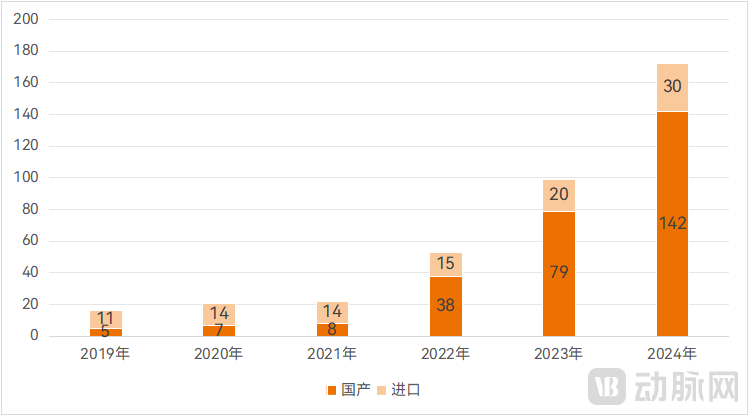
Proportion of Domestically Produced and Imported Dental Implant Products Approved Over the Years, Source: National Medical Products Administration
Amid this shift, domestically produced dental implants have emerged as direct beneficiaries, expanding market penetration and enhancing recognition and acceptance of Chinese brands among both clinicians and patients. AndAs the demand for diverse implantation becomes increasingly apparent, customized abutments, as a critical component of precision implant restoration, have rapidly emerged as the fastest-growing product.
The release of consumer demand for dental implants has not only driven the increased volume of domestically produced implants but also spurred a surge in personalized implant products. Among the rapidly growing new products in implant restoration, the growth of domestically produced personalized abutments and personalized abutment frameworks has been particularly significant.
As a component connecting the implant and the crown, the abutment plays a crucial role in the subsequent performance of dental implants. Based on different manufacturing methods, abutments can be classified into stock abutments and customized abutments.
Compared to prefabricated abutments with highly standardized parameters, custom abutments can be tailored to the specific intraoral conditions of each patient.Computer-aided design and manufacturing (CAD/CAM) is generally employed to fabricate restorations based on the three-dimensional position of the implant placement and the three-dimensional space of the edentulous area. This approach not only helps patients restore missing or defective dentitions and recover masticatory function, but also better ensures patient comfort and aesthetic needs for social interaction. Personalized abutment frameworks are used in the treatment of multiple missing teeth, half-arch, and full-arch cases, in conjunction with implants and abutments.
In 2019, Gaofeng Medical received approval for China’s first customized abutment, followed by approval for China’s first customized abutment-supported crown and bridge in 2022. Prior to 2021, only three licensed customized abutments from three domestic manufacturers were available in China. By 2024, however, 69 new customized abutments and customized abutment-supported frameworks were approved within a single year (with only one product being imported). This surge in the number of such products has become the most direct driver behind the rapid growth of implant-restorative products.
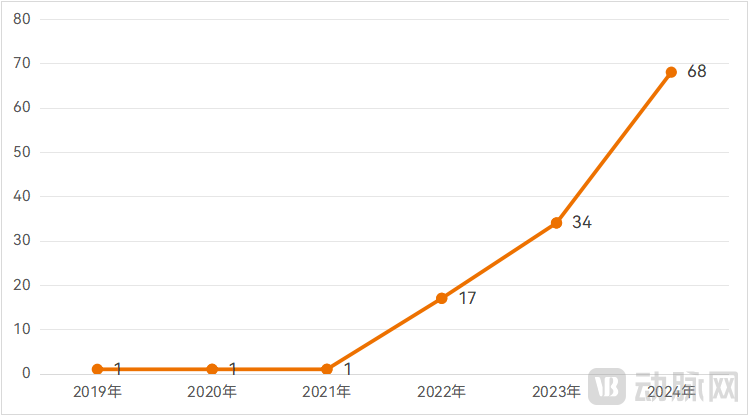
Number of domestically produced custom abutments and custom abutment frameworks approved in recent years. Source: National Medical Products Administration
As of the end of 2024, more than 120 customized abutment and customized abutment framework products from 96 companies had been approved, with the vast majority being domestically produced in China.
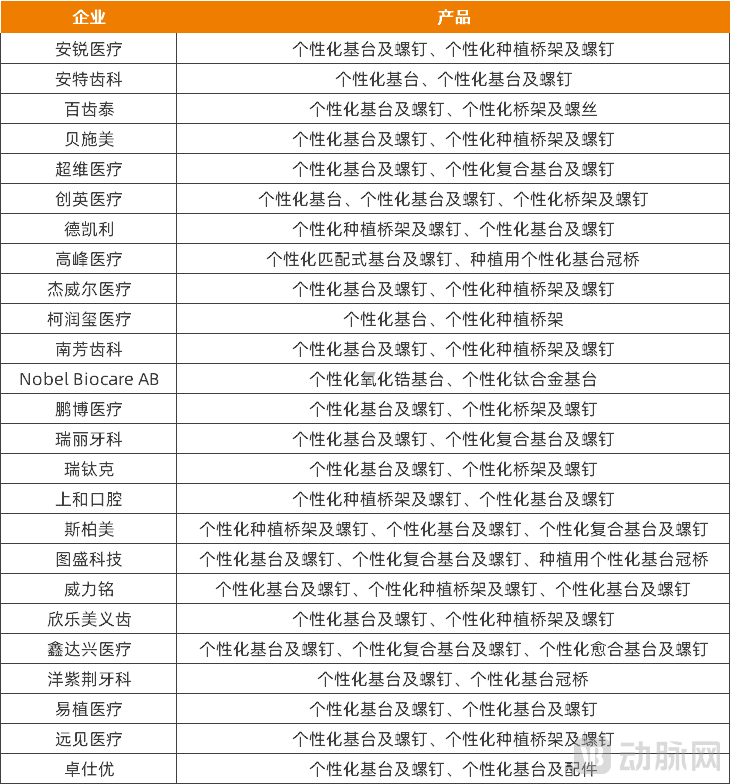
Selected Approved Custom Abutments and Custom Abutment Frameworks, Source: National Medical Products Administration
The surge in personalized abutment products is not without reason.
First and foremost, it is driven by patient demand. Lu Ming (a pseudonym, as requested by the interviewee), a senior executive at a leading domestic company specializing in consumables for dental implantology and prosthodontics, noted that currently in ChinaThe aging population presents a severe challenge. Due to insufficient public awareness of dental health decades ago, the current oral health status among the elderly is suboptimal. This has led to increased clinical difficulties for physicians and an explosive growth in demand for personalized dental implants.
“Since prefabricated abutments are mass-produced to standardized specifications, those of the same model share identical shapes and dimensions, making it difficult to accommodate complex clinical restorative conditions and patients’ individualized needs. ‘For some patients with suboptimal bone conditions, using prefabricated abutments would require extensive bone grafting; if bone grafting is not performed, customized abutments can be considered,’ said Li Qiang, President of Dingzhi Dental.”
Currently,Digital technologies have been widely applied in the field of dental implantology, with their use in the design and manufacturing of customized abutments continuously deepening.
Customized abutments must be designed and fabricated based on the patient’s edentulous space, occlusal relationship, and the three-dimensional position of the dental implant. During the design and fabrication process, an intraoral scanning system is used to scan the model to obtain the spatial relationships between the implant, adjacent teeth, and opposing teeth. Computer-aided design (CAD) is then employed for visualized design, thereby achieving optimal contour, morphology, and gingival profile. Digital technology plays a crucial role in precise scan data acquisition and efficient, high-precision machining.
From the perspective of certificate-holding enterprises, implant manufacturers such as Chuangying Medical, Weigao Jielikang, Baicetai, and Daqing Xige have expanded their product portfolios to include personalized abutments. Meanwhile, numerous dental laboratories and comprehensive oral consumables manufacturers are also actively entering the personalized abutment market.
From Lu Ming’s perspective, the economies of scale achieved by dental laboratories in recent years have endowed them with greater professional capabilities in the fabrication of custom abutments. “Large-scale dental laboratories possess the financial capacity to invest in digital production equipment, which has significantly promoted the development of custom abutments.”
Furthermore, customized abutments once went through a period of disorder and chaos; with tightening regulations, licensed and compliant production and sales have now become imperative.
“Custom abutments have rapidly gained widespread clinical adoption.” This is Li Qiang’s direct observation.
Currently, customized abutments have demonstrated significant clinical value across various aspects of practice. For instance, in patients with anterior tooth loss, the combination of customized restorative abutments and immediate implant placement, along with nursing interventions, can enhance the quality of implant-supported restorations, achieve satisfactory aesthetic outcomes, and improve oral health status.
Studies have also indicated that personalized abutments, by virtue of their favorable transmucosal contour and superior retention, reduce food impaction and enhance patient treatment satisfaction.
However,The prerequisite for fully realizing the clinical value of customized abutments is precise interface matching and meticulous personalized fabrication.
The lower interface portion of a customized abutment (i.e., the interface between the abutment and the implant) is categorized into various connection types depending on the compatible implant, such as triangular, internal hex, cross-lock, and octagonal configurations. The lower interface must match the implant’s connection geometry, dimensions, and taper. Even within the same implant brand, multiple distinct implant connection designs are often available.
The interface between the abutment and the implant is the site where occlusal forces are transmitted from the abutment to the implant. A precise fit between the two facilitates the uniform distribution of masticatory forces, thereby ensuring the long-term stability of the abutment-implant system. Given the need to connect with implants of various brands and models, the compatibility between customized abutments and implants is particularly critical. Mismatched interfaces between customized abutments and implants can lead to complications such as screw loosening or fracture, wear at the connection site, and excessive fit gaps. Furthermore, an excessive gap between the abutment and the implant can result in bacterial microleakage, increasing the risk of peri-implantitis and alveolar bone resorption.
Therefore,The precise compatibility between customized abutments and the implant interfaces of major brands has always been a key focus for abutment manufacturers and is a critical factor affecting the quality of customized abutments.
As one of the earlier products to enter the market, Gaofeng Medical’s personalized abutments have established a robust database, featuring high machining precision and compatibility with multiple implant interfaces.
Chuangying Medical’s customized abutments are compatible with a wide range of implant systems. They are manufactured using the same production processes and quality inspection standards as the implants themselves, with interface precision comparable to that of the original manufacturer’s abutments.
Beishimei custom abutments are compatible with over 100 implant system models, enabling personalized customization of parameters such as transmucosal contour, transmucosal height, abutment diameter, restorative height, and angulation. Precision machining using CNC multi-axis equipment ensures a high degree of compatibility between the custom abutments and original manufacturer implants and analogs.
The upper portion of a custom abutment is the customized machined section. Although it can be tailored to the patient’s oral conditions, the customization parameters for each product are limited to specific ranges, including milling angle, transgingival height, and thickness at the thinnest milled area.
Lu Ming frankly stated,Customized abutments have higher mechanical strength requirements than prefabricated abutments. If only cutting efficiency is pursued during machining, while neglecting the necessary angles and ranges, it may result in insufficient mechanical strength, leading to abutment fracture over time. “This is an important aspect where quality control for future customized abutments needs to be strengthened.”
Furthermore,Personalized abutments also enhance treatment efficiency through product design or workflow optimization.
Ruizhikang’s restorative product series, represented by customized abutments and screws as well as millable abutment posts and screws, emphasizes personalized design and simplifies the treatment process compared to traditional abutments, eliminating the need for dental retraction cords and custom impression copings.
Ke Runxi Medical’s customized abutments ensure high quality while accommodating diverse clinical cases. By integrating with scan bodies and intraoral scanners, they enhance operational efficiency in dental practice and save chairside time.
Bauhinia Dental fabricates customized abutments and implant crowns in parallel, saving time on ordering, logistics, and adjustment.
The development of various products for implant-supported restoration is not independent.
Over the past two years, thanks to the implementation of centralized procurement policies for dental implants, domestically produced implants have undergone a rapid leap forward.
Lu Ming believes that, on one hand, domestically produced dental implants are transitioning from mere availability to comprehensive product portfolios. “Ten years ago, most manufacturers typically offered only a single implant system, continuously validating its efficacy and quality after market launch. Subsequently, these manufacturers have been steadily expanding their product lines. Currently, many companies, driven by clinical needs, have deployed multiple implant systems to address diverse indications, catering to varied requirements such as half-arch implantation, full-arch implantation, and cases with compromised bone conditions.”
On the other hand, changes in distribution channels are forcing manufacturers to upgrade and iterate their products. It is understood that after the centralized procurement of dental implants, due to compressed profit margins, some distributors have exited the market, resulting in a reduction in training and academic exchanges originally provided by distributors to medical institutions. Therefore, manufacturers continuously optimize the design of core products and supporting surgical tools from the perspective of ease of use for doctors, shortening the time it takes for doctors to learn new products and helping them improve the predictability and success rate of surgical outcomes.
More importantly, domestically produced products have gained patient recognition. Currently, dental implant manufacturers are placing increasing emphasis on patient follow-ups, particularly among companies whose products have been on the market for 5–10 years, by which time the implants have been in place for a significant period. “According to our follow-up surveys, patients generally recognize the quality of these products. However, domestic brands still need to further strengthen their brand influence among clinicians,” Lu Ming introduced.
As a product that also benefits from centralized procurement, can customized abutments follow the same path?From the perspective of approval milestones, most compliant new products currently have a short track record in actual clinical practice, and their long-term stability remains to be continuously observed.
However,What is certain is that, tailored to each patient’s individual condition, the trend toward personalization in dental implantology extends beyond customized abutments to encompass systematic innovations that meet patients’ personalized needs.
Li Qiang cited dental implants as an example, noting that novel products—such as pterygoid implants and zygomatic implants—may be utilized in immediate implantation procedures or cases where bone grafting is not performed. However, there remains a gap in the availability of such specialized implants. Joint research and development efforts by medical institutions and upstream manufacturers are needed to address this shortfall and meet the implant needs of middle-aged and elderly patients who require minimal or no bone grafting.
It is believed that, with the joint efforts of all stakeholders—including dental implant consumable manufacturers, processing enterprises, medical institutions, and regulatory authorities—the public will not only gain a more comprehensive understanding of dental implants and oral health, but also access more affordable products, and easily obtain personalized implant restoration solutions best suited to their individual needs.
References:
Chinese Journal of Medical Devices: A Brief Analysis of Key Focus Areas in the Clinical Evaluation of Customized Abutments and Abutment-Supported Crown and Bridge Products
Jilin Medical Journal: Efficacy and Nursing Care of Immediate Implantation Combined with Personalized Abutments in the Treatment of Anterior Tooth Loss
Journal of Modern Stomatology: Research Progress on the Use of Customized Abutments to Prevent Horizontal Food Impaction Following Implant-Supported Restoration