

Kadevax Submits IPO Prospectus: Pioneering Non-Invasive Early Diagnosis for Gynecologic Cancers with First-in-Class Endometrial Cancer Methylation Test
Cervical cancer is primarily caused by high-risk human papillomavirus (HPV) and ranks as the second most common malignancy in the female reproductive system globally, as well as the eighth leading cause of cancer-related death. In China, a "two-cancer screening" program for eligible women in rural areas was launched in 2009 and expanded in 2022 to include eligible women (aged 35–64 years) in both urban and rural areas. In 2024, the Action Plan for Accelerating the Elimination of Cervical Cancer (2022–2030) was released, calling for further improvement of the cervical cancer prevention and control service system, enhancement of comprehensive prevention and control capabilities, establishment of a supportive social environment, efforts to curb the rising trends in incidence and mortality rates, and reduction of the societal disease burden associated with cervical cancer.
The team led by Academician Ma Ding of the Chinese Academy of Engineering, together with the Department of Obstetrics and Gynecology at Tongji Hospital, has been deeply engaged in the field of gynecologic oncology for many years. Leveraging the clinical R&D achievements of Academician Ma Ding’s team, Wuhan Kaidewei Biotechnology Co., Ltd. (hereinafter referred to as “Kaidewei Biotech”) was established in 2018. Focusing on the prevention and treatment of gynecologic tumors, the company conducts business centered on diagnostic reagents, innovative biologics, and technology development and services, with a strong commitment to the research and development of products related to gynecologic oncology.
On January 20, 2025, Wuhan Kaidewei Biotechnology Co., Ltd. announced thatIts independently developed “Human CDO1/AJAP1/GALR1 Gene Methylation Detection Kit (Fluorescent PCR Method)” (trade name “EcPredict”®“Kaiyi Jian” has officially received the medical device registration certificate issued by the National Medical Products Administration, ushering in a non-invasive era for the early and auxiliary diagnosis of female endometrial cancer.Meanwhile, the world’s first HPV integration detection kit has also been approved to enter China’s Special Review Procedure for Innovative Medical Devices, with the potential to benefit a broad population of HPV-positive women.
1The World’s First HPV Integration Assay Kit for Cervical Cancer: Facilitating Cancer Risk Assessment Following Positive HPV Screening
Multiple studies have confirmed that early screening for cervical cancer can effectively prevent and reverse the disease, with a 100% cure rate for precancerous lesions.In 2021, the WHO released the Guidelines for Screening and Treatment of Precancerous Lesions for Cervical Cancer Prevention, stating that cervical cancer is the first malignant tumor globally that can be eliminated. Persistent infection with high-risk human papillomavirus (HPV) is closely associated with cervical cancer. The progression from common cervical inflammation to invasive cervical cancer generally takes 10 to 15 years, or even up to 20 years. Timely diagnosis and treatment during this precancerous stage can prevent the lesion from progressing to life-threatening invasive cancer.
The WHO recommends optimizing diagnostic tools and screening strategies, endorsing HPV DNA testing as the primary screening method for cervical cancer.Cervical cancer screening in China primarily comprises the following three steps: pelvic examination and wet mount microscopy/Gram staining of vaginal secretions, followed by cervical exfoliated cell Pap smear or visual inspection with acetic acid/visual inspection with Lugol’s iodine (VIA/VILI) → colposcopy → histopathological examination. Epidemiological data from a 2019 study indicated that the national HPV prevalence rate was approximately 15.54% (95% CI: 13.83%–17.24%).According to the recommended target population for China’s national two-cancer screening program (approximately women aged 31 to 65, with slight variations across provinces and municipalities), the total population size is nearly 400 million.
The more critical issue is that, beyond the current mainstream diagnostic approaches such as histopathological examination of biopsy specimens and fluorescence-based methods—which confirm cervical cancer in patients and identify individuals without high-risk HPV infection—there exists a substantial at-risk population infected with high- or intermediate-risk HPV subtypes who have not yet developed malignancy. These individuals urgently require more convenient and accessible methods for early detection and auxiliary diagnosis.
“Women who test positive for HPV but show no abnormalities on biopsy during clinical surveys are a key target population for cervical and breast cancer screening, and they are highly likely to experience collective anxiety. In some extreme cases we have encountered, these patients seek repeated consultations at major Grade 3A hospitals, trapped in a cycle of alternating negative and positive test results,” said Yang Fan, Deputy General Manager of Wuhan Kaidewei Biotechnology Co., Ltd., in an interview with VCBeat.This key population requires more specific and standardized risk diagnostic data.
Specifically, standalone HPV testing (or conventional cytology screening) has certain limitations in specificity for detecting cervical malignancies, which may lead to high false-positive rates and unnecessary repeat screenings. Therefore,Cancer Screening Based on HPV Integration Status Has Emerged—HPV Integration into the Host Genome Is a Key Etiological Event in the Development and Progression of Cervical Cancer.Previous studies have shown that HPV integrates randomly into the host genome; however, methodological challenges such as controversies over its role and inconsistencies in findings persist in specific clinical studies.
In 2015, Dr. Martin’s team published a paper in Nature Genetics titled “Genome-wide sequencing analysis identifies hotspots and microhomology-mediated mechanisms of HPV integration in cervical cancer.” In 2023, Academician Martin’s team from Tongji Hospital, Tongji Medical College, Huazhong University of Science and Technology, published a study in Cell Genomics. Through multi-omics and single-cell sequencing of cervical cancer, this study described for the first time the molecular characteristics of two human papillomavirus (HPV) integration states in cervical cancer—transcriptionally active integration and silent integration—and demonstrated that transcriptionally active integration is subject to selective pressure and is associated with tumor invasion, immune evasion, and disease progression.
In 2022, leveraging the 15-year research achievements of the team led by Academician Ma Ding of the Chinese Academy of Engineering, Kaidewei Biotechnology launchedThe world’s first in vitro diagnostic kit for HPV integration detection.By integrating next-generation sequencing (NGS) technology and capturing HPV DNA, this product detects whether viral DNA has integrated into the host cell genome. It not only identifies infections with 14 high-risk HPV subtypes but also predicts disease progression, enabling risk assessment for cervical precancerous lesions.In August of the same year, the genetic testing kit was recognized as an “Innovative Medical Device” by the National Medical Products Administration (NMPA). Clinical enrollment for registration has been completed, and it is expected to obtain the medical device registration certificate within the year.
2First Combined Use of the Optimal Three-Target Panel Opens a New Chapter in Non-Invasive Early Diagnosis of Endometrial Cancer
On January 20, the “Human CDO1/AJAP1/GALR1 Gene Methylation Detection Kit (Fluorescent PCR Method)” (trade name: EcPredict) was approved for market launch.® Kaiyijian®) represents Kaidewei Biotechnology’s innovative breakthrough in another type of gynecologic cancer—endometrial cancer.
Endometrial carcinoma is an epithelial malignant tumor arising from the endometrium, also known as corpus uteri cancer. It is one of the three most common malignant tumors of the female reproductive tract and predominantly affects perimenopausal and postmenopausal women. Over the past two decades, owing to increased life expectancy and changes in lifestyle, the incidence of endometrial carcinoma has shown a continuous upward trend with a shift toward younger age groups. In Western countries, endometrial carcinoma has become the most frequently diagnosed malignancy of the female reproductive system. In China, it is the second most common gynecologic malignancy after cervical cancer, accounting for approximately 20%–30% of all gynecologic cancers.
Clinical symptoms of endometrial cancer tend to appear at an early stage. Approximately 70% of cases are diagnosed when the tumor is confined to the uterine corpus, representing early-stage disease with a favorable prognosis and a 5-year survival rate of up to 95%. However, 10–20% of patients already have distant metastases at the time of diagnosis, with a 5-year survival rate of less than 20%. Therefore, it is crucial to achieve early diagnosis and treatment of endometrial cancer through effective screening methods.
However, unlike cervical cancer, for which screening has been widely implemented, endometrial cancer still faces the challenges of low coverage of early screening and diagnosis at the primary care level and the difficulty of promoting traditional invasive sampling and pathological examination in primary care settings.. Kaidewei Biotechnology's Original Innovative Product EcPredict®Kaiyi Jianzheng targets the industry gap in non-invasive early diagnosis of clinical endometrial cancer by applying high-sensitivity and high-specificity molecular diagnostic techniques to detect methylation in ultra-trace amounts of shed endometrial cells, thereby pioneering innovative options for non-invasive risk prediction and auxiliary diagnosis.
EcPredict®By conducting DNA methylation sequencing on clinical endometrial cancer samples from the Chinese population, Kaiyijian identified candidate methylation targets specific to this demographic. Following expanded testing on over 1,000 samples, the company screened out the optimal three-target combination—CDO1, AJAP1, and GALR1—and pioneered their combined use for the early detection and auxiliary diagnosis of endometrial cancer.
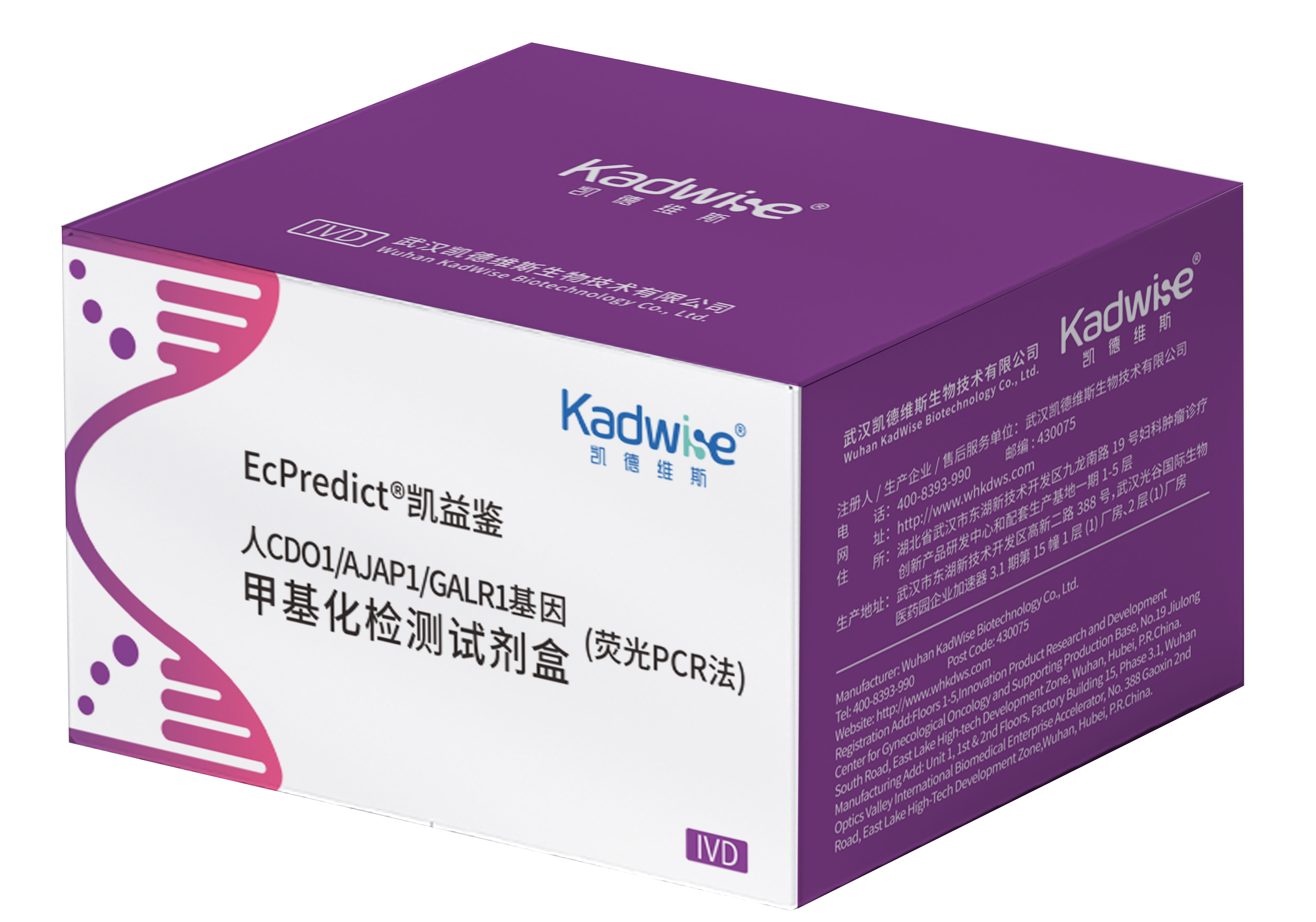
Specifically, leveraging the jointly developed proprietary disposable endometrial exfoliated cell sampler, the “Kai Brush,” this test kit offers simple and convenient operation with support for automation, ensuring ease and efficiency. Real-world clinical trials have demonstrated that the product achieves both sensitivity and specificity exceeding 90%, delivering exceptional accuracy across multiple subtypes of endometrial cancer and exhibiting broad applicability.Notably, this product has demonstrated consistently stable and reliable performance in tests across diverse population samples. It effectively addresses the limitations of transvaginal ultrasound in endometrial cancer screening, where accuracy has been suboptimal, thereby serving as a powerful tool to enhance detection precision.
Furthermore, Wuhan Kaidewei Biotechnology Co., Ltd. strives to make its kit applications simpler and more efficient. The accompanying extraction and conversion reagents, available in both column-based and magnetic bead-based formats, have obtained filing certificates. The kits enable multiplex target detection in a single well, feature long shelf-life and post-opening stability, offer short turnaround times, and support automated result interpretation. They are compatible with a wide range of real-time fluorescent quantitative PCR instruments, covering common imported and domestic models.
Yang Fan, Deputy General Manager of Wuhan Kaidewei Biotechnology Co., Ltd., stated that as the company’s self-developed products successively enter the commercialization phase, Wuhan Kaidewei Biotechnology is poised to embark on a new stage of revenue growth and development: “In the future, we will advance our expansion plan into countries along the ‘Belt and Road’ initiative, bringing the ‘Kaidewei Solution’ for the prevention and treatment of gynecological tumors to the global stage.”Currently, Kaidewei has established a 23,000-square-meter industrialization base for gynecologic oncology diagnostic and therapeutic products, equipped with facilities including a medical testing laboratory, an IVD production workshop, and a pilot-scale pharmaceutical production workshop. The facility is gradually undergoing fit-out and occupancy, laying the foundation for subsequent commercialization and diversified development.
Meanwhile, Wuhan Kaidewei Biotechnology Co., Ltd. is implementing a four-pronged genetic diagnosis and treatment strategy for gynecologic oncology, encompassing “screening, testing, diagnosis, and treatment.” Its pipeline includes therapeutic products such as cancer therapeutic vaccines and oncolytic viruses. The company is also developing a scoring system to predict cervical cancer responses to immunotherapy, as well as exploring the innovative combined application of surgery and optimized treatment regimens. These efforts are dedicated to benefiting women at large and improving long-term survival outcomes for patients with gynecologic tumors.