

DeepSeek Paves a New Path for Internet Healthcare with Advanced Reasoning AI

DeepSeek
Large Language Model (LLM) and Related Technology Developers
DeepSeek’s momentum continues, with its deep reasoning models and deep thinking modes fully demonstrating the advantages of extended chain-of-thought processing. Through conversations with DeepSeek, users can obtain more comprehensive, clear, and rigorously reasoned high-quality answers.
As internet healthcare platforms require frequent interaction with consumer-end users, AI-powered Q&A products have been widely adopted. To enhance the precision of responses, companies such as Chunyu Doctor, JD Health, Ping An Health, Tencent Health, Weimai, and Zhiyun Health have integrated DeepSeek’s large language model capabilities into their products.
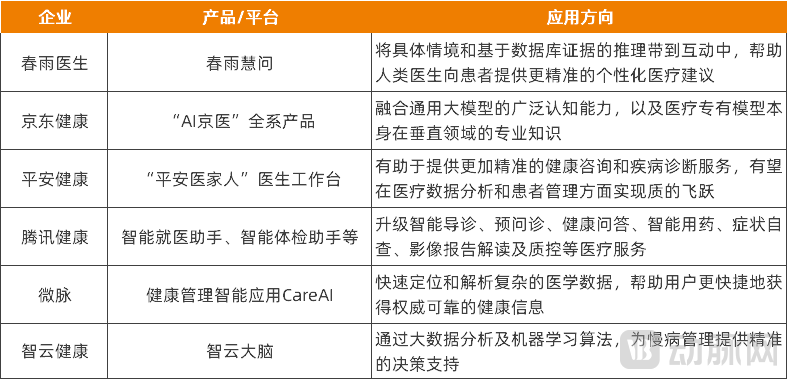
Internet Healthcare Service Products or Platforms Integrated with DeepSeek, Source: Publicly Available Corporate Information
In fact,Regardless of whether platforms have integrated DeepSeek, AI has become increasingly deeply embedded in internet-based medical services. However, the innovative mindset demonstrated by DeepSeek has revealed yet another new possibility for the industry.
The Emergence of DeepSeek: Beyond Technological Upgrades, It Inspires Product and Model Innovation
First, AI cannot replace doctors, but it can help create digital twins of physicians, replicating part of their service capabilities.
The shortage of physician resources is a long-standing issue, prevalent in both online and offline settings; however, the unique characteristics of internet healthcare have made this phenomenon more pronounced.
Although physicians can provide services on internet healthcare platforms through multi-site practice arrangements, their labor relationships remain with their primary offline practice institutions, and practicing on third-party platforms primarily utilizes fragmented time. In the past, to fully activate these fragmented resources, internet healthcare platforms not only attracted more physicians to join but also mobilized physicians’ time through “order-grabbing” consultation products to promptly meet patients’ consultation needs. This approach mainly targeted primary-care physicians or other physicians with relatively flexible schedules.
For renowned medical experts, whose fragmented time is scarce and whose appointment slots are highly sought after, digital avatars can play a more practical role. By deeply learning the experts’ knowledge and personalized diagnostic and treatment styles, these digital avatars can respond to patients’ consultation requests at any time.
Secondly, AI can enable online medical services to combine rationality with warmth.
“The phenomenon of ‘waiting in line for an hour, seeing the doctor for three minutes’ has been widely criticized in the traditional healthcare service system for many years. The root cause is, on one hand, that doctors see a large number of patients and have no time to engage in extensive communication with them.”
Although internet-based medical services have improved the efficiency of healthcare delivery, the issue of doctors providing only brief explanations persists. This points to another critical factor: not every physician is skilled in communication, nor can they all clearly and logically articulate the causes and consequences of a diagnosis to patients.
When DeepSeek responds to user queries in its deep thinking mode, it provides both the reasoning process and a structured framework. This approach offers valuable insights for online healthcare services, helping physicians and other stakeholders deliver more logically coherent answers to user inquiries.
Meanwhile, the platform builds interactive and evolving digital avatars. By deeply integrating data ethics, interaction design, and service models, it embeds a profound understanding of human dignity, emotional needs, and cultural differences into its technological logic, enabling it to keenly detect and respond to users’ emotions. This approach may also significantly improve users’ perceptions of doctors who are often regarded as having a “poor attitude.”
Finally, by analyzing massive datasets and conducting deep reasoning, we can precisely identify users’ unmet needs, thereby driving commercial conversion.
On a comprehensive internet healthcare platform, in addition to consultation services, data is generated across multiple dimensions, including search and browsing behavior, health monitoring, and medication habits. Relying solely on single-dimensional or partial-dimensional data analysis makes it difficult to grasp users’ true needs. Insight into these genuine needs is built upon the construction of multi-dimensional user profiles and heavily relies on semantic reasoning from unstructured text; meanwhile, it is also necessary to track changes in user demands in response to shifts in key data metrics.
As can be seen, some internet healthcare platforms are already iterating their AI products and service capabilities along the aforementioned path.
Online consultation is the most representative service of internet healthcare. To alleviate the current shortage of physician resources,Internet healthcare platforms have promoted the intelligentization of online consultations by creating agents and digital humans to replicate the capabilities of physicians and other service roles.
Since 2024, Alipay has begun building AI agents for physicians. Zhang Tao, a chief physician at Peking University People’s Hospital, is the first doctor to launch an AI agent assistant on Alipay. The AI agent provides AI-powered tools tailored to clinical practice needs and establishes a “digital twin” for the physician, thereby amplifying the service capacity of renowned medical experts.
Recently, JD Health’s AI Doctor Agent product completed its internal beta testing, with the first batch of AI digital avatars of medical experts going live on JD Internet Hospital. These AI digital avatars can deeply learn doctors’ professional knowledge, thinking patterns, and communication styles to provide 24/7 responses to patient inquiries. Additionally, they can assist patients with appointment registration, scheduling consultations with the respective doctors, or delivering post-diagnosis services as needed.
Chunyu Doctor’s specialty-specific digital physician is built on de-identified clinical data from top-tier human specialists across various departments, combined with a vast medical knowledge base to deliver its services.
Not only doctors, but other roles in healthcare services are also beginning to be endowed with agent capabilities.
JD Health, leveraging the “Jingyi Qianxun” medical large language model, has developed a suite of professional digital human services, including not only AI physicians but also AI pharmacists, AI nutritionists, and AI psychological counselors.
While building physician AI agents, Alipay also collaborates with health commissions, medical insurance authorities, healthcare institutions, and specialty departments to develop corresponding AI agents. For example, the Zhejiang Provincial Health Commission and Alipay jointly built “Anzhen’er,” the first intelligent medical service agent. In December 2024, “Anzhen’er” was upgraded to version 2.0, offering users services such as renowned physician AI agents, intelligent report interpretation, intelligent health records, and intelligent medical consultation accompaniment.
The addition of AI agents for more roles and institutions has further enriched online service resources and deepened the integration of online and offline services.From online consultations to services delivered by AI agents and digital humans, artificial intelligence has brought significant changes to internet healthcare.
In the past, online medical consultations have taken various forms, including text-and-image exchanges, voice messages, video calls, and telephone conversations. Each modality has its own advantages and disadvantages, allowing users to choose according to their individual circumstances. To this day, these remain the primary means of communication between doctors and patients.The agent integrates multiple interaction modalities, fully leveraging the advantages of each.
The agent has also achieved an iteration from passive answering to proactive questioning.In the traditional consultation process, when users initiate a consultation request, they need to present a core question along with a description of that question. The platform also provides targeted prompts to encourage patients to supplement their condition details or medical records, which are then addressed and diagnosed by doctors. When interacting with patients, intelligent agents can take more proactive interventions, especially in conducting deep reasoning and simulating the logical follow-up questions typically asked by doctors.
Meanwhile, the agent adopts a “human” persona to bridge the psychological distance with users.Currently, digital twins typically appear in the likeness of physicians or other specific individuals, capturing personal characteristics such as voice, tone, and communication patterns to ensure that the digital avatar closely resembles the real person during user interactions. In contrast, institutional agents exist as approachable virtual digital humans, which can take on diverse forms. Regardless of the avatar type, both facilitate more authentic emotional connections with users.
Copywriting, planning, spreadsheet creation… In many fields, DeepSeek’s in-depth reasoning can inspire users and help them improve efficiency. Healthcare services are unique,Although internet healthcare platforms can provide users with health advice, report interpretation, or nutritional plans, these offerings are essentially informational and struggle to fully address users’ practical problems. Therefore, “conversation as a service” has emerged as an exploratory approach to overcoming this limitation.
VCBeat has learned that WeDoctor Holdings is currently developing a new AI product for consumer-facing users, which is in the internal testing phase and will be launched soon. The product will integrate the capabilities of multiple advanced large language models to enhance WeDoctor’s medical large language model, enabling it to provide users with safe, compliant, effective, and more personalized services.
Since its launch in July 2024, JD Health’s AI health agent, “Kangkang,” has leveraged the company’s pharmaceutical e-commerce and internet healthcare service ecosystem to integrate appointment registration resources from more than 52,000 medical institutions and over 190 health services. This integration encompasses JD Health’s proprietary service matrix—including JD Medicine, JD Internet Hospital, JD Daojia Rapid Testing, and JD Nurse-at-Home—as well as a wide range of third-party health services.
In September 2024, Alipay launched the “AI Health Assistant,” providing users with AI-driven health services such as finding doctors, interpreting medical reports, accompanying patients during consultations, querying health insurance information, and managing personal health. For instance, while using the “Health Insurance Inquiry” feature, users can directly handle health insurance-related matters through AI-recommended entry points when needed.
Behind these services lies Alipay’s deep connectivity and integration of internal and external resources, including the various AI agents mentioned earlier. Meanwhile, Alipay has also announced the opening of its AI agent collaboration framework to the medical and broader health industries, aiming to attract more collaborative resources.
In February 2025, after integrating the capabilities of DeepSeek’s V3 and R1 models into its intelligent health management application, CareAI, Weimai deployed these models across multiple scenarios, including pre-consultation triage, physician recommendation, service recommendation, and case management.
To support the aforementioned services, CareAI leverages not only Weimai’s proprietary service resources but also integrates online and offline medical and healthcare resources from Weimai’s contracted partner hospitals, as well as resources from third-party ecosystem partners in sectors such as insurance, medical accompaniment, in-home nursing, home-based wellness and elderly care, and remote monitoring.
Tencent Health has recently integrated the DeepSeek large language model via Tencent Cloud, forming a “dual-model” combination with its own Hunyuan large language model. Meanwhile, Tencent Health is accelerating the development of a large-model-based medical service application platform, providing large-model-driven medical services and intelligent applications to more than 1,000 hospitals across China. Partnering hospitals can choose to use either DeepSeek or Tencent Hunyuan, leveraging AI assistants to deliver various medical services and health information, thereby creating more patient-centered care plans and health management strategies.
In short, beyond merely outputting information, AI must strive to resolve user issues through its services with the utmost precision. Leveraging precise recommendations to address user needs is also one of the platform’s pathways to commercialization.
On the one hand, with the passage of time, internet healthcare platforms have carried increasingly rich service content.In reality, not all users possess the professional expertise and patience to locate and search for the services they need. As previously mentioned, AI can perform deep reasoning based on multidimensional user data to capture user needs, often understanding them more clearly than the users themselves.Only products or services recommended to users based on a deep understanding of their needs can achieve higher conversion rates.
On the other hand, internet healthcare platforms play a significant role in the out-of-hospital market, serving as a nexus connecting medical providers, nursing services, pharmaceuticals, and insurance. These platforms will collaborate with these stakeholders to explore personalized user service models.In this process, the value of AI lies in improving the matching of resources with users, enabling healthcare providers, nurses, pharmacists, and insurers to efficiently reach their target users, while allowing users to precisely access medical care, nursing services, pharmaceuticals, and insurance coverage.
Overall, deep reasoning, represented by DeepSeek, is not merely a technological tool but also points to a new path for internet healthcare:Upgrading from simple “online consultations” to an “intelligent medical brain” enables the acquisition of all necessary medical resources for each individual user, making personalized, full-lifecycle health services a reality. Judging by the current state of products on major platforms, there is still a gap to bridge in achieving this goal; nevertheless, a critical step from zero to one has already been taken.
Across the industry, enthusiasm for DeepSeek’s transformation of healthcare service models is surging. However, this makes it all the more critical to remain calm and uphold the fundamental boundaries of AI applications in internet-based healthcare.
Previously, the “Detailed Rules for the Supervision of Internet-Based Diagnosis and Treatment (Trial)” explicitly stipulated that other personnel, artificial intelligence software, etc., shall not impersonate or replace physicians in providing diagnosis and treatment services; the use of artificial intelligence or other means to automatically generate prescriptions is strictly prohibited.
In real-world scenarios, the act of AI-driven prescription is relatively easier to define and avoid, whereasThe red line of AI replacing doctors in providing diagnostic and treatment services must be guarded against. In services provided by doctor agents and digital avatars, there may be a blurred boundary between health advice and clinical practice, particularly when it comes to disease diagnosis and medication recommendations.The industry must always maintain a sense of reverence; only by innovating within the framework of laws, regulations, and ethics can it go further.