

Bluebird Bio's 'Floor-Price' Acquisition: A Bargain Buy or a Value Trap?

BlueBird Bio
Gene Therapy Developer

The Carlyle Group
Diversified Investment Institutions

SK Capital Partners
Private Investment Firm in Specialty Materials, Chemicals, and Healthcare Industries
The Tragedy of Star Pharmaceutical Companies’ Decline Is Unfolding.
On February 21, bluebird bio, the former star of the gene therapy sector, announced its acquisition by private equity giant The Carlyle Group and SK Capital for a total consideration of approximately $100 million. Under the terms of the agreement, shareholders will receive $3 in cash per share, with an additional “bonus” of $6.84 per share if sales of the company’s existing therapies reach $600 million by the end of 2027, bringing the maximum total value to nearly $10 per share. The transaction is subject to conditions including tender acceptance by a majority of shareholders and regulatory approvals, and is expected to close in the first half of 2025.
The acquisition of bluebird bio carries a significant “gambling” element—with a minimum payout of only $29.16 million and a maximum of just $100 million even if the earn-out targets are met. Compared to bluebird bio’s peak market capitalization of $30 billion, this represents a decline of over 99%, amounting to a “rock-bottom” price. Nevertheless, bluebird bio’s board of directors believes that this transaction is the only viable solution to create value for shareholders.
BlueBird Bio’s Dilemma: From Technological Leadership to Internal and External Troubles
In 2013, bluebird bio successfully listed on the NASDAQ, raising $116 million through its initial public offering (IPO). On its first day of trading, the company’s stock price surged 50% above the offering price, closing at nearly $26 per share. Leveraging its innovative technologies in gene therapy, bluebird bio quickly became a focal point of the industry. In 2017, the company was named one of the World’s 50 Smartest Companies, and in 2018, it ranked among the top ten most likely merger and acquisition targets. bluebird bio’s stock price reached a high of $230 per share in 2018, with its market capitalization briefly approaching $30 billion.
However, Bluebird Bio’s moment in the spotlight did not last long. The launch of its gene therapies was initially delayed due to the COVID-19 pandemic; it was not until 2019 that Bluebird Bio’s first gene therapy product, Zynteglo, received approval for market launch. In 2021, Bluebird Bio secured successive approvals for two additional products—Abecma, the world’s first approved BCMA-targeted CAR-T cell therapy, and Skysona, the first one-time gene therapy for CALD approved by the EMA.
However, due to safety concerns, the clinical trials of LentiGlobin for the treatment of transfusion-dependent β-thalassemia and eli-cel for the treatment of cerebral adrenoleukodystrophy were successively halted in 2021. These events not only delayed the progress of clinical trials but also had a significant impact on BlueBird Bio's commercialization process.
To make matters worse, the market performance of its launched products fell far short of expectations due to excessive pricing. In an effort to swiftly reverse its bleak commercialization outlook, Bluebird Bio spun off its oncology pipeline into an independent company, 2seventy bio, in 2021; its key product includes the BCMA CAR-T therapy Abecma.
However, the split did not reverse BlueBird Bio’s predicament. Financial statements show that BlueBird Bio reported a net loss of $562.6 million in 2021, with revenue of only $3.7 million and approximately $397 million in available cash and related liquid assets.
As of September 30, 2024, Bluebird Bio had cash and cash equivalents totaling approximately $118.7 million. However, the company faces short-term debt pressure, with short-term borrowings reaching $70.6 million, resulting in significant cash flow strain. For the first three quarters of fiscal year 2024, cumulative revenue amounted to $45.286 million, representing a year-on-year increase of 109.05% from $21.663 million in the same period last year; net loss widened by 61.72% to $212 million, compared to $131 million in the corresponding period of the previous year.
The Board of Directors of bluebird bio believes that without a substantial capital injection in the short term, the company faces the risk of violating its loan covenants. A more severe scenario could be an operational shutdown; last year, bluebird bio publicly stated that its cash flow might only last until the second quarter of this year. In 2024, market concerns over safety issues surrounding bluebird bio’s gene therapy, Skysona, further exacerbated the company’s difficulties. Entering 2025, the company’s market capitalization fell below $100 million, with its stock price dropping under $1 per share, bringing the risk of delisting dangerously close.
Bluebird Bio’s “downward spiral” did not occur overnight; rather, it resulted from the combined effect of various internal and external factors. Internally, while Bluebird Bio achieved technological breakthroughs, it failed to establish mature commercialization capabilities. The customized production required for gene therapies demands extremely high standards, yet Bluebird Bio did not build a scalable supply chain, leading to excessively long product delivery cycles and significant patient attrition. Furthermore, its gene therapies were priced prohibitively high; for instance, Skysona was priced at $2.8 million, far exceeding the affordability limits of payment systems. Following failed negotiations with health insurance providers, its market share remained extremely low. Since 2021, frequent departures of core executives and intensified layoffs have severely undermined strategic continuity and management stability. These internal issues ultimately caused the company to gradually lose its competitive edge in the market.
Changes in the external environment have also had a significant impact on BlueBird Bio. According to statistics from VCBeat, global gene therapy financing declined by 40% year-on-year in 2024, exacerbating BlueBird Bio’s risk of a cash flow crunch. Meanwhile, technological iteration in the gene therapy sector has accelerated, with the rise of gene-editing technologies such as CRISPR. BlueBird Bio’s lentiviral vector therapies have faced scrutiny over potential carcinogenic risks, leading to a loss of clinical advantage. Under multiple pressures, BlueBird Bio’s financial condition has continued to deteriorate, making acquisition at a low price an unavoidable choice for survival.
The Acquirer’s Logic: Bottom-Fishing vs. “High-Stakes Gamble”
Notably, the field of gene therapy is undergoing rapid transformation in recent years. Multiple multinational corporations (MNCs), represented by Novartis and Vertex, have rapidly entered this sector through mergers and acquisitions, imposing unprecedented survival pressures on biotech companies.
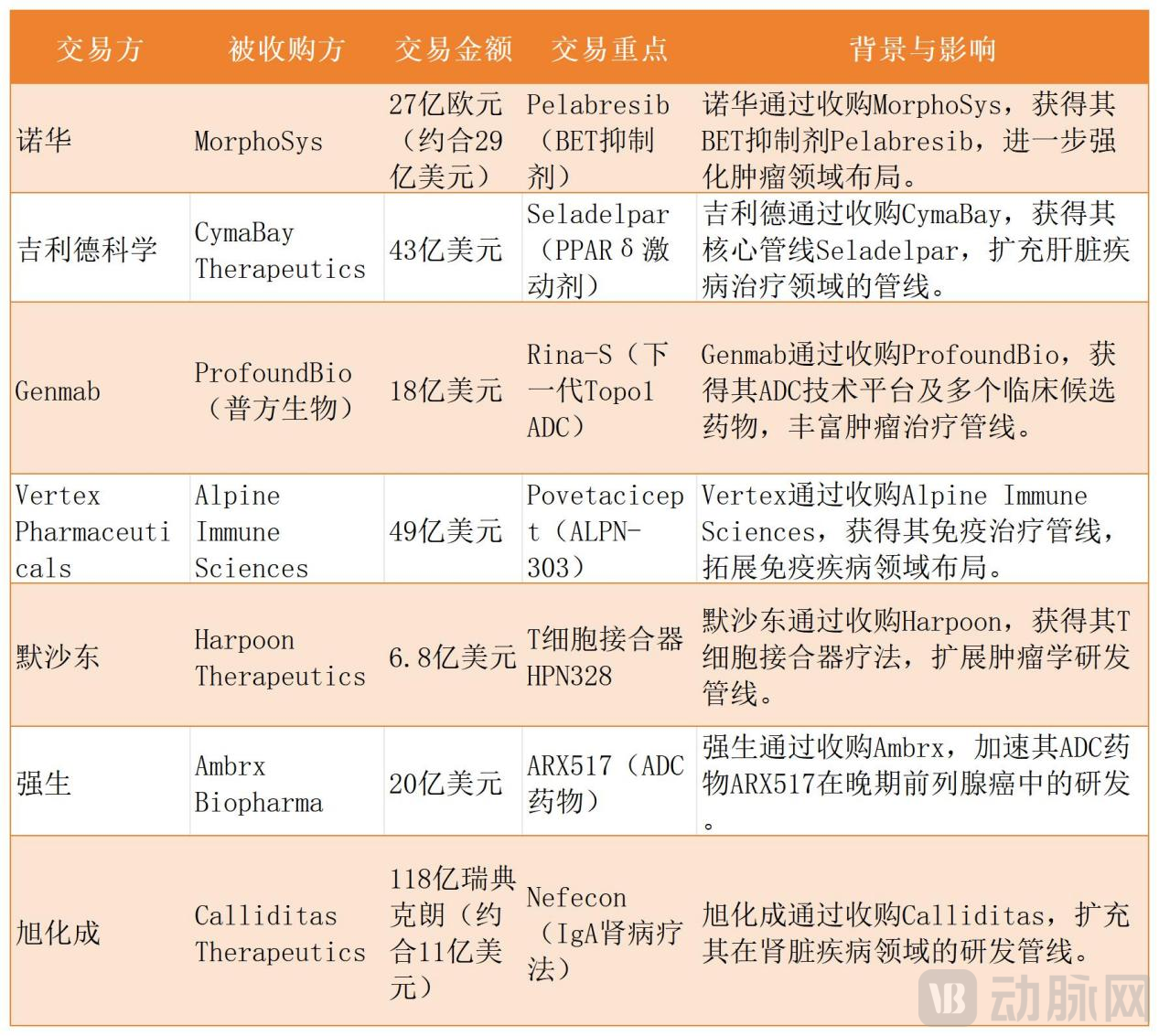 Selected Acquisitions in the CGT Sector in 2024 | Graphic by VCBeat
Reviewing the M&A deals in the CGT sector in 2024, technology has undergone multiple rounds of iteration. Despite BlueBird Bio’s deep technical expertise and approved product portfolio in gene therapy, its commercialization challenges and financial pressures have made it a “hot potato.” According to BlueBird Bio’s press release, the company met with more than 70 potential investors and partners over the past five months before finalizing this deal. It also announced that David Meek, a veteran of the pharmaceutical industry, would be brought in to steer the company, aiming to “unlock the potential of BlueBird’s scientific legacy.”
David Meek previously led Mirati Therapeutics and Ipsen, bringing extensive experience in commercialization and strategic management within the pharmaceutical industry. His appointment was met with high expectations that his professional background and industry resources would help turn the tide for BlueBird Bio. However, the realistic challenges facing BlueBird Bio remain severe:
Challenges in Medical Insurance Reimbursement: Bluebird Bio’s gene therapy products are priced extremely high—Zynteglo is priced at $2.8 million, and Lyfgenia at $3.1 million. Such exorbitant prices make them unaffordable for both healthcare payers and patients, resulting in limited market acceptance. Persuading payers to cover these “sky-high-priced drugs” will be the primary challenge facing David Meek.
Sales Growth PressureUnder the acquisition agreement, shareholders of bluebird bio will receive a cash consideration of $3 per share, as well as contingent value rights (CVRs) worth $6.84 per share, payable if the company achieves $600 million in net sales by the end of 2027. This implies that bluebird bio must increase its sales from the current tens-of-millions level to $600 million within three years, representing a 60-fold growth. However, the gene therapy market is highly competitive, with new technologies and products continually emerging, while advances in alternative therapies are reducing patients’ reliance on high-priced gene treatments. bluebird bio needs to strike a balance between R&D efficiency and cost control, while exploring flexible pricing strategies and payment models to alleviate reimbursement pressures and drive sales growth.
The Cost-Benefit Balance of Innovative Drugs: Private equity firms excel at enhancing corporate financial performance through cost control, but the research and development (R&D) and commercialization of innovative drugs require sustained capital investment. On one hand, private equity involvement can optimize cost structures; on the other hand, the R&D and market promotion of innovative drugs still demand substantial financial support. How to maintain innovation momentum while controlling costs will be the key determinant of BlueBird Bio’s future success or failure.
Clinical and Regulatory Risk Management: Long-term efficacy data for certain therapies remain insufficient. For instance, five-year follow-up studies of its gene therapy Skysona indicate that therapeutic effects may gradually wane over time, thereby diminishing its market competitiveness. As the FDA imposes increasingly stringent review standards for gene therapies—requiring additional real-world evidence to support product safety and efficacy—not only will the commercialization timeline for BlueBird Bio’s products be delayed, but R&D and marketing costs will also rise significantly. For example, the FDA rejected its gene therapy Lyfgenia due to manufacturing quality control issues, extending the development cycle by two to three years and substantially delaying its commercialization schedule.
Carlyle and SK Capital’s acquisition is, in essence, a bet on bluebird bio’s technological potential and future market opportunities. If successful, bluebird bio could leverage new funding and a revamped management team to stage a remarkable turnaround, emerging as a formidable competitor in the gene therapy sector. If it fails, the company may lose its market relevance entirely, fading into obscurity amidst the tide of innovative drug development. Ultimately, innovation in pharmaceuticals is a game for the bold, and the outcome of this high-stakes gamble on bluebird bio’s fate remains unpredictable.
Reference Article:
1. From a Billion-Dollar Valuation to a Fire-Sale Exit: What Happened to the Star Gene Therapy Company? By Medical Colleagues
2. Pioneer Bluebird Bio Stumbles: The Other Side of the Gene Therapy Boom. Amino Observation