

Dual Focus on Refractive and Optometric Services: YueTong Eye Care Emerges as an Innovative Force in China's Ophthalmic Market
“The future of private ophthalmic medical services in China will no longer pursue large-scale volume, but will instead shift toward ‘small and specialized’.”
Ye Chaohong, a veteran with nearly 30 years of experience in investment and management within the ophthalmic medical services sector who has previously held executive positions at two domestically listed ophthalmic healthcare companies, shared his views on the future trajectory of private ophthalmic medical services in China.
And Shanghai Yuetong Jiashi Hospital Management Co., Ltd. (hereinafter referred to as “Yuetong Eye Care”), where he serves as Chairman, has firmly embarked on the path of exploring “small yet specialized” ophthalmic medical service institutions.
From Pursuing Scale to Seeking “Small and Specialized”: Does This Signal a “Downturn in Ophthalmology”?
Frost & Sullivan’s data provides a strong negative answer. From 2015 to 2024, the overall size of China’s ophthalmic medical services market grew from RMB 73 billion to RMB 223.1 billion, with private ophthalmic medical institutions experiencing relatively faster growth, reaching more than five times their 2015 market size by 2024. This indicates thatThe ceiling of the ophthalmic medical services market is still far from being reached.
So, what has driven the shift in industry development trends? Insights from interviews with Yuetong Ophthalmology provide the answer.
On the one hand, phased weakness in consumer spending, an influx of new market entrants, the implementation of centralized procurement for intraocular lenses (IOLs), and price wars driven by homogeneous competition have collectively led to a “sharp increase” in revenue pressure for private ophthalmic medical institutions, while also prolonging their path to profitability. On the other hand, the rise of Generation Z as a consumer force has brought keywords such as “brand independence,” “emphasis on consumption experience,” and “personalization” to the forefront. “Small but specialized” institutions, with their smaller operational footprints and relatively lower operating costs, are well-positioned to meet the current need for “cost reduction and efficiency enhancement” among private ophthalmic medical providers.
On the other hand, “small but specialized” institutions tend to focus on providing differentiated services, thereby meeting patients’ needs for personalized and comfortable care. Moreover, as they are often located in close proximity to residential communities, they can maintain strong engagement with local residents. This not only increases the likelihood of repeat visits but also facilitates customer base expansion through positive word-of-mouth. Under the combined influence of these factors, the “small but specialized” model has become the primary choice for the expansion of private ophthalmic medical institutions.
A Concrete Understanding of “Small and Specialized”: “Small” primarily refers to relatively smaller operational space and investment costs. “Specialized” can be expanded to include “precise” target customer groups, “refined” operations, and “exquisite” services.
Business "Precision": Dual Focus on Optometry and Refractive Surgery
Focusing on Yuetong Ophthalmology’s practices, the term “precise” in relation to its target customer base primarily refers to its focus on urban white-collar and gold-collar professionals (and their families). This demographic exhibits stronger demand for eye health-related services and possesses greater purchasing power.
Yuetong Ophthalmology’s “meticulous” business operations are closely tied to its industry insights.
Due to relatively limited investments of energy and capital, coupled with comprehensive considerations such as enhancing patient stickiness, most ophthalmic medical service institutions tend to adopt a business model centered on one core service, supplemented by other related services. In most cases, this “core service” refers to optometric services for myopia prevention and control.
The underlying reasons need no elaboration; they are inextricably linked to favorable policies and market demand. It is worth noting that, in addition to offering optometry services like other “small but specialized” institutions, Yuetong Ophthalmology’s core business also includes refractive surgery services, which currently account for 80% of its revenue.In other words, Yuetong Ophthalmology’s core business is dual-focused on optometry and refractive services.
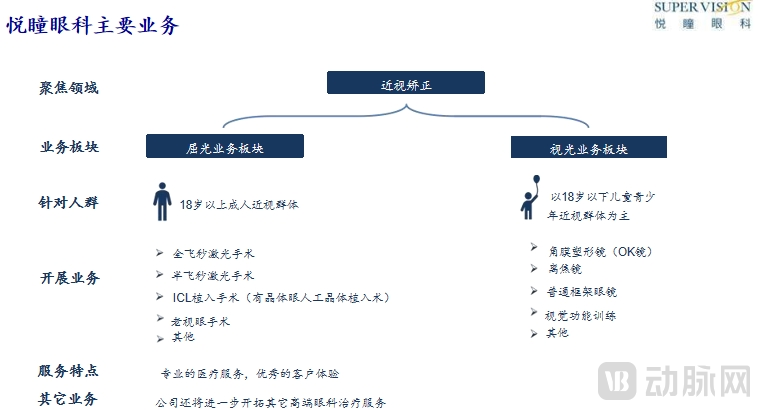
The reasons for choosing optometry and refractive surgery as the core business are as follows:First, these two core businesses serve as the revenue and even profit pillars for ophthalmic medical service institutions. By adopting a “small but specialized” model to deploy optometry and refractive services, institutions “invisibly” expand their profit margins and shorten the prolonged cash-flow breakeven cycle that was inevitable during the initial investment phase of traditional large-scale general ophthalmic hospitals.
Taking Yuetong Ophthalmology as an example, it can capture 70%–80% of the operating revenue (i.e., the proportion attributable to refractive and optometric services) of large comprehensive ophthalmic hospitals while incurring only one-third of their rent and labor costs. This relatively low-cost “cherry-picking” business model is evidently more efficient, yielding higher revenue per square meter, which constitutes a core competitive advantage for Yuetong Ophthalmology.
Secondly, the comprehensive coverage of optometry and refractive services means that nearly all age groups—from children to adolescents and adults—can find corresponding solutions for their optometric issues within this business framework.This represents another dimension of comprehensive business “coverage.” Furthermore, optometry and refractive services exhibit strong synergistic effects: the early screening services provided by optometry can accumulate potential patients for refractive services and cultivate brand loyalty through continuous, meticulous care; likewise, refractive services can provide professional refractive surgical solutions to adult patients identified during optometric screenings, thereby forming a closed-loop business model.
Combining the above two points,By achieving full coverage of optometry and refractive services, Yuetong Ophthalmology can not only maximize its customer base expansion and provide the most comprehensive eye health services to its target audience, but also enhance customer stickiness and brand loyalty.“After all, if a child has been receiving optometric and medical services from the same institution since the age of eight, that institution is highly likely to become their first choice when they require refractive surgery as an adult,” said Liu Lin, CEO of Yuetong Ophthalmology.
Service “Excellence”: Building a Differentiated Service System
While focusing on both optometry and refractive services, Yuetong Eye Hospital has been continuously refining its service system to address the strong demand for personalized and comfortable care among white-collar and gold-collar professionals (and their families), optimizing the patient journey and experience across three key stages: pre-consultation, during consultation, and post-consultation.
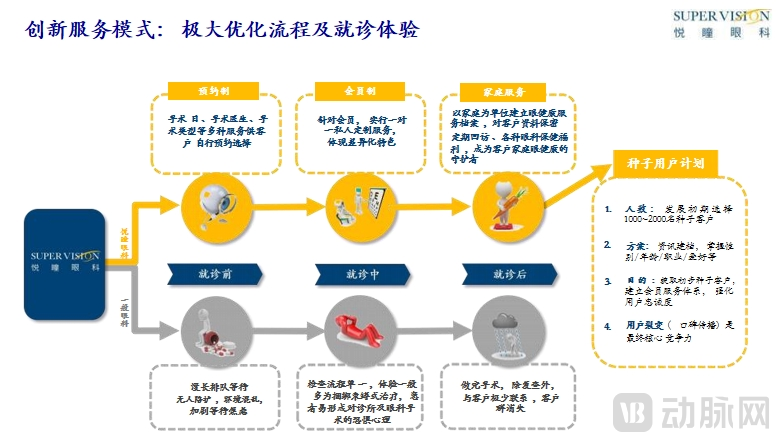
However, the criteria for evaluating the quality of services are often difficult to standardize and quantify. In this regard, during the interview, VCBeat asked Ye Chaohong a question: How can the “service optimization” of Yuetong Ophthalmology be understood in concrete terms?
A moment later, Ye Chaohong revealed the details. These “details” are the answer. From flexible scheduling of surgery times and private car pick-up and drop-off services, to a cup of warm water upon arrival, alcohol swabs torn open in front of patients, and customized commemorative photography and video services, among others… Within the basic service framework encompassing pre-consultation appointments, in-clinic guidance, and post-consultation follow-ups, Yuetong Ophthalmology has been meticulously refining various “invisible” details. It is precisely these details that have subtly elevated the service experience at Yuetong Ophthalmology.
“Yuetong has consistently studied Atour Hotel’s attention to service details, advocating for the prominence of three peak experience touchpoints,” stated Ye Chaohong. “I require all regional CEOs to personally experience a weekend stay at an Atour Hotel with their families each quarter, to appreciate the continuous refinement and enhancement of detail-oriented services that keep pace with the times. High-quality service experiences act as an amplifier for doubling business performance—a factor particularly crucial in an environment characterized by homogeneous competition.”
Innovative Model: Independent Operation of Optometry Clinics under the “1+N” Model
The so-called “1+N” model refers to establishing one ophthalmic hospital and N optometry clinics in a given city.This may sound similar to the mainstream tiered diagnosis and treatment model currently prevalent in the industry. However, a statement repeatedly emphasized by Ye Chaohong during the interviews revealsWhat Sets Yuetong Ophthalmology’s “1+N” Model Apart: Yuetong’s optometry outpatient clinics are not “affiliates” of ophthalmic hospitals, and there is no “headquarters-branch” relationship between them.
According to Ye Chaohong, one of the reasons why most general ophthalmology hospitals’ optometry clinics fail to meet expectations at this stage is that they are treated merely as ancillary units. Furthermore, refractive surgery services, which primarily target adults with established purchasing power and quicker decision-making processes, coupled with higher profit margins, exhibit a relatively high return on investment (ROI). In contrast, optometry services mainly cater to children and adolescents, whose parents serve as the primary decision-makers. This elongated decision-making chain entails greater time and cost investments, resulting in a lower ROI for optometry services compared to refractive surgery services.
For this reason, resources in comprehensive eye hospitals are typically skewed toward the refractive surgery department, while those allocated to the optometry department are relatively constrained. Under a “headquarters-branch” management model, resources for optometry services may be further encroached upon.
Therefore, Ye Chaohong proposed thatIn terms of management mechanisms, the optometry business needs to operate independently. For each project under Yuetong Ophthalmology, its optometry business has an independent operations team.
As of now, Yuetong Ophthalmology has established three facilities in Shenzhen, Wuhan, and Chengdu. In 2023, the Shenzhen and Wuhan clinics served 10,289 and 11,753 patient visits, respectively, with revenues showing consistent month-over-month growth since their inception.
Ye Chaohong is highly confident in the revenue performance of existing stores. Regarding the future expansion of Yuetong Ophthalmology, however, his response was markedly rational: “In the current market environment, our development strategy is to ‘do whatever it takes to survive and make steady, incremental progress toward improvement.’”
Specifically, in terms of market expansion, we have maintained a steady growth trajectory while continuously refining our approach and exploring new opportunities.Yuetong Ophthalmology plans to expand into new cities in 2025 by establishing ophthalmic and optometric hospitals, entering local markets with differentiated services. Furthermore, during the interview, Ye Chaohong indicated that Yuetong Ophthalmology is highly optimistic about the growth prospects of presbyopia-correcting surgery and will prioritize this sector in its future strategic layout.
“In fact, the ophthalmic services industry has not seen significant model innovation or transformation in recent years. As a practitioner with over two decades of experience in this field, I hope to spend the next 8–10 years creating an innovative pilot model for exploring industry development patterns, using Yuetong Ophthalmology as a practical template. This will also contribute to the advancement of eye health care in our country,” summarized Ye Chaohong.