

Aizhitong Launches Era of 5-Diopter Full Wavefront Precision Refraction with Approved Class II Innovative Medical Device
What Does a 5-Diopter Refraction Mean?
In traditional optometric refraction and spectacle dispensing, the smallest refractive increment is typically 0.25 diopters, whereas 0.05 diopters represents one-fifth of this interval, enabling a more granular division of refractive power. This approach not only enhances the precision of myopia surgery and patients’ postoperative visual quality but also improves visual outcomes for spectacle wearers.
September 2024,Zhejiang Aizhitong Medical Technology Co., Ltd. (hereinafter referred to as “Aizhitong”) has independently developed the “BWFOM Binocular Wavefront Aberrometer with Integrated Subjective and Objective Refraction,” which has been approved as a Class II Innovative Medical Device (Zhejiang Medical Device Registration No. 20242161702). This marks a fivefold improvement in precision over the 0.25-diopter refraction interval that has been used for 180 years.。
Shen Li, CEO of Aizhitong, stated in an interview with VCBeat: “This marks not only the launch of the first innovative medical device in the field of ophthalmic optometry examination in Zhejiang Province, but also fills a significant gap in this sector across China.” He pointed out that this innovative device will also usher in an era of precise prescription based on fifth-order full aberration.
A Decade of Refinement: Three Major Innovations Achieve Precise Optometry
“The BWFOM Integrated Binocular Wavefront Optometer” traces its origins to 2009, when Professor Wang Ningli, Dean of the Department of Ophthalmology at Beijing Tongren Hospital, identified a critical issue: the accuracy of existing optometric equipment was limited to 0.25 diopters, and wavefront aberration testing was not typically included in routine refraction unless specialized wavefront devices were employed—devices that were extremely scarce in the field of ophthalmic optometry.
Thus, a research and development team was assembled with the goal of “designing a visual quality analysis device capable of addressing the aforementioned issues.” The team comprised accomplished scientists in the field of astronomical observation, experts in optometry and ophthalmic optics, and manufacturing specialists in ophthalmic diagnostic equipment. After five years of intensive research and development, the blueprint for a globally leading device was finalized. In 2018, Aizhitong was officially established and launched its first generation of integrated subjective-objective binocular wavefront aberrometers. The product underwent continuous upgrades and refinements, culminating in 2024 with a breakthrough achievement: the acquisition of an Innovative Medical Device Certificate.
As an innovative work in the field of optometry,The Integrated Subjective-Objective Binocular Wavefront Aberrometer achieves precise refraction by integrating subjective and objective measurements, enabling the simultaneous execution of the previously independent functions of "measurement, correction, and evaluation" on a single device for the first time. It breaks the traditional 0.25 D step interval in refraction, achieving a precision of 0.05 D, with an average examination time of four and a half minutes.
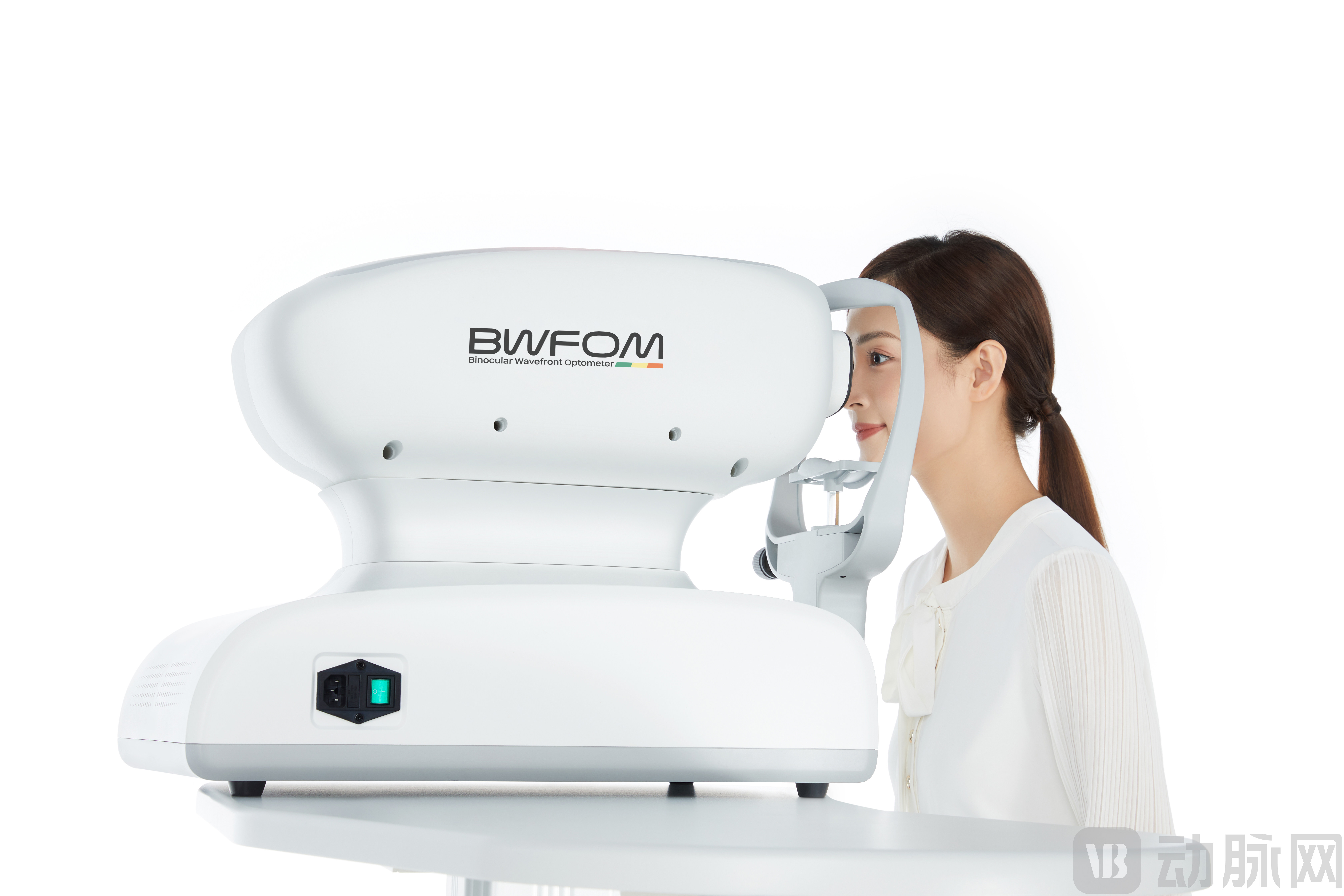
BWFOM Integrated Binocular Wavefront Aberrometer
Specifically, the integrated subjective-objective binocular wavefront aberrometer highly integrates the optometry procedure into a single device. Guided by intelligent software and a visual interface, it makes the refraction process more efficient and convenient, with an average completion time of just 4.5 minutes, thereby allowing more time for communication between optometrists and consumers.
Unlike traditional optometers, which typically perform refraction on each eye separately, the integrated subjective-objective binocular wavefront optometer features two built-in optotypes, one for each eye. This setup tricks the brain into perceiving that the eyes are focusing at infinity, thereby resolving the issue of testing distance. Even in a small room measuring just one square meter, it can simulate the effect of gazing into the distance.
Moreover, the team successfully applied wavefront aberration and adaptive optics technologies from astronomy to ophthalmology, enabling separate measurements of high-order and low-order aberrations of the human eye and optimizing more accurate objective refraction values. Shen Li stated:“Currently, the assessment of higher-order aberrations in ophthalmology is largely overlooked, primarily due to the high cost of equipment and the complexity of the examination process. We have integrated wavefront sensing into optometry devices, making it a part of routine examinations.””
Throughout the entire optometry process, patients first undergo objective refraction: wavefront aberrations are measured using a Hartmann-Shack wavefront sensor based on wavefront aberration and adaptive optics technologies, with higher-order and lower-order aberrations separated to achieve more precise measurement results. Subsequently, the measured lower-order aberration data are converted into objective refractive power values, which serve as the starting refractive power for subjective refraction.
Next, subjective refraction is performed. Traditional refraction methods employ a trial lens set, with a minimum increment of 0.25 D for each lens change. In contrast, the BWFOM refractor utilizes a set of optical modulators to simulate spherical and cylindrical lenses, adjusting them by moving linearly along the optical axis until the patient’s best visual acuity is achieved. Due to this linear movement, the BWFOM can achieve a refraction step size as fine as 0.01 D. However, considering that the human eye can minimally resolve a refractive change of 0.05 D, the final prescription is provided in 0.05 D increments.
Annual production capacity of 400–600 units, for sale in both domestic and international hospital markets.
Unlike conventional electronic products, the integrated binocular wavefront aberrometer contains over 3,000 precision optical components. Discussing the manufacturing process of this device, Shen Li stated that its key core lies in the assembly and alignment phase, a step whose precision is “comparable to the Swiss watchmaking industry,” as he vividly put it. The entire assembly and alignment process relies heavily on senior, experienced professional engineers, particularly those rigorously trained alignment specialists, whose skills and expertise are crucial to ensuring the device’s final performance.
It is understood that,Aizhitong plans to increase production to 400–600 units in 2025 to meet market demand.。
The market positioning of these cutting-edge devices is clear and well-defined:One segment targets professional ophthalmic hospitals and optometry centers, including specialized hospitals, general hospitals, and community hospitals, providing advanced diagnostic solutions for the field of ophthalmic care; the other segment focuses on optical retail stores and private ophthalmic clinics, supporting them in delivering precise optometric services, eyewear dispensing, and myopia prevention and control.
However, as a domestically developed, independently innovated medical device, establishing a firm foothold in the clinical field is no easy task.
Shen Li candidly stated, “Over the past three decades, foreign brands have deeply ‘cultivated’ the market. Many doctors tend to be skeptical when they learn that our equipment is independently developed in China. In their minds, international giants such as Zeiss, Essilor, and Nidek are synonymous with this type of equipment.” To address such market “bias,” Aizhitong has adopted an experiential promotion strategy, inviting potential partners to try the product first. “Many medical institutions that were initially skeptical discovered, after hands-on experience, that this domestically produced equipment offers improvements in multiple areas and can even help them overcome certain clinical challenges,” he said.
New Round of Financing Launched to Accelerate Product Portfolio Expansion
In addition to its independently developed integrated subjective-objective binocular wavefront aberrometer, which enables 5-degree full aberration measurement of the human eye, Aizhitong Medical has also launched a suite of revolutionary 5-degree optometric product solutions (including 5-degree freeform lenses and 5-degree personalized aberration-correcting lenses), thereby establishing a comprehensive “5-Degree Full Aberration Personalized Fitting Technology.”
Aizhitong’s 5th-Generation Total Aberration Personalized Fitting Technology has achieved an evolution in refractive power increments from 0.25 D to 0.05 D and upgraded correction from standard refractive error management to total aberration-based fitting. This breakthrough not only resolves a visual challenge that has plagued humanity for over a century but also establishes total aberration fitting as the new global standard in the ophthalmic and optometric industry.
Furthermore,Aizhitong is actively expanding device functionalities to meet a broader range of ophthalmic examination needs. For instance, the newly added visual function assessment module will cover key tests such as stereopsis and binocular fusion, providing patients with more comprehensive and in-depth evaluations of ocular health.
Regarding market strategy, Shen Li stated: “We have decided to first focus on the domestic market to accumulate experience and resources, and then gradually expand into overseas markets..” Looking to the future, Aizhitong has launched its Series A financing round to attract industrial capital. Such investors not only provide financial support but also bring valuable channel resources, technological collaboration opportunities, and international market access, injecting strong momentum into Aizhitong’s long-term development. We have every reason to believe that in the near future, Aizhitong will emerge as a leader in the field of vision correction, delivering clearer vision and a better quality of life to more patients.