

Fuyuan Pharma Subsidiary Secures Approval for Minoxidil Liniment, Targeting China's 250 Million Hair Loss Sufferers

Foyou Pharma
Pharmaceutical Formulation and Medical Device R&D Developer
On February 25, Beijing Front Pharmaceutical Co., Ltd. announced that its wholly-owned subsidiary, Front Pharmaceutical PLC, had recently received the Drug Registration Certificate for Minoxidil Liniment [Specification 1: 2% (60ml:1.2g), Specification 2: 5% (60ml:3.0g)] issued by the National Medical Products Administration. The acquisition of this Drug Registration Certificate is deemed as passing the consistency evaluation.
Minoxidil is the most commonly used medication for treating hair loss, primarily indicated for androgenetic alopecia and alopecia areata. Notably, minoxidil topical solution is available in two strengths: 2% (60 mL:1.2 g) and 5% (60 mL:3.0 g). The 2% strength is suitable for women or individuals with sensitive skin, while the 5% strength is restricted to male use only.
As of the announcement date, Front Pharmaceutical has incurred a cumulative R&D investment of RMB 4.0771 million for this drug.
From Antihypertensive Drug to “Miracle Cure for Hair Loss”: Minoxidil’s Rise to Stardom
In today’s fast-paced society, hair loss has become a “top-priority” concern that many find difficult to discuss openly.
According to a survey on hair loss released by the National Health Commission of China in 2019, there are approximately 250 million people suffering from hair loss in China, with a trend toward younger demographics; individuals born in the 1990s account for as high as 39.3% of this population. Furthermore, epidemiological data indicate that the prevalence of androgenetic alopecia among Chinese men is approximately 21.3%. Androgenetic alopecia is not exclusive to men; it also occurs in women, with a prevalence rate of approximately 6%.
Data shows that the market size for hair loss prevention drugs was approximately RMB 8 billion in 2023, with minoxidil-based products accounting for over 60%. The market is projected to surpass RMB 12 billion by 2025. The primary consumer group consists of men aged 20–40, representing 70% of the market, while the female segment is growing at a faster annual rate of 25%.
Hair loss not only affects personal appearance but also gradually undermines people’s confidence, potentially impacting their mental health. In this context, minoxidil has gained significant popularity among young adults and is hailed as a “miracle drug for hair loss prevention.”
In fact, minoxidil was initially developed as an antihypertensive medication for the treatment of high blood pressure, exerting its therapeutic effects by dilating blood vessels and lowering blood pressure. However, during clinical application, physicians unexpectedly observed that patients using minoxidil developed hypertrichosis. This side effect is likely attributable to local vasodilation, which increases blood flow, improves scalp microcirculation, and provides adequate nutrition to hair follicles, thereby promoting hair growth.
This unexpected discovery sparked researchers’ interest. Following further research and development, topical minoxidil formulations were approved in 1988 specifically for the treatment of androgenetic alopecia (AGA) and alopecia areata. In 1996, topical minoxidil solution/foam became the first FDA-approved hair loss medication, exerting its effects by dilating scalp blood vessels and prolonging the anagen (growth) phase of hair follicles.
Currently, minoxidil is widely recognized as a first-line medication for the treatment of androgenetic alopecia (which accounts for over 90% of hair loss cases), with a clinical efficacy rate of approximately 60%-70%.
The minoxidil liniment approved for Front Pharmaceutical has undergone targeted optimizations in dosage form, formulation, and manufacturing process. In terms of manufacturing, Front Pharmaceutical employed nano-microemulsion technology to enhance drug solubility and optimized the formulation by adding ingredients such as glycerin, thereby reducing scalp dryness and itching potentially associated with traditional minoxidil products. Regarding the dosage form, the company innovatively adopted a dual-mode “spray + rollerball” design to improve drug penetration and minimize waste.
Compared with similar products, Front Pharmaceutical's pricing strategy is competitive, with expected terminal pricing 15%-20% lower than that of comparable products, targeting the lower-tier markets and mid-to-low-end consumer segments.
Furthermore, the minoxidil liniment approved for Front Pharmaceutical comes in two specifications: 2% concentration (60 mL:1.2 g) and 5% concentration (60 mL:3.0 g). According to the approval by the National Medical Products Administration (NMPA), the 2% specification is indicated for the treatment of androgenetic alopecia and alopecia areata in both men and women, while the 5% specification is restricted to male use only. This differentiated design aligns with clinical guideline recommendations for patients of different genders (women are generally advised to use lower concentrations to avoid the risk of hypertrichosis) and expands the coverage of the target population.
The Multi-Billion Hair Loss Prevention Market: Anxiety Creates a Blue Ocean, with Channels and Marketing Determining the Winner
Currently, the minoxidil formulations approved in China include liniments, sprays, gels, tinctures, tablets, and foams. The domestic market has formed a competitive landscape characterized by “one dominant player and several strong contenders.” According to the official website of the National Medical Products Administration (NMPA), there are more than 20 production approvals for minoxidil liniment in China, involving well-known enterprises such as Zhejiang Saimo Pharmaceutical, Shandong Jingwei Pharmaceutical, and Shanxi Zhendong Anxin Biopharmaceutical, indicating intense competition.
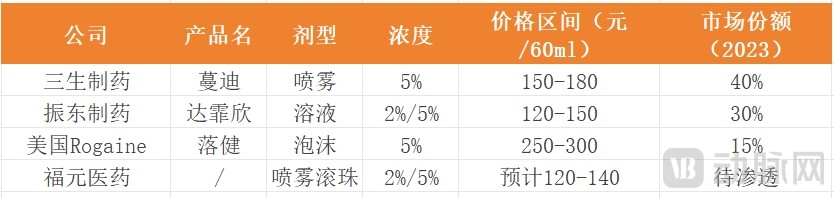
Comparison of Mainstream Minoxidil Products
Among them, the success of leading enterprises hinges on two core strategies: deep channel cultivation and marketing innovation. For instance, 3SBio’s Mandi (minoxidil) holds approximately a 40% market share, leveraging its first-mover advantage as the first generic version launched in 2001. It has achieved coverage in over 100,000 pharmacies and rapidly penetrated the market through OTC channels, while also establishing a presence on platforms such as JD Health and Ali Health to achieve omnichannel coverage.
Zhendong Pharmaceutical’s Dafeixin targets the female market with its 2% concentration formulation. In 2023, its sales doubled through e-commerce live streaming, capturing a market share of approximately 30%. Notably, in terms of marketing strategy, the company collaborated with influencers such as Li Jiaqi to promote the concept of “hair loss prevention as skincare,” bundling hair growth solutions with serums for joint sales. As a result, e-commerce sales accounted for over 50% of total revenue in 2023.
In the international brand segment, Rogaine (known as Luojian in China) from the United States dominates the high-end market with its foam formulation, while Kirkland captures the remaining share through cross-border e-commerce channels. Notably, Rogaine’s foam format addresses the greasiness associated with traditional solutions, granting it significant pricing power, with a single bottle priced as high as RMB 250–300.
Furthermore, companies such as Jingwei Pharmaceutical, Bausch + Lomb, and Wansheng Pharmaceutical have accelerated their market expansion in recent years by launching differentiated dosage forms like sprays and gels, further intensifying market competition.
Front Pharmaceutical’s entry marks the onset of comprehensive competition in the domestic minoxidil market. Its dual-strength formulation allows it to simultaneously compete with Mandi (5% for the male market) and Dafeixin (2% for the female market), thereby establishing a differentiated competitive position.
However, the current market suffers from severe homogenization, with approved minoxidil products differentiated only by dosage form and concentration. To break through, Front Pharmaceutical PLC must strengthen its efforts in channel penetration into lower-tier markets and brand building.
On one hand, compared with Mandi and Dafeixin, which have accumulated market presence for over a decade, Front Pharmaceutical lacks a foundation of consumer trust. On the other hand, according to data from Menet, online channels contributed RMB 630 million in sales in 2023, becoming the primary sales market. However, Front Pharmaceutical had not previously established an e-commerce operations team and needs to rapidly strengthen its digital marketing capabilities. Furthermore, as new players such as Jingwei Pharmaceutical and Wansheng Pharmaceutical enter the market, the mid-to-low-end segment may descend into chaotic price competition, thereby squeezing profit margins.
However, Front Pharmaceutical also possesses its own unique advantages. Leveraging the Group’s integrated API (Active Pharmaceutical Ingredient) industrial chain, the company maintains production costs 20% lower than those of its peers, thereby capitalizing on the Group’s API capacity advantages to reduce expenses. Furthermore, as its product has passed the Consistency Evaluation, it qualifies for hospital market access, enabling significant expansion into public hospital channels.
Currently, Front Pharmaceutical has filed for the first generic approval of “Minoxidil Foam” (with no domestically produced products currently available in China) and is advancing the clinical development of a “Minoxidil + Finasteride” combination gel to enhance efficacy through a dual-mechanism approach. Additionally, the company has entered the plant extract sector with “Polygonum Multiflorum Nano Hair Growth Essence,” emphasizing a natural concept to avoid controversies surrounding the side effects of chemical drugs.
Front Pharmaceutical’s Minoxidil in Two Specifications Approved: A Reflection of Domestic Pharma Firms’ Technical Accumulation and an Attempt at “Self-Disruption” Breakthrough in the Red Ocean Market. Its Success Hinges on Finding a Differentiated Niche by Balancing Cost Advantages with Branding Weaknesses.
In the long run, the ultimate competition in the hair loss prevention market is not merely a contest of “hair regrowth efficacy,” but rather a deep insight into consumers’ psychological anxiety. Those who can combine “scientific proof” with “emotional resonance” will remain invincible in this “top-of-the-head business” serving 250 million people.