

Internet Healthcare Rising Star Hims & Hers Reports 70% Revenue Surge to $1.5B, Sets $2.4B Target for 2025

Hims
Men's Health Product Supplier
On February 24, Hims & Hers, a rising star in the U.S. telehealth sector, released its full-year financial report for fiscal year 2024, continuing its strong performance with results that exceeded even the most optimistic forecasts. Meanwhile, its recent series of promotional campaigns have triggered sharply divergent, explosive reactions among the general public and professional communities. More notably, its stock price has undergone extreme volatility over the past two weeks, leaving many analysts and shareholders reeling.
As an emerging internet healthcare company initially positioned in the fields of men’s sexual health and hair loss, Hims & Hers has significantly expanded its business scope in recent years. It has not only entered the women’s health sector but also progressively covered areas such as mental health and obesity, and is currently extending into sleep disorders, reproductive health, and diabetes. Furthermore, the company has demonstrated outstanding financial performance in recent years, standing out as a notable exemplar in the digital health sector. This has attracted significant attention and offers substantial reference value for the industry.
What Exactly Is Hims & Hers Going Through, and What Does the Future Hold? VCBeat Has Compiled Public Information.
Founded in November 2017, Hims & Hers initially focused on two niche segments of men’s health before expanding into the women’s market, with a mission to provide internet-based healthcare services to younger generations (Generation X). As its business scope has expanded, Hims & Hers no longer targets solely a specific user group; instead, it is committed to delivering personalized solutions for its users.
Since its inception, the company’s growth rate has been remarkably impressive. In 2018, just one year after its founding, its revenue reached $27 million. For a startup that had only been in operation for a year, this was already a quite commendable achievement.
However, this is only the beginning of the legend. ByIn 2023, its revenue reached $842 million, a 31-fold increase from the initial figure. The six-year compound annual growth rate (CAGR) stood at an impressive 77.4%, with actual revenue exceeding prior-year forecasts for three consecutive years.。
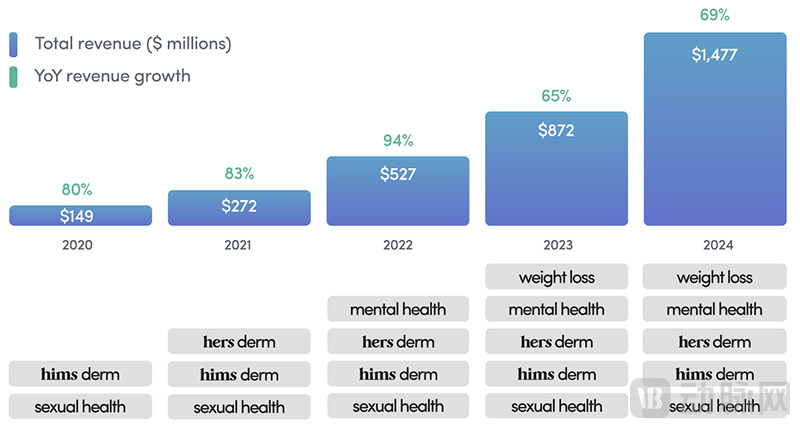
Hims & Hers’ Revenue Growth Has Been Impressive in Recent Years
In its fiscal 2023 annual report, the company had projected that its fiscal 2024 revenue would surpass $1 billion for the first time, reaching $1.17–1.2 billion. However, in its first-half 2024 financial report, it raised its full-year revenue guidance to $1.37–1.4 billion. Ultimately,Hims & Hers’ revenue for fiscal year 2024 stood at $1.477 billion, representing a year-over-year increase of 69%., with impressive performance.
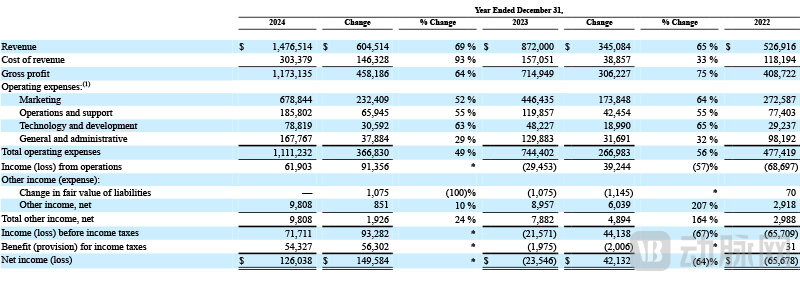
Hims & Hers Achieves Positive Net Income Amid Rising Costs
Hims & Hers achieved such substantial revenue growth in fiscal year 2024 that, despite a 49% surge in total operating costs for the full year, it still secured its first-ever positive net profit more than seven years after its founding—From a loss of $23.546 million in fiscal year 2023 to a profit of $126 million. Adjusted EBITDA surged from $50 million in fiscal year 2023 to $177 million, while the adjusted EBITDA margin increased significantly from 6% to 12%.
Among these, the second half of the year contributed the most to revenue.Revenue in the third and fourth quarters was $402 million and $481 million, respectively, accounting for more than 60% of the full-year total; this represents year-on-year growth of 77% and 95%, respectively, compared with the same period in fiscal year 2023.. In particular, revenue in the fourth quarter nearly doubled compared to the same period in fiscal year 2023. In fact, viewed on a quarterly basis, the acceleration in revenue growth during the second half of fiscal year 2024 was quite pronounced, coinciding precisely with the launch of its weight-loss business.
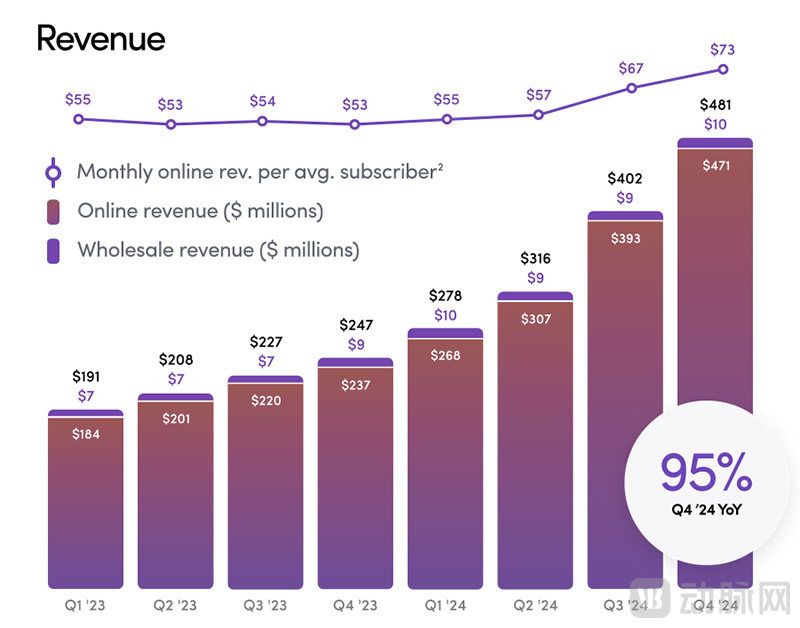
Hims & Hers’ quarterly revenues in recent years have been primarily driven by online channels, while the average monthly spending per user has also increased.
It is worth noting that since the fourth quarter of 2020,Hims & Hers’ revenue has grown for the 16th consecutive quarter, which is evident from its rapid growth in recent years.
According to the annual report, Hims & Hers’ revenue is primarily dependent on the consumer segment. The vast majority of the company’s revenue comes from subscription fees paid by online subscribers, while revenue from wholesale operations is negligible. Consequently, the number of subscribers and the average selling price have a direct impact on its revenue. In fiscal year 2024, Hims & Hers achieved significant improvements in both of these metrics.
First, Hims & Hers saw a significant increase in its subscriber base. Annual subscribers grew from approximately 1.5 million to around 2.2 million, representing a 45% increase.
Secondly, there was also a significant increase in the average monthly spending per subscriber in fiscal year 2024. Prior to this, Hims & Hers’ average monthly spending per subscriber had remained relatively stable, hovering around $53.In Q1 of fiscal year 2024, the average spending per individual subscriber was only $55; it rose significantly to $67 in Q3 and further reached $73 in Q4, representing a 38% increase within one year.. Clearly, the newly added weight-loss business in the second half of the year made significant contributions.
If Hims & Hers’ achievements in fiscal year 2024 were staggering, the management team’s forecasts for 2025 are likely to shock even the most optimistic observers—Revenue for fiscal year 2025 is projected to reach $2.3–2.4 billion, representing a 56–63% increase; first-quarter revenue is forecast to grow by 87–94%, reaching $520–540 million.。
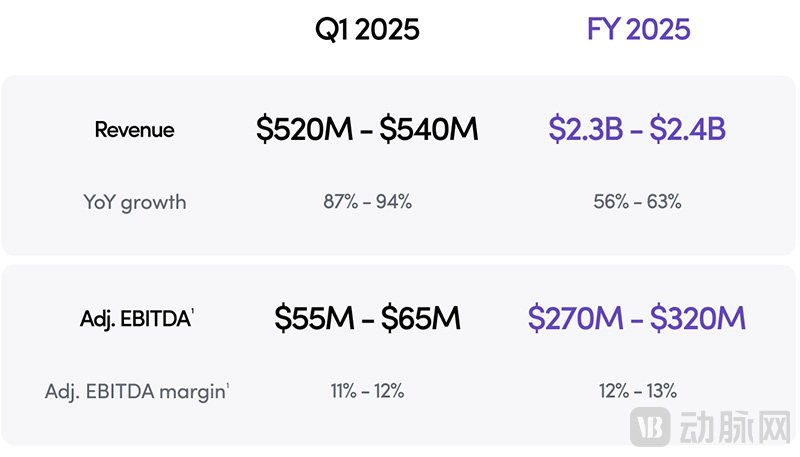
Hims & Hers Is Highly Optimistic About Its 2025 Revenue Forecast
“How was this achieved? Is it truly feasible?” I believe that upon seeing this series of exaggerated growth figures, I am not the only one who thinks so.
All signs indicate that Hims & Hers’ robust performance in fiscal year 2024 is likely inextricably linked to its launch of weight-loss services during the year.
As early as 2023, Hims & Hers had intentions to enter the weight loss market and planned to announce the launch of its weight loss products in December 2023, offering a bundled solution that included both pharmaceuticals and digital health products. However, at that time, the pharmacological regimen primarily consisted of personalized combinations of bupropion, metformin, naltrexone, and topiramate with vitamin B12. The highly anticipated GLP-1 medications, which were rumored to be part of the offering, were not included.
The plan to launch GLP-1 drugs was not implemented until May of last year. Hims & Hers offers users compounded GLP-1 injectable medications, with a monthly subscription fee of $199 (later reduced to $165). In contrast, Novo Nordisk’s semaglutide injectable products are significantly more expensive, with Ozempic for diabetes averaging around $968 and Wegovy for weight loss reaching as high as $1,349.
Such a significant price disparity has drawn numerous consumers to Hims & Hers, driving its business growth. Initially, Hims & Hers projected that its weight-loss segment would generate over $100 million in revenue within the year; however, actual figures far exceeded this expectation. In its letter to shareholders, Hims & Hers reported that full-year revenue, excluding GLP-1 products, grew by 43% year-over-year to reach $1.2 billion.
In other words,GLP-1 drugs generated nearly $300 million in revenue over six months, far exceeding initial expectations.。
So, why is Hims & Hers able to offer GLP-1 injectable medications at such affordable prices? This inevitably brings us to the FDA’s drug shortage emergency mechanism. Under a series of policies within this framework, whenever a shortage of a particular class of drugs occurs, qualified compounding pharmacies and outsourcing facilities may temporarily provide compounded medications as substitutes under the shortage provisions.
Since 2023, Ozempic and Wegovy have faced prolonged shortages due to surging demand, landing them on the FDA’s drug shortage list. Consequently, compounding pharmacies were permitted during this period to produce compounded medications containing the same active ingredient as semaglutide. Hims & Hers offers precisely such compounded products, reportedly in partnership with a leading U.S. manufacturer of generic drugs and Section 503B-compounded injectable medications.
To further enhance its services, Hims & Hers acquired a California-registered 503B sterile compounding pharmacy last September—namely, the MedisourceRx business unit under Nivagen Pharmaceuticals.
Hims & Hers’ business has been warmly received by users. According to its white paper on the weight-loss business released last October, only 13% of GLP-1 customers canceled their subscriptions within the first month, indicating high user stickiness.
Of course, it is not just Hims & Hers; many other companies are also offering compounded GLP-1 medications. However, its subsequent moves have significantly boosted its reputation.
In the past, Hims & Hers was known for its bold and provocative marketing. This style has carried over to its weight-loss business, sparking significant controversy.
Earlier this year, Hims & Hers aired an advertisement during the Super Bowl, often dubbed “America’s Spring Festival Gala,” declaring obesity as the “deadliest epidemic” in the United States and lambasting the healthcare system for being designed to keep patients “sick and poor.” The ad also took a swipe at pharmaceutical companies, asserting that the pricing of highly effective weight-loss medications (implicitly referring to GLP-1 drugs) is “for profit, not for patients.”
Coming shortly after the assassination of a UnitedHealth executive, this advertisement struck a strong chord with patients, causing a surge in attention for Hims & Hers. As a result,Its stock price closed at $68.74 on February 19, reaching a historical high.. It is worth noting that as recently as early February, its stock price was only around $40.
This promotional campaign has also sparked significant controversy. Not only did industry associations representing the pharmaceutical sector send letters to the FDA condemning the advertisement for violating drug advertising regulations, but several senators also called on the FDA to investigate it. Novo Nordisk, the target of the implied criticism, subsequently placed full-page advertisements in mainstream media outlets, questioning the safety and efficacy of GLP-1 compounded medications led by Hims & Hers under the headline, “Do You Really Know What You’re Injecting Into Your Body?”
As Novo Nordisk has stated, as long as a drug is listed as being in short supply, the FDA permits the compounding of that medication; however, its production process and quality are no longer subject to regulatory oversight. This differs significantly from FDA-approved pharmaceuticals and poses safety risks. Indeed, prior instances have revealed that compounded GLP-1 medications contained hazardous impurities, banned substances, or incorrect dosages.
Frankly speaking, compared to the recent heated debate in China over generic versus originator drugs, the path of compounded medications is clearly far more unconventional and appears to carry significantly higher risks.
On February 21, just days before Hims & Hers released its earnings report, the FDA announced that Novo Nordisk had confirmed its Ozempic and Wegovy production capacity could meet current and future national demand, marking the end of the shortage.
Whether the shortage has truly been resolved or merely succumbed to immense public pressure remains unclear. However, this implies that companies such as Hims & Hers will no longer be able to leverage drug shortages to continue supplying compounded GLP-1 medications. Following the news, its closing share price plummeted from $66.41 the previous day to $49.28, and has recently retreated to the pre-surge level of around $40.
However, the FDA has also established a smooth transition period, requiring Section 503A (state-licensed compounding pharmacies) to cease production by April 22, while Section 503B (outsourcing facilities) are granted an extension until May 22.
Executives at Hims & Hers have stated that expanding personalized treatments is a key strategic priority for the future. The company will continue to offer personalized treatment plans to meet patient needs within the bounds of applicable laws, and announced two acquisitions in February. It acquired peptide manufacturing facilities from CS Bio to enhance its long-term potential in delivering personalized medications, and acquired Trybe Labs to provide at-home testing services for customers.
In its annual report, the number of users of personalized medicine has surged in recent years, rising from just 18% of the total user base in the first quarter of 2023 to 56% in the fourth quarter of 2024.
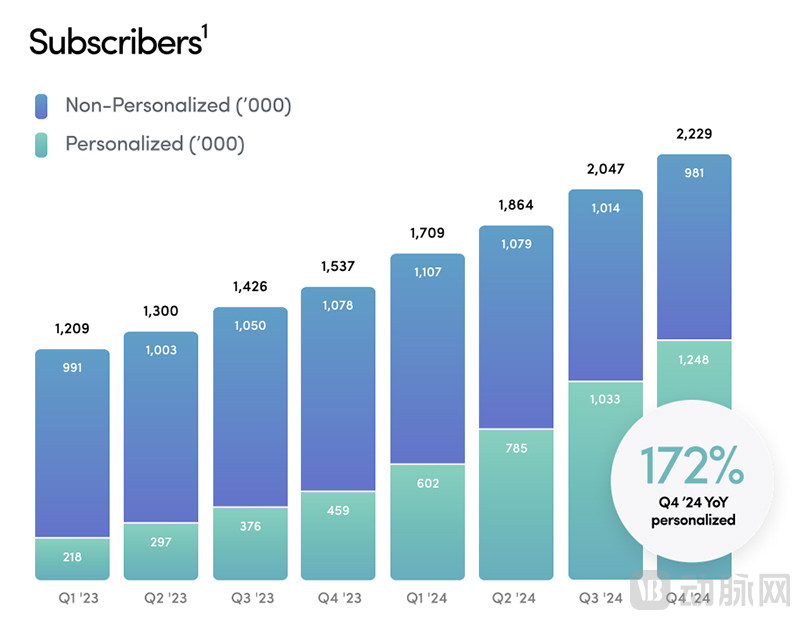
Significant Increase in the Proportion of Users Adopting Personalized Medication
Under the FDA’s regulatory framework, compounded medications are indeed permitted to meet personalized medication needs when approved drugs fail to address specific patient requirements—such as when patients are allergic to excipients in conventionally manufactured products and require customized formulations excluding those specific excipients. Some analysts have also pointed out that Hims & Hers might qualify for providing personalized compounded medications by adding vitamins or adjusting dosages to enhance therapeutic efficacy for users.
Although experts have widely pointed out that this claim is highly far-fetched, neither Novo Nordisk nor Eli Lilly has taken it lightly; both have already submitted requests to the FDA to include GLP-1 drugs on the “Difficult to Copy List” for compounded medications, thereby restricting pharmacies and physicians from providing compounded versions without FDA approval.
The so-called “if you don’t pull up the weeds by the roots, they will grow again with the spring breeze” is nothing more than this.
Hims & Hers is pinning its hopes on liraglutide, stating that it plans to offer liraglutide-based solutions to customers in 2025.
The story between Hims & Hers and the GLP-1 pharmaceutical giants is likely to continue unfolding in the future, ultimately determining whether the company will continue its meteoric rise or face a precipitous decline.
Hims & Hers’ rapid rise is not without historical precedent. In recent years, we have witnessed the sustained high-speed growth of Teladoc, a U.S. telehealth giant. However, with the end of the pandemic leading to a decline in telehealth utilization and overly aggressive strategic decisions, Teladoc is now facing a downturn.
Can Hims & Hers avoid the pitfalls of its predecessors—soaring to new heights on the back of its GLP-1 business, or stumbling because of it? VCBeat will continue to monitor the situation closely.
References:
Heather Landi,fiercehealthcare.com:Hims & Hers projects weight loss business to hit $725M in 2025 despite GLP-1 market shift
Marissa Plescia,medcitynews.com:Hims & Hers vs. Novo Nordisk: Are Compounded GLP-1s Safe?
Lindsey Leake,fortune.com:Ozempic, Wegovy maker calls out Hims & Hers Super Bowl ad: ‘Check before you inject’