

Ergothioneine: The Anti-Aging Breakthrough Driving a 60-Fold Sales Surge as Domestic Brands Enter Fierce Competition
The hottest anti-aging ingredient right now is ergothioneine.
Despite the skepticism and controversy it has faced along the way, ergothioneine’s commercial appeal cannot be underestimated. According to the “Nutrition & Health Insights” report by Plant Extraction Bridge Research Institute,2024YearQ2“Nutrition and Health Industry Scan” data,2024In the first half of the year, sales of oral ergothioneine beauty supplements on a single e-commerce platform surged year-on-year.60times. Behind this lies more than200In recent years, a wave of cosmetics and health supplements featuring ergothioneine as the primary active ingredient has been intensively launched onto the market.
Meanwhile, the development and application of ergothioneine are becoming increasingly standardized.2Month8On [date], the Shanghai-based Ergothioneine Biotechnology Group stated that its independently developedDr.Ergo®Ergothioneine raw material has successfully obtained approval after undergoing rigorous safety assessment.FDAofGRASCertification. This is the first in China and the second globally to passFDA GRASCertified Ergothioneine Products.FDA GRASAgainst the backdrop of increasingly stringent certification requirements, this regulatory endorsement of ergothioneine is all the more valuable. Furthermore, earlier1Month, independently developed and produced by Bloomage BiotechMitoEGTL-Ergothioneine Successfully Obtains U.S.Self-affirmed GRASApproved.
Ancient Amino Acids
At its core, ergothioneine is a colorless and odorless natural amino acid primarily found in certain bacteria and fungi, such as edible mushrooms including king oyster mushroom, yellow-white oyster mushroom, maitake, and enoki mushroom. The human body is incapable of synthesizing ergothioneine on its own.1909Year, ScientistsCharles Tanret During research on the ergot fungus that destroys rye grains, a unique sulfur-containing crystalline compound was isolated, later identified as ergothioneine.2After the turn of the year, the molecular structure of ergothioneine was determined; as a derivative of histidine betaine, it thereby entered the scientific community’s field of vision.
However, ergothioneine did not gain widespread attention until nearly a century later.
2005In [year], scientists discovered a special transporter protein present in keratinocytes and melanocytesOCTN1, which exhibits extremely high affinity for ergothioneine, enabling the transport and accumulation of substances such as carnitine and acetylcholine into mitochondria and the cell nucleus via this mechanism. Mitochondria are the primary sites within cells for maintaining energy supply and aerobic respiration; while generating energy, they also produce substantial amounts of free radicals, ultimately leading to mitochondrial apoptosis, which triggers cell death and skin aging.
Due to the structural characteristics of mitochondria, very few natural antioxidants can penetrate them. This makes ergothioneine’s ability to be transported across mitochondrial membranes exceptionally rare.People have high hopes for the anti-aging and antioxidant properties of ergothioneine, which is now stepping into the spotlight.
On the one hand, a series of studies have also confirmed the antioxidant, cytoprotective, and anti-inflammatory effects of ergothioneine.In terms of antioxidant activity, the primary mechanism of action of ergothioneine is the scavenging of free radicals, such as hydroxyl radicals and superoxide anion radicals.CauseDNAInjury, Protein Denaturationactive substances, thereby delaying cellular aging and death. In addition, ergothioneine can also interact withVitaminC. VitaminsEwork synergistically with other antioxidants to enhance the body's antioxidant defense system.
In terms of cytoprotection, the primary role of ergothioneine is to protect mitochondria. Studies have shown that ergothioneine selectively accumulates in cellular mitochondria, where it safeguards mitochondrial membrane structure and functional integrity through its antioxidant properties. This ensures normal mitochondrial energy metabolism, provides sufficient energy for cells, and maintains normal cellular physiological activities. Furthermore, in skin cells, ergothioneine can absorb harmful free radicals generated by ultraviolet (UV) radiation, thereby reducing UV-induced damage to skin cells and preventing issues such as sunburn, tanning, and photoaging.
In terms of anti-inflammatory effects, ergothioneine primarily modulates the immune system by inhibiting the activation of inflammatory cells and the release of inflammatory mediators, such asTumor Necrosis Factor-α, Interleukin- 6 Waiting plays a key role in the inflammatory response.inflammatory cytokines, thereby attenuating the inflammatory response and alleviating inflammation-related symptoms. Meanwhile, in certain inflammation-associated diseases, such as arthritis and inflammatory bowel disease, ergothioneine can mitigate oxidative stress and tissue damage at inflammatory sites through its dual antioxidant and anti-inflammatory effects, promote tissue repair and regeneration, improve disease symptoms, and enhance patients' quality of life.
On the other hand, ergothioneine has successively gained recognition from food and drug regulatory authorities in multiple countries.2017In [year], the European Union first released ergothioneine (L-EGT) as a safety statement for food additives, approving it as a novel food ingredient and stipulating that the application standard is for the general population at a daily intake of30mg,3Children aged ___ and above, daily20mg, and it is contraindicated in pregnant and lactating women. The following year, the European Union expandedL-Beyond dietary supplements, ergothioneine can also be incorporated into conventional food products such as beverages and cereal bars.
In the same year, the United StatesFDACertificationBlue CalifoniaThe company uses ergothioneine produced by fermentation of genetically engineered bacteria.GRASStatus: Can be used in cakes, biscuits and pastries (including oat bars), coffee, tea, fruit beverages and cider, carbonated soft drinks, and chocolate-containing confectionery, at a usage level of5mg/portion. The following year, ergothioneine once again passed the U.S.FDAofGRASCertification can be applied to general food products.1Post-Chinese New Year, Japan has already launched Foods with Function Claims containing ergothioneine, a product designed to improve memory function in the elderly.2024Year5In [Month], China's National Health Commission officially accepted the application for ergothioneine as a novel food ingredient.
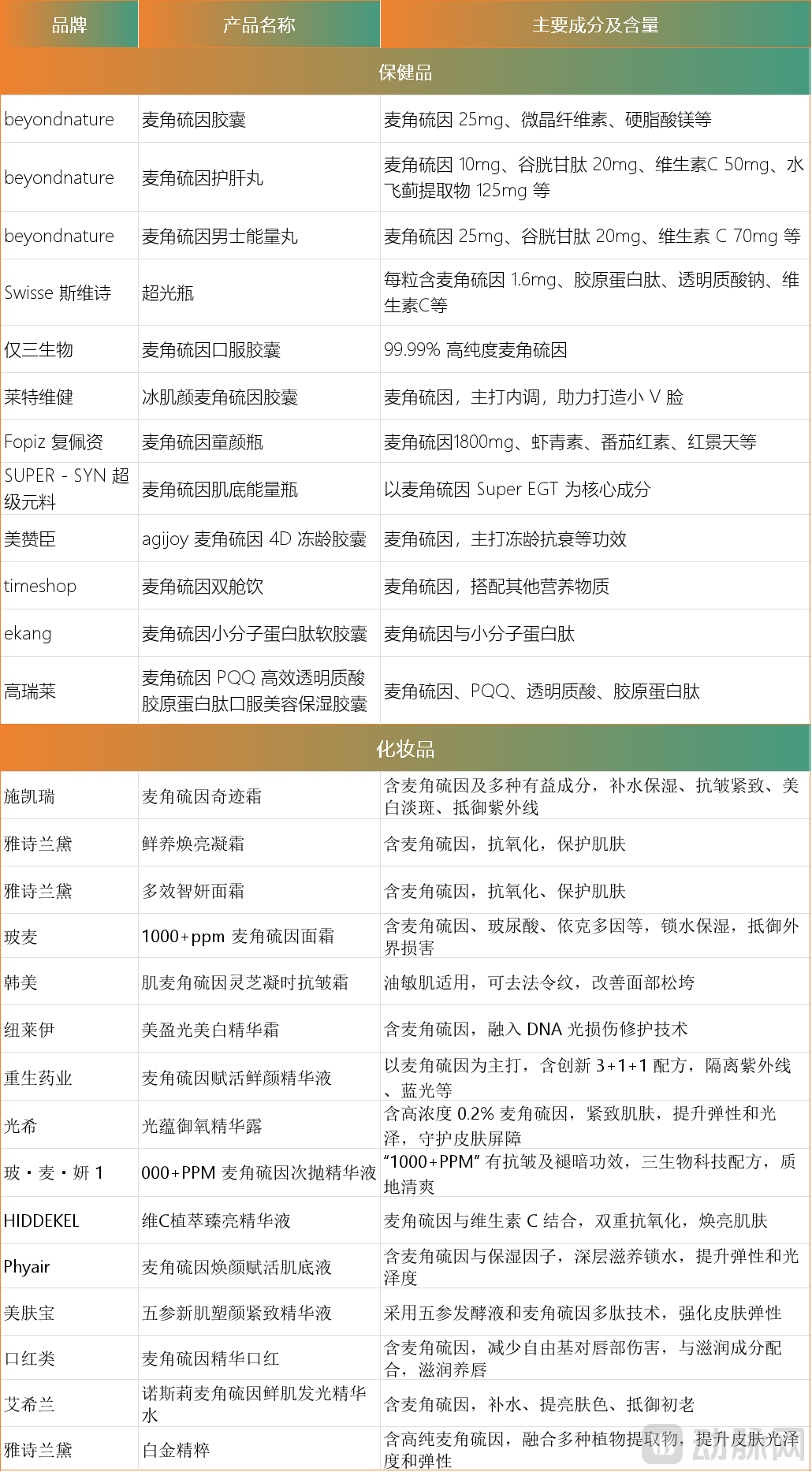
According to incomplete statistics from VCBeat, there are already dozens of health supplements and cosmetics currently on the market that feature ergothioneine as their primary active ingredient, including offerings from leading brands such as Swisse, Mead Johnson, and Estée Lauder. Among them,Swisse of the Ultra-Light Bottle product innovatively combines "ergothioneine+ Collagen Peptides+ "Sodium Hyaluronate" enjoys high visibility and attention in the market. Lightway Health's Ice Skin Ergothioneine Capsules utilize a patented technology from the Shanghai Institute of Organic Chemistry, Chinese Academy of Sciences, to extract purity as high as99.9%Ergothioneine has repeatedly sparked buying frenzies during major sales events on mainstream domestic platforms such as JD.com and Tmall, earning deep affection from consumers worldwide.
Domestic Brands Race to Seize Market Segments
For a long time after its introduction, ergothioneine did not gain widespread popularity. This was because ergothioneine produced using traditional methods had extremely low yields and was prohibitively expensive.
As previously mentioned, ergothioneine is widely present in edible fungi, ergot, grains, and other substances. In particular, edible fungi have relatively high ergothioneine content and have once served as a major source for extraction. For instance, the ergothioneine content in boletes reaches1812μg/g, King Oyster MushroomThe ergothioneine content in shiitake mushrooms is respectively542μg/gand353μg/g. In the early days, ergothioneine was primarily obtained through chemical extraction, with edible mushroom fruiting bodies, pig blood, animal tissues, ergot, and grains serving as raw materials. However, the chemical extraction method for obtaining ergothioneine yields very low results, and the purification process is time-consuming and costly, causing the price of ergothioneine to reach millions or even tens of millions of yuan per kilogram.
Subsequently, the U.S.-basedBarnet ProductsThe company attempted to produce ergothioneine via chemical synthesis, significantly reducing its production costs. However, the chemical synthesis method struggles to control the optical activity of ergothioneine and involves complex processes, making large-scale mass production still difficult to achieve. In recent years, there has been a surge in exploring the use of synthetic biology for ergothioneine production. Although the synthetic biology approach is still in its early stages of development, related enterprises have sprung up like mushrooms after rain, hoping to leverage new technologies to overtake competitors.
At present, the main production areas of global ergothioneine are still concentrated overseas.According to statistics,2022In 2025, the market share of ergothioneine produced in North America and Europe reached63.07% and23.13%. Among them, in addition to the aforementionedBarnet ProductsAdditionally, headquartered in France,Tetrahedronand U.S.-headquarteredMironova Labs,accounted for the largest share of the global ergothioneine market. Data shows that,2022Year,TetrahedronandBarnet Products accounted for the global ergothioneine82.16%market share. Among them, onlyTetrahedron's market share reached58%, is the world's largest producer of ergothioneine. These leading ergothioneine manufacturers primarily obtain ergothioneine through chemical methods.
In China, most ergothioneine producers have opted to manufacture the compound via synthetic biology, resulting in rapid advancements in both production processes and product development. Data indicate that China is currently the region with the fastest growth rate in global ergothioneine output. It is projected that by2029In [year], the share of ergothioneine produced in China in the global market will reach49.62%At this stage, domestic ergothioneine manufacturers are rapidly advancing in process development, product optimization, and industry standardization, demonstrating strong momentum to capture market share.
First, the continuous innovation in ergothioneine production processes has gradually enabled efficient mass production.Among them, Bloomage Biotech’s strategic layout in ergothioneine is particularly representative.2018YearBloomage Biotechnology has strategically entered the field of synthetic biology, gradually establishing a self-contained, closed-loop ecosystem across the entire synthetic biology industry chain, encompassing platforms, talent, technology, and commercialization. Through continuous process optimization and strain iteration, Bloomage Biotechnology has developed a natural and sustainable fermentation process, achieving ultra-high-purity ergothioneine via one-step biosynthesis and establishing a synthetic pathway for producing ergothioneine from corn-derived glucose. Furthermore, to address challenges such as the complex composition of impurities in fermentation broths, the company has innovatively developed a multi-stage continuous resin-based impurity removal process. This approach constructs a purification workflow—from pretreatment to impurity removal and enrichment—that does not require the addition of toxic or hazardous reagents.
For another example, Zhongke Xinyang, headquartered in Guangdong, adopts a microbial cell factory-based total synthesis approach to achieve efficient ergothioneine production, shortening the entire synthesis cycle.24 hours, reduced glucose consumption28.5%, reduced electricity consumption in production30%, reduced water consumption50%, reductions in both air and water pollution50%Furthermore, by continuously optimizing process controls such as the cooling gradient, crystallization concentration, and stirring methods, we secured three patents for purification processes and achieved large-scale production of ergothioneine at the hundred-ton level.
Furthermore, Sanbio,Hechen Biotech, and others, have also successively achieved mass production of ergothioneine via synthetic biology methods. LeveragingGMPStandard Pharmaceutical Manufacturing Platform, Mastered Only by Sanbio20ton-scale fermentation tank's fermentation process and purification capacity, with the produced ergothioneine purity exceeding99.9%, significantly reducing the production cost of ergothioneine.2023Year8Month,Hechen BiotechHefei Headquarters Hosts Commissioning Ceremony for Agile Mass Production Platform, Which Adopts Digital and Modular Design Concepts to Enable Rapid and Flexible Mass Production of Various Target Active Ingredients and Bio-based Materials.
Second,In recent years, domestic brands have intensively launched hit products featuring ergothioneine.For example,2023In 20XX, independently developed and produced by Bloomage BiotechBioyouth™-EGT PureUltra-pure ergothioneine has been officially launched. Trials have shown that,Bioyouth™-EGT PureNot only protects mitochondria, but also promotesⅢPromotes collagen production, reduces skin hyperpigmentation, and enhances skin radiance.In the same year,“Remarkable Chinese Ingredients”In the selection,Bioyouth™-EGT Pure Ultra-Pure Ergothioneine Wins“Premium Raw Materials from China”Title.
Furthermore, under Synbio Tech’sSIYOMICRO-ERGO® Ergothioneine products, focusing on fields such as active ingredients for efficacy-based skincare and functional nutritional supplements. Although not disclosed through public channels, Zhongke Xinyang, which has received investment from Proya, may become the raw material supplier for the latter’s products with ergothioneine as the main active ingredient. And the biotechnological development of ergothioneineDr.Ergo®with high stability, in2024At the Food Research Institute’s Super Ingredients Conference, it won the annual “Oral Beauty” Award, featured in Swisse’s Ultra Glow Bottle and LiteOn’s Ice Skin Formula,GRANVERFlagship products such as Jifandun use ergothioneine as a raw material.
Third,Driven by domestic ergothioneine manufacturers, industry regulations are being rapidly refined across multiple dimensions.2023Year9MonthThe standard “High-Purity Ergothioneine for Cosmetic Ingredients,” led by Bloomage Biotech, has been officially released and implemented. Additionally, the company is collaborating with the National Institutes for Food and Drug Control (NIFDC) to develop national reference standards for ergothioneine.
Meanwhile, the first domestic group standard for “Ergothioneine as a Cosmetic Ingredient,” co-developed by Sanbio, has been officially implemented. This standard specifies industry requirements for ergothioneine used in cosmetics, including technical specifications, testing methods, inspection rules, labeling and packaging, storage, and shelf life. Furthermore,Ergothioneine participated in the drafting of "Quality Standards for Raw Materials Used in Import and Export"L-Group Standard for Ergothioneine and Standard for Ergothioneine as a Cosmetic Ingredient2024Year6MonthThe group standard "Ergothioneine," led and compiled by Hechen Biotechnology and officially released by the China Chamber of Commerce for Import and Export of Medicines and Health Products, has been formally issued. Primarily addressing product innovation and quality management requirements of international market customers, particularly in the fields of health supplements, functional foods, and dietary supplements, the standard strictly specifies technical indicators for quality management during the production, storage, and transportation of ergothioneine.
Practical Challenges
Compared with other star raw materials in the upstream consumer healthcare sector, such as hyaluronic acid and collagen, ergothioneine remains confined to a very niche market. The underlying reason is that downstream applications of ergothioneine have not truly flourished due to production capacity constraints. For this ancient amino acid, resolving the challenge of stable, large-scale production remains an urgent priority.
On the one hand, it is extremely difficult to achieve significant breakthroughs in cost and efficiency with traditional chemical methods for ergothioneine preparation.For the current period and the foreseeable future, chemical synthesis will remain the primary source of ergothioneine in commercial applications. It is expected that2029Year, the market share of chemically synthesized ergothioneine will remain at70%The above。
The chemical synthesis of ergothioneine typically requires specific chiral raw materials, such as amino acids with defined configurations. The sources of these chiral starting materials are relatively limited, and their production and extraction processes can be complex. Furthermore, to ensure the smooth progression of synthetic reactions and the purity of the final product, extremely high purity standards for the raw materials are required, leading to elevated costs that hinder large-scale chemical manufacturing. Meanwhile, the molecular structure of ergothioneine is relatively complex, often necessitating multiple reaction steps to construct the complete molecule. For instance, the preparation of ergothioneine involves multi-step functional group transformations and cyclization reactions. Each step demands precise condition control and optimization under stringent reaction conditions; any issue in a single step may result in the failure of the entire synthetic route or reduced yield.
On the other hand, emerging biosynthetic methods have resolved challenges related to raw material sourcing and cost reduction; however, significant technical bottlenecks remain across various stages, from strain construction to separation, purification, and scaled-up production.Natural strains with high ergothioneine synthesis efficiency often exhibit low yields, making it difficult to meet the demands of large-scale production. Screening for high-yield strains from a vast pool of microorganisms is akin to finding a needle in a haystack, requiring substantial time and effort. Moreover, even when relatively high-yielding strains are identified, they may possess poor genetic stability, leading to a decline in yield during subculturing.
Furthermore, ergothioneine produced via synthetic biology methods often exhibits low concentrations in the fermentation broth. The presence of abundant impurities—such as cell debris, proteins, polysaccharides, and culture medium components—which may share similar physicochemical properties with ergothioneine, significantly increases the difficulty of separation. More importantly, the biosynthetic production of ergothioneine requires substantial resources, including large volumes of culture media and energy, as well as specialized technical personnel and equipment for the control and management of the fermentation process, all of which continue to drive up the production costs of ergothioneine.
In a sense, as an anti-aging ingredient highly sought after by consumers, ergothioneine has only just taken its first step toward commercialization. Whether it can ultimately gain a foothold in the fiercely competitive medical aesthetics market remains to be seen, as ergothioneine still has a long way to go.