

Boston Scientific's Farapulse PFA System Achieves Over $1 Billion in Sales Within First Year of U.S. Launch
PFA (Pulsed Field Ablation System for Atrial Fibrillation Treatment) is taking the market by storm, poised to dominate the landscape immediately upon its launch.
In January 2024, Boston Scientific’s PFA product, Farapulse, received FDA approval for market launch in the United States. By the end of 2024, its sales had surpassed $1 billion, with over 200,000 patients treated.
Meanwhile, following their regulatory approvals in 2024, PFA products from Medtronic and Johnson & Johnson have achieved significant sales volume. For instance, Medtronic’s PulseSelect Pulsed Field Ablation System has been deployed in 20 countries and regions worldwide, cumulatively treating over 10,000 patients; Johnson & Johnson’s Varipulse PFA System has successfully completed more than 3,000 procedures globally.
Undoubtedly, PFA is disrupting the global electrophysiology market landscape at an unprecedented pace, replacing traditional radiofrequency ablation and cryoablation.
In China, PFA products from companies such as Jinjiang Electronics, Denovo Electrophysiology, Huitai Medical, Hongtong, Xuanyu, Medtronic, Boston Scientific, and Johnson & Johnson have all received approval from the National Medical Products Administration (NMPA). This is expected to accelerate the transformation of the domestic electrophysiology market.
We need to consider: Can PFA products replicate the miracle of surpassing $1 billion in annual sales in the Chinese market? How will the promotion of PFA products affect the landscape of the domestic electrophysiology market? How will the surge in sales volume of PFA products impact the competition between domestically produced and imported products?
Generally, an innovative medical device requires several years of market cultivation before achieving significant sales volume. However, Boston Scientific’s pulsed field ablation (PFA) product achieved over $1 billion in sales within its first year on the market. In addition to the widely recognized advantages of PFA products over radiofrequency ablation and cryoablation in terms of safety, efficacy, and ease of use, a series of strategic initiatives undertaken by Boston Scientific were also key factors contributing to its breakthrough of $1 billion in annual sales.
First, Boston Scientific optimized its products through clinical trials and standardized procedural techniques, laying the foundation for product promotion.In 2021, Boston Scientific published the IMPULSE/PEFCAT/PEFCAT II studies to elucidate its exploration of parameters for the Farapulse pulsed field ablation system.
Initially, the Farapulse Pulsed Field Ablation System employed a bipolar unidirectional waveform design, with the pulse generator delivering voltages of 900–1000 V. Following adjustments based on clinical feedback, the product was optimized to a bipolar bidirectional waveform design, and the voltage output of the pulse generator was increased to 1800–2000 V. Through continuous refinement, the Farapulse Pulsed Field Ablation System ultimately achieved remarkable pulmonary vein isolation rates.
Meanwhile, Boston Scientific has collaborated with clinical experts to standardize the procedural technique. In the single-center 5S study, it designed a validation phase and a refinement phase. Clinicians first tested the operational procedure during the validation phase and subsequently standardized the surgical workflow in the refinement phase. This approach not only reduced the overall procedure time but also improved the treatment efficiency of the Farapulse Pulsed Field Ablation System, ensuring its reliability.
Building on this, Boston Scientific released extensive clinical trial data to persuade clinicians of the safety and efficacy of Farapulse. For instance, in August 2023, Boston Scientific announced positive 12-month results from the Farapulse clinical trials: despite most physicians having experience only with thermal ablation, the Farapulse system demonstrated non-inferiority to standard-of-care therapies (radiofrequency ablation and cryoablation), meeting both primary efficacy and safety endpoints.
Previously, the Farapulse pulsed field ablation system received CE certification in 2021. By the time it obtained U.S. approval in 2024, the product had been used to treat more than 40,000 patients in Europe and had been featured in over 100 clinical papers.
Based on extensive and reliable clinical trial data and real-world evidence, clinicians widely recognize the safety and efficacy of the Farapulse Pulsed Field Ablation System and have a strong interest in using this product.
Second, Boston Scientific has conducted extensive academic promotion activities by leveraging its own strengths.As an international giant, Boston Scientific previously held a certain market share in the electrophysiology field. Leveraging its global sales network and promotional teams, its Farapulse pulsed field ablation system has rapidly made waves in the clinical community.
For example, Boston Scientific invited Professor Vivek Reddy to present trial data on the Farapulse Pulsed Field Ablation (PFA) System at the 2025 International Atrial Fibrillation Symposium, a highly influential international conference in the field of atrial fibrillation, drawing significant attention from clinicians. In collaboration with Professor Vivek Y. Reddy of Mount Sinai Hospital in New York, Boston Scientific reported a head-to-head trial comparing PFA products with radiofrequency ablation at the 2023 European Society of Cardiology Congress, sparking interest among physicians worldwide. At the 2025 Annual Meeting of the Asian Pacific Heart Rhythm Society, the Boston Scientific team presented experimental demonstrations and results to attendees, planting the seed for future adoption of PFA products.
In addition to the aforementioned initiatives, changes in the electrophysiology market and actions by other competitors have also impacted sales of Boston Scientific’s PFA product, Farapulse.Notably, the rapidly growing global electrophysiology market offers substantial incremental opportunities for the Farapulse Pulsed Field Ablation (PFA) System. In the United States, comprehensive insurance reimbursement for PFA products reduces patient financial burden, making physicians and patients more inclined to adopt Farapulse due to its multiple advantages over radiofrequency ablation and cryoablation.
In addition, industry giants such as Medtronic and Johnson & Johnson have joined Boston Scientific in advancing the field of pulsed field ablation (PFA), creating synergies that have collectively driven the market adoption of PFA technology. Previously, Medtronic’s PFA product, PulseSelect, received U.S. FDA approval in December 2023; Johnson & Johnson’s PFA product, VARIPULSE, was approved by the FDA in November 2024.
It is worth noting that after Johnson & Johnson’s pulsed field ablation (PFA) product, VARIPULSE, received approval, the company announced in January 2025 that it would suspend external evaluations and commercial use of the device in the United States to investigate the causes of four post-treatment stroke events reported during external assessments. In February 2025, following a comprehensive investigation, Johnson & Johnson announced a limited resumption of VARIPULSE promotion in the United States.
Johnson & Johnson stated, “Following an investigation into potential device-, procedure-, and patient-related factors, it has been concluded that the VARIPULSE device is operating as intended, with no performance differences observed among VARIPULSE system configurations available globally.”
Regarding post-treatment stroke events, Johnson & Johnson’s research has found that the risk of neurovascular events may increase if extensive ablation, overlapping ablation, and/or extra-pulmonary vein ablation is performed.
As can be seen, Boston Scientific’s ability to achieve over $1 billion in sales for its Farapulse Pulsed Field Ablation (PFA) System within one year of its market launch is attributable not only to the disruptive advantages of the PFA product and its own promotional strategies, but also significantly to the policy environment and health insurance reimbursement frameworks in European and American markets.
So, can Boston Scientific replicate this sales miracle in the Chinese market?
To date, the PFA products of Boston Scientific, Medtronic, and Johnson & Johnson have been approved for market launch by the National Medical Products Administration (NMPA) in July 2024, September 2024, and January 2025, respectively.
These overseas giants are aggressively expanding into the domestic market, introducing significant uncertainties to China’s electrophysiology sector. However, given the substantial differences between the Chinese and U.S. markets, these industry leaders—despite their proven success in Europe and the United States—must still address numerous challenges to achieve a breakthrough in China.
First, significant variations in anesthesia resources affect the implementation of PFA procedures.. At the current stage, Boston Scientific’s PFA products require general anesthesia for surgical procedures. There is a sufficient supply of anesthesiologists in the United States, and radiofrequency ablation and cryoablation, which have historically dominated the U.S. electrophysiology market, are also typically performed under general anesthesia. Therefore, there are no barriers to adopting the general anesthesia-based PFA procedure as a replacement.
However, there is a significant shortage of anesthesiologists in China. Statistical data show that the United States has 2.5 anesthesia professionals per million people, whereas China has only 0.7 per million, indicating a substantial gap in the number of anesthesiologists.
Meanwhile, radiofrequency ablation and cryoablation procedures previously performed in the domestic electrophysiology market were primarily conducted under local anesthesia. This has created habitual and resource-related barriers for Chinese physicians when transitioning from locally anesthetized radiofrequency and cryoablation procedures to general anesthesia–based pulsed field ablation (PFA).
Fortunately, there are multiple products supporting local anesthesia-guided PFA procedures available in the Chinese market, which facilitates domestic physicians in transitioning from radiofrequency ablation and cryoablation to PFA without altering their anesthesia protocols.
For example, Jinjiang Electronics’ pulsed field ablation (PFA) system enables procedures to be performed under local anesthesia without inducing muscle twitching; Huitai Medical’s 3D pulsed multi-morphology atrial fibrillation solution allows procedures under local anesthesia plus sedation by optimizing ablation parameters and strategies; AccuPulse PFA System launched by Aikemai also supports procedures under local anesthesia; and the PFA system independently developed by Ruidi Bio permits application under local anesthesia while minimizing patient pain and discomfort.
The shortage of anesthesiologists may limit the adoption of PFA products requiring general anesthesia, such as those from Boston Scientific, but this also presents development opportunities for domestically produced PFA products with differentiated advantages, such as those from Jinjiang Electronics and Huitai Medical.
Secondly, variations in medical insurance policies lead to significant differences in patient financial burden, which may affect the rate of market penetration.In the United States, abundant clinical data have demonstrated the superior safety and efficacy of pulsed field ablation (PFA) products compared to radiofrequency ablation and cryoablation. Consequently, the U.S. healthcare insurance system covers and reimburses PFA procedure costs, resulting in a low out-of-pocket expense ratio for patients.
In China, the vast majority of regions have not yet included pulsed field ablation (PFA) in their medical insurance coverage, requiring patients to pay out-of-pocket. In contrast, competing modalities such as radiofrequency ablation and cryoablation have been on the market for a longer period and are covered by medical insurance in most provinces and municipalities. Furthermore, in 2022, a centralized volume-based procurement program for electrophysiology products, led by Fujian Province, covered 27 provinces, autonomous regions, and municipalities. This program included radiofrequency and cryoablation products and was implemented for a two-year cycle, encompassing the majority of China’s electrophysiology market.
In addition, the price premium for pulsed field ablation (PFA) procedures is relatively low in European and American markets, but significantly higher in the Chinese market. According to research, in Europe and the United States, the cost of PFA procedures carries a premium of approximately 10%–20% over the average total procedural costs of radiofrequency ablation and cryoablation. In contrast, the premium for PFA procedures in China is approximately 100%.
Currently, in China, the average cost of a single atrial fibrillation ablation procedure is RMB 40,000–50,000 for radiofrequency ablation and cryoablation, while pulsed field ablation (PFA) costs RMB 80,000–90,000.
Given factors such as medical insurance coverage, implementation of centralized procurement, and patients’ ability to pay, the penetration of the PFA procedure in China’s existing market may be somewhat affected.
However, multiple companies believe that the PFA procedure is poised for rapid adoption.On one hand, an increasing number of provinces and municipalities are gradually incorporating pulsed field ablation (PFA) into medical insurance coverage, thereby reducing the financial burden on patients. Consequently, PFA is gaining favor among physicians due to its clinical advantages. Furthermore, China released the "Expert Consensus on Clinical Application and Operational Procedures of Pulsed Field Ablation for Atrial Fibrillation" in August 2024, which provides a reference framework for the clinical use of PFA in treating atrial fibrillation.
On the other hand, the Fujian-led centralized procurement program for electrophysiology concluded in 2025. Multiple pulsed field ablation (PFA) products have already received approval in the Chinese market. With national policies encouraging innovative products, PFA devices may be included in future centralized procurement rounds, which would directly shorten the time and streamline the processes required for hospital adoption, thereby accelerating market penetration. Moreover, current centralized procurement policies and rules have become increasingly rational and comprehensive, ensuring reasonable profit margins for innovative enterprises and their products.
Finally, the domestic market for PFA products features more competitors, with some companies already holding a first-mover advantage.. In 2024, competition in the U.S. market for pulsed field ablation (PFA) products was limited to Boston Scientific and Medtronic, with Johnson & Johnson’s PFA product not receiving FDA approval until November 2024. By contrast, the domestic market in China is more complex and intensely competitive.
To date, seven pulsed field ablation (PFA) systems have been approved for marketing in China. Among them, Jinjiang Electronics’ LEAD-PFA was approved in December 2023, and DynaVie Electrophysiology’s CardiPulse was approved in March 2024, both preceding the domestic approval of Boston Scientific’s and Medtronic’s PFA products.
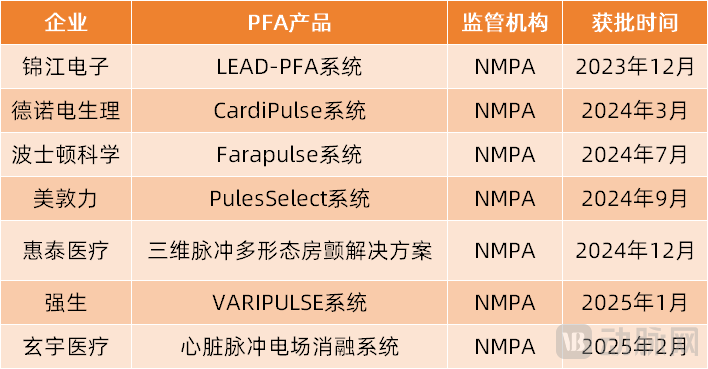
It should be noted that Huatai Medical’s disposable cardiac pulsed field ablation catheter is intended for use in conjunction with products from Hongtong Industrial and Apt Medical to treat drug-refractory, recurrent, symptomatic paroxysmal atrial fibrillation. Huatai Medical’s product is used for ablation at the pulmonary vein ostia and antra, while Apt Medical’s product is used for supplemental ablation.
In addition, domestic innovative enterprises such as AccuPulse Medical, Ruidi Biotech, MicroPort EP, Shangyang Medical, Maiwei Medical, Zhouling Medical, Xinhanglu Medicine, NorthXin Life, Jianhu Medical, and Xinlvtong have also laid out their PFA product portfolios, with smooth progress in product development. It is expected that more PFA products will be approved for marketing in the Chinese market in 2025.
Among these innovative PFA products, domestic brands and multinational giants each have their own advantages.
From the perspective of indications, the pulsed field ablation (PFA) products of companies such as Jinjiang Electronics, Denuo Electrophysiology, and Boston Scientific are primarily used for paroxysmal atrial fibrillation, whereas Medtronic’s PulseSelect system is indicated for both paroxysmal and persistent atrial fibrillation, offering a broader range of indications.
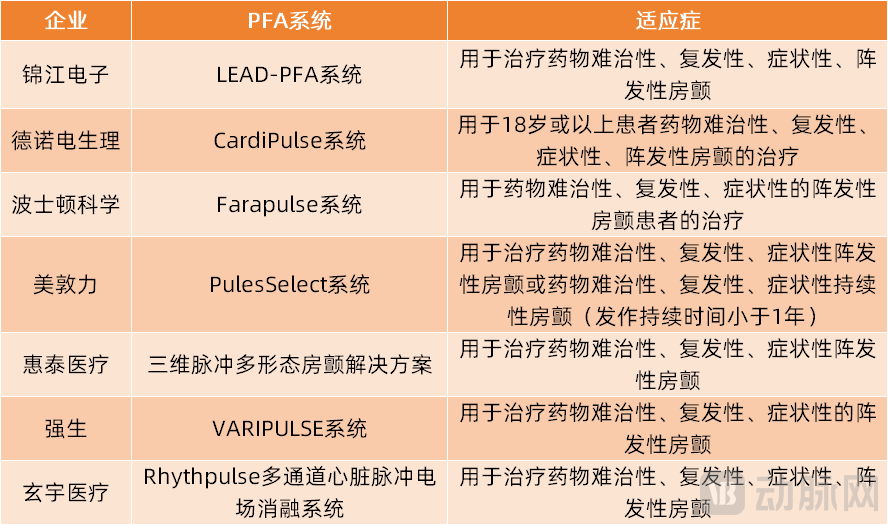
From a product perspective, Boston Scientific’s currently approved Farapulse system is primarily indicated for two-dimensional electrophysiology procedures. In China’s electrophysiology market, however, three-dimensional electrophysiology procedures have become the mainstream. According to a Frost & Sullivan research report, three-dimensional procedures accounted for 82.31% of cardiac electrophysiology procedures in China in 2021.
In this regard, multiple domestically produced innovative PFA products are compatible with 3D surgical procedures. For instance, Jinjiang Electronics’ LEAD-PFA Pulsed Field Ablation System seamlessly integrates with the LEAD-Mapping Magnetic-Electric Dual-Localization 3D Mapping System, enabling integrated modeling, mapping, and ablation. This integration shortens the learning curve and significantly reduces X-ray exposure, truly achieving green pulsed field ablation.
AccuPulse’s pulsed field ablation system, under the AccuMai brand, is compatible with its self-developed AccuCardia 3D cardiac mapping system, enabling both mapping and ablation with a single catheter. This 3D mapping system integrates the latest generation of magnetic-electric dual-location technology and ultra-high-density mapping technology.。
Innovative PFA products from companies such as Xuanyu Medical and Ruidi Biology are compatible with mainstream 3D mapping systems for cardiac electrophysiology. Notably, Xuanyu Medical’s RHYTHPULSE system features the world’s first ablation catheter with a 10-mm ring diameter, enabling a single discharge to fully cover an ablation area within a 10-mm diameter. This represents more than a threefold increase in ablation area per application compared to traditional point-by-point radiofrequency or pulse-field ablation catheters. The system is also equipped with an intelligent contact-force detection module that real-time monitors the contact status between the electrodes and myocardial tissue.
Ruidi Bio’s pulsed electric field ablation system employs advanced image processing technologies in three-dimensional navigation and contact visualization, providing clearer and more intuitive visual support for surgical procedures. The product also supports procedures under local anesthesia and is designed with physicians’ habits and needs in mind, featuring a simple and efficient workflow that reduces the learning curve and operational complexity.
Furthermore, Denovo EP’s single-use pulsed field ablation catheter for cardiac applications enables pulmonary vein isolation without reliance on three-dimensional mapping. The catheter features a flexible, transformable configuration (basket/petal) and is available in three diameter specifications to accommodate varying pulmonary vein anatomies. Guided by a guidewire during the procedure, the catheter can rapidly reach the pulmonary veins, thereby simplifying the operator’s workflow.
Notably, Johnson & Johnson’s Carto 3 three-dimensional cardiac mapping system holds a significant market share in the 3D electrophysiology market, and this product is compatible with J&J’s PFA product, the Varipulse system. This compatibility is expected to provide certain advantages for Johnson & Johnson’s product promotion.
As can be seen, in the PFA market, domestic brands and overseas giants each possess their own advantages. The electrophysiology market is also gradually transitioning from the era of radiofrequency ablation and cryoablation to the era of pulsed field ablation (PFA). In this new PFA era, multinational giants cannot fully carry forward their previous advantages. This will provide a more favorable market environment for the breakthrough and development of domestic brands.
Based on the above considerations and analysis, we predict that domestically produced PFA is poised for takeoff.
We thank companies such as Aikemai and Xuanyu Medical for their support of this article.