

Two Sessions Spotlight: These Medical Markets Are Set to Explode
The annual "Two Sessions" have kicked off, with the signals released during this period once again becoming a focal point of attention across all sectors, including healthcare.
Yesterday, among the ten major tasks for 2025 outlined in the “Government Work Report,” multiple items pertained to healthcare. Six key areas are directly related to healthcare: expanding the supply of diversified services such as health, elderly care, childcare, and domestic services as part of special initiatives to boost consumption; fostering future industries—including biomanufacturing, quantum technology, embodied AI, and 6G—while cultivating and strengthening emerging and future industries; and enhancing basic medical and health services, with a new proposal to establish a catalog of innovative drugs and support their development.
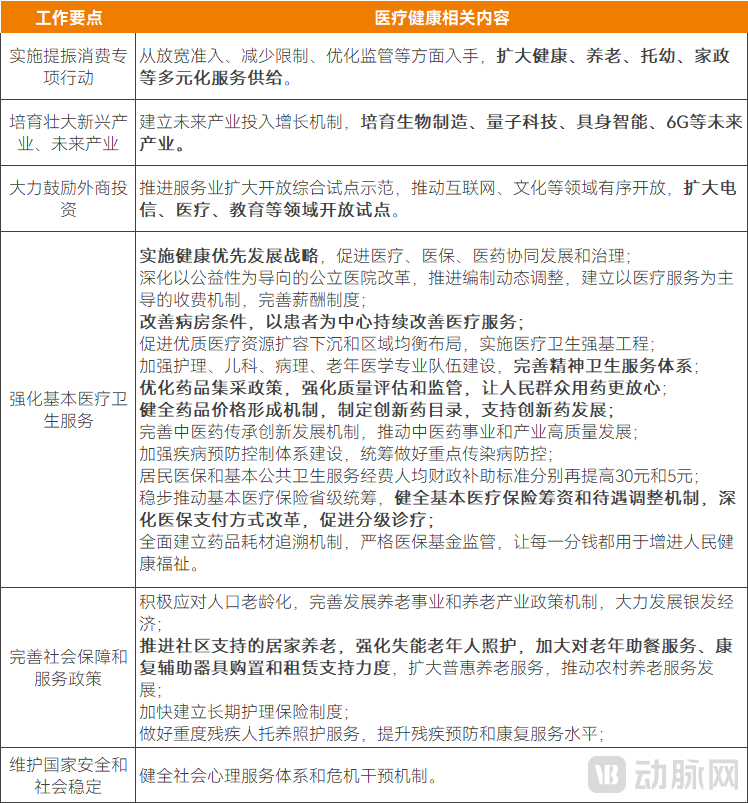
2025 “Government Work Report”: Healthcare-Related Tasks, Source: Xinhua News Agency
Furthermore, the government’s work tasks related to technological innovation and venture capital are also strongly correlated with healthcare. Examples include continuously advancing the “Artificial Intelligence Plus” initiative, supporting the widespread application of large language models, and improving support policies for the commercialization of scientific and technological achievements as well as market services.
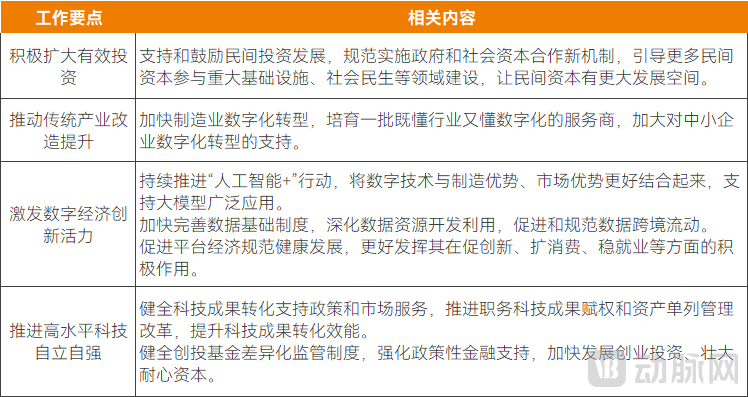
Healthcare-Related Tasks in the 2025 "Government Work Report," Source: Xinhua News Agency
Under the guidance of the key tasks outlined in the “Government Work Report,” several trend-driven sectors within the healthcare industry have become more clearly defined.
Since 2025, DeepSeek has sparked widespread attention across various industries toward large language models (LLMs). LLMs hold profound significance for the development of artificial intelligence, driving technological breakthroughs, lowering development barriers, and accelerating the deployment of AI across diverse industrial sectors.
Prior to this, the 2024 Report on the Work of the Government had already proposed for the first time the launch of the “Artificial Intelligence Plus” initiative.The 2025 “Report on the Work of the Government” mentioned the continued advancement of the “AI+” initiative and support for the widespread application of large models.
In the realm of healthcare, artificial intelligence sparked its first wave of enthusiasm in China starting from 2016–2017, and has since achieved substantial results.In clinical applications, according to VBInsight’s “2024 Medical Artificial Intelligence Research Report,” more than 160 imaging AI products have obtained Class III medical device certification in China. Imaging AI companies are gradually expanding beyond radiology departments into fields such as medical equipment and surgical assistance systems, unlocking a new market worth tens of billions of yuan. In healthcare services, artificial intelligence has been widely applied to triage, pre-consultation, health counseling, and report interpretation, enhancing service efficiency and improving the patient experience. Meanwhile, AI is also being actively explored for use in new drug development.
From the current landscape, since 2024–2025, large language models have ushered in the second wave of transformative change driven by artificial intelligence in the healthcare sector.According to incomplete statistics, over one hundred large language models have entered the healthcare sector. With the surging popularity of DeepSeek, medical institutions, healthcare enterprises, and regulatory authorities across various regions are increasingly integrating DeepSeek to leverage large language models for enhancing service delivery and management efficiency.
Not only during the National Two Sessions, but also in the preceding local Two Sessions, government work reports from multiple regions highlighted the integrated applications of artificial intelligence (AI) and large language models in healthcare. Some regions further advanced the “AI+” initiative by formulating special policies for “AI+ Healthcare,” thereby promoting the industrial implementation of AI with greater specificity.
For example, in March 2025, the “Action Plan for Accelerating the Innovative Development of ‘AI + Pharmaceutical and Healthcare’ (2025–2027) (Draft for Comment)” issued by Beijing Municipality stated that it would promote the research and development of large pharmaceutical and healthcare models, support innovative entities in jointly establishing key laboratories and technology innovation centers, and develop autonomous and controllable multi-scale foundational models for pharmaceuticals and healthcare at the molecular, cellular, and organ/system levels; it also encourages innovative pharmaceutical enterprises to conduct training of large pharmaceutical and healthcare models leveraging AI data training bases.
In November 2024, the “Shanghai Work Plan for the Development of Medical Artificial Intelligence (2025–2027)” pointed out the need to build an AI-driven drug discovery platform and establish a dry-wet iterative design platform for large-molecule biopharmaceutical large models. It also emphasized developing integrated automation technologies that combine large models with low-throughput wet-lab experiments, thereby achieving full-process automation of low-throughput wet-lab procedures—including plasmid construction, expression, purification, and performance testing—to accelerate product development.
Leveraging large language models, artificial intelligence is poised to contribute greater strength in clinical assistance and healthcare services, while also delivering more tangible value in basic research and drug development amidst the new wave of transformative change.
It is worth noting that the healthcare industry has its unique characteristics, and the application of artificial intelligence faces legal and regulatory red lines as well as ethical challenges.A typical case is that artificial intelligence can learn a vast amount of medical knowledge in a short period and make relatively accurate diagnoses for complex and difficult cases. It is uncontroversial that existing laws and regulations do not permit AI to conduct independent diagnoses. However, where exactly will the legal and ethical boundaries between AI and human physicians lie in the future? This requires continuous exploration through practice and inquiry.
Furthermore, the 2025 Report on the Work of the Government addressed 6G for the first time, proposing to establish a growth mechanism for investment in future industries and to foster such industries, including 6G.
Previously, 5G’s support for high-definition image transmission and real-time data sharing has enhanced the timeliness and accuracy of telemedicine.In the future, with the deployment of 6G, ultra-high-precision telemedicine will become a reality, and 6G will also serve as infrastructure to facilitate further leaps in medical artificial intelligence.
“Vigorously boost consumption, improve investment efficiency, and comprehensively expand domestic demand” is the top priority among the ten major tasks outlined in the 2025 Government Work Report, including the implementation of special initiatives to stimulate consumption and the active expansion of effective investment. Among these,We will expand the supply of diversified services in health, elderly care, childcare, and domestic work by relaxing market access, reducing restrictions, and optimizing regulation.
Fundamentally, boosting consumption encompasses two aspects: one is to stimulate consumer willingness to spend, and the other is to optimize the supply of goods and services and improve the consumption experience.
In 2024, the trade-in subsidy policy, with a total value of up to RMB 300 billion, yielded significant results in boosting consumer willingness. Certain physical products, represented by home-use medical devices, directly benefited from this initiative, while medical equipment manufacturers also secured successive orders under large-scale equipment renewal programs. In 2025, the subsidy policy will continue, further enhancing consumer willingness and placing greater emphasis on increasing high-quality supply and improving the consumption environment, with health-related consumption being no exception.
In February 2025, the Three-Year Action Plan for Optimizing the Consumer Environment (2025–2027), jointly issued by the State Administration for Market Regulation and four other departments, also proposed toCreate more consumption scenarios, focusing on digital consumption, green consumption, and health consumption to build new types of consumption scenarios.
The concept of health consumption is broad. In a general sense, apart from medical services that are primarily public-welfare oriented or focused on disease treatment, all other healthcare products and services can be regarded as part of health consumption.
Therefore,Across the healthcare industry, in addition to physical products, many health service consumption categories are seizing opportunities amid initiatives to boost consumer spending.
For example, with the implementation of centralized procurement for dental implants and intraocular lenses, service volumes in dentistry and ophthalmology have rapidly increased, enabling private medical institutions to acquire a large number of patients. These institutions can leverage this opportunity to provide patients with diversified, preventive, and high-quality services.
Currently, there is a strong demand for mental health services, yet professional resources remain scarce. Empowered by digital technologies, novel mental health services can achieve better integration with psychiatric diagnosis and treatment, seamless connectivity with smart devices, and personalized patient support, thereby delivering services that provide a greater sense of benefit and satisfaction.
In recent years, the demographic receiving Traditional Chinese Medicine (TCM) services has become increasingly younger. Beyond leveraging its strength in "preventive treatment of disease," TCM can also integrate more deeply into the consumption scenarios of younger populations.
The “silver economy” has long become a buzzword in the industry. As population aging deepens, health services in home-based elderly care settings—such as in-home nursing and rehabilitation, remote monitoring, and chronic disease management—are becoming increasingly urgent. Services that offer both accessibility and cost control have greater potential for growth.
Internet-based medical services integrate online and offline resources, providing users with seamless, end-to-end healthcare services. With strong platform characteristics, they serve as connectors for stakeholders across the medical, pharmaceutical, diagnostic, and insurance sectors, and can even be regarded as a pivotal hub in the health consumer market, underscoring their significant value.
Furthermore, consumer services in sectors such as physical examinations and dermatology, along with health products including foods for special medical purposes (FSMP) and nutritional supplements, are also poised to benefit from initiatives aimed at boosting consumption.
Following 2024, the 2025 Government Work Report continues to vigorously encourage foreign investment and expand pilot programs for opening up sectors such as telecommunications, healthcare, and education. Under this trend, medical resources introduced by foreign investors will help elevate domestic medical technology standards, meet patients’ diversified demands for high-end healthcare and specialized services, and inject new vitality into the health consumption market.
Overall,As public health awareness continues to strengthen, the health consumer market will continue to expand and innovate, offering consumers more diversified and personalized choices.
Innovative Drugs: The Payment Bottleneck Is About to Be Broken
From late 2024 to early 2025, a discussion on the quality of drugs included in the centralized procurement program unfolded online. This year’s Government Work Report proposed: “Optimize policies for centralized drug procurement, strengthen quality assessment and supervision, and ensure that the public can use medications with greater confidence.” This constitutes a timely response to a prominent social concern.
Equally garnering significant attention alongside volume-based procurement (VBP) drugs and generic drugs is the current state and future prospects of innovative drugs.
For innovative drugs, one end concerns public welfare, determining whether patients can timely access new and effective medicines that address clinical challenges; the other end concerns the industry, determining whether innovative enterprises can obtain reasonable returns, recoup R&D costs, and reinvest in new rounds of research and development. The pricing and reimbursement systems for innovative drugs are a critical link in achieving balance between these two ends.
Since the launch of China’s review and approval system reform, the innovation journey for drugs and medical devices has reached a significant milestone, ushering in a harvest period. A wave of new drugs has been launched, put into clinical use, and even included in the National Reimbursement Drug List (NRDL). According to data from the National Healthcare Security Administration, 835 new and high-quality drugs have been added to the NRDL over the past seven years. Last year alone, 38 “global-first” innovative drugs were newly included, setting a record high.
However, as the basic medical insurance fund is positioned to “cover essential needs,” its reimbursement scope is limited; therefore, innovative drugs require diversified payment channels. The establishment and sustainability of such diversified channels first necessitate an inclusion list.
Following the initial mention of innovative drugs in 2024, the 2025 Government Work Report further clarified the need to improve the drug price formation mechanism, establish a catalog of innovative drugs, and support the development of innovative drugs.
In early 2025, the National Healthcare Security Administration (NHSA) also revealed its plan to release the first edition of the Class C Drug List within the year. The Class C List primarily focuses on drugs that exhibit a high degree of innovation, possess substantial clinical value, and deliver significant patient benefits, but are temporarily excluded from the Basic Medical Insurance Directory due to their deviation from the “basic coverage” mandate. To facilitate implementation, the NHSA will explore optimizations and adjustments to payment management policies. For drugs included in the Class C List, they may be excluded from the calculation of patients’ out-of-pocket expense ratios and from monitoring scopes for substitutable varieties selected through centralized procurement. Additionally, eligible cases involving these drugs may be exempted from diagnosis-related group (DRG) payment schemes and instead reimbursed under a fee-for-service model.
The aforementioned plan not only lays the groundwork for exploring diversified payment models for innovative drugs, but also provides greater assurance for their effective implementation and use within hospitals.
As a crucial component of the multi-tiered medical security system, commercial health insurance will also usher in a window for differentiated development, driven by the inclusion of innovative drugs in coverage formularies.
In the past, traditional health insurance products largely mirrored the national medical insurance reimbursement catalog. Their supplementary role within the healthcare security system was primarily limited to secondary expense reimbursement, which did alleviate some financial burdens for policyholders. However, the critical issue lies in the fact that conditions or treatments excluded from national medical insurance coverage were often also excluded from commercial health insurance, or covered only to a very limited extent. In short, there was significant overlap between conventional health insurance and the “basic coverage” provided by national medical insurance, while protection beyond the scope of national medical insurance remained inadequate.
The Class C Drug List, dominated by innovative drugs, primarily aligns with commercial health insurance. This list will decouple health insurance from its strong reliance on the National Reimbursement Drug List (NRDL), fostering differentiated development alongside basic medical insurance and establishing a more distinct market positioning.
At the National Healthcare Security Work Conference held in December 2024, the National Healthcare Security Administration made multiple references to commercial health insurance. In addition to the Class C drug list, it also stated:Guide commercial insurance companies to increase investment in the research, development, and production of innovative drugs and medical devices by allocating a portion of health insurance funds through regulated channels.The healthcare security authorities will explore initiatives in areas such as data sharing, the use of individual accounts, expense settlement, and combating insurance fraud and deception.Engage in higher-level collaboration with commercial insurance companies that invest real capital to support innovative drugs and medical devices.
In the past, commercial health insurance faced significant challenges in product design, pricing, and risk control due to a lack of integration with and support from medical data. By leveraging the support of healthcare security departments in areas such as data, settlement, and risk control, health insurance can better achieve differentiated positioning relative to basic medical insurance and enhance the claims experience. Of course, third-party service providers will also play a substantial role in the transformation of the health insurance sector.
The 2025 Government Work Report also pointed out that,We must improve policies supporting the commercialization of scientific and technological achievements and enhance market-based services; accelerate the development of venture capital and expand the pool of patient capital.
As China’s healthcare innovation and venture capital sector completes its first decade-long cycle, industry attention has extended to the application and payment segments. Nevertheless, it is undeniable that tapping into sources of innovation remains a top priority; high-quality transformation of scientific and technological achievements, along with venture capital investment, continues to serve as the sustained driving force for innovation-driven development in healthcare.
The translation of scientific and technological achievements in the healthcare sector has long faced numerous challenges, including a lengthy commercialization chain with insufficient systemic support, a shortage of specialized talent and service agencies, fragile funding chains and financing difficulties, and a disconnect between technology and market demands. On the industry side, projects featuring original or global innovation are extremely scarce; for high-quality projects, investment institutions compete fiercely yet struggle to secure access, while other projects receive little attention.The past two years have been widely recognized within the industry as a “capital winter,” and these phenomena have become even more pronounced during this period. The numerous asymmetries underscore that high-quality technology transfer services and venture capital services remain essential needs for the industry.
The Government Work Report delivered during the Two Sessions also outlined other new priorities in healthcare, including the establishment of a fee-for-service mechanism centered on medical services and the comprehensive implementation of traceability systems for pharmaceuticals and medical consumables. Viewed holistically alongside the aforementioned points, these measures provide a systematic roadmap for the development of the healthcare industry in the coming year. As these new tasks are implemented, all industry stakeholders will serve not only as executors but also as beneficiaries of these new initiatives.