

Global First: Yizhun Intelligence Secures World's First Class III NMPA Approval for Dynamic Breast Ultrasound AI

MEDICAL AI
AI-Assisted Medical Imaging Diagnosis System Developer
Since the first auxiliary diagnostic software incorporating deep learning gained market access in 2020, the National Medical Products Administration (NMPA) has successively approved hundreds of Class III medical device registrations for imaging AI, covering nearly all types of imaging equipment and the vast majority of high-volume diseases.
However, all approved AI systems are used for analyzing static images.Dynamic Imagingare not included in this category.
Until recently, under MEDICAL AIBreast Ultrasound Imaging Computer-Aided Detection SoftwareApprovedClass III Medical DevicesReview and approval have finally broken the silence.

Screenshot of MEDICAL AI's Breast Ultrasound Imaging Auxiliary Detection Software Approval
It is reported that this certificate is not only the first Class III medical device registration certificate for AI-assisted diagnosis in breast ultrasound in China, but alsoThe World's First Class III Certificate for Dynamic Imaging AI。
From “2D” to “3D” and then to “dynamic imaging,” AI in medical imaging has set its sights on new frontiers.
Compared with imaging examinations such as CT and MRI, ultrasound examination is radiation-free, has a wide range of indications, and enables dynamic observation and real-time dynamic comparison of images, making it particularly suitable for organs that are in constant motion, such as the heart.
However, ultrasound examination is highly dependent on the operator's technique and diagnostic experience. Incomplete procedures and limited cognitive assessment may lead to diagnostic conclusions that significantly deviate from the correct diagnosis.
By leveraging AI technology to empower ultrasound examinations, it is theoretically possible to effectively mitigate issues of missed and misdiagnoses, serve as an effective supplement to medical resources, help physicians shorten their learning curves, and enhance the diagnostic capabilities of doctors at all levels. Meanwhile, AI learns and replicates the diagnostic reasoning of ultrasound experts, enabling rapid identification of all imaging slices containing lesions. This provides a basis for the diagnosis and treatment of complex diseases, thereby informing subsequent therapeutic strategies.
However,The R&D of ultrasound AI products inherently presents certain challenges.. Especially in the process of “transitioning from static to dynamic,” numerous technical bottlenecks must be overcome.
First, training ultrasound AI requires high-quality imaging data. In real-world scenarios, due to differences in the browsing, processing, and storage practices for ultrasound images, such data is more difficult to obtain, less standardized, and harder to acquire compared to radiological imaging data such as CT scans.
The difficulty of acquiring ultrasound images depends on the sonographer's operational techniques and the specific models of ultrasound equipment. It requires a highly competent expert team to clean and analyze these data, which poses a challenge to corporate cost control.
Meanwhile, the acquisition of imaging data from CT, MRI, and DR is performed by radiologic technologists, who then submit the images to radiologists for interpretation; during this process, AI analyzes static images.
, the difficulty of data acquisition and AI processing is relatively low. Ultrasound examinations require simultaneous image acquisition and interpretation. During the data acquisition phase, physicians must assist in lesion identification and collect dynamic imaging data, which presents corresponding challenges.
Secondly, for algorithms, this is equivalent to adding a temporal dimension to conventional two-dimensional image processing. This not only requires technology innovators to design new image processing algorithms but also necessitates careful consideration of computational power to reduce the hardware requirements of the algorithms. If the algorithm is overly complex, processing speed will be significantly reduced; if computational capacity fails to meet the required standards, the algorithm will struggle to process real-time imaging data consisting of dozens or even hundreds of frames.
Therefore, ultrasound AI is not developer-friendly. It requires innovators to bear the costs of algorithm development and data collection, while also overcoming risks related to insufficient real-time performance, dynamic processing capabilities, and accuracy. Consequently, the pace of innovation in ultrasound AI (particularly dynamic AI) lags behind that of other imaging AI modalities in the market.
Challenges in Market Access Are Similar to Those in R&DWith the introduction of the temporal dimension, the diagnostic logic of dynamic AI ultrasound has shifted from static image recognition to dynamic, real-time video analysis. This transition significantly increases the volume of data processed, thereby escalating the challenges in risk management, dataset construction, and clinical trials, which in turn necessitates changes in the regulatory review logic and guidelines for medical devices.
To circumvent market access restrictions, existing AI-powered ultrasound systems on the market typically adopt a technical approach based on static image recognition, following a logic similar to that of CT scanners for lesion identification. One category involves plane analysis; for instance, the AI embedded in Samsung ultrasound devices can identify and save key imaging planes containing lesions, allowing physicians to review them after the ultrasound examination is completed. Under this model, while the AI itself does not provide diagnostic assistance, it bypasses the cumbersome clinical trial process.
Another category involves comprehensive cross-sectional analysis across the entire duration of lesion presence, enabling AI-assisted diagnosis. However, this approach has certain limitations in practice. Although it can analyze each cross-section containing lesions, the cross-sections are not interrelated; consequently, some frames may fail to capture the lesions during actual application, posing a risk of missed diagnoses.
Nowadays, MEDICAL AI’s breast ultrasound imaging auxiliary detection software, which provides AI-assisted diagnosis based on “dynamic imaging,” effectively circumvents the aforementioned issues. It not only enables AI-based assisted diagnosis but also ensures the continuity, real-time performance, and logical coherence of the entire diagnostic process. Clinical data indicate that the AI’s capability in detecting and analyzing dynamic real-time ultrasound images is largely comparable to that of mid- to senior-level sonographers. Thus, the integration of physicians and AI can effectively reduce missed diagnoses and misdiagnoses in ultrasound detection and interpretation.
Under the constraints of R&D and market access, most ultrasound AI products that have passed the review and approval of the National Medical Products Administration (NMPA) are currently classified as Class II medical devices. Some equipment manufacturers, such as Mindray, Samsung, and Sonoscape, have integrated AI directly into their devices to optimize diagnostic workflows and have submitted applications for direct approval to the NMPA.
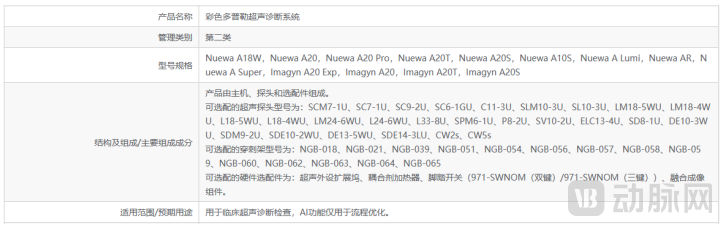
Mindray Medical's Approved "Color Doppler Ultrasound Diagnostic System": AI Applied to Process Optimization
In the category of Class III medical devices, only two products have achieved breakthroughs: Deshang Yunxing’s “Ultrasound Imaging Software for Auxiliary Diagnosis of Thyroid Nodules” and MEDICAL AI’s “Ultrasound Imaging Software for Auxiliary Detection of Breast Lesions.” These are used for ultrasound examination of the thyroid and breast, respectively, with the former enabling static detection and the latter facilitating dynamic monitoring. Additionally, in overseas markets, Caption Health (acquired by GE Healthcare in February 2023) offers AI-based cardiac ultrasound examinations, 2D transthoracic echocardiography analysis, and ejection fraction calculation, all of which have received FDA approval.
For startups engaged in ultrasound AI R&D, delayed technical validation presents both opportunities and challenges.
In terms of usage frequency, the volume of ultrasound examinations exceeds that of other imaging modalities such as DR, CT, and MRI, reaching 2 billion procedures annually by 2018. However, the intensity of AI competition in this sector remains relatively low, with primary participants being startups and ultrasound equipment manufacturers. Under the prevailing trend of AI-assisted diagnosis becoming mainstream, startups such as MEDICAL AI and Deshang Yunxing will gain significant strategic flexibility in their commercial pathways after successfully navigating market access requirements.
On the one hand, approval from the National Medical Products Administration (NMPA) helps certified companies open up sales channels and models, enabling direct commercial conversion. On the other hand, it allows them to engage in deeper collaborations with medical imaging equipment manufacturers, rapidly achieving intelligent upgrades of imaging devices and large-scale coverage across healthcare institutions.
From the perspective of application scenarios, there are numerous unmet needs for ultrasound AI in both tertiary hospitals and primary healthcare institutions across China.
Taking primary healthcare as an example, there are nearly 900,000 relevant institutions in China. They urgently need AI to improve key metrics such as “detection rate,” “accuracy,” and “efficiency,” while also requiring quality control processes to monitor ultrasound examinations, addressing issues like incomplete data acquisition and unclear images. Furthermore, ultrasound AI companies can engage in medical talent training programs to support the high-quality development of primary healthcare professionals.
Some physicians have stated that AI-empowered ultrasound, which dynamically and in real time assists clinicians in detecting and analyzing lesions, provides sonographers with a “second pair of eyes.” This represents a beneficial enhancement to the ultrasound detection and diagnostic capabilities of primary healthcare institutions.
Returning to tertiary hospitals. Ultrasound AI startups can also continue to focus on specialized ultrasound, serving multiple clinical departments such as cardiology, obstetrics and gynecology, and surgery, to meet complex diagnostic needs.
For instance, ultrasound image navigation can provide precise craniotomy sites and lesion localization, as well as assist in formulating surgical plans, thereby becoming an important tool for minimally invasive neurosurgery, particularly “keyhole” procedures. The foundation for improving the quality of neurosurgical operations and reducing collateral damage lies in accurate localization. In breast surgery, the use of ultrasound can enhance the efficacy of breast-conserving surgery, significantly reducing tumor residual rates, re-excision rates, and the volume of resected specimens.
In the field of anesthesiology, AI applications are primarily focused on scenarios such as ultrasound-guided vascular puncture, nerve blocks, and intraoperative transesophageal echocardiography (TEE), aiming to enhance the safety of anesthetic procedures and the accuracy of organ function assessment. This differs from diagnostic ultrasound; in those contexts, AI facilitates trauma assessment, image registration/fusion, system quality assurance, scanning assistance, and Doppler noise suppression.
Additionally, some companies are promoting the clinical implementation of AI-powered ultrasound in musculoskeletal applications, providing precise diagnostic support for physicians, avoiding nerve injury, and significantly improving surgical success rates.
Overall, the ultrasound AI sector is characterized by limited corporate participation and a wide range of applicable scenarios, with most areas remaining blue oceans.
With the continuous advancement of ultrasound AI, automated image quality assessment, image standardization, image segmentation, automatic measurement, computer-aided diagnosis, and surgical navigation can all leverage AI integration to enhance quality and efficiency. Ultrasound AI holds significant potential in each of these areas.
Now that MEDICAL AI’s dynamic breast ultrasound detection system has received regulatory approval, its significance extends beyond establishing an effective commercialization pathway for the company itself. It also sets a benchmark for numerous other dynamic AI-powered ultrasound applications that have yet to gain market access, thereby driving the development of the entire medical AI ultrasound industry.
In the coming years, we may witness the emergence of more ultrasound AI companies and the market entry of additional ultrasound AI applications, driving ultrasound equipment comprehensively into the era of digital intelligence.