Multiple New Transdermal Patches Approved, Reshaping Market Landscape with Retail Channels as Key Growth Driver
A “Plaster Patch” Hides a Big Business.
Currently, the types of patches available in China are predominantly traditional Chinese herbal plasters, with generic chemical drug patches accounting for only a small minority. On the other hand, domestic patch consumption is quite substantial; data indicates that annual patch consumption in China exceeds 10 billion units, far surpassing the markets in Japan and the United States.
Constrained by factors such as raw materials, manufacturing processes, and regulatory policies, the number of domestically produced chemical drugs has been limited in recent years. Previously, only a handful of modern transdermal patches from companies such as Tide Pharmaceutical, Jiudian Pharmaceutical, and Lingrui Pharmaceutical were marketed in China. In particular, for the two major analgesic varieties—flurbiprofen cataplasms and loxoprofen sodium patches—no new products have been launched since the approval of the first generic versions.
However, since the beginning of 2025, multiple products in these two major categories have received approval, signaling a loosening of regulatory controls. In just the first two months of 2025, 17 chemical drug patches were submitted for marketing approval, nearly equivalent to the total for the entire year of 2022. Coupled with the 51 products that submitted applications in 2024, this market is poised for significant transformation. Given the pronounced consumer-oriented nature of these patches, the out-of-hospital market will become the key battleground. Those who seize opportunities in this wave will dominate this emerging market.
Completing the BE study is enough to pass; the market is about to undergo a major shakeup.
After Leming Pharmaceutical received marketing approval in January upon “completion of bioequivalence (BE) studies,” the regulatory floodgates for loxoprofen sodium cataplasm were suddenly opened. Within just three working days after the Spring Festival, products from Beijing Tide and Nanjing Haina Pharmaceutical were also approved in succession. The market landscape, previously dominated solely by Jiudian Pharmaceutical in this category, has now been broken.
Another major analgesic product on the market, flurbiprofen cataplasm, has also welcomed competitors. The Class 4 generic drug application for flurbiprofen cataplasm submitted by Wuhan Pharmastar Pharmaceutical was recently approved. In addition, similar products from several other companies, including Wango Pharmaceutical and Fuyuan Pharmaceutical, are currently under review and approval.
Notably, Beijing Tide’s Deshuping is currently the only loxoprofen sodium cataplasm approved for marketing that has passed the consistency evaluation and been validated through clinical trials. Other products were approved based solely on bioequivalence (BE) studies without completing full clinical trials, which to some extent reflects a shift in the regulatory attitude of the drug administration authorities toward cataplasms.
Prior to this, obtaining approval for cataplasm patches was a significant challenge, with many companies’ marketing applications being rejected. At that time, most companies typically conducted only bioequivalence (BE) studies using plasma drug concentration as the endpoint, rather than clinical trials based on therapeutic efficacy. A prevailing view within the industry held that plasma drug concentration is not strongly correlated with the actual local therapeutic effect of the drug, meaning that BE studies could not demonstrate product efficacy. Consequently, the previous consensus in the industry was that cataplasm patches required comprehensive clinical trials.
In its 2022 “Technical Guidelines for Clinical Trials of Topically Administered Drugs with Local Action,” the Center for Drug Evaluation (CDE) relaxed clinical requirements for generic chemical drug patches and plasters. However, it was not until Leming Pharmaceutical’s product received approval that the implementation of this policy was conclusively demonstrated, indicating a relative lowering of entry barriers in this therapeutic area.
This market is on the eve of transformation.
Anti-inflammatory and analgesic effects are the primary application scenarios for transdermal patches.
A comparison of the domestic and international transdermal patch markets reveals that China’s market is dominated by traditional Chinese medicine plasters, while newer formulations—primarily chemical drug cataplasm gels—account for a relatively small share. According to a research report by Tianfeng Securities, the penetration rate of topical plasters in the anti-inflammatory and analgesic field in China is less than 10%, significantly lower than the 50%–70% penetration rate observed in the Japanese market, indicating substantial room for growth.
Taking flurbiprofen cataplasm, a major product in China’s domestic chemical drug cataplasm market, as an example, its originator is Mikasa Pharmaceutical Co., Ltd. of Japan. It was introduced into the Chinese market by Tide Pharmaceutical Co., Ltd. through a sales model characterized by “imported originator products with domestic repackaging.” Subsequently, Tide Pharmaceutical launched its generic version of flurbiprofen cataplasm, which rapidly captured over 80% of the market share, becoming a classic case of generic substitution for the originator product.
In 2023, flurbiprofen cataplasms generated nearly RMB 2.9 billion in sales. According to the 2024 semi-annual report of China Biopharmaceutical, the flurbiprofen cataplasms produced by its subsidiary, Tide Pharmaceutical, achieved breakthrough growth in the first half of 2024, building on the strong momentum seen in 2023.
Such market performance has naturally attracted the participation of multiple manufacturers; however, since Tede Pharmaceutical, no second generic flurbiprofen cataplasm has been approved for marketing in China. According to incomplete statistics, approximately 13 product listing applications were rejected between 2020 and 2024. It was not until late January 2025 that Wuhan Pharmastar Pharmaceutical’s flurbiprofen cataplasm received approval, becoming the second domestically produced product to be approved. Notably, products from several other companies, including Wango Pharmaceutical, Leming Pharmaceutical, Bio-Pharmaceutical, Fuyuan Pharmaceutical, Pudao Medicine, and Sailike Pharmaceutical, are still under review.
The development trajectory of another major analgesic product, loxoprofen sodium gel patch, is also quite similar.
Loxoprofen Sodium Cataplasms, used for anti-inflammatory and analgesic purposes, were originally developed by Japan’s LEAD CHEMICAL and marketed by Daiichi Sankyo, entering the Chinese market in 2014. Jiudian Pharmaceutical’s Loxoprofen Sodium Cataplasms received approval for launch after undergoing formulation improvements based on the original product. According to the company’s financial reports, sales of Jiudian Pharmaceutical’s Loxoprofen Sodium Cataplasms reached RMB 849 million (a year-on-year increase of 104.15%), RMB 1.303 billion (a year-on-year increase of 53.54%), and RMB 1.547 billion (a year-on-year increase of 18.70%) in 2021, 2022, and 2023, respectively.
With the sequential approval of loxoprofen sodium gel patches from Leming Pharmaceutical, Tide Pharmaceutical, and Haina Pharmaceutical, Jiudian Pharmaceutical’s previously dominant market position has been broken, leading to a continuous decline in its stock price. In response, Jiudian Pharmaceutical stated that it would address the situation through both product and sales dimensions.
In terms of products, Jiudian Pharmaceutical expects nearly 10 products to be approved in the next two years. Regarding sales, while continuing to strengthen in-hospital sales, the out-of-hospital market will become a key channel for expansion. Currently, Jiudian Pharmaceutical has formulated a new sales strategy, increasing resource allocation to the out-of-hospital market and focusing on building brand awareness to enhance its market influence in the field of transdermal drug delivery.
Currently, due to a late start, the domestic market for such products is dominated by generic drugs, making it challenging to establish differentiated product advantages. However, industry pioneers can offer valuable insights for sales strategies.
Although transdermal drug delivery systems are still in their early stages of development in China, they have been evolving for decades abroad.
Taking Japan as an example, despite having a population of less than 200 million, the country is home to more than 50 manufacturers of transdermal drug delivery formulations. Currently, Teikoku Seiyaku and Hisamitsu Pharmaceutical are the industry leaders. According to data released by Hisamitsu Pharmaceutical, annual sales of non-steroidal anti-inflammatory drug (NSAID) transdermal formulations in Japan have remained at approximately 5 billion patches per year in recent years, with transdermal patches constituting the majority and hydrogel formulations accounting for a relatively smaller share.
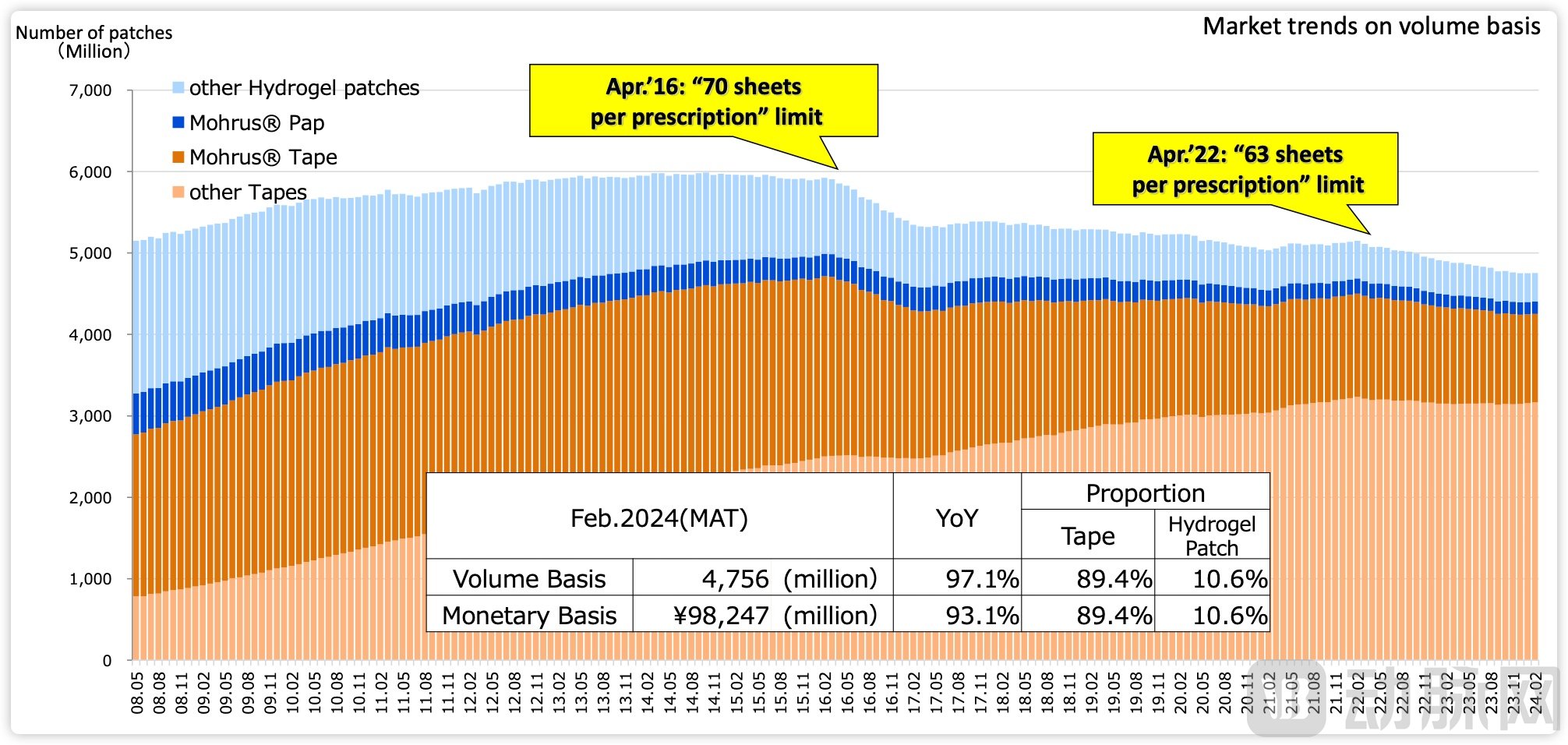
Market Size of Transdermal Patches in Japan, Source: Company Official Website
Hisamitsu Pharmaceutical has expanded into new therapeutic areas based on its transdermal patch technology, starting with topical anti-inflammatory and analgesic treatments and gradually extending to systemic analgesia, menopausal disorders, and postmenopausal osteoporosis. In terms of financial performance, its core revenue still comes from topical anti-inflammatory and analgesic products.
According to the company’s annual report, Hisamitsu Pharmaceutical’s top-selling product in fiscal year 2024 was Salonpas, used for relieving muscle and joint pain, which captured nearly 40% of the market share for topical analgesic patches in Japan. Meanwhile, Hisamitsu Pharmaceutical is actively expanding into European and American markets.
Notably, over-the-counter (OTC) drug revenue accounts for nearly half of Hisamitsu Pharmaceutical’s total revenue, indicating that the out-of-hospital retail market is a key strategic focus.
Such a high market share indicates that the company has made significant efforts in channel development. Hisamitsu Pharmaceutical has not only established partnerships with 5,000 healthcare institutions but also collaborated with more than 30,000 retail pharmacies and drugstores across Japan, creating an extensive distribution network. On the other hand, Hisamitsu is actively embracing new changes by initiating its digital transformation.
Leveraging digital technologies, Hisamitsu Pharmaceutical has initiated organizational restructuring and business transformation, while vigorously cultivating relevant talent to expand new sales channels. In addition to traditional media, the company has increasingly invested in online marketing. According to data from DCF Modeling, Hisamitsu Pharmaceutical has allocated approximately $10 million to online marketing in recent years. In 2023, online sales accounted for 15% of the company’s total revenue, while consumer-facing website traffic increased by 25%.
Furthermore, Hisamitsu Pharmaceutical has spared no effort in building its brand image. On one hand, the company collaborates with over 100 healthcare organizations through sponsorships or other forms of partnership; on the other hand, it participates in multiple international healthcare conferences to increase brand exposure.
As previously mentioned, Salonpas holds nearly 40% of the market share in Japan, a success largely attributable to Hisamitsu Pharmaceutical’s long-term localized marketing strategies. These include active participation in community health initiatives and providing health education and various activities for elderly residents. In addition to targeting the elderly demographic, Hisamitsu Pharmaceutical is also committed to fostering shared growth experiences with younger generations through diverse sports events.
For instance, by constructing stadiums for concerts, sporting events, and exhibitions; sponsoring various youth sports activities and providing health services, or even organizing youth sports competitions; while also offering diverse forms of support to local young athletes. Over time, corporate products subtly capture the minds of young users, creating a moat that is arguably the most difficult for late entrants to cross.
Of course, what deserves even more attention is Hisamitsu Pharmaceutical’s open attitude toward localized implementation in overseas markets.
For instance, given the greater complexity of the Chinese market compared to the Japanese market, it is clearly impractical to establish all distribution channels independently. Hisamitsu Pharmaceutical has entrusted Chaoqi E-commerce with integrated, refined brand operations, authorizing it to sell Hisamitsu’s Japanese-made over-the-counter topical anti-inflammatory and analgesic patches and other products through its Tmall Flagship Store, JD.com Flagship Store, Tmall Global Flagship Store, JD.com Global Flagship Store, and Alibaba Pharmacy.
On the other hand, operators have invested in building infrastructure for emerging interest-based e-commerce channels to address brands’ weaknesses. From establishing self-owned live-streaming bases and equipping them with professional live-streaming teams, to providing support through industry policy insights, strategic product selection and portfolio management, segmented audience operations, and multi-scenario interactive marketing, they help brands rapidly achieve a breakthrough from scratch in the live-streaming sector, enabling them to gain broader market visibility and stand out.
According to data from Mojing Insights, Hisamitsu Pharmaceutical topped the 2024 Tmall Global OTC Brand Ranking with sales revenue of RMB 500 million. In the 2024 Tmall Global OTC Store Ranking, in addition to the top three stores—Ali Health Pharmacy Overseas Store, Tmall Global Self-Operated Global Super Store, and Tmall Global Health Research Lab—the fourth- and fifth-ranked UURMI Overseas Flagship Store and HABALAN Overseas Flagship Store saw year-on-year sales growth of 112.7% and 358.8%, respectively. Their best-selling brand was also Hisamitsu Pharmaceutical.
Furthermore, on precision-targeted platforms such as Xiaohongshu (Little Red Book), various influencer-endorsed posts promoting Hisamitsu Pharmaceutical’s topical anti-inflammatory and analgesic patches have enabled the product to successfully break through to a broader audience.
Currently, by embracing an open attitude and implementing multi-channel market entry strategies, Hisamitsu Pharmaceutical has expanded its product sales to more than 30 countries worldwide, establishing a significant presence in North America, Europe, and Asia. Domestic companies can draw valuable insights from this approach.
New product approvals are queued, with market changes imminent.
According to data from the National Medical Products Administration (NMPA), as of March 6, 2025, marketing authorization applications had been accepted for 17 transdermal patches, whereas only 22 products were submitted throughout the entire year of 2022. Notably, 51 products were submitted in 2024 alone, indicating that the market is poised for significant changes in the foreseeable future.
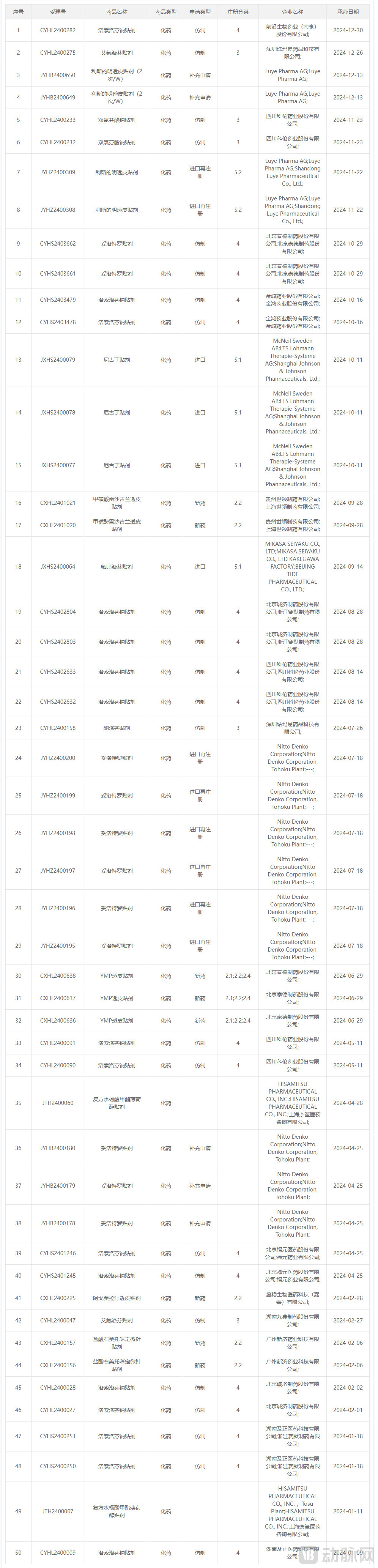
2024 Application List, Source: CDE
In terms of product portfolio, in addition to the two existing flagship products—flurbiprofen cataplasms and loxoprofen sodium cataplasms—new drugs are expected to receive approval in succession. Jiudian Pharmaceutical, which has lost its exclusive category status, stated during institutional investor surveys that it anticipates approvals in 2025 for indomethacin cataplasms, flurbiprofen cataplasms, lidocaine cataplasms, and loxoprofen sodium patches. In 2026, the company expects approvals for ketoprofen patches, flurbiprofen patches, crisaborole ointment, diclofenac diethylamine emulgel, and tetracaine hydrochloride gel.
Ted Pharmaceutical has taken a step further. In February, its tulobuterol patch, developed by Ted Pharmaceutical, received marketing approval from the National Medical Products Administration (NMPA). It is indicated for the relief of dyspnea and other symptoms associated with airway obstructive diseases such as bronchial asthma, acute bronchitis, chronic bronchitis, and emphysema. As the first domestically produced tulobuterol patch to be approved for marketing, it breaks the nearly 18-year market exclusivity held by the originator drug.
Transdermal technology has undergone three generations of iteration. The first generation relied heavily on the intrinsic properties of the drug, limiting candidates to those with low molecular weight, lipophilicity, and low dosage. The second generation employed penetration enhancement techniques, enabling hydrophilic drugs to permeate the skin. The third generation leverages technologies such as microneedles, ultrasound, and microdermabrasion, allowing even macromolecular drugs and vaccines to be delivered transdermally. Advances in penetration enhancement technologies have improved the ability of drugs to cross the skin barrier, facilitating the development of a broader range of pharmaceuticals into transdermal patches.
In the current global market, products such as Novartis’ Transderm-Nitro for angina prevention and reduction of myocardial infarction risk, Dong-A ST’s Bisono Tape for hypertension, and Sumitomo Pharma’s Lonasen for schizophrenia represent explorations of transdermal formulations in new therapeutic areas.
In terms of product applications, while the mainstream domestic use remains in the field of anti-inflammatory and analgesic treatments, new growth opportunities are emerging in areas such as neurological disorders, cardiovascular diseases, metabolic conditions, Alzheimer’s disease, and depression. From a sales perspective, only those who can strengthen their distribution channels and achieve deep penetration into the out-of-hospital market will possess the resilience to withstand risks amid the continuous emergence of competitive products.
For further information on formulation and process development of topical transdermal preparations, quality and efficacy consistency evaluation, clinical trial design strategies, regulatory submission, as well as conference and training schedules, please feel free to add the WeChat account of [Transdermal Alliance Assistant]: Phone/WeChat: 18600925630