

Domestic Players Surge into the Picosecond Laser Market, Challenging Imported 'Hermès of Laser Aesthetics'
As a popular treatment at medical aesthetic clinics, picosecond laser demonstrates excellent efficacy in spot removal and skin whitening.
Picosecond lasers emit pulses with durations in the picosecond (ps) range, enabling instantaneous generation of extremely high peak power. This induces a photoacoustic (photomechanical) effect on target chromophores, shattering pigment particles into minute fragments. This mechanism ensures effective treatment while minimizing damage to surrounding tissues. Due to their outstanding performance in pigment removal and the historical dominance of costly imported devices, picosecond lasers are often referred to as the “Hermès” of laser-based medical aesthetics.
In 2024, there was a surge in domestically produced picosecond laser devices, with five products successively receiving regulatory approval. This brings the total number of domestic products in this field to six. Prior to this, only three picosecond laser devices were available on the market, all of which were imported. These new domestic offerings have further enriched the variety and quantity of Chinese-made laser-based medical aesthetic devices.
Overall,Domestic laser-based medical aesthetic devices have progressed from nonexistence to availability, taking a shortcut by benchmarking against the technical routes, performance specifications, and market feedback of imported products. In the future, to avoid engaging in blind price wars, it is essential to abandon the “copycat” development model.
Since the first picosecond laser device entered China ten years ago, the domestic market has been dominated by imported equipment. Syneron’s PicoWay and Cynosure’s PicoSure were the earliest to enter the Chinese market and remain the two most influential products to date. In 2020, after Lutronic’s Picocare received approval, it also became one of the major products in China’s picosecond laser treatment market.
In 2024, domestic picosecond laser treatment devices from several companies, including Medtronic, Vishee Medical, Peninsula Medical, Fumilai, and Ander Optoelectronics, received successive approvals. Additionally, the picosecond laser approved for Keying Laser in 2023 underwent upgrades in 2024.
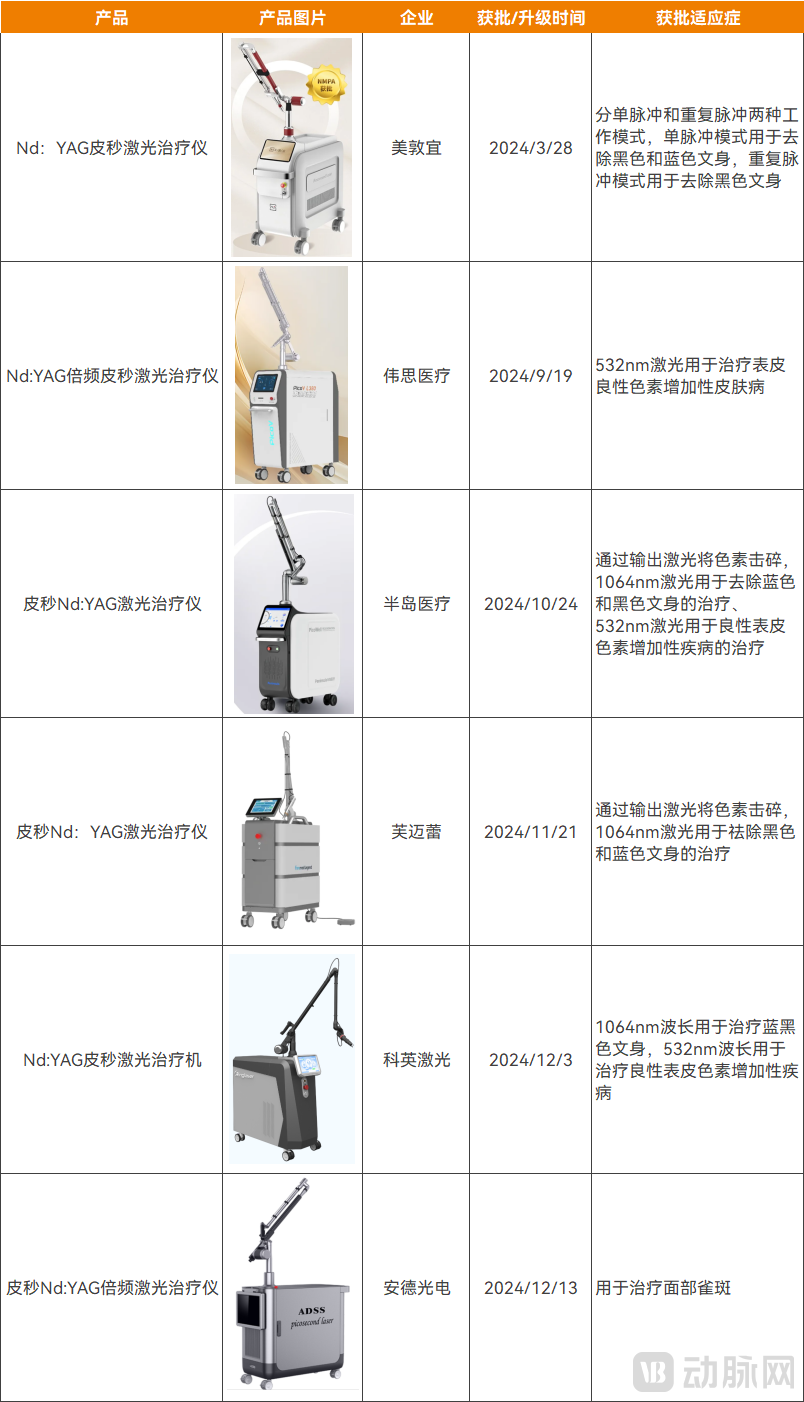
Domestic Picosecond Laser Therapy Devices; Data Sources: National Medical Products Administration, Public Corporate Information
Currently, approved picosecond laser treatment devices, including imported products, are mainly focused on two areas: tattoo removal and the treatment of benign epidermal pigmentary skin disorders.
The reason picosecond lasers can rapidly and efficiently shatter pigment particles is that, as the pulse width is compressed, the photoacoustic effect is continuously enhanced, allowing the laser to break down pigment particles into finer fragments. Meanwhile, smaller particles require a stronger photoacoustic effect for effective fragmentation.
To achieve sufficient photoacoustic effects, parameters such as pulse width and peak power are particularly critical for picosecond laser treatment devices; some new products have announced breakthroughs in these key performance areas.
For example, Medinice’s Nd:YAG picosecond laser system (brand: Xingchao Picosecond) features an ultrashort pulse width of 295 ps and a peak power of 1.4 GW, delivering robust energy output that significantly enhances the photoacoustic effect. Peninsula Medical’s picosecond Nd:YAG laser system (brand: Peninsula White Aurora) achieves an ultrashort pulse width of 250 ps and an ultra-high peak power of 1.6 GW, precisely fragmenting pigment clusters in the skin and reducing treatment time. Keying Laser’s Nd:YAG picosecond laser device (brand: KPICO+) employs microcavity technology, with a minimum pulse width of 350 ps and a peak power of 1.43 GW, instantly shattering pigments into finer particles.
Key technical challenges that picosecond lasers must overcome include the high stability of pulse width generators, optical component design, thermal management, and thermal stabilization.
For example, Fumailai’s picosecond Nd:YAG laser treatment system (brand: Stellar Picosecond) adopts an achromatic handpiece design, ensuring consistent spot sizes across different wavelengths on the treatment surface. It also incorporates technologies such as constant-temperature laser thermal management and a LEM control system to support efficient and stable device output. In contrast, Ande Optoelectronics’ picosecond frequency-doubled Nd:YAG laser treatment system (brand: Youthful Ultra Picosecond) utilizes a combination of single-lamp dual-rod and single-lamp single-rod configurations along with specialized seed-source lasers, offering enhanced heat resistance, abrasion resistance, and reduced performance degradation due to loss.
It is evident that with the market launch of multiple domestically produced picosecond lasers, the landscape of the laser-based medical aesthetics equipment market will undergo corresponding changes.
On one hand, similar to the domestic substitution process in other fields, domestically produced picosecond lasers will capture market share with lower prices, while simultaneously increasing the overall penetration rate of picosecond laser technology.
It is understood that the current price for a domestically produced picosecond laser device entering private medical institutions is approximately RMB 400,000–500,000, which is half the price of imported products. This has significantly lowered the threshold for medical institutions to acquire picosecond lasers.
“Before the launch of domestically produced picosecond lasers, only about 10–15% of demand was met in the private sector market, with substantial unmet demand remaining.” Liu Shuai, General Manager of Mednile, believes that there is significant market potential for domestic products.
On the other hand, picosecond lasers are expected to replace Q-switched lasers.Nanosecond-domain Q-switched lasers have been widely used in clinical practice, but they still have certain limitations, such as limited efficacy for some refractory pigmented disorders. In terms of mechanism, the photomechanical (photoacoustic) effect of picosecond lasers differs from the photothermal effect of Q-switched lasers; picosecond lasers demonstrate superior efficacy in treating pigmented disorders and cause less skin damage to patients.
“It is also widely believed in the market that picosecond lasers are superior to Q-switched lasers. Previously, picosecond lasers were priced higher than Q-switched lasers; however, with the large-scale market entry of domestically produced picosecond lasers, their prices have fallen below those of some imported Q-switched lasers. In the long run, picosecond lasers have the potential to capture the market share of Q-switched lasers, both in terms of existing installed base and new growth.” Xia Yuqing, founder of Fumilei, remarked. In addition,Should picosecond fractional lasers gain regulatory approval for indications in treating fine lines, neck wrinkles, and skin rejuvenation, the market potential would expand significantly.
The performance of the laser determines the quality and power of the output beam of the laser equipment, making it one of the most core components of the laser device.Domestic Picosecond Lasers Gain Clustered Approvals: Driven by Market Demand and Linked to the Maturing Domestic Supply Chain and Localization of Core Components
“The technological pathways and supply chain for picosecond laser seed sources are relatively mature, with some already supplying laser equipment to South Korea; in particular, the supply chain for dual-wavelength (532 nm & 1064 nm) seed sources has laid a solid foundation for R&D by downstream original equipment manufacturers,” said Xia Yuqing. He added that regulatory authorities have already established a standardized review system, so more picosecond laser devices may receive approval in 2025.
According to public information, industrial laser companies such as Leibao Optoelectronics, Zhuolei Laser, and Xinglin Ruiguang have all launched picosecond lasers for medical aesthetics. As the most expensive equipment in the current field of laser-based medical aesthetics, the centralized approval and market entry of domestically produced picosecond lasers have officially ushered in the era of domestic substitution.
It is worth noting that in recent years, as technologies for domestically produced gas lasers, Nd:YAG lasers, and semiconductor lasers have matured, laser treatment devices across a range of wavelengths have all achieved domestic production in China.
“Many industrial laser manufacturers have recognized the demand for lasers in the medical aesthetics sector and launched corresponding laser products, thereby lowering the entry barrier for downstream equipment manufacturers.” Liu Shuai noted that prior to the advent of picosecond lasers, various other laser-based medical aesthetic devices had already achieved a high rate of domestic production in China, including laser hair removal devices, carbon dioxide (CO2) lasers, and Q-switched lasers.
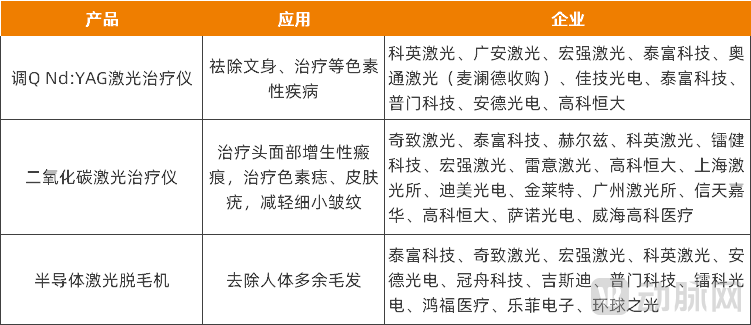
Certain Laser-Based Aesthetic Medical Devices with High Domestic Production Rates; Source: Interviews and Publicly Available Corporate Information
Overall, the localization of laser-based medical aesthetic devices, including picosecond lasers, exhibits two major characteristics.
First, it is highly benchmarked against imported products, with comparable efficacy.
Citing picosecond lasers as an example, Xia Yuqing stated that domestic products have been developed with mainstream imported counterparts as benchmarks from the outset of project initiation. By adhering to the technical route of dual wavelengths at 532 nm and 1064 nm and strictly benchmarking against these imports in all aspects, the final performance parameters are no inferior to those of imported products.
Efficacy on par with imported products is also a key marketing point for many brands. For instance, in November 2024, Vishee Medical stated at its performance briefing that clinical trial data for its frequency-doubled Nd:YAG picosecond laser system showed no difference in pigment clearance rate compared to the benchmark imported product.
Second, products with substantial market potential and strong market reception have achieved “maximum feasible substitution,” particularly in the mid- to low-end equipment market.
Unlike purely therapeutic interventions, medical aesthetics relies on clinical demand as the foundation for market development, but this is not the sole determinant; marketing also plays a critical role in the successful promotion of any given procedure or product.
“Some products that are bestsellers overseas have not gained traction in China, or have only enjoyed fleeting popularity, such as non-ablative fractional lasers, dye lasers, and long-pulsed lasers. There is insufficient momentum for domestic substitution of these products,” believes Xia Yuqing.
Liu Shuai stated that, overall, domestically produced alternatives have already replaced imported laser-based medical aesthetic devices characterized by high market demand and significant substitution value.
In short,Domestic laser-based medical aesthetic devices have achieved rapid development by benchmarking against the technical approaches, performance specifications, and market feedback of imported products, which indeed serves as a shortcut.
The laser medical device industry is a technology-intensive sector characterized by multidisciplinary integration. In addition to safety considerations, the efficacy, accuracy, and long-term reliability of products must be ensured. There are exceptionally high technical requirements in areas such as the development of components like lasers and intense light sources, precise detection and output control of optoelectronic energy, design of human-computer interaction software systems, and comprehensive system integration.
“There is a significant difference between being able to assemble a product and being able to create a good one,” said Xia Yuqing.Building a picosecond laser is not particularly difficult in itself; however, achieving significant differentiated advantages in core areas such as energy control and optical design requires substantially greater investment.
Liu Shuai candidly stated that demand in the medical aesthetics market is endless, as beauty is a comprehensive and multidimensional concept; however, there are currently limited types of laser products available, and the issues they can address are also constrained.“To better address gaps in clinical treatment, mere imitation is certainly not the way forward. Instead, we should focus on specific niche therapeutic areas and innovate to develop effective medical devices. For instance, the effective treatment of melasma requires a novel device that has not yet been introduced anywhere in the world.”
Xia Yuqing believes that the medical aesthetics market is currently in a state of flux, with demand for equipment becoming increasingly differentiated. In the past, medical aesthetics institutions heavily promoted low-priced services to attract customers, but over the last two years, they have gradually come to realize that this model is unsustainable. What patients truly need is effective, comprehensive service delivery, which includes physicians’ professional judgment and recommendations on treatment parameters; equipment constitutes only a small part of ensuring delivery outcomes. “The increase in compliant products provides doctors and institutions with greater flexibility in selection, but it does not imply a leapfrog improvement in their ability to deliver results. All clinical outcome deliveries depend on the professional operations of medical staff, rather than mere conceptual hype.”
Therefore, in his view, domestically produced laser medical aesthetic devices need to break away from the existing mindset of benchmarking against mainstream products, gain a deeper understanding of the personalized needs of Chinese patients and physicians, and develop products that are highly aligned with these needs. Specifically, this can be approached from the following three aspects.
First, launch more “lightweight” and cost-effective products tailored to real-world scenarios.
As previously mentioned, the price of domestically produced picosecond lasers is around 400,000 to 500,000 yuan. Analysis suggests that this figure may continue to decline. In the short term, low pricing is an effective strategy for rapidly capturing market share; however, in the long run, engaging in a "race to the bottom" on price is not a sustainable path, and low prices do not necessarily equate to cost-effectiveness.
To achieve cost-effectiveness, companies can consider forgoing peak performance metrics that merely demonstrate technical sophistication but have limited market demand, and instead identify more cost-efficient technical implementation pathways. Reducing product costs while focusing on users’ actual needs and lowering the barrier to operation may represent a more effective strategy for breaking through competitive barriers. “For example, picosecond lasers are widely used in the United States for tattoo removal, whereas demand for this application is minimal in the Chinese market, where they are predominantly used for skin whitening and pigmentation spot removal. In such cases, could the corresponding functional specifications be omitted?”
Second, build a comprehensive energy platform to better meet the needs of small and medium-sized medical aesthetics institutions, physician clinics, and “optoelectronic supermarkets.”Specifically, it treats various skin conditions through an integrated, multi-functional treatment platform. Currently, there is a gap in the domestic market for comprehensive energy-based platforms, representing significant future market potential.
Third, accelerate the digital transformation of the medical aesthetics industry.It is of great significance for medical aesthetic institutions to leverage digital technologies for standardized management and improved marketing efficiency, especially for small and medium-sized enterprises (SMEs) in the sector. However, the reality is that the level of digitalization in the medical aesthetics field remains extremely low. Equipment manufacturers hold a distinct advantage: by leveraging vast amounts of treatment data to build digital infrastructure, they can provide institutions with integrated solutions combining products and systems, rather than serving merely as equipment suppliers.
In fact, in any field, striving to launch the first product in a niche segment and pursuing global innovation are strategies that enable companies to establish early product and brand recognition, secure first-mover advantage, and thereby enhance competitiveness. Taking ultrasound-based aesthetic treatments as an example, Peninsula Medical introduced the first “Ultrasound Cannon” device and conducted extensive, sustained marketing campaigns, after which numerous other domestically produced products followed suit. Although regulatory approval and oversight for the Ultrasound Cannon still face bottlenecks, it is undeniable that Peninsula’s Ultrasound Cannon has secured a prominent competitive edge in the market.
For the laser-based medical aesthetics sector, domestic manufacturers have achieved technological and product accumulation through benchmarking and following; now is the time to consider more competitive innovative products.