

First Sequential TCM Combination Therapy for Type 2 Diabetes Shows Sustained HbA1c Reduction Two Weeks After Discontinuation

Supreme Life
Provider of Specialized Clinical Treatment Solutions in Traditional Chinese Medicine
On March 11, the First Affiliated Hospital of Guangzhou University of Chinese Medicine, in collaboration with the Institute of Chinese Materia Medica of the China Academy of Chinese Medical Sciences, published the research paper “Sequential Administration of Dihuang Baoyuan Granules and Fuling Yunhua Granules for Treating Spontaneous Type 2 Diabetes in Mice” as a premier article in the *Chinese Journal of Experimental Traditional Medical Formulae*.
This study investigated the pharmacological effects of sequential administration of Dihuang Baoyuan Granules (DHBY, the experimental formula) and Fuling Yunhua Granules (FLYH, the standard formula) in mice with type 2 diabetes (SEQ-1 group and SEQ-2 group). The results indicated thatDuring the administration period, sequential administration of SEQ-1 and SEQ-2 demonstrated significant hypoglycemic effects and improved diabetic retinopathy, with superior glycemic control efficacy compared to the DHBY and FLYH groups receiving monotherapy.
Furthermore, a dapagliflozin (Dapa; approved in China for the treatment of type 2 diabetes and heart failure with reduced ejection fraction) group was included in the experimental design to evaluate the efficacy of Dihuang Baoyuan Granules and Fuling Yunhua Granules. The results showed thatNon-inferior glycemic control comparable to dapagliflozin was observed. Two weeks after discontinuation, fasting blood glucose (FBG) in the Dapa group increased significantly, and glycated hemoglobin (HbA1c) showed an upward trend compared to levels at discontinuation. In contrast, both FBG and HbA1c in the SEQ-2 group remained significantly reduced, and a continued decline in HbA1c was further observed in the SEQ-1 group after discontinuation.
Notably, how can new traditional Chinese medicine (TCM) drugs achieve the therapeutic effect of “addressing both the root cause and the symptoms” through sequential administration? Once this “dual-targeting” pathway is established, what clinical benefits will the first novel drug combination embodying the TCM characteristic of treating both the root and manifestations bring to patients with type 2 diabetes?
1Sequential Chinese Herbal Medicines Demonstrating Non-inferior Glycemic Control Compared to Dapagliflozin
Sequential therapy is a widely adopted clinical treatment strategy that advocates for the use of different therapeutic approaches at various stages of treatment, including the rational sequencing of medication regimens, to achieve optimal efficacy. Previous studies and clinical observations have demonstrated that sequential therapy in patients with type 2 diabetes mellitus (T2DM) offers advantages such as potent and sustained glycemic control, favorable safety profiles, and good adherence.
In recent years, the integrated treatment combining Traditional Chinese Medicine (TCM) and Western medicine has gradually emerged as a new clinical option: sole reliance on sequential Western medical therapy remains insufficient to achieve optimal glycemic control. TCM sequential therapy emphasizes syndrome differentiation and individualized treatment, rationally employing different formulations or types of herbal prescriptions in a specific sequence throughout the entire course of treatment. This stepwise approach facilitates the achievement of therapeutic goals and offers the unique advantage of addressing both the root causes and manifestations of the disease.
This study investigates the sequential administration regimen and therapeutic efficacy of two new traditional Chinese medicine (TCM) formulations: Fuling Yunhua Granules and Dihuang Baoyuan Granules. By employing an alternating sequential treatment strategy that addresses both the root cause and manifestations, these two formulations provide comprehensive intervention across different stages of etiology and pathogenesis.The First New Drug Combination Embodying the TCM Characteristic of Treating Both Root Causes and Symptoms。
Experimental data demonstrate that sequential treatment with traditional Chinese medicine (TCM) exerts synergistic effects, ameliorating metabolic disturbances and pathological damage in diabetes, and exhibiting superior hypoglycemic efficacy and tissue-protective effects compared to monotherapy:
First, the reduction in HbA1c levels observed with each traditional Chinese medicine (TCM) group was comparable to that of the positive control drug, dapagliflozin, making these TCM formulations a rare example of herbal medicines demonstrating non-inferior glycemic-lowering efficacy to dapagliflozin in murine studies.Change in HbA1c (glycated hemoglobin) from baseline is a widely accepted surrogate endpoint in current clinical trials of glucose-lowering drugs, serving as the primary efficacy endpoint in pivotal studies to evaluate the glycemic-lowering effect of the drug.
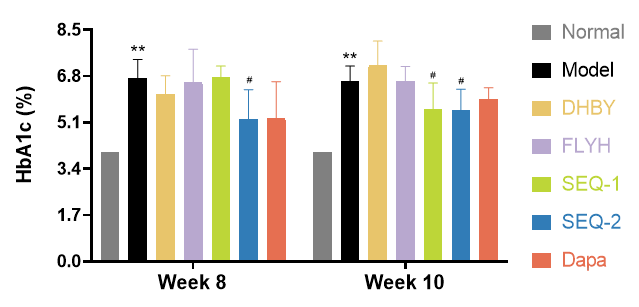
(Changes in Glycated Hemoglobin Data Across Experimental Groups)
Secondly, experimental data demonstrated that both sequential administration groups maintained sustained glycemic control after discontinuation of the medication. This finding, reported for the first time in studies of this type, suggests potential clinical value in achieving effective alleviation of hyperglycemia even after cessation of diabetes treatment.Two weeks after discontinuation, fasting blood glucose (FBG) and HbA1c levels in the Dapa group mice showed a significant rebound. In contrast, eight weeks of SEQ-2 sequential therapy intervention, as well as two weeks post-discontinuation, significantly reduced FBG and HbA1c levels in mice and sustained the therapeutic effect. Meanwhile, the SEQ-1 sequential therapy group exhibited a continuous downward trend in FBG and a sustained significant reduction in HbA1c after discontinuation, suggesting that it may alleviate insulin resistance or repair pancreatic islet cell function. This provides a possibility for clinical exploration of traditional Chinese medicine in achieving effective remission of diabetes.
Underpinning the sustained clinical benefits is the deep restorative mechanism of sequential Traditional Chinese Medicine (TCM) therapy: By administering treatments sequentially to address both manifestations and root causes, this “dual treatment of branch and root” approach effectively resolves two major pathogenic mechanisms in diabetes—namely, internal retention of phlegm-fluids impairing glucose utilization, and spleen deficiency leading to disordered transportation and transformation of food essences. This exemplifies the philosophical advantage of TCM in treating both symptoms and underlying causes.Fuling Yunhua Granules primarily function to promote diuresis and drain dampness, strengthen the spleen, and regulate body fluids. By eliminating damp-turbidity stagnation, enhancing the body’s transportation and transformation capabilities, replenishing nutrient qi, and increasing glucose utilization, they achieve a hypoglycemic effect, serving as a formulation for treating the symptoms. Dihuang Baoyuan Granules focus on tonifying the spleen and generating fluids. As the spleen is the foundation of postnatal transportation and transformation, this formulation fundamentally alleviates the impaired distribution of essential nutrients derived from food and water, serving as a formulation for treating the root cause.
Analysis indicates that dapagliflozin is a sodium-glucose cotransporter 2 (SGLT2) inhibitor. Its primary glucose-lowering mechanism involves increasing urinary glucose excretion by inhibiting glucose reabsorption in the renal tubules, thereby reducing blood glucose levels. This mechanism does not fundamentally improve the pathological processes of diabetes, such as declining islet function or insulin resistance. Consequently, upon discontinuation of the drug, the kidneys resume glucose reabsorption, leading to a rapid rebound in blood glucose levels.
2“Addressing Both Root Causes and Symptoms”: Islet Cell Repair and Clinical Benefits in Complication-Related Outcomes
Furthermore, murine experiments demonstrated a series of improvements in tissue histomorphology and associated tissue function, indicating sustained benefits during administration and after drug withdrawal.
In the normal control group, mouse islet cells were abundant, exhibiting a plump, spherical morphology with uniform distribution and orderly arrangement, and clear boundaries with acinar cells. In the model group, the number of islet cells was reduced, with atrophic morphology, irregular edges, indistinct boundaries, and disordered arrangement. After 8 weeks of treatment, the morphology of islet tissue improved in all test substance groups, characterized by a relatively abundant number of islet cells and more orderly cellular arrangement, with the SEQ-2 group showing more pronounced improvement. Two weeks after cessation of treatment, mice in the SEQ-2 group exhibited milder islet cell atrophy, more orderly arrangement, and clearer boundaries between islet cells and acinar cells.
 (Morphological Changes in Islet Cells of Each Experimental Group)
In terms of relative serum insulin levels, compared with the model group, there were no significant differences in insulin levels in the Dapa group after 8 weeks of administration and 2 weeks of withdrawal. Similarly, no significant differences were observed in the DHBY, FLYH, SEQ-1, and SEQ-2 groups after 8 weeks of administration and 2 weeks of withdrawal; however, the SEQ-2 group showed a trend toward elevated insulin levels.
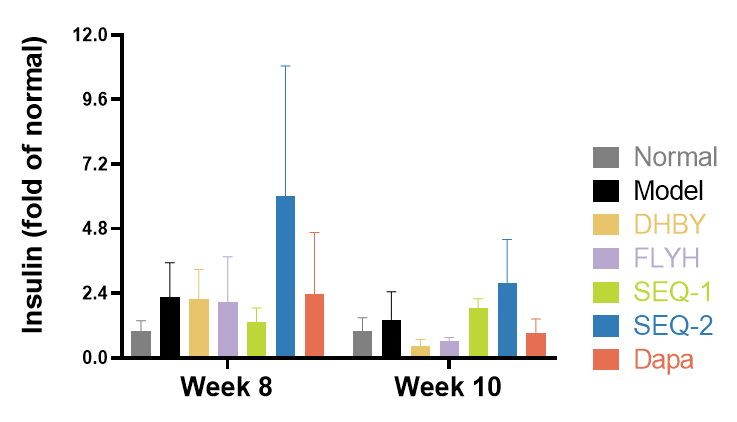
(Changes in Relative Serum Insulin Levels in Each Experimental Group)
Meanwhile, both the traditional Chinese medicine (TCM) group and the sequential therapy group demonstrated improvements in tissue damage and function across four lipid profiles, hepatic histopathology, and renal histopathology induced by type 2 diabetes mellitus (T2DM). Notably, the improvement in murine retinal function suggests potential benefits for related complications and clinical indicators in the future.
After 8 weeks of administration, compared with the model group, the SEQ-1 group showed a significant decrease in triglyceride levels (P < 0.05) and markedly improved vacuolar degeneration of hepatocytes; the SEQ-2 group exhibited significantly reduced renal injury and markedly improved vacuolar degeneration of hepatocytes.
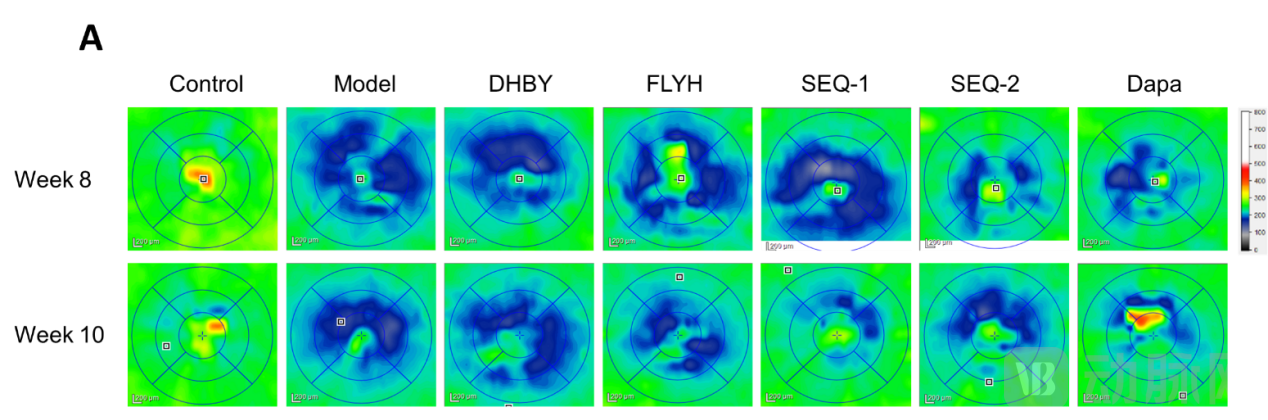
(Retinal OCT Multi-Line Scan Image: The larger and darker the blue area, the thinner the retina)
OCT multi-line scan images showed that retinal thickness was significantly reduced in the model group compared with the normal group. Compared with the model group, retinal thickness was significantly increased after 8 weeks of sequential intervention: retinal thickness was significantly increased in the SEQ-2 group after 8 weeks of drug administration, and significantly increased in the SEQ-1 group after 2 weeks of drug withdrawal (P < 0.05).

(Morphological Changes in Retinal Cells of Each Experimental Group)
Histopathological examination of the retina revealed a significant increase in the number of retinal ganglion cells (RGCs) and marked alleviation of pathological damage. In the DHBY, FLYH, SEQ-1, and SEQ-2 groups, the retinal layered structure gradually regained clarity, with tighter cellular arrangement. Specifically, the number of RGCs in the ganglion cell layer increased, vacuolar degeneration was reduced, and nuclear staining intensity approached that of the normal control group, indicating significant mitigation of retinal pathological injury. Notably, a significant increase in retinal thickness was observed in the SEQ-2 group.
3Over a Decade of Sequential Use of Clinical Specimens: Standardization Exploration of Classical Formulas
It is reported that Fuling Yunhua Granules and Dihuang Baoyuan Granules are derived from the classic Traditional Chinese Medicine text *Shanghan Zabing Lun* (Treatise on Cold Damage and Miscellaneous Diseases). The development was guided by Wang Qi, an academician of the Chinese Academy of Engineering and a National Medical Master, and clinically modified by diabetes expert Hu Tianbao.Both parties have a history of sequential use of clinical specimens for over 10 years, with definitive efficacy, demonstrating significant reductions in patients' blood glucose and glycated hemoglobin levels.Jingyihe Biopharmaceutical (Guangdong Hengqin Guangdong-Macao In-Depth Cooperation Zone) Co., Ltd. is advancing its standardization and evidence-based medicine research.
At the project’s guidance meeting, Academician Wang Qi stated, “The need for lifelong medication in diabetes stems from the persistent presence of the ‘root’ cause. This ‘root’ lies in the impaired transportation and transformation functions of the spleen, leading to inadequate distribution of nutrients derived from food and fluids. While traditional Chinese medicine can address the ‘manifestation’—namely, phlegm-fluid retention that hinders glucose utilization—only by resolving the ‘root’ issue can the body’s transportation and transformation functions be restored, thereby normalizing glucose and lipid metabolism and creating a turning point for diabetes recovery.”
Returning to the registration and review process for traditional Chinese medicine (TCM), increasing attention is being paid to "human use experience," a distinctive feature of new TCM drug development.This month, the “Expert Consensus on the Positioning of the ‘Three-Combination’ Registration Review Evidence System and the Value Orientation of ‘Human Use Experience,’” drafted with the participation of six academicians, including Wang Qi, and ten National Medical Masters, was released. The consensus clarifies thatIn the evidence system for traditional Chinese medicine (TCM) registration and evaluation, which integrates TCM theory, human use experience, and clinical trials (hereinafter referred to as the “Three-Combination” approach),“Human use experience” is the core component thereof,Refers to the summary of experience accumulated through long-term clinical practice, which is used to meet clinical needs and possesses certain regularity, effectiveness, and reproducibility, ultimately resulting in effective treatment regimens or therapeutic drugs.
There is a consensus that “human use experience” represents the practical application of Traditional Chinese Medicine (TCM) theory, and its data encompass critical factors such as the formulation composition, clinical positioning, target population, dosage, treatment duration, and safety of new TCM drugs.Exhibits a clear progressive relationship with clinical trials and provides a research foundation for the design of subsequent clinical trials.“The quality of ‘human use experience’ data determines which phase of clinical trials needs to be conducted subsequently.”
Originating from the Treatise on Cold Damage and Miscellaneous Diseases, and refined through decades of clinical application, the new traditional Chinese medicine products Fuling Yunhua Granules and Dihuang Baoyuan Granules are typical examples that fully leverage human use experience and follow the “three-combination” development pathway.
Previously, Jingyi Hesheng completed a real-world study involving 400 cases of human use experience across eight hospitals from 2019 to 2022. In 2023, it conducted a high-quality real-world clinical study on human use experience with 117 cases, adhering to fixed prescriptions, fixed dosages, and fixed administration regimens. Furthermore, since July 2024, it has been conducting a high-quality investigator-initiated trial (IIT) with a randomized, double-blind, placebo-controlled design at 16 Good Clinical Practice (GCP)-compliant hospitals nationwide.The first sequential-sample Chinese herbal medicine new drug is expected to obtain clinical data more aligned with evidence-based medicine within the year, thereby enabling an IND application and entry into pivotal clinical trials.
On March 7, 2025, the project on sequential treatment of diabetes with “Fuling Yunhua Granules” and “Dihuang Baoyuan Granules” was included in the list of priority varieties by the Greater Bay Area Branch of the Center for Drug Evaluation and Inspection under the National Medical Products Administration (NMPA), thereby entering the fast track for new drug application.