

AstraZeneca to Acquire EsoBiotec for $1 Billion to Advance In Vivo CAR-T Pipeline

AstraZeneca
Pharmaceutical Technology Research and Development Provider
On March 17, Belgian biotechnology company EsoBiotec SA announced that it had entered into a definitive agreement to be acquired by AstraZeneca for a total consideration of up to $1 billion (approximately RMB 7.24 billion).
Under the financial terms, AstraZeneca will acquire all outstanding equity interests in EsoBiotec on a cash-free and debt-free basis, with a total consideration of $1 billion for all issued equity.The transaction includes an upfront payment of $425 million, with the remaining $575 million in contingent consideration subject to regulatory approvals and milestone achievements.. The transaction is expected to close in the second quarter of 2025, subject to regulatory approvals. Upon completion, EsoBiotec will become a wholly-owned subsidiary of AstraZeneca and operate in Belgium.
EsoBiotec, founded in 2020, is a prominent emerging company specializing in the field of in vivo CAR-T therapy. To date, EsoBiotec has secured €22 million (approximately RMB 173 million) in funding from investors including Thuja Capital, UCB Ventures, Invivo Partners, Wallonie Entreprendre (WE), SambrInvest, and Investsud.
EsoBiotec’s Engineered Nanobody Lentiviral (ENaBL) platform has delivered innovative breakthroughs in the field of cancer therapy. By leveraging highly targeted lentiviral vectors with immune-shielding properties, the platform effectively evades immune system attacks, ensuring the precise delivery of genetic instructions to T cells. This enables the efficient in vivo reprogramming of T lymphocytes into cells with specific functions. Taking ESO-T01, a therapy for multiple myeloma, as an example, the platform programs T cells into BCMA CAR-T cells that precisely recognize and tightly bind to tumor cells expressing BCMA, thereby activating an immune response to eliminate the tumors, demonstrating exceptional precision and potency.
The ENaBL platform employs modular technology, offering exceptional compatibility with diverse cell types and broad applicability across various therapeutic areas. This characteristic lays a solid foundation for the development of diversified cell therapies. Therapies developed based on this platform have significantly revolutionized traditional treatment paradigms. As an “off-the-shelf” single-dose regimen, it eliminates the need for lymphodepletion in patients; administration is completed via a single intravenous injection within 10 minutes, substantially simplifying the treatment process, reducing the physiological burden on patients, and lowering time costs. Furthermore, thanks to its scalable manufacturing process, the platform provides a reliable and cost-effective solution for global supply. Compared with traditional ex vivo CAR-T therapies, costs are expected to be reduced by an order of magnitude, greatly enhancing the accessibility of cancer treatments.
Currently, leveraging the ENaBL platform, EsoBiotec has established four clinical candidate pipelines, among which ESO-T01 (BCMA CAR-T), targeting multiple myeloma, has entered the clinical trial stage.
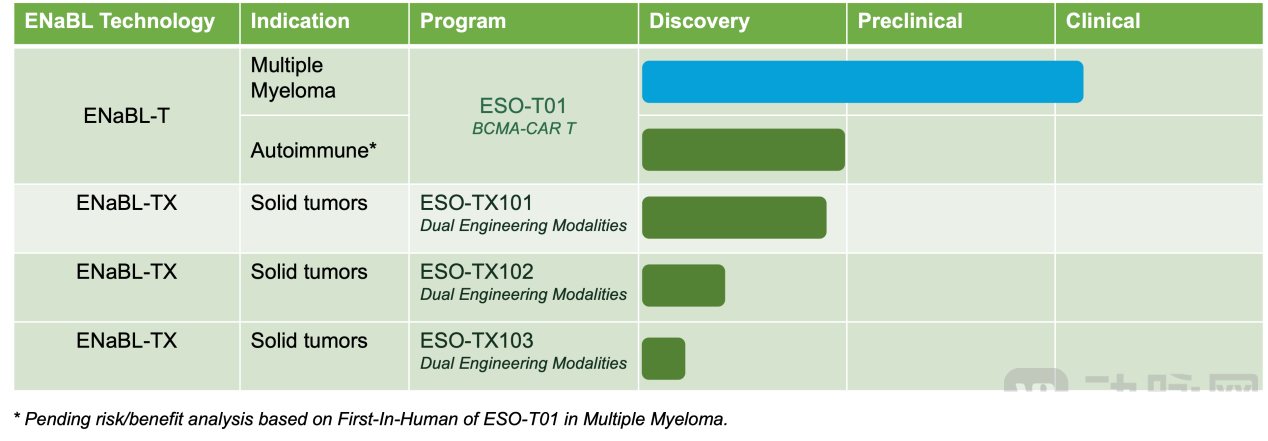 EsoBiotec Candidate Pipeline
ESO-T01 is a third-generation, replication-defective, self-inactivating lentiviral vector with immune-shielding properties and resistance to phagocytosis. In vivo, it specifically reprograms T lymphocytes into highly efficient BCMA CAR-T cells that precisely recognize and tightly bind to BCMA-expressing tumor cells, thereby activating an immune response to eliminate the tumors. By integrating Pregene Biopharma’s BCMA CAR-T transgene with robust industrial manufacturing processes, this vector holds promise as a transformative therapy, offering patients an “off-the-shelf” treatment option.
As the first in vivo BCMA CAR-T candidate to enter human clinical trials and be administered, ESO-T01 demonstrates significant advantages., eliminating the need for patients to undergo cumbersome ex vivo cell collection and processing, thereby greatly simplifying the treatment workflow. Compared with traditional ex vivo CAR-T therapy, its cost of goods may be an order of magnitude lower, which will significantly enhance the accessibility of advanced therapies and redefine patients’ access to cutting-edge treatments.
January 8, 2025EsoBiotec Announces First Patient Treated in China-Based Clinical Trial of ESO-T01 for Multiple Myeloma. Professor Mei Heng (Ph.D., M.D.), Principal Investigator at Union Hospital, Tongji Medical College, Huazhong University of Science and Technology, stated: “Preliminary clinical observations of ESO-T01 indicate a favorable safety profile and encouraging efficacy at an initial dose of 0.25E+09 transduction units per patient, with pharmacokinetic characteristics comparable to those of autologous ex vivo CAR-T therapies. The first patient received the starting dose of ESO-T01 without prior lymphodepletion. By Day 28, minimal residual disease in the bone marrow was undetectable, and levels of free light chains secreted by tumor cells had returned to normal. No serious adverse events were reported during the treatment course.”
In addition to the aforementioned transaction, AstraZeneca recently announced a second collaboration: a licensing agreement worth $750 million with South Korea’s Alteogen to develop and commercialize a subcutaneously injected cancer drug using its ALT-B4 enzyme technology. The agreement includes a $25 million upfront payment and up to $725 million in milestone payments. The deal covers three ALT-B4-based products, with specific drug details yet to be disclosed.
Looking back, AstraZeneca has been highly active in the fields of cell and gene therapy (CGT) and oncology. As early as October 2022, AstraZeneca acquired LogicBio Therapeutics for $68 million, thereby gaining access to its GeneRide gene-editing platform, which leverages cells’ natural repair processes, and its sAAVy delivery capsid platform designed to enhance potency and safety, thus strengthening its gene therapy technology portfolio. The following month, AstraZeneca acquired Neogene Therapeutics with an upfront payment of $320 million, incorporating Neogene’s T-cell receptor discovery and cell engineering platforms to support the development of high-specificity therapies targeting solid tumors.
In 2023, AstraZeneca continued to strengthen its momentum. On May 18, it signed a non-exclusive licensing agreement with the U.S. biotechnology company Revvity to leverage its proprietary Pin-point base editing platform and underlying technologies for advancing cell therapy development targeting cancer and immune-mediated diseases. In the same month, AstraZeneca entered into a preclinical research agreement with Sernova to explore next-generation innovative cell therapies, further enriching its cell and gene therapy (CGT) portfolio.
In late 2023, AstraZeneca made a bold move by acquiring Gracell Biotechnologies for $1.2 billion. Gracell’s BCMA/CD19 dual-target CAR-T therapy, GC012F, developed on its FasTCAR technology platform, has attracted significant attention. This therapy is not only undergoing Phase 1b/2 clinical trials in the United States for relapsed/refractory multiple myeloma but has also received approval in both China and the U.S. to initiate clinical trials for refractory systemic lupus erythematosus. The FasTCAR platform significantly shortens manufacturing time and enhances T-cell health, holding promise for improving the efficacy of autologous CAR-T therapies—a key factor that attracted AstraZeneca to the acquisition.
The above represents merely the tip of the iceberg of AstraZeneca’s presence in the cell and gene therapy (CGT) sector. Looking toward the future of CGT, a growing number of multinational corporations (MNCs)—including Novartis, Johnson & Johnson, and Pfizer—are also entering the field. This transformative technology is writing a new chapter for the pharmaceutical industry.