

DeepSeek Ignites AI Revolution, Empowering Chinese Pharma Enterprises with a New Paradigm of Digital-Intelligent Transformation
Currently, AI iteration is accelerating its penetration from general-purpose domains into vertical industries.
With the emergence of DeepSeek, the application of AI in the life sciences industry has reached a critical turning point, shifting from technological exploration to large-scale implementation. Unlike general-purpose AI technologies, DeepSeek adopts an open-source architecture combined with industry-specific adaptability designs, significantly lowering the technical barriers to AI adoption. This transformation is driving the pharmaceutical industry toward a new paradigm of “data-driven decision-making,” enabling intelligent transformation in core areas such as drug discovery, precision medicine, and smart production management.
AI Is Reshaping the Future of Life Sciences
Previously, AlphaFold, the protein structure prediction tool developed by the DeepMind team, won the 2024 Nobel Prize in Chemistry thanks to its revolutionary algorithmic architecture, becoming a highly acclaimed AI tool within the industry. The milestone significance of AlphaFold lies not only in its resolution of the “protein folding problem,” which had challenged the field of biology for five decades, but also in ushering in a new era of AI-driven interdisciplinary research.
Globally, an increasing number of top pharmaceutical companies are applying AI to various stages of new drug development at the current stage.
In the R&D phase,New drug development is gradually entering uncharted waters, with regulatory requirements for new drug applications continuing to rise. The long-standing “Eroom’s Law,” which has plagued pharmaceutical R&D, has rendered traditional development models unsustainable. According to data from Nature, the average cost of developing a new drug reaches as high as $2.6 billion, takes 10 years, and has a success rate of less than 10%. With the explosive growth of AI technology, pharmaceutical companies are increasingly focusing their attention on the AI sector.
For example, Genentech (a wholly owned subsidiary of Roche) proposed the "Lab in a Loop" system for the drug development process, establishing a closed-loop iterative framework of data-model-experiment to make R&D faster and more efficient. Genentech applied this system to the target discovery phase, integrating multimodal data and leveraging AI agent orchestration technology to build foundation models covering diverse scenarios. By combining public databases with proprietary experimental data, it constructed a multidimensional biological information network that enables collaboration among multiple agents.
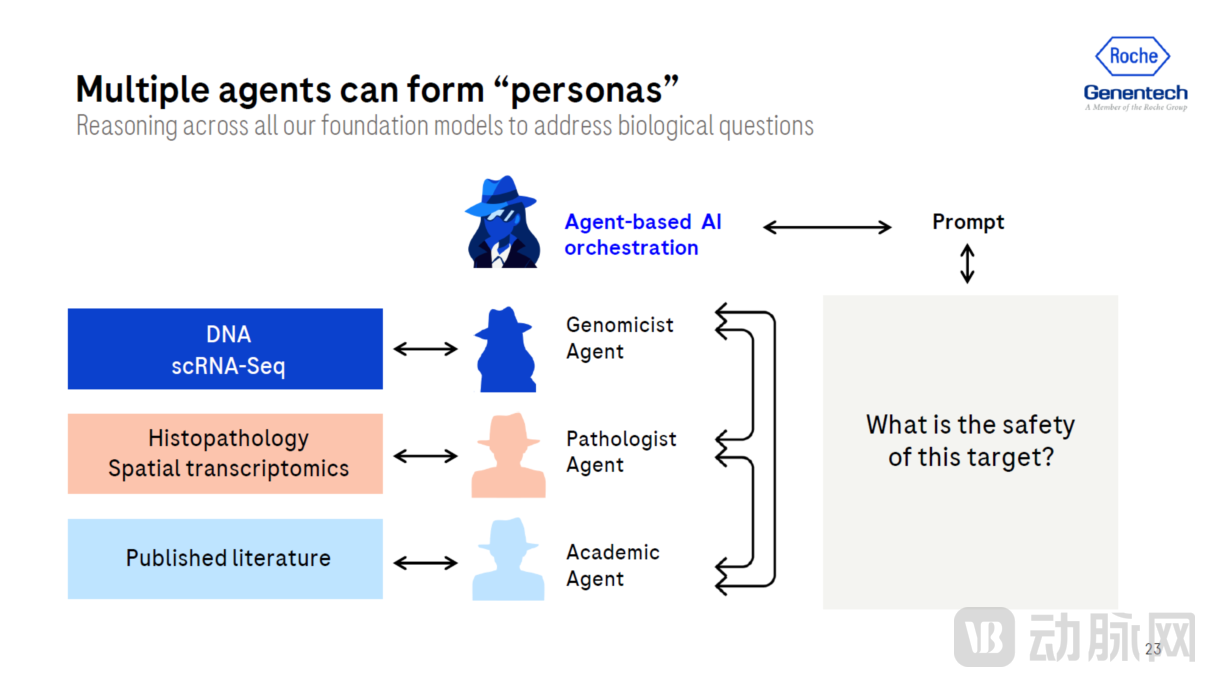
Genentech's Closed-Loop Iteration System
In the production and supply chain segments,Global pharmaceutical giants such as Pfizer and Novo Nordisk have begun integrating AI technologies into their production processes to strengthen their competitive advantages. Applications include real-time monitoring of production data to predict equipment failures and ensure product quality; non-invasive testing of raw materials, finished products, and impurities using online Raman spectroscopy; precise analysis of pharmaceutical packaging information via AI-based image recognition and natural language processing (NLP) to trace distribution chains and assist in counterfeit detection; optimization of logistics and inventory management to enhance supply chain efficiency; prediction of risks based on historical quality deviation data to optimize decision-making; and integration of supply chain data for predictive analytics to reduce costs.
Chinese Pharmaceutical Companies Explore New Models for AI Application
Shifting the focus to China, over the past decade, AI applications have been constrained by data availability, use cases, and computing power, making it difficult to integrate them into core business processes such as production and sales. Consequently, AI adoption has been predominantly concentrated in the field of drug discovery and development, remaining largely at a nascent stage characterized by “tools replacing manual labor.”
Within pharmaceutical companies, the construction and application of information technology and digitalization have generated massive amounts of data in R&D and production processes. This has led to stricter data compliance requirements and an exponential increase in digitalization workloads. Consequently, compliance pressures are driving pharmaceutical companies to accelerate the adoption of digital intelligence tools in production quality control. Although some leading enterprises have implemented AI internally as part of this compliance-driven proactive exploration, large-scale application has not yet been achieved.
Since 2015, the Chinese pharmaceutical industry has faced mounting pressure. With increasingly stringent domestic regulatory trends and the implementation of policies such as volume-based procurement and the two-invoice system, corporate profit margins have been further squeezed. This has prompted companies to seek breakthroughs through digital and intelligent transformation, marking a shift from localized pilots to multi-stage expansion.
In terms of business operations, domestic pharmaceutical companies are beginning to build integrated foundational platforms, gaining a deeper understanding of the critical importance of data integrity. In practice, traditional R&D processes are undergoing digital and intelligent transformation; for instance, repetitive tasks such as experimental data entry and report generation are increasingly being handled by automated systems, allowing researchers to focus on core innovation activities. This accumulation of digital and intelligent practices is driving systematic optimization of job functions across R&D, production, quality control, and sales.
Vertical AI Agents Drive Industrial Reshaping
Currently, AI has evolved from isolated tools into strategic infrastructure. Vertical-domain AI applications are driving a fundamental transformation in the AI application paradigm through a "dual-helix" model characterized by "technical architecture reconstruction + industrial logic reshaping." The essence of this transformation lies in achieving an industrial upgrade from "general capabilities" to "deep exploration of vertical industry value" through the deep coupling of industry knowledge, data assets, and AI agent technologies.
Taking Mingdu Zhiyun as an example, as a pioneer in AI vertical applications within the life sciences sector, Mingdu Zhiyun began strategizing in key AI domains as early as 2021, committing to integrating cutting-edge artificial intelligence technologies into comprehensive scenarios. To date, leveraging AI technologies such as computer vision, large language models, and world models, Mingdu Zhiyun has launched “Atlas,” the first agent platform in the life sciences field, providing pharmaceutical companies with end-to-end empowerment across all scenarios—from R&D, quality control, and manufacturing to sales.
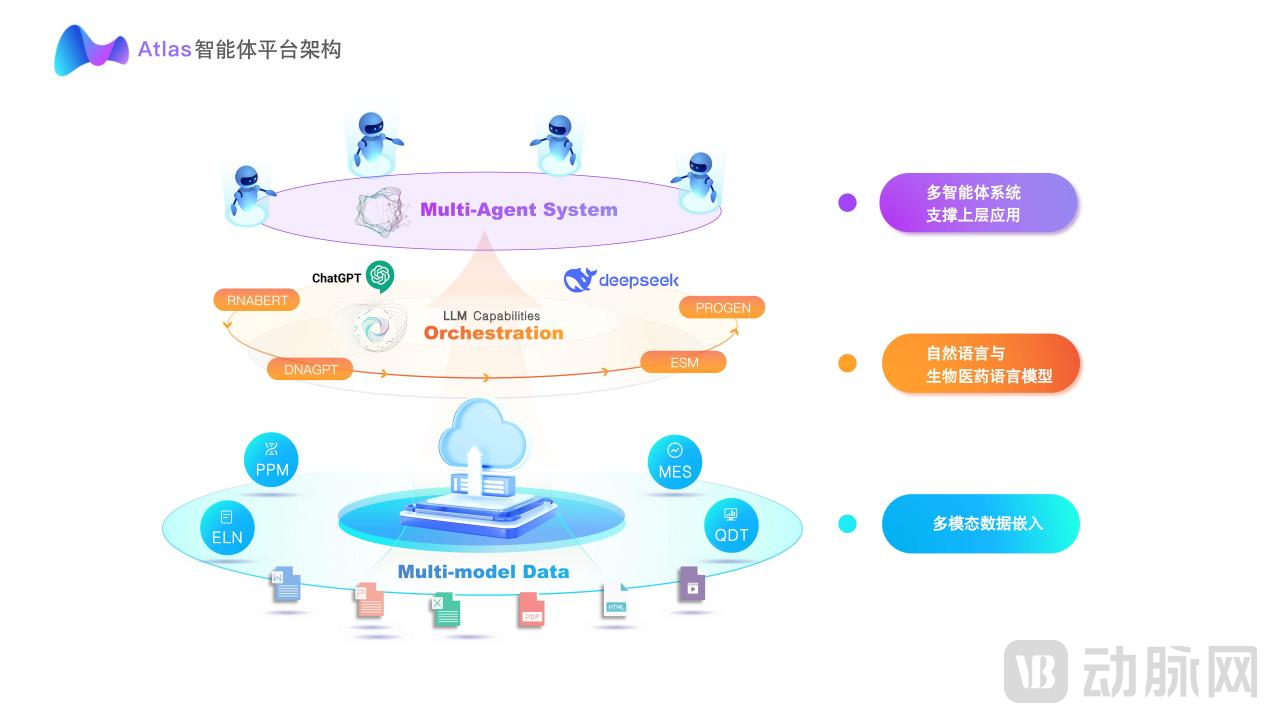
Mingdu Zhiyun's Agent Platform Architecture
“We believe that artificial intelligence will reshape every aspect of pharmaceutical companies, including R&D, manufacturing, quality control, and sales. Mingdu Zhiyun will continue to accompany our clients at every step of their journey from data accumulation to intelligent transformation, breathing new life into dormant data and co-creating best practices in AI,” said Wang Fei, CEO of Mingdu Zhiyun.
As an AI agent platform for the vertical industry, Atlas integrates core capabilities such as DeepSeek, specialized pharmaceutical databases, industry-specific knowledge graphs, and multimodal knowledge engines, enabling seamless integration with pharmaceutical enterprises’ information systems.
Atlas employs a risk-based confidence assessment framework. Throughout the design and development process, it fully references the FDA’s “Considerations for the Use of Artificial Intelligence to Support Regulatory Decision-Making for Drug and Biological Products: Guidance for Industry and Other Interested Parties” to comprehensively evaluate AI model outputs, ensuring their accuracy and reliability in specific use contexts. This framework not only meets regulatory requirements for data integrity and decision transparency but also provides robust assurance for pharmaceutical companies in practical applications.
Furthermore, Atlas adopts an open ecosystem strategy, enabling users to integrate their own models and tools to independently create AI agents. Currently, Atlas has deployed a series of AI agent applications across various specialized scenarios, including R&D agents, process engineering agents, and quality control agents, helping enterprises enhance quality and improve efficiency.
Michael Li, Chief AI Scientist at Mingdu Zhiyun, stated, “We are transforming AI into ‘evolvable algorithms’ for the life sciences—rather than forcing the industry to adapt to code, we enable code to understand life. This is just the beginning. Mingdu will continue to deepen its application and learning of models such as DeepSeek, aiming to help clients better meet challenges through these innovations and drive progress across the entire pharmaceutical industry.”
Currently, Henlius, a leading domestic innovative pharmaceutical company, has successfully implemented the Atlas platform. By leveraging the Atlas Process Agent to achieve intelligent data acquisition and structuring, it has established a foundational data base for process optimization at Henlius. Moving forward, the Atlas Process Agent will further utilize in-depth big data analytics to identify areas for improvement and predict future process variations, thereby driving innovation in production workflows and continuous process enhancement.
Chinese Characteristics: The Preference for Private Deployment
Certainly, as Chinese pharmaceutical companies rapidly advance their digital and intelligent transformation, they exhibit distinct Chinese characteristics, particularly in the realm of data security. To ensure the security and privacy of corporate data, a growing number of pharmaceutical enterprises favor privatized solutions. Unlike the global market, where public cloud-based architectures are widely adopted for comprehensive solutions, Chinese pharmaceutical companies—whether large pharmaceutical corporations (Big Pharma) or biotechnology startups (Biotech)—tend to build and operate their own underlying infrastructure, thereby ensuring absolute control over their data.
The emergence of DeepSeek holds particularly profound significance for Chinese enterprises. It provides stronger support for unlocking the value of enterprise data and, as an open-source model, enables localized data deployment. This ensures efficient intelligence while better safeguarding data security and privacy compliance. For instance, the DeepSeek all-in-one appliance solution, powered by large language models, can rapidly meet the needs for private deployment. By integrating with the AI application development foundation of an agent platform, this approach not only satisfies the flexible adaptation and development requirements of various business scenarios but also reserves room for evolution in technological iteration and multi-agent applications. This “growable” intelligent infrastructure is redefining the underlying logic of enterprise digital and intelligent transformation.
DeepSeek’s large language models have not only propelled Chinese AI technology onto the international competitive stage but are also reshaping the entire pharmaceutical industry chain, encompassing drug R&D, manufacturing, and distribution. Amidst this transformation, Chinese pharmaceutical companies are actively exploring and implementing new development paradigms.
In the future, as AI agents begin to autonomously design clinical trial protocols, digital twin factories optimize bioreactor parameters in real time, and blockchain smart contracts automatically execute the commercialization of R&D achievements, the digital-intelligence revolution among Chinese pharmaceutical companies is transcending the scope of mere technological upgrades, evolving into a fundamental transformation of production relations.
In this transformation, digital-intelligence pioneers in the life sciences sector, represented by Mingdu Zhiyun, are building new industrial infrastructure. These domestic enablers of digital intelligence are no longer limited to managing single business workflows or improving partial efficiency; instead, they leverage agent networks to achieve continuous accumulation of knowledge assets and exponential value creation—this may well be the ultimate key to leapfrog development for Chinese pharmaceutical companies.
Today, standing at the intersection of technological revolution and industrial transformation, Chinese pharmaceutical companies are embarking on a new journey of digital and intelligent transformation.